

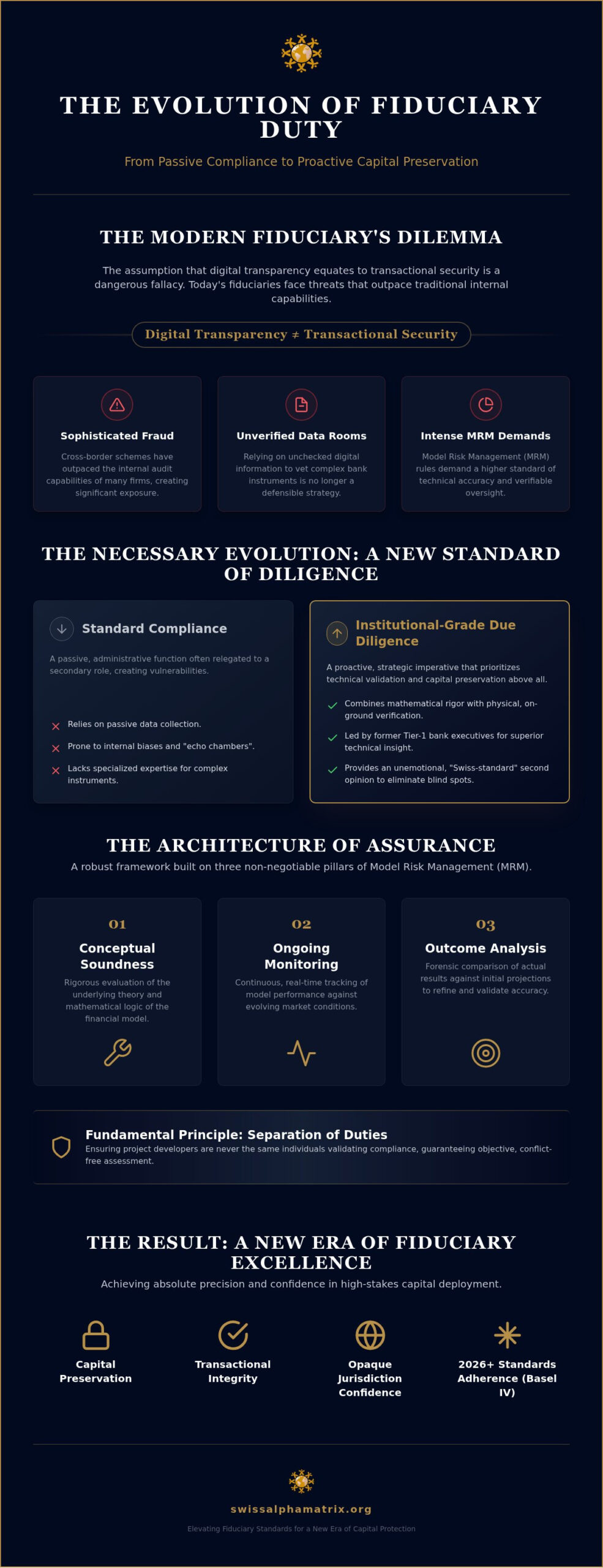
The assumption that digital transparency equates to transactional security is perhaps the most dangerous fallacy currently facing institutional fiduciaries. In an environment where sophisticated cross-border fraud has outpaced the internal audit capabilities of many firms, relying on unverified data rooms to vet complex bank instruments is no longer a defensible strategy. It’s a reality that creates significant exposure, especially as regulatory pressure regarding Model Risk Management (MRM) demands a higher standard of technical accuracy and oversight.
You recognize that safeguarding capital in 2026 requires more than a cursory review; it demands a synthesis of mathematical rigor and physical, on-ground verification. This article details how specialized regulatory due diligence services establish a robust institutional framework designed for absolute precision in capital deployment decisions. We’ll examine the methodology behind audit-grade reporting and illustrate how a boutique, executive-led approach to complex project management provides the necessary clarity to navigate opaque jurisdictions with confidence, discretion, and an unwavering commitment to capital preservation.
Key Takeaways
- Understand the transition from standard compliance to institutional-grade validation as a strategic necessity for capital preservation in a volatile global landscape.
- Discover how professional regulatory due diligence services apply audit-grade rigor to identify and mitigate counterparty risks within opaque jurisdictions.
- Learn why physical, on-ground verification remains the only definitive method for validating complex financial instruments and preventing sophisticated cross-border fraud.
- Explore the integration of rigorous risk management frameworks into the project lifecycle to ensure adherence to evolving 2026 standards, including Basel IV.
- Recognize how leveraging senior executive oversight provides the technical accuracy and discretion required for high-level institutional decision-making.
Defining Institutional-Grade Regulatory Due Diligence Services
The landscape of global finance has undergone a tectonic shift, necessitating a move away from passive compliance toward a more rigorous, proactive methodology that prioritizes capital preservation. Historically, the concept of due diligence was often relegated to a secondary administrative function; however, in the current climate of 2026, it has emerged as a critical strategic imperative. Institutional-grade regulatory due diligence services differ fundamentally from standardized verification by prioritizing technical validation over mere data collection, a distinction that is vital for high-stakes mandates where deal integrity depends on the absolute precision of counterparty assessment.
For entities operating at a Tier-1 global standard, the separation of duties is not merely a recommendation but a structural requirement that safeguards against internal conflicts of interest. This framework ensures that those developing a financial project are not the same individuals validating its compliance and risk profile, thereby maintaining a necessary professional distance. By adhering to these rigorous standards, organizations can achieve a level of transactional integrity that internal teams, who are often constrained by institutional familiarity or limited audit resources, simply cannot replicate.
The Scope of Modern Model Risk Management
In the context of complex cross-border instruments, the “model” encompasses the entire logical and mathematical framework used to predict performance and manage risk. Modern Model Risk Management (MRM) rests upon three non-negotiable pillars: conceptual soundness, which evaluates the underlying theory; ongoing monitoring, which tracks performance in real-time; and outcome analysis, which compares actual results against initial projections. Regulatory expectations for audit-grade documentation have intensified, requiring a granular view of these pillars to ensure that every deployment of capital is backed by a logically sound and thoroughly tested framework that withstands the scrutiny of global financial markets.
Why Independent Advisory Beats Internal Review
Internal audit departments, while proficient in routine operations, frequently lack the specialized expertise required to vet sophisticated bank instruments or navigate the nuances of opaque jurisdictions. Relying solely on internal reviews can lead to an institutional echo chamber, where inherent biases and a desire for project approval might cloud objective judgment. Engaging an independent advisory firm, particularly one led by former Tier-1 bank executives, provides a Swiss-standard second opinion that is both unemotional and technically superior. This external oversight eliminates the risk of internal blind spots, offering executive stakeholders the high-level intelligence necessary to protect institutional interests against sophisticated global threats.
The Structural Architecture of Risk Management Frameworks
The construction of a robust risk management framework for complex financial instruments necessitates a departure from the generic, off-the-shelf models that often fail to capture the intricate nuances of bespoke arrangements, such as Standby Letters of Credit or multi-jurisdictional project financing. For institutions managing high-value cross-border transactions, the integrity of the entire validation process is inherently dependent on the meticulous quality of the underlying data; consequently, preventing a “garbage in, garbage out” scenario is a primary objective of professional regulatory due diligence services. This structural architecture must incorporate sophisticated sensitivity analysis and stress testing that specifically accounts for the heightened geopolitical volatility and shifting liquidity profiles projected for 2026. By utilizing financial advisory methodologies that prioritize capital protection over speculative yields, firms can establish a defensive posture that remains resilient against black swan events. It’s this commitment to technical accuracy that distinguishes a truly protective authority from a passive service provider, ensuring that every deployment of capital is supported by a logically sound and thoroughly vetted strategy.
Evaluating Conceptual Soundness
Conceptual soundness represents the foundational bedrock of instrument validation, ensuring that the theoretical framework of a financial model aligns with its intended transactional reality. This involves a meticulous assessment of the mathematical logic and the underlying assumptions that drive the model’s outputs. Validators must verify that the model is appropriate for its specific transactional use, particularly when dealing with instruments that don’t fit standard banking profiles. If the conceptual basis is flawed, the entire risk management structure becomes inherently unstable, leading to potential capital erosion. A nuanced assessment at this stage prevents the institutional echo chamber from overlooking fundamental risks that could compromise the entire mandate.
Ongoing Monitoring and Performance Validation
A framework is only as effective as its ability to adapt to shifting market conditions. Establishing clear thresholds for model recalibration is essential in volatile cross-border markets, where predictive accuracy can degrade rapidly without dedicated oversight. Back-testing serves a critical role here, as it allows validators to verify the model’s accuracy by comparing historical predictions against actual outcomes over time, thereby providing an empirical basis for continued model reliance. This rigorous process ensures that the framework remains in full compliance with international financial regulations, including the finalized Basel IV standards. For stakeholders seeking a partner to navigate these complexities with technical precision, exploring the expertise at Swiss Alpha Matrix provides a path toward sustained transactional integrity and fiduciary excellence.
Paper Validation vs. Physical Reality
The assumption that a digital confirmation is an infallible proof of instrument authenticity is a vulnerability that sophisticated fraudsters regularly exploit. Digital records can be manipulated or issued by compromised actors within unregulated financial entities. To mitigate this risk, on-ground verification services provide the only definitive safeguard for institutional capital. This approach involves physically visiting counterparty facilities to verify their operational capacity and existence. We don’t just review the paperwork; we confirm that the entity possesses the physical presence and personnel required to execute the mandate. In opaque jurisdictions, this level of technical scrutiny is the only way to ensure that a counterparty is more than a mere digital ghost.
Audit-Grade Instrument Validation Protocols
Authenticating complex bank instruments requires a level of access and technical expertise that far exceeds standard compliance protocols. Led by former senior executives from Tier-1 global banks, our audit-grade validation process involves a forensic review of issuing bank mandates and the specific terms of the instrument itself. This is a deliberate, step-by-step exercise that requires discreetly liaising with institutional counterparties to confirm that the mandate is active and unencumbered. We produce executive-level intelligence that survives the highest levels of stakeholder scrutiny. By combining physical site visits with deep technical analysis, we ensure that every transactional component is legitimate and compliant before any capital is deployed.
Strategic Implementation within the Cross-Border Lifecycle
The successful deployment of capital in high-stakes international transactions depends on the seamless integration of validation protocols throughout the entire engagement duration. Rather than treating compliance as a static, isolated event, elite institutions utilize regulatory due diligence services as a continuous thread that informs every phase of the investment. By embedding these rigorous checks into the broader independent financial project management lifecycle, fiduciaries ensure that their defensive posture remains synchronized with evolving 2026 standards, including the finalized Basel IV requirements. Coordinating diverse stakeholders across multiple jurisdictions requires a disciplined approach, often utilizing RACI matrices to clarify accountability for complex validation mandates. This structured coordination, combined with a meticulous audit trail, ensures long-term regulatory compliance and provides a defensible record of due care that withstands the most demanding institutional scrutiny.
The Validation Lifecycle for Institutional Deals
In the pre-deal phase, the primary objective is the validation of the instrument and counterparty before any capital commitment occurs, effectively neutralizing risk at the point of entry. During the execution phase, the focus shifts to real-time monitoring of model performance, ensuring that the transactional reality aligns with the initial conceptual soundness. Finally, the post-deal phase involves a comprehensive review and a formal “lessons learned” session, which serves to refine future mandates and strengthen the organization’s institutional knowledge. This lifecycle approach transforms regulatory due diligence services from a reactive necessity into a proactive tool for strategic advantage, ensuring that every transaction is supported by a legacy of technical accuracy.
Risk Mitigation and Capital Preservation
The financial impact of a validation failure extends far beyond the immediate loss of principal, encompassing profound reputational erosion and potential regulatory sanctions that can persist for years. In this high-stakes environment, senior-level intuition, honed through decades of Tier-1 global banking experience, acts as the final sanity check for even the most complex mathematical models. This human element, rooted in Swiss financial traditions of precision and discretion, provides a layer of protection that automated systems cannot replicate. Building a culture of precision ensures that interests are managed by seasoned experts who prioritize long-term stability over short-term speculation. For stakeholders requiring this level of technical oversight, engaging with Swiss Alpha Matrix secures a partnership dedicated to the highest standards of capital preservation.
Ensuring Transactional Integrity through Senior Executive Oversight
The culmination of a robust capital protection strategy lies not in the volume of data collected, but in the caliber of the professionals interpreting it. While standardized regulatory due diligence services often rely on automated filters and junior analysts, institutional-grade validation requires the seasoned judgment of those who have managed these instruments from within the world’s most prestigious financial institutions. This executive oversight ensures that every nuance of a cross-border transaction is evaluated through the lens of institutional risk, transforming raw information into actionable intelligence. By moving beyond the limitations of standard consulting, we act as a strategic partner dedicated to the long-term preservation of capital, providing a level of security that only true expertise can offer.
The Ex-Tier 1 Executive Differentiator
Thinking like a banker is essential when validating complex instruments because it allows for an understanding of the issuing bank’s internal mandates and credit appetite that outsiders simply don’t possess. This perspective is bolstered by a global network effect, where personal connections enable the on-ground verification necessary to bypass the obfuscation often found in opaque markets. Our leadership consists of former senior executives from global Tier-1 institutions, ensuring that every mandate is overseen by individuals who have spent decades navigating the highest levels of transactional complexity. This background allows us to anticipate counterparty behavior and identify structural weaknesses that remain invisible to those without direct experience in the world’s primary capital markets.
Precision, Discretion, and Results
Every mandate we undertake is hyper-personalized, with a validation scope customized to the specific risks and jurisdictional challenges of your transaction. This commitment to Swiss-precision ensures that every audit-grade report we produce is technically accurate and formatted for the highest levels of executive scrutiny. We understand that in the world of private wealth and institutional management, discretion is as valuable as the data itself. For those ready to move toward a more secure transactional future, the next logical step is initiating a formal bank instrument validation services mandate. We invite you to contact Swiss Alpha Matrix for a confidential consultation to discuss how our bespoke methodology can safeguard your next international project with the technical rigor your stakeholders expect.
Elevating Fiduciary Standards for a New Era of Capital Protection
The financial landscape of 2026 demands a transition from superficial compliance checklists to a robust institutional framework that prioritizes absolute precision. It’s clear that relying solely on digital ledgers or unverified SWIFT messages creates unacceptable exposure in complex cross-border transactions where sophisticated fraud is the norm. By utilizing professional regulatory due diligence services, fiduciaries can ensure that every deployment of capital is supported by a logically sound and physically verified strategy. This methodology, rooted in Swiss traditions of discretion and technical accuracy, provides the necessary clarity to navigate even the most opaque jurisdictions with confidence and logical calm.
Protecting your interests requires a partner who understands the intricate nature of global banking from the inside. Swiss Alpha Matrix provides this specialized oversight, led by former Tier-1 bank executives who bring decades of transactional expertise to every mandate. With our audit-grade validation standards and global on-ground verification capability, we transform complex project management into a secure, predictable process. It’s time to move beyond standard consulting and adopt a more rigorous defensive posture. Secure your next cross-border mandate with Swiss Alpha Matrix and ensure your capital remains protected by the highest standards of institutional excellence.
Frequently Asked Questions
What is the primary difference between regulatory due diligence and a standard audit?
The primary distinction lies in the temporal focus and technical depth of the engagement. A standard audit typically serves as a retrospective examination of historical financial records to ensure accounting accuracy. In contrast, regulatory due diligence services provide a forward-looking, technical validation of the structural integrity and compliance of a specific transaction. This process evaluates the conceptual soundness of financial models before capital is committed to a high-stakes mandate.
Why is on-ground verification necessary for bank instrument validation?
Digital records and SWIFT messages, while standard in global finance, remain susceptible to sophisticated manipulation or unauthorized issuance in opaque jurisdictions. On-ground verification confirms the physical existence and operational capacity of the counterparty, ensuring that the entity possesses the personnel and infrastructure required to execute the mandate. This physical scrutiny provides a definitive safeguard against cross-border fraud that digital databases and remote reviews often fail to detect.
How often should an institutional financial model be re-validated under 2026 standards?
Under the rigorous 2026 standards, including the finalized Basel IV requirements, institutional financial models should undergo formal re-validation at least annually. However, more frequent reviews are necessary whenever significant market shifts or geopolitical events alter the underlying risk profile. Establishing clear recalibration thresholds ensures that ongoing monitoring triggers immediate re-validation if model performance deviates from predictive benchmarks, thereby maintaining the conceptual soundness of the framework.
Can Swiss Alpha Matrix validate standby letters of credit (SBLCs) across different jurisdictions?
Our global on-ground verification capability allows us to validate SBLCs and other complex financial instruments across diverse and challenging jurisdictions. We leverage a network of former Tier-1 bank executives to ensure that each instrument is technically sound and compliant with both local mandates and international regulatory requirements. Our focus remains on providing audit-grade instrument validation that offers executive stakeholders absolute clarity before capital deployment.
What are the common red flags identified during a complex financial model review?
Common red flags often manifest as inconsistent mathematical logic or unrealistic underlying assumptions that fail to account for current market volatility. We also scrutinize counterparties that lack a verifiable physical presence or whose mandates appear incongruent with institutional credit appetites. Identifying these structural weaknesses early is a core function of our regulatory due diligence services, ensuring that capital is never deployed based on flawed or unverified models.
How does independent project oversight improve the outcome of cross-border investments?
Independent oversight effectively eliminates internal bias and the institutional echo chamber effect that can cloud executive judgment. By providing a Swiss-standard second opinion, it ensures a necessary separation of duties between those developing a project and those validating its risk profile. This objective technical scrutiny enhances transactional integrity and provides a defensible record of due care, which is essential for long-term capital preservation in volatile markets.
Is your validation process compliant with Basel IV and SR 11-7 standards?
Our validation frameworks are meticulously designed to meet or exceed the requirements of Basel IV and the Federal Reserve’s SR 11-7 guidelines for model risk management. We prioritize the three pillars of conceptual soundness, ongoing monitoring, and outcome analysis to ensure comprehensive oversight. Our audit-grade reporting standards provide the granular documentation required to satisfy the most demanding regulatory expectations within the global financial landscape.
What is the typical timeframe for an audit-grade instrument validation mandate?
The duration of a mandate is inherently dependent on the complexity of the instrument and the specific jurisdictional challenges present. Generally, a comprehensive audit-grade validation requires a period of two to four weeks to complete the necessary technical analysis and on-ground verification. We prioritize a meticulous, logic-driven approach to ensure that our executive-level intelligence survives the most demanding stakeholder scrutiny without compromising on technical accuracy.