

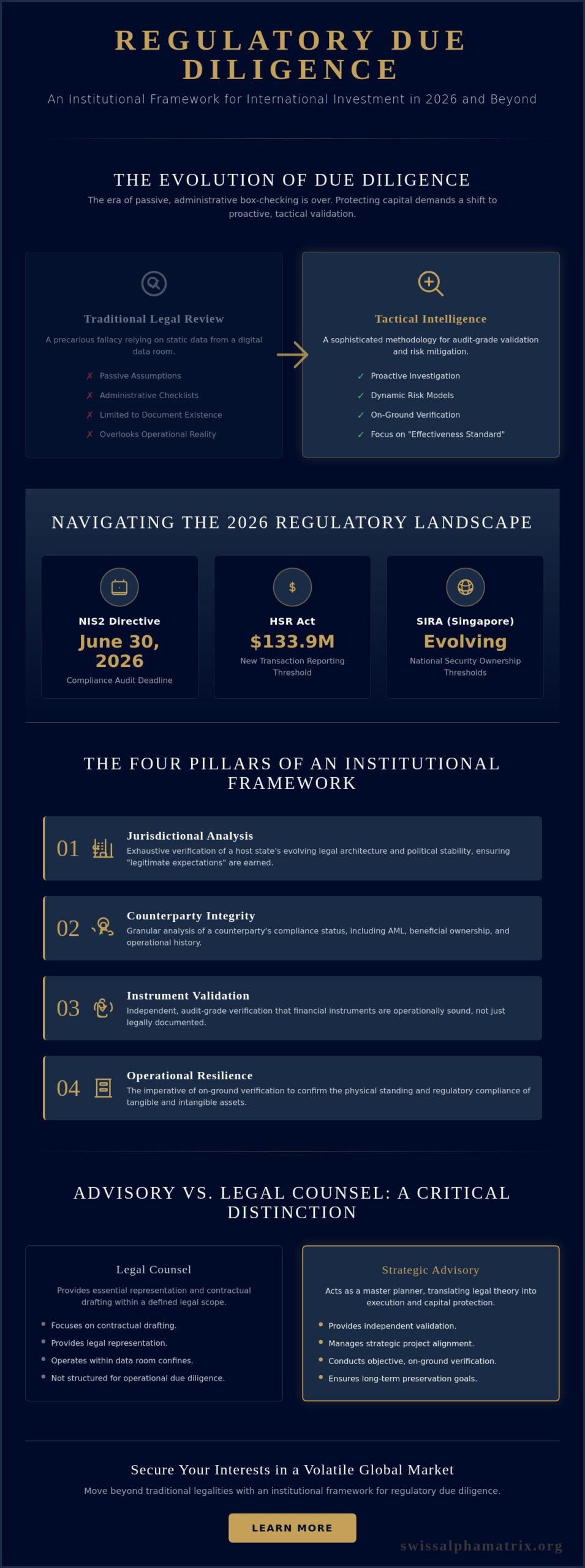
The assumption that a standard legal review constitutes sufficient protection is a precarious fallacy in an era where regulatory environments are increasingly opaque and punitive. As the June 30, 2026, deadline for NIS2 compliance audits passes and new HSR Act thresholds of $133.9 million redefine transaction reporting, the necessity for a more rigorous approach becomes clear. You likely recognize that protecting capital requires more than a cursory glance at a data room; it demands a sophisticated methodology for regulatory due diligence for international investments that prioritizes tactical validation over administrative box-checking.
This guide outlines an institutional framework designed to move beyond traditional legalities, offering a path to audit-grade validation of financial instruments and the mitigation of counterparty risk. We’ll explore how on-ground verification and a deep understanding of evolving national security screenings, such as Singapore’s SIRA ownership thresholds, create a stable foundation for long-term preservation. By integrating these strategic pillars, you’ll gain the intellectual depth required to navigate complex cross-border transactions with the quiet authority that defines elite asset management. We’ll move from broad philosophical principles of capital protection down to the specific strategic pillars that ensure your interests remain secure in a volatile global market.
Key Takeaways
- Understand the evolution of “legitimate expectations” within modern investment treaties to ensure your strategy aligns with the rigorous host-state verification standards required in 2026.
- Identify the four essential pillars of an institutional framework—jurisdictional, counterparty, instrument, and operational—to establish a multi-layered defense against cross-border volatility.
- Master the methodologies of regulatory due diligence for international investments to move beyond superficial legal checklists and secure audit-grade validation of financial instruments.
- Discover why on-ground verification remains the only definitive method for validating the physical standing and regulatory compliance of assets in increasingly opaque environments.
- Learn to integrate regulatory intelligence into the project management lifecycle using RACI matrices to define accountability and mitigate counterparty risk during complex transactions.
Defining Regulatory Due Diligence in the 2026 Global Investment Landscape
In the sophisticated theater of modern finance, regulatory due diligence for international investments has transcended its origins as a mere administrative formality. It’s now defined as the systematic, exhaustive verification of a host state’s evolving legal architecture and the granular compliance status of any prospective counterparty. This process ensures that capital isn’t just deployed, but anchored within a framework of regulatory precision. As we move through 2026, the concept of due diligence has become inextricably linked to the standard of Fair and Equitable Treatment (FET). International investment treaties now place a higher burden of proof on the investor; “legitimate expectations” are no longer granted to those who rely on passive assumptions. Instead, they’re earned through proactive, documented investigations that prove the investor understood the specific regulatory risks at the time of entry.
The Shift from Legal Checklists to Tactical Intelligence
Traditional legal reviews often fail because they operate within the sterile environment of a digital data room. These checklists confirm that documents exist, but they rarely interrogate whether those documents reflect operational reality in volatile emerging markets. Tactical intelligence requires an executive-level interpretation of regulatory shifts, such as the nuances of the NIS2 Directive or the KRITIS-Dachgesetz registration requirements. It’s a move from static data to dynamic risk models. We don’t just ask if a license is valid; we investigate the political and administrative stability of the body that issued it. This level of regulatory due diligence for international investments identifies operational red flags that a standard law firm might overlook, such as subtle changes in local enforcement priorities or undisclosed beneficial ownership structures.
Advisory vs. Legal Counsel: Understanding the Distinction
It’s vital to distinguish between the roles of legal representation and strategic advisory. While legal counsel provides essential representation and contractual drafting, they don’t typically offer the comprehensive project management required to validate complex financial instruments or conduct on-ground verification. Swiss Alpha Matrix bridges this gap. We provide the independent oversight and operational due diligence that legal firms are not structured to deliver. Our role is one of a master planner, ensuring that legal theory translates into financial execution and capital protection. This distinction is the difference between having a map and having a seasoned navigator who has walked the terrain. We prioritize:
- Independent validation of regulatory standing beyond provided documentation.
- Strategic project management that aligns legal findings with investment timelines.
- Objective risk assessment free from the conflicts of interest inherent in legal representation.
By maintaining this separation, we ensure that our findings serve the investor’s long-term preservation goals rather than just facilitating a transaction’s closure.
The Core Pillars of an Institutional-Grade Regulatory Framework
An institutional framework for regulatory due diligence for international investments must be constructed upon four immutable pillars that ensure capital isn’t just protected, but insulated from the caprice of shifting global dynamics. These pillars—Jurisdictional Analysis, Counterparty Integrity, Instrument Validation, and Operational Resilience—form a holistic defense that transcends the limitations of traditional legal checklists. We’ve observed that a multi-layered approach is the only viable method for managing cross-border risk, particularly as we move through 2026. This methodology requires an integration of Anti-Money Laundering (AML) requirements that prioritizes the “Effectiveness Standard” over mere procedural compliance, ensuring that every facet of a transaction is scrutinized for both technical accuracy and moral character. Such a rigorous structure aligns perfectly with our established financial advisory methodologies, which treat regulatory intelligence as a vital component of a broader capital protection strategy.
Jurisdictional and Socio-Political Risk Mapping
Assessing the stability of a host state’s regulatory framework, especially in volatile regions, requires a nuanced understanding of the tension between a sovereign’s “Right to Regulate” and the investor’s right to protection. It’s essential to interrogate the due diligence obligations of host states, as this determines the level of legal recourse available should the regulatory environment shift unexpectedly. Even within the seemingly stable markets of London, Geneva, or Hong Kong, hidden hurdles often emerge in the form of evolving “ownership and control” tests or national security-based investment screenings like Singapore’s SIRA. We don’t just map the current laws; we analyze the socio-political trajectory that influences how those laws are enforced, providing a level of foresight that passive participants lack.
Operational Due Diligence: Beyond the Balance Sheet
Operational due diligence is often where the veneer of regulatory compliance begins to crack, revealing deeper structural weaknesses within a target entity. We move beyond the balance sheet to validate internal controls and the prevailing compliance culture, as operational failures frequently masquerade as regulatory non-compliance. For executive stakeholders, audit-grade reporting is the only acceptable standard, providing the technical accuracy and intellectual depth required for high-level decision-making. It’s not enough to know that a firm claims to be compliant; we must verify that their internal systems are robust enough to maintain that status under stress. For those seeking to fortify their portfolios against these intricate dynamics, establishing a bespoke Risk Management Framework is a logical and necessary progression in the pursuit of long-term preservation.
Beyond the Data Room: The Imperative of On-Ground Verification
The digital age has fostered a dangerous reliance on Virtual Data Rooms (VDRs), which, although they provide an efficient mechanism for the dissemination of vast quantities of information, frequently serve as a curated veil for sophisticated financial fraud that desk-bound analysts are ill-equipped to penetrate. Relying solely on these digital repositories for regulatory due diligence for international investments is a strategy fraught with existential risk, primarily because it assumes the inherent integrity of the data provided by the counterparty without independent, external verification. We believe that true capital protection is only achieved when one moves beyond the screen to conduct a physical validation of assets, entities, and their actual regulatory standing. Paperwork, regardless of how meticulously it has been organized or how authoritative it appears, is merely a representation of a claim; it is not, in itself, a substitute for the verifiable operational reality found on the ground.
Identifying Sophisticated Document Fraud
Desk reviews are inherently limited by their inability to interrogate the physical context of a document, often missing high-level forgery or the subtle inconsistencies found in fraudulent government permits that only an experienced eye can detect. Common red flags that escape digital scrutiny include anomalies in metadata, the absence of verifiable physical security features on official licenses, and the lack of direct, face-to-face confirmation from the local administrative bodies responsible for oversight. Our methodology for verifying the authenticity of permits involves on-ground engagement with the issuing authorities to confirm that the records held in the data room match the official, physical ledger. This physical presence is required to validate “operational reality,” ensuring that a project’s regulatory standing is as robust as the promotional materials suggest and that the moral character of the counterparty remains beyond reproach.
Case Study: When Paperwork Diverges from Reality
Consider a hypothetical mandate involving a high-value infrastructure investment in a jurisdiction where the regulatory environment is notoriously opaque. The digital data room presented a comprehensive suite of environmental permits and land-use rights, all of which appeared to be in perfect order and were accompanied by favorable legal opinions. However, through our On-Ground Verification Services, our senior experts discovered that the “approved” site was actually subject to a local administrative freeze that had been omitted from the digital files. This discrepancy, which a desk review would have inevitably missed, saved the investor from a catastrophic loss of principal. The cost-benefit analysis of deploying senior experts for physical site audits becomes clear when contrasted with the potential for total capital forfeiture, as the price of precision is always lower than the cost of failure. By tethering these on-ground findings to a broader framework for cross-border investment due diligence, we provide the quiet authority and technical accuracy necessary to navigate these complex environments with absolute precision.
Mitigating Counterparty Risk through Complex Instrument Validation
In the meticulous architecture of cross-border finance, the validation of bank instruments serves as the final, impenetrable barrier between institutional capital and sophisticated fraud. This technical layer of regulatory due diligence for international investments ensures that the instruments presented, be they Standby Letters of Credit (SBLC) or Documentary Letters of Credit (LC), represent authentic institutional commitments rather than mere administrative fabrications. We view this process as the “last line of defense” because it interrogates the financial reality of the transaction at its most granular level. To maintain this standard, we utilize a Deliverable Review Matrix, a structured tool that interrogates every technical facet of the instrument against established international standards and the specific regulatory requirements of the 2026 landscape. This independent validation prevents capital exposure to non-performing instruments that often bypass standard legal reviews.
Validation of Standby Letters of Credit (SBLC)
The technical requirements for audit-grade SBLC verification in 2026 demand a forensic approach to SWIFT message validation, specifically focusing on MT760 and MT799 protocols. It’s no longer sufficient to accept a scanned copy of a bank instrument; one must verify the transmission path and the authority of the signing officers within the issuing institution. Distinguishing between an authentic institutional commitment and fraudulent paperwork requires an understanding of the subtle nuances in bank communication codes and the specific formatting requirements of Tier-1 banks. Our bank instrument validation services provide this level of scrutiny, ensuring that every document is backed by a verifiable, operative credit line rather than a dormant account.
Counterparty Risk and the “Know Your Instrument” (KYI) Principle
Applying traditional AML logic to the instruments themselves, rather than just the entities involved, has become a cornerstone of our risk management framework. This “Know Your Instrument” (KYI) principle requires a deep assessment of the issuing bank’s regulatory standing, its current liquidity ratios, and its historical reliability in international trade finance. We don’t just look at the bank’s name; we analyze its geographic exposure and its adherence to evolving global standards. Protecting capital through these rigorous frameworks is a hallmark of a master planner’s approach to wealth preservation. By treating the instrument as a dynamic risk variable, we provide a level of security that aligns with the highest institutional standards. For those managing high-value transactions, securing Audit-Grade Instrument Validation is an essential step in ensuring that every component of the deal is technically sound and regulatory-compliant.
Strategic Execution: Integrating Regulatory Intelligence into Project Management
The final phase of institutional capital protection lies in the seamless transition from investigation to strategic execution, ensuring that findings aren’t merely archived but actively utilized. Regulatory intelligence shouldn’t exist in a vacuum; it’s a dynamic variable that must be integrated into the broader independent financial project management lifecycle. This integration ensures that every discovery made during the process of regulatory due diligence for international investments informs the tactical maneuvers of the mandate. We utilize sophisticated RACI matrices to define absolute accountability throughout complex investigations, ensuring that stakeholders understand precisely who is responsible for validating each regulatory pillar. This structured approach transforms raw data into a series of actionable “Go/No-Go” milestones, allowing the master planner to protect the investor’s interests with unwavering logic and professional calm.
Managing Stakeholder Expectations during Long-Term Mandates
Delivering sensitive findings to the C-suite requires a level of discretion and Swiss precision that mirrors the traditional values of high-end private wealth management. We prioritize technical accuracy over frantic speed, ensuring that reports are exhaustive and technically sound before they reach executive stakeholders. Communication protocols are designed to be steady and measured, providing the intellectual depth required for high-level strategic growth. By maintaining a dignified and formal reporting structure, we foster a sense of stability and trust, making the audience feel that their interests are in the hands of seasoned, unemotional experts who prioritize long-term preservation over short-term speculation.
The 2026 Outlook: Future-Proofing International Investments
As we look toward the horizon, the landscape of international financial regulations continues to evolve with an increased emphasis on ESG mandates and cybersecurity resilience. Future-proofing international investments in 2026 demands a proactive stance on these emerging requirements, treating them as integral components of the risk management framework. The rising importance of the NIS2 Directive and the “Effectiveness Standard” in financial crime prevention means that passive participants will face increasing exposure. By securing institutional-grade advisory, you ensure that your capital is not just deployed, but fortified against the complexities of the future. Swiss Alpha Matrix stands ready as your dedicated partner, providing the high-level access and meticulous attention to detail that your interests deserve. Secure your capital today through our Regulatory Compliance Advisory and ensure your portfolio reflects the highest standards of moral character and regional excellence.
Securing Institutional Capital through Regulatory Precision
The complexity of the 2026 global market necessitates a transition from passive compliance to a proactive, institutional-grade framework. We’ve established that regulatory due diligence for international investments isn’t just a peripheral legal concern; it’s a central pillar of capital preservation. By prioritizing on-ground verification and audit-grade instrument validation, investors effectively insulate themselves from counterparty risk and sophisticated fraud. This methodology ensures every cross-border transaction is anchored in technical accuracy and a deep understanding of local regulatory shifts. Relying on superficial data rooms is a strategy of the past. Success today requires an interrogation of the operational reality behind the paperwork.
Led by former Tier-1 global bank executives, Swiss Alpha Matrix provides the elite oversight required for complex mandates. Our team combines global reach with the traditional discretion and precision synonymous with Swiss excellence. We offer a standard of service that’s both broad in its strategic vision and meticulous in its attention to operational detail. Engage Swiss Alpha Matrix for your next cross-border mandate to ensure your interests are managed by experts dedicated to long-term stability. Your capital deserves the protection of a master planner who understands that true security is built on verified intelligence.
Frequently Asked Questions
What is the difference between legal and regulatory due diligence?
Legal due diligence primarily concerns itself with the validity of contracts and the provision of formal representation, whereas regulatory due diligence for international investments involves the systematic verification of a host state’s legal architecture and the counterparty’s actual adherence to those mandates. This distinction is critical because an investment can be contractually sound while remaining operationally non-compliant with local administrative standards. We focus on the operational reality that exists beyond the written agreement, ensuring that capital is anchored in a framework of technical accuracy.
How long does an audit-grade regulatory investigation typically take?
The duration of an audit-grade investigation is contingent upon the complexity of the jurisdictional environment and the transparency of the counterparty, typically spanning several weeks to several months. We prioritize technical accuracy over administrative speed, ensuring that every facet of the regulatory landscape is interrogated with the meticulous attention to detail that institutional capital requires for long-term preservation. This measured pace allows for the deep investigation necessary to mitigate counterparty risk in opaque environments where superficial reviews often fail.
Why is on-ground verification necessary if the data room is complete?
Virtual data rooms are inherently curated environments that may omit physical discrepancies or local administrative freezes that only a physical presence can identify. On-ground verification serves as the definitive method for validating the physical standing and regulatory compliance of assets, ensuring that the operational reality aligns perfectly with the promotional narratives provided by the counterparty. It’s the difference between having a map and having a seasoned navigator who has walked the terrain to confirm that the path remains clear of hidden hurdles.
Can financial instrument validation prevent cross-border fraud?
Technical validation of financial instruments acts as a robust barrier against sophisticated fraud by interrogating the authenticity of institutional commitments such as SBLCs and LCs. By verifying SWIFT message protocols and the issuing bank’s actual liquidity, this process ensures that capital isn’t exposed to non-performing or fraudulent instruments that often bypass standard reviews. It is the final, impenetrable barrier in our risk management framework, providing a level of security that aligns with the highest institutional standards of moral character.
How do 2026 AML requirements impact international due diligence?
The 2026 landscape emphasizes an “Effectiveness Standard” for Anti-Money Laundering programs, moving beyond procedural checklists toward a more substantive assessment of compliance efficacy. This shift requires a deeper investigation into complex corporate structures and beneficial ownership, ensuring that every transaction meets the elevated standards of institutional integrity. Our methodology incorporates these evolving requirements to ensure that your portfolio reflects the highest standards of quality and permanence, distinguishing a performance-oriented mindset from passive participants.
What are the risks of ignoring regulatory due diligence in emerging markets?
Neglecting regulatory due diligence for international investments in emerging markets exposes capital to the risks of total forfeiture, deal unwinding, and severe administrative penalties. Without a sophisticated understanding of the host state’s “Right to Regulate,” investors may find themselves without legal recourse when local enforcement priorities shift or national security screenings are broadened unexpectedly. This oversight can lead to catastrophic losses of principal that a more rigorous, institutional-grade framework would have easily identified and mitigated before capital deployment.
How does Swiss Alpha Matrix ensure discretion during sensitive mandates?
We maintain the highest levels of discretion by utilizing secure communication protocols and a team comprised of former Tier-1 global bank executives who understand the traditional requirements of privacy. Our approach mirrors the quiet authority of high-end private wealth management, ensuring that sensitive findings are delivered with the technical accuracy and professional calm that our elite clientele expects. This commitment to exclusivity and hyper-personalization ensures that your interests are in the hands of seasoned experts who prioritize long-term preservation over short-term speculation.
What are the key red flags in international financial instruments?
Primary red flags include anomalies in SWIFT MT760 or MT799 message protocols, non-standard formatting that deviates from Tier-1 bank requirements, and the absence of a verifiable, operative credit line. Identifying these subtle inconsistencies requires an expert eye and a “Know Your Instrument” approach that interrogates the issuing institution’s actual regulatory standing and historical reliability. We look for descriptors that emphasize quality and moral character, ensuring that every instrument presented represents a genuine institutional commitment rather than an administrative fabrication.