

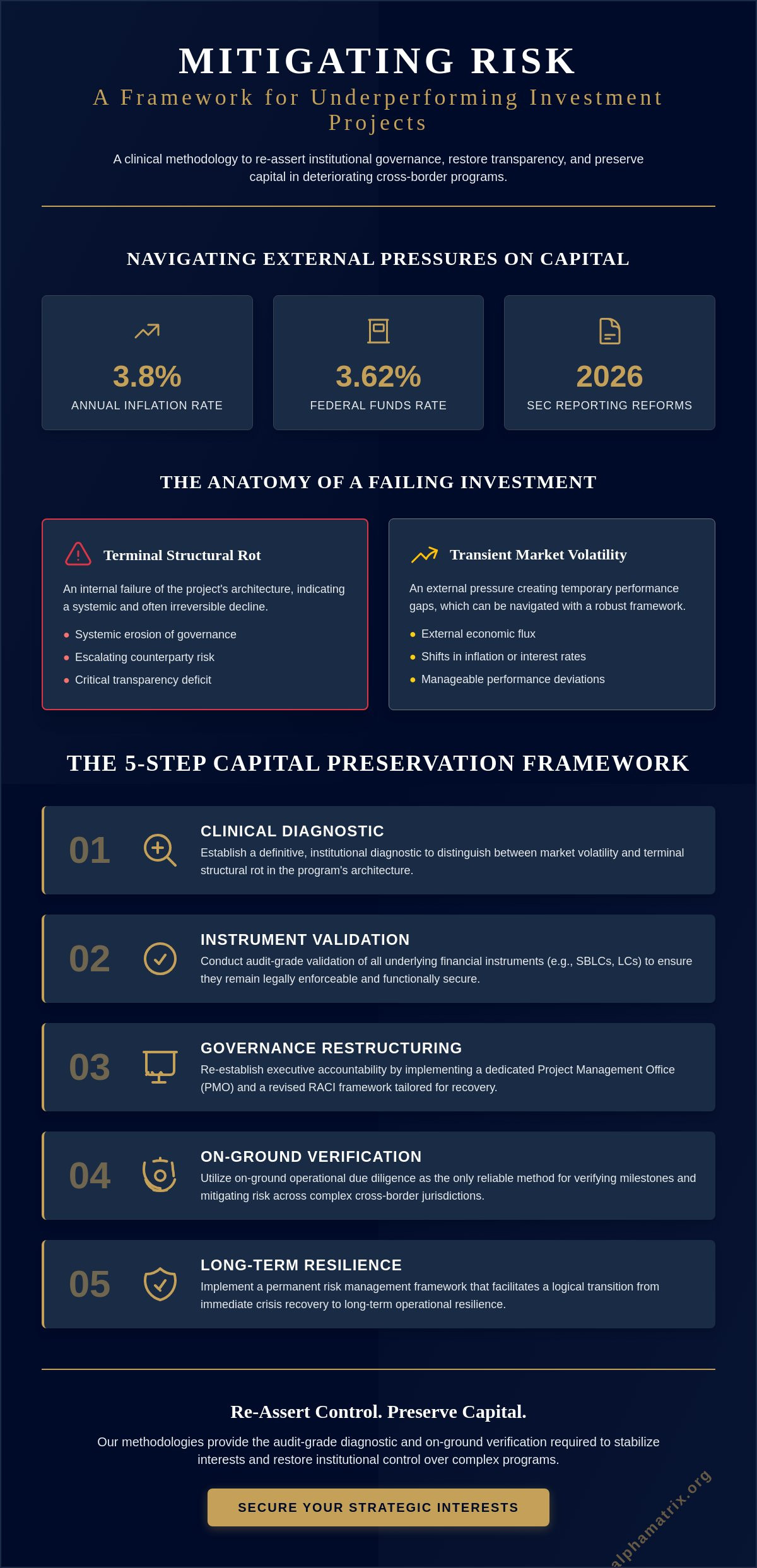
The preservation of capital within a deteriorating cross-border program is rarely achieved through reactive withdrawal, but rather through the rigorous, clinical re-assertion of institutional governance. You likely recognize the unsettling silence that follows a lack of transparency from on-ground leads, especially when suspected instrument invalidity or jurisdictional friction begins to erode stakeholder confidence. Successfully mitigating risk in underperforming investment projects requires moving beyond superficial reporting to establish a definitive, audit-grade diagnostic of why a project is failing; it’s a process that demands a seasoned, unemotional expert to stabilize interests. This is particularly vital as the 3.8% annual inflation rate and shifting regulatory thresholds, such as the SEC’s May 2026 proposed reforms to reporting frameworks, place additional pressure on capital preservation.
This article details the sophisticated methodologies required to restructure complex programs and restore the transparency necessary for institutional control. You’ll discover how to utilize operational due diligence and on-ground verification services to salvage value from projects facing systemic failure. We’ll examine a structured framework for capital protection that prioritizes risk management and regulatory compliance advisory, ensuring your strategic interests are handled with the same precision and discretion expected in high-end private wealth management.
Key Takeaways
- Establish the ability to distinguish between transient market volatility and terminal structural rot through a clinical, institutional diagnostic of your program’s architecture.
- Understand the requirement for audit-grade instrument validation to ensure that underlying financial instruments, such as SBLCs or LCs, remain legally enforceable and functionally secure.
- Verify the necessity of on-ground operational due diligence as the only reliable method for mitigating risk in underperforming investment projects across complex cross-border jurisdictions.
- Re-establish executive accountability and transparency by implementing a dedicated Project Management Office (PMO) with a revised RACI framework specifically tailored for recovery.
- Implement a permanent risk management framework that facilitates a logical transition from immediate crisis recovery to long-term operational resilience and capital preservation.
The Anatomy of a Failing Investment: Identifying Structural vs. Operational Rot
Identifying the precise nature of an asset’s decline is the primary requirement for capital preservation. While market participants often conflate temporary volatility with terminal failure, the distinction is critical for those charged with mitigating risk in underperforming investment projects. External economic flux, such as the 3.8% annual inflation rate recorded through April 2026, can create temporary performance gaps; however, structural rot is a failure of the project’s internal architecture. When a cross-border program deviates from its trajectory, the cause is rarely a single market event. It’s usually a systemic erosion of governance. This creates a transparency deficit where executive-level intelligence is obscured, preventing critical data from reaching the board until the project faces institutional failure.
Counterparty risk escalation often remains hidden behind polished digital reports that lack substantive validation. Independent oversight serves as the corrective lens, revealing whether project milestones are grounded in reality or are merely administrative fictions used to sustain eroding stakeholder confidence. In the current environment, where the Federal Funds Rate sits at 3.62%, the cost of capital makes these inefficiencies unsustainable. Re-asserting control requires a clinical diagnostic of the project’s foundation, ensuring that every instrument and operational claim is verified by an unemotional, third-party expert.
Early Warning Signals in Institutional Mandates
Detecting failure before it becomes terminal requires a return to the original independent financial project management framework. Deviations manifest as subtle shifts in reporting cadence or the introduction of non-standard documentation from counterparties. In multi-jurisdictional programs, “scope creep” often serves as a mask for operational inefficiency, where capital is deployed into unvetted sub-sectors without rigorous validation. If instrument reporting becomes delayed or opaque, it’s rarely a clerical error; it’s a signal that the underlying financial integrity is compromised. Our methodology focuses on identifying these frictions early, moving beyond digital checks to perform audit-grade validation of all project instruments.
The Governance Gap: When Internal Controls Fail
Internal project teams frequently develop cognitive blind spots or conflicts of interest as a project enters a failing phase. The professional proximity to the original deal can cloud judgment, making a detached, third-party assessment essential for restoration. This process often begins with an analysis of the RACI matrix to identify where accountability has dissipated in the project hierarchy. By applying principles of Turnaround management, we re-impose institutional-grade discipline and uncover misrepresented milestones. This approach is vital for mitigating risk in underperforming investment projects, as it replaces internal bias with a logical, measured framework for recovery. Through operational due diligence and on-ground verification, we ensure that governance is not just a policy, but a strictly enforced operational reality.
The Diagnostic Phase: Audit-Grade Validation of Project Instruments
The recovery of a compromised capital program begins with a clinical, forensic examination of the project’s financial instruments, which often serve as the fragile foundation for ostensibly robust initiatives. While many entities rely on digital snapshots or surface-level confirmations, mitigating risk in underperforming investment projects requires a transition toward audit-grade validation. This diagnostic phase isn’t merely an administrative exercise; it’s a strategic necessity to determine if the underlying financial paper, such as Standby Letters of Credit (SBLCs) or Documentary Letters of Credit (LCs), possesses the legal and operational substance required for enforceability. Failing projects frequently suffer from a “paper-only” syndrome, where the financial architecture exists in digital ledgers but lacks any tangible, on-ground liquidity or bank-side commitment. By adopting a mindset similar to the IT Investment Management Framework, which emphasizes moving from project-centric views to rigorous portfolio-based oversight, we identify where the financial logic has decoupled from operational reality.
Effective salvage operations necessitate an audit-grade instrument validation of all counterparty claims before any further capital is risked. This forensic approach exposes the point of failure within the financial architecture, allowing for a structured re-alignment of the project’s resources. Without this level of scrutiny, stakeholders remain vulnerable to the same systemic flaws that initiated the project’s decline.
Verifying the Integrity of Bank Instruments
In a recovery context, the utilization of bank instrument validation services is essential to uncover fraudulent or non-performing assets that may be stalling progress. We move beyond simple digital verification, cross-referencing instrument metadata with issuing bank protocols to ensure absolute precision. This process identifies whether a standby letter of credit is genuinely backed by the issuing institution’s liquidity or if it’s a non-functional instrument that lacks the necessary credit strength to support the project’s mandates. By confirming the validity and enforceability of these assets, we establish a secure baseline for restructuring efforts.
The Role of Operational Due Diligence in Salvage Operations
Salvaging value requires deep-dive investigations into the project’s operational entities to confirm their actual liquidity and transactional history. This forensic review is critical for mitigating risk in underperforming investment projects, as it validates counterparty claims that are often misrepresented during periods of institutional failure. We also ensure the project’s financial structure complies with the latest international financial regulations, including the Basel III framework that became effective on January 1, 2026. This rigorous compliance check ensures that any restructured model is both legally sound and operationally resilient, preventing future regulatory friction from compromising the recovery process.
Re-Architecting Governance: A Master Planner’s Approach to Restructuring
Once the diagnostic phase has exposed the structural rot and validated the integrity of the underlying instruments, the recovery effort must pivot from investigation to the re-imposition of institutional order. This isn’t a mere adjustment of timelines; it’s a fundamental re-architecting of governance designed to halt the erosion of stakeholder confidence. Central to this approach is the establishment of a dedicated Project Management Office (PMO) with a specific mandate for capital protection. Unlike a standard PMO focused on growth, this recovery-oriented entity operates as a protective authority, implementing a revised RACI analysis to re-establish clear lines of executive accountability that often dissipate in complex, cross-border programs. By clarifying who is ultimately responsible and accountable for each strategic pillar, we replace administrative ambiguity with a logical, measured hierarchy of control.
This restructuring is essential for mitigating risk in underperforming investment projects, particularly as the cost of capital remains elevated with the Bank Prime Loan Rate at 6.75% as of June 2026. We employ a “Swiss Discretion” model, which prioritizes the management of stakeholder expectations through dignified, firm pivots rather than reactive announcements. This model allows for the sensitive realignment of project goals, establishing new milestones that prioritize capital preservation over speculative growth. By shifting the focus toward the protection of remaining assets, the master planner ensures that every subsequent move is grounded in technical accuracy and long-term stability.
Implementing Independent Project Oversight
Independent oversight acts as a vital “circuit breaker” for failing project logic, stopping the momentum of historically flawed decision-making. We implement a deliverable review matrix to ensure that all future project outflows and capital deployments are strictly validated against on-ground performance metrics. This represents a transition from “passive monitoring,” which often relies on self-reported data from local leads, to “active institutional management” of the mandate. This shift ensures that the project’s operational due diligence is constant and rigorous, preventing the recurrence of the transparency deficits identified during the anatomy of the failure.
Strategic Stakeholder Management in Volatile Periods
Maintaining deal integrity during a restructuring phase requires transparent, audit-grade reporting to the C-suite and the board. We navigate the delicate balance between maintaining transactional momentum and ensuring absolute regulatory compliance, particularly under the Basel III framework and the SEC’s June 2026 reporting proposals. By utilizing sophisticated financial advisory methodologies, we provide the logical foundation required to justify difficult “stop-loss” decisions. This methodology ensures that any decision to withdraw or redirect capital is viewed not as a retreat, but as a strategic re-assertion of institutional governance and moral character in the face of regional complexity.
Cross-Border Recovery: The Necessity of On-Ground Verification
Digital oversight, while providing a necessary layer of administrative visibility, often creates a false sense of security that fails to detect the subtle, yet terminal, decoupling of reported milestones from physical reality. When mitigating risk in underperforming investment projects, relying solely on electronic ledgers or video-conferencing is insufficient for the preservation of institutional capital. The necessity of physical verification becomes paramount when the geographical distance between the board and the asset allows for the emergence of “Distance Risk,” a phenomenon where local managers may inadvertently or intentionally deviate from the rigorous Tier-1 banking standards required by institutional mandates. In global finance hubs such as Geneva, London, and Hong Kong, regulatory nuances regarding asset disclosure and instrument validity can be exploited if independent oversight isn’t physically present to enforce the master planner’s standards.
For programs requiring immediate, high-level field intervention to stop the erosion of value, our on-ground verification services offer the technical precision necessary to validate every physical asset and operational claim. This clinical approach ensures that the recovery strategy isn’t based on misrepresented data, but on the unvarnished reality of the project’s current state.
The Institutional Standard for Physical Verification
Site visits must transcend superficial “tourist” level inspections, which often serve only to confirm the existence of a facade rather than the integrity of the operation. A true institutional audit involves deep operational scrutiny, where we identify discrepancies between reported progress and the actual on-ground reality in remote jurisdictions. This process requires a sophisticated understanding of regional excellence, ensuring that local operations are adhering to the specific mandates of the recovery framework. By leveraging regional precision, we navigate the cross-border legal hurdles that often stall turnarounds, ensuring the master plan remains intact despite the complexities of diverse legal environments. This level of detail is the only way to confirm that project milestones are grounded in tangible progress rather than administrative fiction.
Jurisdiction-Specific Recovery Strategies
Adapting a recovery plan to cross-border investment due diligence standards requires a nuanced understanding of how local AML and KYC requirements impact restructuring. In Hong Kong, for instance, the “Foreign Entity of Concern” (FEOC) rules that became effective on January 1, 2026, necessitate increased due diligence for projects involving specific technological or equipment components. Similarly, navigating the traditional discretion of Geneva requires a different communication rhythm than the structured transparency demanded in London. We coordinate closely with local counsel to ensure compliance while maintaining centralized strategic control from the PMO. This dual-layered approach ensures that mitigating risk in underperforming investment projects is handled with both global perspective and regional precision, preventing local regulatory friction from compromising the broader capital preservation objective.
Stabilising Value: Transitioning from Recovery to Long-Term Resilience
The culmination of a recovery mandate is the transition from acute intervention to a state of stabilized, long-term resilience. This terminal phase requires a calculated exit strategy, where the master planner determines whether the project’s structural integrity has been sufficiently restored to warrant continued deployment or if a structured capital withdrawal is the most prudent course for mitigating risk in underperforming investment projects. In an environment where the 10-year U.S. Treasury Constant Maturity rate is 4.47% as of June 2026, the opportunity cost of misallocated capital is significant. The “Swiss Alpha Matrix” standard serves as the operational anchor during this pivot, merging traditional financial discipline with a level of meticulous attention to detail that ensures every remaining asset is protected by an audit-grade governance structure.
Finalizing the mandate isn’t an abrupt departure, but a managed transition to a sustainable, independent oversight model. This ensures that the transparency and accountability established during the recovery phase become permanent features of the project’s lifecycle. By shifting from a crisis footing to a posture of steady-state resilience, institutional entities can protect the gains made during the turnaround while preventing the return of the governance gaps that originally allowed for the transparency deficit. This logical progression from recovery to resilience creates a sense of professional calm, encouraging confidence among stakeholders who have witnessed the restoration of their interests through clinical, expert intervention.
Establishing a Permanent Risk Management Framework
Integrating the lessons learned from a failing project into the firm’s broader investment policy is essential for preventing the recurrence of structural failure. A permanent risk management framework must include:
- Continuous monitoring protocols that maintain the integrity of complex, multi-jurisdictional financial programmes.
- Mandatory audit-grade validation for all underlying instruments before capital is deployed.
- Regular on-ground operational due diligence to bridge the gap between digital reporting and physical reality.
- Strict adherence to international financial regulations, including the Basel III disclosure requirements effective as of January 2026.
These elements ensure that all future capital deployment follows a validated protocol, establishing a standard of regional excellence and precision that distinguishes a performance-oriented mindset from passive participation.
The Mandate for Precision: Why Professional Intervention is Essential
The complexities of mitigating risk in underperforming investment projects demand a level of senior-level expertise that internal teams, often compromised by proximity or bias, cannot provide. Salvaging high-value, cross-border mandates requires the unemotional expertise of a partner who prioritizes long-term preservation over short-term speculation. This master-planner approach provides the intellectual depth necessary to navigate regulatory friction and counterparty risk with absolute technical accuracy. Secure your capital’s future by engaging Swiss Alpha Matrix for a comprehensive project audit, ensuring your interests are managed with the discretion and precision that institutional-grade recovery requires.
Re-Asserting Institutional Control for Strategic Capital Preservation
The successful recovery of a deteriorating cross-border program is never a matter of chance; rather, it’s the inevitable outcome of applying clinical, audit-grade methodologies to structural failures. By prioritizing on-ground verification over digital snapshots and re-architecting governance through a dedicated Project Management Office, institutional entities can effectively bridge the transparency gap. This process of mitigating risk in underperforming investment projects requires a detached, forensic perspective that only seasoned experts can provide. Our approach, guided by former Tier-1 global bank executives, leverages decades of transactional risk management expertise and rigorous instrument validation protocols to restore order and protect remaining capital.
If your program faces jurisdictional friction or suspected instrument invalidity, the time for passive monitoring has passed. Order must be restored. We invite you to Request a Confidential Advisory Mandate for Project Recovery to secure your interests through our specialized risk management frameworks. With the application of disciplined oversight and regional precision, you can successfully navigate the complexities of institutional failure and transition toward a sustainable model of long-term resilience. Your capital’s preservation is a strategic objective that demands nothing less than absolute technical accuracy and professional discretion.
Frequently Asked Questions
What are the first signs that an investment project is failing structurally?
Structural failure often manifests as a persistent transparency deficit, where on-ground reporting becomes increasingly opaque or decoupled from the original financial management framework. You might notice subtle shifts in counterparty communication or the introduction of non-standard documentation that lacks institutional-grade validation. These signals indicate that the project’s foundation is eroding, moving beyond simple market volatility into systemic operational rot that requires immediate forensic intervention.
How does independent project oversight differ from standard project management?
Independent project oversight functions as a clinical, third-party circuit breaker designed to prioritize capital preservation over speculative growth. While standard project management often focuses on internal timelines and localized milestones, independent oversight applies audit-grade scrutiny to the entire financial architecture. This approach is essential for mitigating risk in underperforming investment projects by re-imposing institutional discipline and removing the internal biases that frequently cloud failing programs.
Can a bank instrument that has been questioned still be validated and salvaged?
A questioned bank instrument can often be salvaged if the underlying liquidity and legal enforceability are confirmed through audit-grade validation. This process involves cross-referencing instrument metadata with issuing bank protocols to distinguish between administrative errors and terminal fraud. If the instrument is found to be valid yet non-performing, we restructure the operational mandates to ensure it meets the necessary Tier-1 banking standards for project deployment.
What is the role of a RACI matrix in recovering a failing project?
In a recovery context, the RACI matrix serves to re-establish clear lines of executive accountability that have dissipated during the project’s decline. By explicitly defining who is Responsible, Accountable, Consulted, and Informed for each recovery pillar, we eliminate the administrative ambiguity that allows for misrepresentation. This logical restructuring ensures that every strategic pivot is grounded in a verifiable chain of command and institutional authority.
Why is on-ground verification critical for cross-border investment recovery?
On-ground verification is the only reliable method for confirming that reported milestones correspond to physical assets and operational substance in diverse jurisdictions. Digital due diligence often fails to detect “Distance Risk,” where remote project managers may deviate from established standards. Physical audits provide the unvarnished reality required for mitigating risk in underperforming investment projects, ensuring that recovery strategies aren’t built on administrative fictions.
How long does a typical institutional project recovery mandate take?
The duration of an institutional recovery mandate is dictated by the complexity of the financial architecture and the severity of the governance failure. While immediate stabilization can often be achieved within a few weeks of on-ground intervention, a full transition to long-term resilience typically follows a measured, logical pace. Each phase, from diagnostic validation to the re-imposition of a permanent risk management framework, is executed with technical accuracy rather than frantic energy.
Is it possible to restructure a project that is already in regulatory non-compliance?
Restructuring a project in regulatory non-compliance is possible through the implementation of a rigorous regulatory compliance advisory framework. This involves aligning the project’s financial structure with current international standards, such as Basel III or the SEC’s 2026 reporting proposals. By correcting compliance gaps and restoring transparency, we provide the board with the logical foundation necessary to maintain transactional momentum while adhering to strict legal requirements.
What is the difference between operational due diligence and a standard financial audit?
Operational due diligence transcends the scope of a standard financial audit by examining the qualitative substance and physical reality behind the balance sheet. While an audit verifies historical financial statements, operational due diligence scrutinizes the integrity of counterparty claims, the validity of bank instruments, and the efficacy of on-ground governance. This forensic approach identifies the systemic points of failure that traditional accounting methods often overlook in complex cross-border programs.