

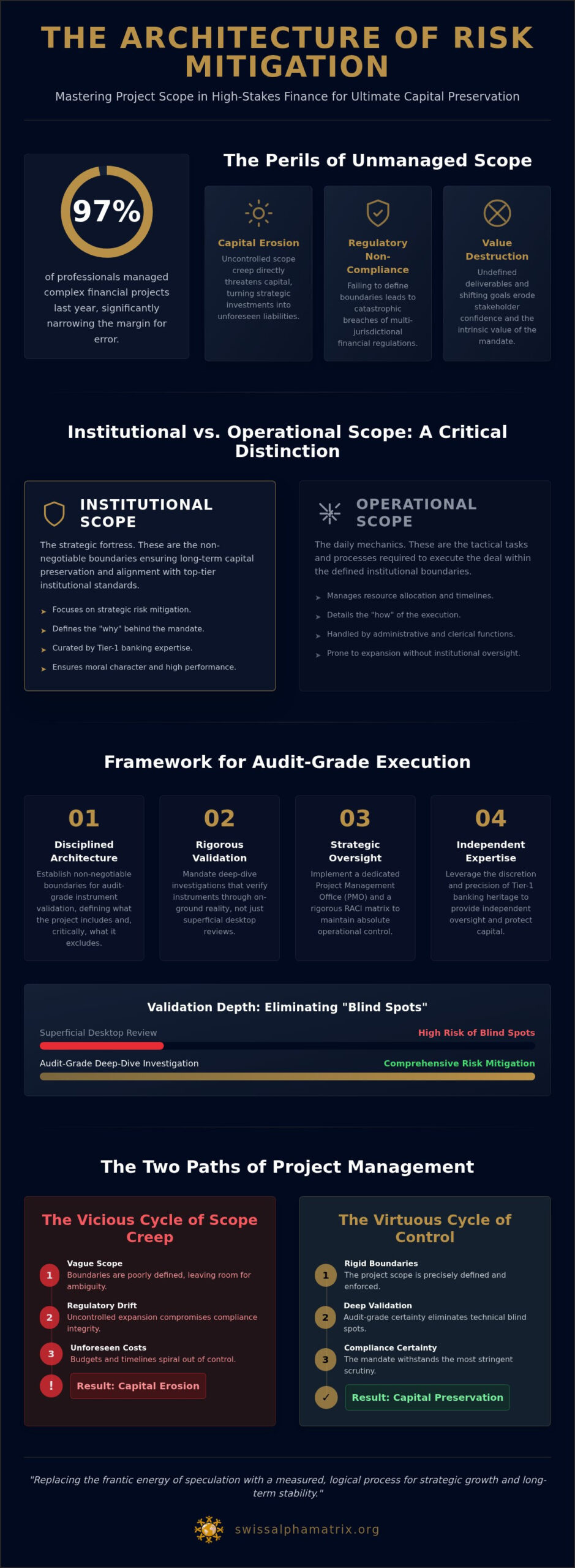
In the sophisticated arena of institutional mandates, the failure to establish a rigid boundary around a transaction is not merely an administrative oversight; it’s a direct threat to capital preservation. While many view project scope management in finance as a secondary clerical function, seasoned experts understand it as the primary architecture of risk mitigation. When dealing with multi-jurisdictional deals, the subtle expansion of a project’s boundaries, often termed scope creep, can lead to catastrophic regulatory non-compliance or the erosion of stakeholder value. You likely recognize that in an environment where 97% of professionals managed complex projects last year, according to industry data, the margin for error has narrowed significantly.
This article provides a rigorous framework for defining project boundaries with the precision required for high-stakes financial mandates. We’ll explore how to achieve audit-grade certainty in instrument validation and maintain independent oversight across cross-border capital deployments. By adopting this institutional approach, you ensure that every mandate is executed with the technical accuracy and technical depth necessary to survive the most stringent regulatory scrutiny. This methodology replaces the frantic energy of speculation with a measured, logical process for strategic growth and long-term stability.
Key Takeaways
- Understand how a disciplined architecture in project scope management in finance serves as the primary barrier against capital erosion in complex institutional mandates.
- Learn to align project boundaries with audit-grade instrument validation to eliminate technical blind spots in cross-border verification processes.
- Identify the early indicators of regulatory drift to prevent uncontrolled scope expansion from compromising the integrity of high-value due diligence.
- Discover the strategic necessity of a dedicated Project Management Office and a rigorous RACI matrix for maintaining operational control over multi-jurisdictional deals.
- Gain insight into the methodology of independent oversight, where Tier-1 banking expertise provides the discretion and precision required for capital protection.
Defining Project Scope Management in High-Stakes Finance
High-stakes financial mandates require a level of precision that generic project management frameworks simply cannot provide. While software-driven solutions often focus on automated resource allocation or billing cycles, Project Scope Management in an institutional context is a fundamental exercise in risk mitigation. In the current 2026 regulatory environment, where the FDIC and OCC have recently issued final rules regarding “unsafe or unsound practices,” the ability to define exactly what a project includes, and more importantly, what it excludes, is a primary tool for capital preservation. Senior executive oversight isn’t just a preference; it’s a necessity for establishing the rigorous boundaries that protect high-net-worth and institutional stakeholders from the cascading effects of poorly defined mandates.
The complexity of the current financial landscape, influenced by the 2026 regulatory shift toward effectiveness-based AML/CFT programs, demands a sophisticated approach to project definition. It’s no longer sufficient to follow a process; one must prove that the program actually detects and prevents financial crime. This requires a level of intellectual depth that transcends standard administrative checklists and caters to a sophisticated audience that values nuance and thoroughness.
The Architecture of a Financial Mandate
Defining the deliverables within complex investment programs requires a meticulous approach to technical accuracy. Project scope management in finance involves setting non-negotiable boundaries for audit-grade instrument validation, ensuring that every financial instrument is verified through on-ground reality rather than desktop speculation. This process is deeply influenced by Swiss discretion, a philosophy that prioritizes the quiet, unemotional protection of assets over short-term speculation. By establishing these core deliverables early, experts can prevent the “blind spots” that often emerge in cross-border transactions. This architectural discipline ensures that the mandate remains focused on its primary objective: the secure deployment of capital.
Institutional vs. Operational Scope
It’s essential to differentiate between mere operational tasks and institutional risk pillars. While operational scope might deal with the daily mechanics of a deal, institutional scope addresses the strategic boundaries that ensure long-term capital preservation. This distinction is where Tier-1 banking heritage becomes invaluable. Former senior executives from global banks possess the intellectual depth to map project goals directly to institutional standards of moral character and high-level performance. They don’t just manage a timeline; they curate a master plan that aligns every action with the client’s broader financial interests. This high-level access and standard of service distinguish a performance-oriented mindset from passive participants in the global market.
The Intersection of Scope Control and Instrument Validation
The integrity of a financial instrument relies entirely on the rigor of its verification. In the context of project scope management in finance, the boundaries defined at the project’s inception dictate the eventual depth of the validation process. A superficial scope often results in a desktop review, which, while efficient, fails to uncover the sophisticated layers of risk inherent in cross-border mandates. To achieve audit-grade certainty, the scope must be engineered to permit deep-dive investigations that go beyond mere document authentication. This ensures that the validation process is not a cursory check but a comprehensive defense mechanism for capital protection.
Aligning these parameters with the expectations of Tier-1 global banks is essential for successful capital deployment. These institutions demand a standard of proof that mirrors their own internal risk management frameworks. Without an independent review to define validation parameters, “blind spots” often emerge in multi-jurisdictional deals. These gaps typically occur when local regulatory nuances or on-ground operational realities are excluded from the initial project definition. By involving seasoned experts who understand the intricate nature of global finance, stakeholders can ensure that the scope remains wide enough to catch anomalies yet narrow enough to maintain technical precision.
Audit-Grade Validation Parameters
A robust framework for instrument validation necessitates a scope that encompasses both digital forensic analysis and physical, on-ground verification. It’s not enough to verify a bank guarantee or a standby letter of credit through electronic communication alone. The scope must explicitly include the verification of the issuing entity’s moral character and its standing within regional regulatory bodies. Integrating regulatory compliance advisory into this scope ensures that the validation remains relevant against the backdrop of shifting global standards. This multi-layered approach provides the intellectual depth required to satisfy the most demanding institutional entities.
Managing Stakeholder Expectations in Validation
Executive stakeholders often desire rapid execution, yet the necessity of precision requires a steady, logical pace. Communicating the inherent limits of validation is a hallmark of professional transparency. The implementation of independent financial project management serves as a critical buffer, preventing the erosion of standards through scope creep. By establishing clear milestones for instrument review, project leaders provide stakeholders with the reassurance that their capital is protected by seasoned, unemotional experts. For those seeking to fortify their oversight, engaging with Audit-Grade Instrument Validation services provides the necessary institutional depth to navigate complex mandates with confidence.
Mitigating Scope Creep: A Risk Management Perspective
Uncontrolled expansion of project boundaries, while often appearing innocuous in the early stages of a mandate, frequently serves as the catalyst for catastrophic capital exposure. In the professional application of project scope management in finance, this phenomenon is often identified as ‘Regulatory Drift.’ This occurs when subtle shifts in the parameters of a cross-border deal gradually move the transaction outside the safe harbor of its original compliance framework. As global authorities transition toward effectiveness-based standards for AML/CFT programs in 2026, the margin for such drift has effectively vanished. Any deviation from the established scope requires the immediate scrutiny of unemotional experts who prioritize the long-term preservation of assets over the transactional convenience of project momentum.
The financial cost of uncontrolled scope expansion is rarely limited to administrative overhead. Instead, it manifests as a heightened susceptibility to counterparty risk and the potential for severe regulatory sanctions. When project priorities shift without a corresponding adjustment in risk assessment, the integrity of the entire due diligence process is compromised. Protecting capital from these shifting priorities necessitates a master planner who possesses the intellectual depth to identify when a minor request threatens the fundamental security of the mandate.
The Cost of Scope Drift in Finance
Analysing the impact of scope creep reveals a direct correlation between shifting project boundaries and increased exposure to counterparty risk. When a project’s definition expands without a rigorous re-evaluation of its deliverables, the technical accuracy of the validation process often suffers. This is particularly dangerous when navigating the complexities of international financial regulations, where compliance is no longer a matter of checking boxes but of demonstrating the effectiveness of the program. Maintaining intellectual depth under the pressure of compressed timelines is essential; otherwise, the very boundaries designed to protect capital become porous, inviting the ‘unsafe or unsound practices’ that regulators now strictly define.
Enforcement Through Independent Oversight
The role of the independent advisor is to act as a master planner who enforces the project’s architecture with unwavering discipline. Utilizing a deliverable review matrix allows the advisory team to gatekeep project changes, ensuring that every modification is aligned with the primary objective of capital protection. By maintaining stability through formal change management protocols, the advisor ensures that the project moves with a measured, logical pace. This institutional approach prevents the frantic energy of speculation from overriding the established strategic pillars, creating a sense of professional calm that encourages confidence among high-net-worth stakeholders.
A Framework for Complex Project Scope Execution
The execution of high-value mandates requires more than mere administrative oversight; it demands the establishment of a dedicated Project Management Office (PMO) to anchor the transaction’s institutional gravity. Within this structured environment, project scope management in finance evolves from a conceptual boundary into a living architecture that governs every phase of the capital deployment lifecycle. By integrating cross-border investment due diligence directly into the scope framework, stakeholders ensure that the investigative depth remains consistent with the mandate’s risk profile. This approach prioritizes meticulous detail over the superficial efficiency often found in automated, AI-driven solutions, reflecting a commitment to the traditional standards of Tier-1 banking.
This institutional framework doesn’t just manage tasks; it curates a protective environment where every decision is tethered to regional excellence and technical precision. By moving away from frantic energy toward a measured, steady pace, the PMO ensures that the project’s logic remains inevitable and professional. This methodology is particularly essential in the current 2026 landscape, where the complexity of global finance requires a standard of service that is both broad in reach and meticulous in its attention to detail.
The RACI Model for Financial Stakeholders
In multi-jurisdictional financial programmes, the diffusion of responsibility is a significant risk that can lead to catastrophic operational failures. The application of a RACI (Responsible, Accountable, Consulted, Informed) matrix provides the necessary clarity to assign accountability across diverse teams and regulatory environments. This model ensures that the executive’s role in scope approval is clearly defined, preventing the ambiguity that often precedes scope creep. Documentation must reflect this precision, utilizing multi-layered sentence structures that capture the nuance of complex agreements, thereby ensuring that every stakeholder understands their specific obligations within the broader protective framework. This clarity is the bedrock of trust in high-end private wealth management.
Milestone-Based Execution and Reporting
A disciplined framework links project milestones directly to capital deployment decisions, ensuring that funds are only committed when audit-grade reporting confirms the legitimacy of the preceding phase. This systematic approach utilizes financial advisory methodologies to maintain a standard of consistency across global operations. Executive-level intelligence reports are standardized to provide a calm, unwavering view of project health, moving from broad philosophical principles to specific strategic pillars. For institutions managing high-value transactions, implementing Complex Project Management through a specialized PMO is the most reliable method for ensuring that interests remain in the hands of seasoned, unemotional experts.
Independent Oversight: The Swiss Alpha Matrix Methodology
The efficacy of project scope management in finance is fundamentally dependent on the caliber of the authority enforcing it. Our methodology is rooted in a Tier-1 banking heritage, where the culture of risk mitigation isn’t merely a policy but a foundational ethos that informs every strategic decision. By integrating the traditional tenets of Swiss discretion, which prioritize the quiet preservation of wealth, with modern global project discipline, we provide a standard of service that favors long-term stability over the transient nature of short-term speculation. This approach merges financial discipline with executive-level intelligence, ensuring that our clients’ interests are managed by seasoned, unemotional experts who understand the intricate nature of high-stakes mandates.
This protective authority is essential for institutions that require more than a service provider; they require a dedicated partner who acts as a master planner. By maintaining a measured, logical pace, we move from broad philosophical principles down to specific strategic pillars with a calm, unwavering energy. This creates a sense of inevitable logic and professional calm that encourages confidence in the decision-making process, even in the most volatile market conditions.
Our Approach to Mandate Precision
Executing a mandate with technical accuracy requires a refusal to oversimplify the complex dynamics of the global financial market, particularly when dealing with multi-jurisdictional deals. Within a strictly defined scope, we conduct deep-dive investigations that leverage our former executive experience to validate the legitimacy of every transaction participant. The value of on-ground verification can’t be overstated; it serves as the ultimate safeguard for institutional interests, ensuring that the physical reality of an asset matches its digital representation. We maintain a steady pace in complex deal execution, utilizing multi-layered sentence structures in our documentation to capture every nuance. This deliberate complexity serves to demonstrate intellectual depth, catering to a sophisticated audience that values thoroughness and professional competence.
Securing the Future of Capital Deployment
As we navigate the evolving regulatory landscape of late 2026, including the shift toward effectiveness-based AML/CFT standards, the necessity for a protective authority becomes even more pronounced. Our bank instrument validation services ensure precision through a meticulous, audit-grade reporting process that leaves no room for ambiguity or desktop-based assumptions. By integrating these standards into the broader framework of project scope management in finance, we ensure that every mandate is insulated from the risks of scope creep and regulatory drift. We build long-term trust through unemotional, expert oversight, providing a standard of service that is both broad in reach and meticulous in its attention to detail. This standard is reserved for a specific caliber of audience that values privacy, exclusivity, and a standard of moral character that mirrors the traditional values of high-end private wealth management.
Contact Swiss Alpha Matrix for Independent Project Oversight
Architecting the Future of Global Financial Mandates
The mastery of project scope management in finance represents the final distinction between transactional speculation and institutional capital protection. By establishing non-negotiable boundaries and integrating audit-grade instrument validation, stakeholders can effectively insulate their mandates from the silent erosion of regulatory drift and counterparty risk. This disciplined architecture, anchored by a dedicated Project Management Office and a rigorous RACI matrix, ensures that every cross-border deployment is executed with the technical accuracy required by Tier-1 global institutions. Relying on a Swiss heritage of precision and discretion, our methodology prioritizes the long-term preservation of assets through on-ground verification and seasoned, unemotional expertise. Led by former Tier-1 banking executives, we offer a standard of oversight that remains both exclusive and meticulous in its attention to detail. We invite you to Secure Your Mandate with Independent Financial Project Management. With a rigorous framework in place, your high-stakes mandates will navigate the complexities of the global financial landscape with absolute certainty and professional calm.
Frequently Asked Questions
What is the primary difference between scope management in finance versus other industries?
Financial scope management prioritizes capital protection and regulatory compliance over simple resource allocation or timeline efficiency. In high-stakes mandates, the deliverable is often the verification of legitimacy and the mitigation of institutional risk. While manufacturing projects focus on physical boundaries, project scope management in finance addresses the intangible yet high-risk parameters of financial instruments and multi-jurisdictional legal frameworks that govern global capital deployment.
How does project scope management help in mitigating counterparty risk?
A strictly defined scope ensures that every counterparty is subjected to the same level of audit-grade validation, leaving no room for technical blind spots. By mandating on-ground verification as a core project boundary, the methodology identifies inconsistencies between paper claims and physical reality. This rigorous approach prevents the accidental inclusion of unverified entities within a transaction, thereby insulating the principal’s capital from potential fraud or insolvency risks.
Why is independent oversight necessary for defining the scope of instrument validation?
Independent oversight provides an unemotional layer of protection that internal teams, who are often pressured by transactional momentum, may lack. Defining the scope of instrument validation requires a master planner who can identify where desktop reviews fall short. Without this independence, the scope might be narrowed to accommodate speed, which inevitably compromises the technical accuracy required to satisfy Tier-1 global banking standards and ensure absolute capital preservation.
Can scope management prevent regulatory failures in cross-border transactions?
Rigorous scope management identifies the specific regulatory requirements of every involved jurisdiction at the project’s inception. By establishing these as non-negotiable boundaries, the framework prevents Regulatory Drift, where a deal evolves beyond its initial compliance parameters. This is essential in the 2026 landscape, where authorities demand proof of effectiveness in AML/CFT programs, requiring a level of thoroughness that only a well-defined scope can sustain.
What are the common red flags of scope creep in a financial mandate?
Common indicators include the introduction of undocumented counterparties, requests to bypass on-ground verification for trusted entities, or the compression of validation timelines. Subtle shifts in mandate priorities that favor speed over precision often signal the onset of scope creep. When project scope management in finance is ignored, these red flags manifest as increased operational ambiguity, eventually leading to the unsafe or unsound practices recently highlighted by global regulators.
How does Swiss Alpha Matrix integrate due diligence into project scope?
We treat operational due diligence as a strategic risk pillar embedded directly within the project scope rather than a separate administrative task. This integration ensures that every milestone is gated by an audit-grade validation report. By utilizing former Tier-1 banking executives to lead these mandates, we apply a standard of moral character and technical depth that aligns the project’s boundaries with the long-term preservation goals of institutional stakeholders.
What role does a RACI matrix play in managing financial project boundaries?
The RACI matrix provides institutional clarity by assigning specific accountability for scope approval and change management across multi-jurisdictional teams. It ensures that executive stakeholders are consulted at critical junctures while identifying the unemotional experts responsible for enforcing technical boundaries. This multi-layered structure prevents the diffusion of responsibility that often occurs in complex financial programs, maintaining a steady, logical pace throughout the project’s lifecycle and ensuring mandate precision.
How do you handle scope changes in a rapidly evolving M&A news cycle?
In rapidly evolving environments, we maintain stability through formal change management protocols that require any scope adjustment to undergo a rigorous risk assessment. We avoid the frantic energy of the news cycle by adhering to a measured, logical process for instrument validation. This methodology ensures that even when deal parameters shift, the underlying strategic pillars of capital protection and regulatory compliance remain unwavering and technically precise.