

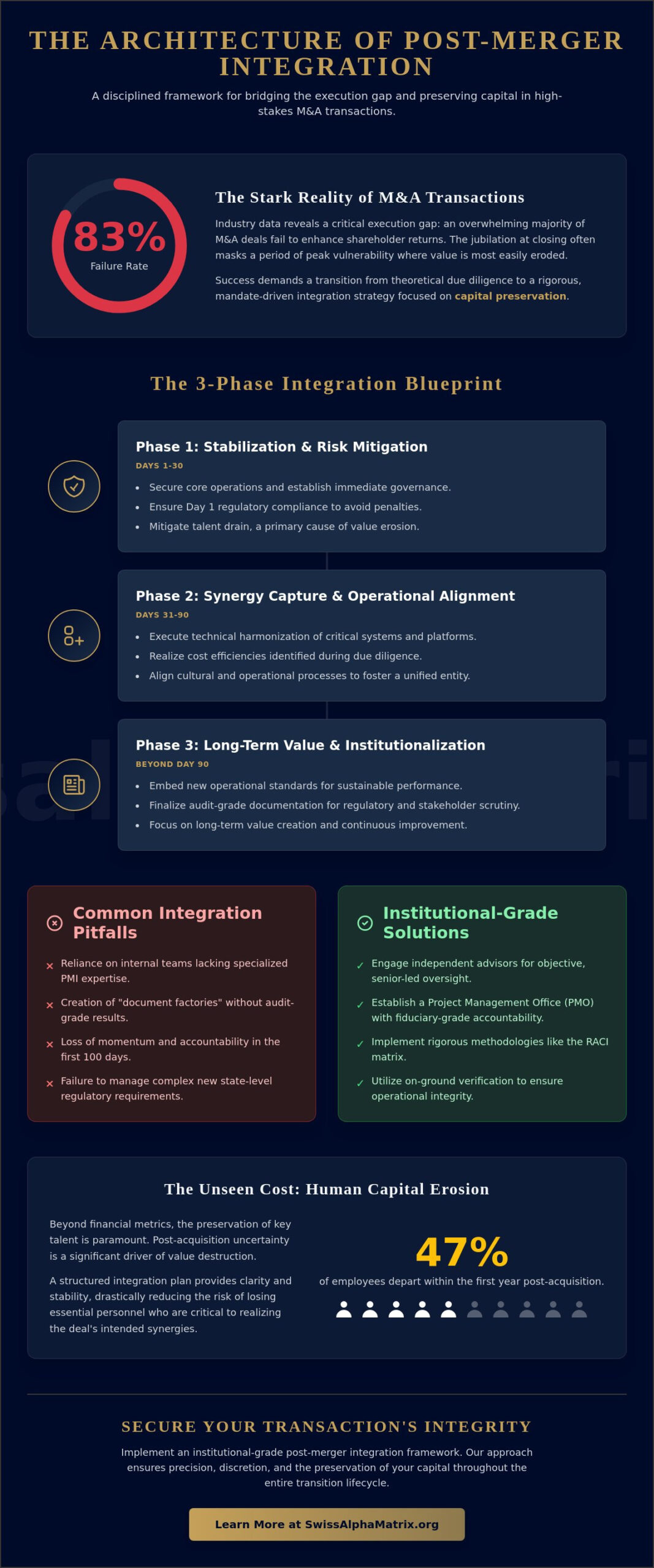
If eighty-three percent of M&A transactions fail to enhance shareholder returns, then the traditional jubilance surrounding a deal’s closure is frequently misplaced. It’s a moment of peak vulnerability where the promise of the prospectus meets the harsh reality of execution. Effective post-merger integration project management requires more than just administrative oversight; it demands a rigorous, senior-led framework that prioritizes the preservation of capital through meticulous risk management and operational due diligence.
You’ve likely seen how easily momentum dissipates during the transition phase, particularly when navigating the intricate new state-level premerger notifications in Washington or Colorado that now supplement federal HSR requirements. This article provides a sophisticated blueprint to master these complexities, promising a stabilized, integrated entity that realizes its intended synergies through disciplined execution. We’ll explore the institutional pillars of a successful transition, including audit-grade documentation and on-ground verification services designed to ensure that the integrity of your capital remains uncompromised throughout the 2026 fiscal cycle.
Key Takeaways
- Understand how to bridge the execution gap by transitioning from high-level due diligence to a disciplined, mandate-driven integration strategy that protects your firm’s interests.
- Implement rigorous technical methodologies, such as the RACI matrix, to maintain absolute accountability within your post-merger integration project management framework.
- Learn why relying on internal teams often leads to value erosion and how independent, on-ground verification services provide the necessary distance for objective oversight.
- Secure the long-term integrity of the transaction through audit-grade documentation and regulatory compliance advisory that satisfies the most stringent institutional requirements.
The Architecture of Post-Merger Integration Project Management
The architecture of post-merger integration project management is defined not by the mere aggregation of assets, but by the disciplined, senior-led execution of strategic mandates that follow a transaction’s closure. It represents the bridge between the theoretical value proposed in the deal room and the kinetic reality of operational synergy. When one considers that eighty-three percent of M&A deals fail to boost shareholder returns, according to 2023 industry data, it becomes clear that the transition phase is where capital is most frequently eroded. This disciplined approach to post-merger integration (PMI) ensures that the investment thesis remains the central pillar of every operational decision, preventing the loss of momentum that often characterizes the first hundred days of a new entity.
Closing the execution gap requires a transition from the sterile environment of due diligence to a rigorous Project Management Office (PMO) that operates with fiduciary-grade oversight. This office does not merely track tasks; it acts as a protective authority, ensuring that the deal integrity is maintained during high-velocity transitions. By establishing a PMO as early as the Letter of Intent stage, a strategy often referred to as the “Shift Left” in integration planning, firms can mitigate the risk of regulatory non-compliance and cultural friction before they manifest as financial liabilities.
The Strategic Mandate vs. Operational Execution
Aligning the integration roadmap with the original investment thesis is a prerequisite for capital preservation. The project management team must identify the critical path, particularly in complex, cross-border financial integrations where regulatory frameworks in multiple jurisdictions may overlap. Establishing a governance structure that mirrors institutional-grade standards allows for a transparent flow of information, ensuring that senior leadership retains control over the most sensitive aspects of the transition. This level of precision distinguishes a performance-oriented integration from a passive, reactive process.
Phasing the Integration for Maximum Capital Protection
A structured, three-phase approach provides the measured rhythm necessary for successful integration:
- Phase 1: Stabilisation and Immediate Risk Mitigation (Days 1-30). Focus resides on securing core operations, ensuring regulatory compliance, and preventing the immediate erosion of talent, noting that forty-seven percent of employees typically depart within the first year of an acquisition.
- Phase 2: Synergy Capture and Operational Alignment (Days 31-90). This phase involves the technical harmonisation of systems and the realisation of cost efficiencies that were identified during the due diligence phase.
- Phase 3: Long-Term Value Creation and Institutionalisation. The final phase focuses on the permanent adoption of new operational standards and the final audit-grade documentation of the integration process.
Establishing Institutional-Grade Project Oversight
The efficacy of any high-stakes transaction rests upon the transition from conceptual value to tangible reality, a process that often exposes the limitations of internal administrative teams. Many organizations fall into the trap of creating “document factories,” which are entities that produce vast quantities of reports but fail to deliver audit-grade integration results. Establishing institutional-grade oversight ensures that every facet of the combined entity is scrutinized through a lens of capital preservation. This is particularly vital in strategic post-merger integration, where the sheer complexity of the task can quickly overwhelm standard operational resources.
Effective post-merger integration project management requires a Project Management Office (PMO) structured for absolute transparency and accountability. In cross-border M&A involving financial hubs like Geneva, London, and Hong Kong, the stakeholder ecosystem is notoriously intricate. Managing these disparate interests requires a steady, logical rhythm that prioritizes regulatory compliance over short-term expediency. By implementing rigorous project oversight, firms can ensure that the integration process survives the scrutiny of both internal stakeholders and external regulatory bodies.
The Independent Advisor Advantage
Internal teams often suffer from inherent biases or executive blind spots that obscure emerging risks during the transition phase. Engaging an independent advisor provides a layer of protective authority, utilizing Tier-1 global banking expertise to navigate the regulatory hurdles that often stall integration. This approach maintains the tradition of Swiss discretion, which is indispensable when dealing with sensitive institutional mandates or high-net-worth interests. By leveraging complex project management from a neutral perspective, firms ensure that their interests are handled by unemotional experts who prioritize long-term stability and strategic growth.
Regulatory Compliance and Risk Mitigation Frameworks
The regulatory landscape of 2026 demands a meticulous approach to integration. For instance, transactions closing after February 17, 2026, must navigate the updated HSR “Size of Transaction Threshold” of $133.9 million, while firms with a principal presence in California must prepare for electronic filings under SB 25 starting in 2027. Ensuring that the newly integrated entity adheres to international financial regulations is not merely a legal necessity but a core component of capital protection. Our methodology involves implementing risk management frameworks designed to survive the most rigorous external audit scrutiny, specifically focusing on counterparty risk mitigation during the high-velocity transition of financial assets.
Technical Methodologies for High-Stakes Integration
The technical rigor applied to post-merger integration project management determines whether a deal matures into a high-yield asset or remains a perpetual liability. While many generalist approaches focus exclusively on cultural alignment or organizational charts, an institutional framework prioritizes the granular validation of every financial instrument and operational process acquired. Adhering to post-merger integration best practices requires a shift from passive observation to active, audit-grade verification. This methodology ensures that the capital transition is not only seamless but also resilient against the fraudulent activities that often surface during periods of organizational flux.
Effective post-merger integration project management treats operational due diligence as a continuous, kinetic process rather than a static pre-deal checkbox. This involves the deployment of on-ground verification services to confirm the physical existence and legal standing of assets across disparate jurisdictions. By maintaining this level of technical scrutiny, the project management office provides a protective barrier that preserves deal integrity well beyond the initial hundred days.
The RACI Analysis in Complex Mandates
In the high-pressure environment of a cross-border merger, decision paralysis often stems from a lack of clearly defined roles. Utilizing a RACI matrix allows the integration team to map exactly who is Responsible, Accountable, Consulted, and Informed for every strategic pillar. This mapping is essential for maintaining the quiet authority required to lead a complex stakeholder ecosystem. A meticulously defined RACI matrix serves as the primary safeguard against the dilution of accountability that frequently precipitates synergy erosion.
Deliverable Review and Financial Validation
Standardizing the underlying financial advisory methodologies across the new entity is a prerequisite for long-term stability. This standardization requires a sophisticated understanding of the distinction between project milestones vs deliverables; while milestones mark progress, only high-quality deliverables ensure value. Our approach includes:
- Audit-Grade Instrument Validation: Executing a deep-dive review of all acquired financial instruments to ensure they meet institutional standards.
- On-Ground Asset Verification: Conducting physical inspections of assets to prevent post-merger fraud and confirm operational readiness.
- Harmonised Validation Protocols: Ensuring that bank instrument validation services are applied uniformly across all regional offices, from London to Hong Kong.
This level of technical precision provides the audit-grade documentation necessary for future regulatory reviews. It reinforces the image of a master planner who prioritizes meticulous detail over the frantic energy often found in less disciplined integration efforts.
Common Pitfalls in Post-Merger Project Management
The erosion of capital during a transition is rarely the result of a single catastrophic event; rather, it’s the cumulative effect of systemic oversights and the persistent neglect of technical detail. One of the most prevalent errors in post-merger integration project management is the optimistic over-reliance on internal teams who, while competent in their native operational roles, often lack the specialized experience required to govern a complex integration mandate. Statistics indicate the severity of this risk, as eighty-four percent of IT integrations failed or encountered significant issues in 2024. When internal resources are stretched between maintaining business continuity and executing a merger, the resulting friction often leads to a loss of momentum and the gradual dissolution of the original investment thesis.
Failure to continue the investigative process post-closure represents another critical vulnerability. Many firms treat due diligence as a finite, pre-deal exercise, neglecting the necessity of mastering cross-border investment due diligence during the actual absorption of the new entity. This lack of continuity allows technical debt and fragmented financial systems to persist, which can lead to thirty to fifty percent of anticipated deal value being lost to ineffective IT integration. To mitigate these risks, we recommend implementing a robust risk management framework that prioritizes long-term preservation over short-term expediency.
The “Paperwork-Only” Fallacy
A profound risk in contemporary M&A is the reliance on “desktop” due diligence, which assumes that digital documentation accurately reflects the physical and legal reality of acquired assets. For complex financial instruments and cross-border holdings, this paperwork-only approach is insufficient. True capital protection requires on-ground verification services to validate the legitimacy of holdings and ensure they align with institutional standards. This level of Swiss precision in auditing prevents long-term capital exposure by identifying discrepancies that are invisible to remote observers.
Inadequate Stakeholder Communication
Fragmented reporting structures frequently lead to a breakdown in executive decision-making, as different departments operate with conflicting data sets. Without a centralized “Source of Truth” for integration progress, the risk of cultural clashes increases, a factor cited by sixty-eight percent of M&A professionals as the primary challenge in integration. Managing the news cycle and market perception requires a measured, steady flow of accurate information that demonstrates the entity’s stability. Establishing a disciplined communication rhythm ensures that both internal staff and external investors remain confident in the master planner’s vision, thereby preventing the talent drain where seventy-five percent of acquired employees depart by the third year.
The Swiss Alpha Matrix Approach: Precision and Discretion
Swiss Alpha Matrix operates at the intersection of elite technical execution and the traditional discretion of high-end private wealth management. We approach post-merger integration project management not as a series of administrative tasks, but as a high-stakes financial mandate that requires the same level of technical rigor as the initial capital deployment. Our firm leverages decades of Tier-1 global banking expertise to provide a standard of service that is both broad in reach and meticulous in its attention to detail. This commitment to excellence ensures that every strategic decision is backed by rigorous, audit-grade instrument validation, providing executive-level intelligence that protects the interests of high-net-worth individuals and institutional entities alike.
In the evolving M&A landscape of 2026, where regulatory scrutiny from jurisdictions such as California or Washington has intensified alongside federal HSR requirements, the value of a protective authority cannot be overstated. Our team acts as a master planner, coordinating every facet of the integration with a sense of quiet authority that reflects our historical reliability. By prioritizing long-term preservation over short-term speculation, we ensure that the combined entity is built upon a foundation of stability and technical accuracy, avoiding the common pitfalls of synergy erosion and talent loss that plague less disciplined integration efforts.
A Mandate-Specific Advisory Model
Unlike large-scale consultancies that prioritize high-volume engagements, we operate on a mandate-specific advisory model. We deliberately limit the number of active projects to ensure that every client receives the undivided attention of a senior partner, a necessity in sensitive financial environments where discretion is paramount. This elite level of access allows for a hyper-personalized project management framework, which is meticulously customized to the specific risk profile and regional nuances of your transaction. This partner-led approach distinguishes a performance-oriented mindset from passive participation, ensuring that interests are always in the hands of seasoned, unemotional experts.
Securing the Future of the Integrated Entity
The ultimate objective of our oversight is to create a foundation for sustainable, long-term growth that survives the initial volatility of integration. By implementing robust risk management frameworks and conducting continuous operational due diligence, we facilitate a transition from a complex integration project to “Business as Usual” with zero operational friction. Our focus remains on the preservation of capital and the realization of synergies through a measured, logical rhythm that avoids the frantic energy often found in the industry. This disciplined methodology provides the audit-grade documentation necessary to satisfy internal stakeholders and external regulators, securing the future of the integrated entity for the long term.
Request a confidential consultation regarding your integration mandate.
Securing the Long-Term Integrity of Your Integration Mandate
The successful synthesis of two distinct financial entities requires a departure from the frantic energy of the transaction room in favor of a measured, logical rhythm. By adopting a rigorous framework for post-merger integration project management, firms can bridge the execution gap and ensure that the original investment thesis remains uncompromised. It’s a transition that demands more than simple administrative oversight; it requires the deployment of audit-grade financial instrument validation and on-ground verification to identify risks that digital documentation often obscures.
Ensuring the long-term stability of your capital requires a partner who understands the intricate nature of cross-border mandates and the necessity of absolute technical accuracy. Managed by former senior executives from Tier-1 global banks, our approach leverages decades of cross-border transactional expertise to deliver a standard of service characterized by precision and discretion. We invite you to secure your integration mandate with Swiss Alpha Matrix precision. With the right institutional oversight, the complexities of integration become the foundation for your next era of strategic growth.
Frequently Asked Questions
What is the primary difference between M&A project management and standard project management?
M&A project management differs through its intense focus on capital preservation and the high-velocity transition of fiduciary responsibilities. While standard management focuses on cyclical outputs or isolated deliverables, post-merger integration project management requires an elite level of technical rigor to ensure the original investment thesis survives the complexities of operational absorption without value erosion.
How does a PMO add value during a post-merger integration?
A Project Management Office acts as the master planner, providing a centralized source of truth that prevents information asymmetry among disparate stakeholders. It adds value by implementing rigorous risk management frameworks and operational due diligence protocols that protect the entity from the technical debt and fragmented financial systems that often persist post-closure.
What are the risks of using internal teams for PMI project management?
Internal teams often struggle with inherent biases and the dual burden of maintaining business as usual while executing a complex integration mandate. This lack of specialized experience frequently leads to a loss of momentum, contributing to the talent drain where high percentages of acquired employees depart within the first three years due to cultural friction and unclear leadership.
How do you manage cross-border regulatory compliance during an integration?
Managing compliance requires a meticulous understanding of regional excellence and precision across multiple jurisdictions. For transactions in 2026, this involves navigating the updated 133.9 million dollar HSR threshold and the specific state-level notification requirements now active in Washington and Colorado, ensuring every filing meets institutional standards for accuracy.
What is the role of a RACI matrix in post-merger integration?
The RACI matrix serves as the primary governance tool for defining absolute accountability within the integration team. By mapping exactly who is Responsible, Accountable, Consulted, and Informed for every strategic pillar, it prevents the decision paralysis that often characterizes high-stakes mergers, ensuring that synergy capture remains on the critical path.
Why is independent instrument validation necessary after a merger is closed?
Independent validation provides an objective, audit-grade assessment of acquired financial assets that internal teams might overlook due to familiarity or executive pressure. This on-ground verification ensures that every capital deployment decision is backed by technical accuracy, protecting the firm from post-merger fraud or discrepancies in the valuation of complex financial instruments.
How long does a typical post-merger integration project management mandate last?
A typical post-merger integration project management mandate follows a structured, three-phase rhythm that often spans twelve to twenty-four months for full maturity. While initial stabilization and risk mitigation occur within the first thirty days, full institutionalization and the realization of intended synergies require a measured pace to ensure long-term growth and stability.