

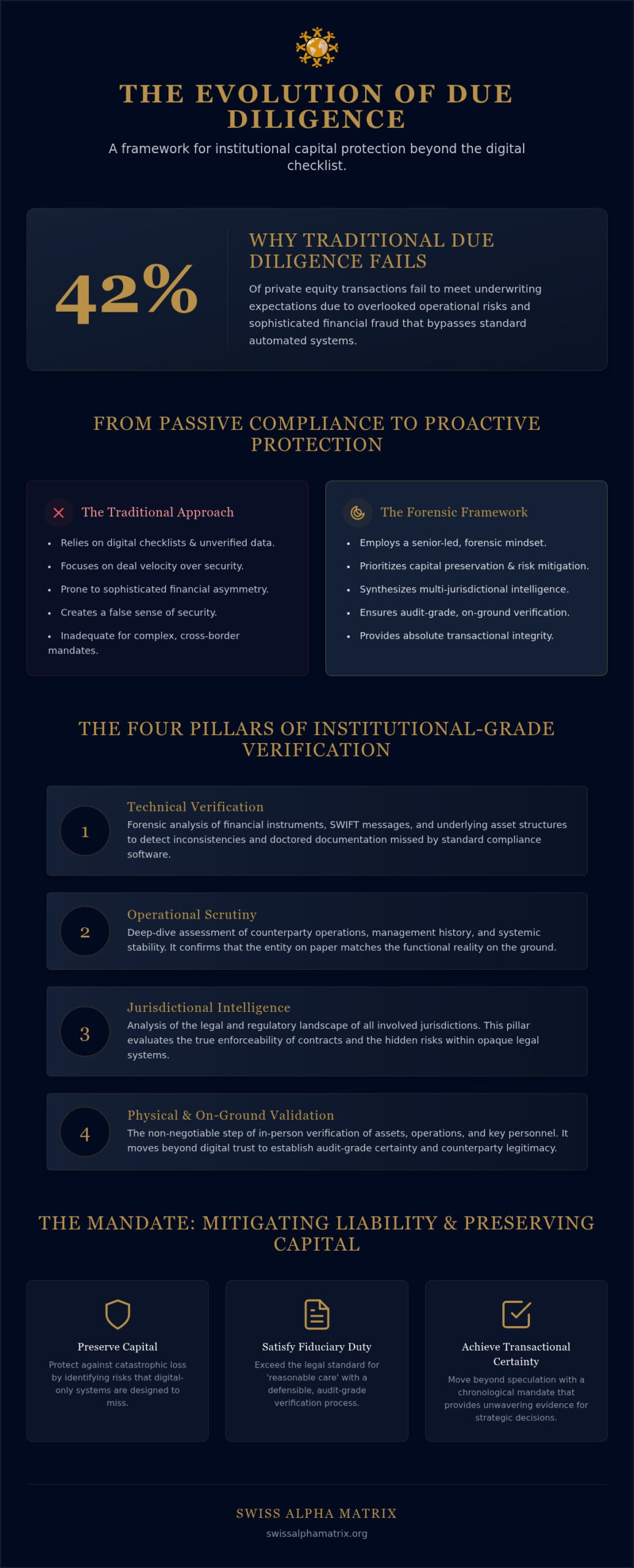
When 42% of private equity transactions fail to meet their underwriting expectations due to overlooked operational risks, the traditional digital checklist reveals its profound inadequacy. For the institutional allocator, the challenge isn’t a lack of data, but rather the presence of sophisticated financial fraud and information asymmetry that bypasses automated verification systems. Achieving true transactional integrity requires a shift toward a more forensic, senior-led approach to institutional investment due diligence that prioritizes capital preservation over the mere speed of the deal.
You’ve likely recognized that as regulatory pressures for deeper fiduciary oversight intensify, the margin for error in global capital deployment has vanished. We’ll provide a sophisticated framework for complex capital protection in 2026, moving beyond superficial metrics to ensure audit-grade certainty for your most critical mandates. By synthesizing multi-jurisdictional intelligence with on-ground verification, we’ll outline a methodology that mitigates personal liability through precise counterparty legitimacy. This discussion moves from broad philosophical principles of capital preservation down to the specific strategic pillars required for regional excellence and absolute transactional security.
Key Takeaways
- Master the transition from passive compliance to a proactive, forensic risk mitigation strategy that synthesizes technical, operational, and jurisdictional workstreams.
- Evaluate the limitations of digital-only verification and learn why on-ground, audit-grade instrument validation is essential for ensuring absolute transactional integrity in 2026.
- Navigate the systemic conflicts of interest within traditional banking by implementing a senior-led framework for institutional investment due diligence that prioritizes long-term stability.
- Discover how to structure a chronological mandate that integrates forensic intelligence into the capital deployment process to mitigate personal and corporate liability.
- Gain insights into the Swiss Alpha Matrix methodology, where former Tier-1 executives provide the meticulous attention to detail required for complex cross-border project management.
The Evolution of Institutional Investment Due Diligence in 2026
The conceptual landscape of due diligence has undergone a profound transformation, evolving from a peripheral administrative check into a rigorous, multi-dimensional synthesis of forensic verification. By 2026, institutional investment due diligence has become the primary mechanism for preserving capital against increasingly sophisticated global threats. Standard digital checklists and unverified SWIFT messages, while once considered sufficient for routine transactions, now prove dangerously inadequate for high-value bank instrument validation services. For C-suite executives and family office principals, this evolution necessitates a shift toward proactive risk mitigation that prioritizes absolute transactional integrity over deal velocity.
The Rise of Sophisticated Financial Asymmetry
Modern financial fraud has reached a level of sophistication where it perfectly mimics institutional protocols, effectively bypassing standard digital filters designed to flag irregularities. These actors exploit information asymmetry in emerging markets, utilizing the intricate nature of cross-border capital flows to mask the true nature of counterparties. While adhering to international financial regulations remains a non-negotiable baseline, these standards often serve as a ceiling for passive participants rather than the floor for seasoned experts. Navigating opaque jurisdictions requires a forensic mindset that looks beyond the surface of digital data rooms to identify the subtle inconsistencies that precede catastrophic capital loss.
This asymmetry is often exacerbated by the speed of modern markets, where the pressure to deploy capital can cloud professional judgment. True protection isn’t found in automated software but in the seasoned interpretation of complex financial structures. It’s the difference between seeing a document and understanding the jurisdictional reality of its enforcement.
Fiduciary Duty as a Driver of Deep-Dive Verification
The legal expectations for ‘reasonable care’ have shifted, placing a heavier burden of proof on those managing institutional capital. It’s no longer enough to claim ignorance of a counterparty’s history; the failure to conduct deep-dive verification is increasingly viewed as a breach of fiduciary duty. Beyond the immediate threat of financial loss, the reputational risks associated with unverified relationships can cause permanent damage to an institution’s moral character and market standing. Audit-Grade Due Diligence is defined as a rigorous, senior-led verification standard that provides the forensic evidence required to withstand the most intense regulatory and judicial scrutiny.
By establishing this standard, institutions protect not only their capital but also the personal liability of their leadership. In an era where transparency is demanded by both regulators and stakeholders, the depth of your institutional investment due diligence serves as the ultimate proof of professional competence and moral integrity. It provides a logical, unwavering foundation for every strategic decision in the portfolio management lifecycle.
The Four Pillars of Institutional-Grade Cross-Border Verification
The reliance on digital data rooms and unverified SWIFT messages has created a precarious environment for capital deployment. While these tools provide a surface-level convenience, they often mask the underlying jurisdictional and operational realities that determine transactional success. A truly robust framework for institutional investment due diligence must be built upon four critical pillars: Technical, Operational, Jurisdictional, and Physical. This multi-dimensional approach ensures that every facet of the transaction is scrutinized by seasoned experts who understand the nuances of complex financial structures and the subtle indicators of institutional instability.
Utilizing standardized frameworks like the ILPA Due Diligence Questionnaire provides an essential baseline for operational inquiries, yet the unique challenges of 2026 demand a more forensic application. Effective cross-border investment due diligence maps the entire transaction lifecycle, identifying potential points of failure before capital is committed. This process requires the intellectual depth of senior-level authorities who can interpret the specific language used in asset backing and instrument issuance. For those navigating these complexities, implementing rigorous risk management frameworks is the only path to ensuring long-term capital preservation.
Technical and Forensic Instrument Validation
The validation of Standby Letters of Credit (SBLCs) and Bank Guarantees requires a forensic examination that transcends simple authentication. It involves a meticulous review of the issuing officer’s credentials and a deep-dive into the capital adequacy of the counterparty institution. Experts must identify ‘poison pill’ clauses, which are often buried in dense technical language, that could render an instrument unenforceable or subject to unexpected recalls. Without this level of technical precision, the risk of holding a worthless paper instrument remains unacceptably high, regardless of the perceived prestige of the issuing bank.
Operational and Physical On-Ground Verification
Digital verification cannot replace the clarity provided by physical on-ground verification. In many emerging financial hubs, ‘paper-only’ entities are established to project an image of institutional legitimacy while lacking any physical or operational substance. Conducting site visits and in-person interviews remains the only definitive method to confirm the existence of an entity and the moral character of its leadership. This layer of verification prevents fraud and ensures that the operational history of the counterparty aligns with their presented documentation. It’s a process rooted in regional precision, ensuring that the interests of the allocator are protected by more than just a digital signature.
Internal Compliance vs. Independent Advisory: Navigating the Conflict of Interest
While internal compliance departments within global banking institutions serve a fundamental regulatory purpose, their standardized, ‘box-ticking’ methodology often lacks the forensic depth required for complex capital deployment. These internal teams are frequently bound by rigid protocols designed for mass-market efficiency, which, while sufficient for routine transactions, fail to address the intricate nuances of bespoke financial programs. In contrast, the investigation conducted by an independent advisory firm is inherently forensic, prioritizing the identification of subtle structural weaknesses that standardized filters are not programmed to detect. This distinction is critical when the objective of institutional investment due diligence is the absolute preservation of capital in an increasingly opaque global market.
Systemic conflicts of interest represent a persistent challenge within traditional banking environments, where the drive for transaction-related fees can inadvertently influence an institution’s risk tolerance. When the same entity facilitating a transaction is also responsible for its internal approval, an inherent bias toward deal completion may emerge, potentially compromising the objectivity of the risk assessment. Independent oversight serves as a necessary ‘external auditor,’ providing an unemotional evaluation that is entirely decoupled from the financial success of the transaction itself. This independence ensures that the allocator’s interests remain the sole priority, mirroring the traditional discretion and protective authority found in high-end private wealth management.
The presence of ‘Chinese Walls’ within large financial institutions, though legally mandated to prevent the illicit flow of information, often creates unintended silos that hinder effective risk intelligence. These internal barriers can prevent a compliance officer from accessing critical jurisdictional or counterparty data held by another department, resulting in a fragmented view of the transaction’s true risk profile. Independent advisors operate outside these silos, maintaining the ability to synthesize intelligence from diverse sources to provide a holistic and unvarnished perspective on counterparty legitimacy.
The Limitations of Automated KYC and AML
Automated KYC and AML systems are designed to flag broad patterns of illicit activity, yet they frequently miss the sophisticated, high-level fraud that mimics institutional protocols with alarming precision. These digital filters lack the intellectual depth to interpret the moral character of a counterparty or the subtle inconsistencies in complex instrument language. By utilizing financial advisory methodologies that prioritize senior-led human interpretation over algorithmic probability, allocators gain a more rigorous risk assessment. Seasoned experts provide a level of forensic scrutiny that automated systems simply cannot replicate, ensuring that every mandate is evaluated with a master planner’s attention to detail.
Mandate-Specific Oversight for Complex Transactions
Every cross-border project presents a unique set of jurisdictional challenges that demand a tailored approach to verification rather than a standardized template. Through independent financial project management, firms can structure their oversight to align with the specific risks and operational realities of a unique mandate. This bespoke approach ensures that deal integrity is maintained throughout the transaction lifecycle, providing decision-makers with executive-level intelligence. It’s a process that moves beyond the collection of raw data, delivering the strategic insights required to navigate complex capital protection with absolute professional calm.
Structuring a Robust Due Diligence Framework for 2026
The architecture of a successful mandate depends on a logical progression of verification stages. It isn’t a static checklist but a dynamic sequence that adapts to the evolving risk profile of the transaction. By implementing a Deliverable Review Matrix, allocators ensure that every risk vector, from technical instrument validity to the moral character of counterparties, is systematically addressed. This structured methodology transforms raw data into high-level intelligence, allowing for the seamless integration of findings into the broader capital deployment decision-making process. A well-structured institutional investment due diligence process serves as the definitive safeguard against the sophisticated financial fraud that often bypasses digital-only verification.
Real-time, audit-grade reporting is essential during the diligence window. Executive stakeholders require transparency that withstands regulatory scrutiny, moving beyond simple summaries to provide forensic depth. This level of precision ensures that interests are protected by seasoned experts who prioritize long-term preservation over short-term deal speed. Integrating these milestones into your workflow ensures that fiduciary duties are met with absolute professional calm. For those overseeing complex global mandates, adopting specialized Risk Management Frameworks provides the necessary oversight to protect capital at every stage of the transaction.
Jurisdictional Analysis and Enforceability
The legal landscape in global financial hubs like Geneva, London, or Hong Kong dictates the ultimate enforceability of any financial instrument. A robust framework must account for the specific regulatory requirements of these zones, particularly when verifying sovereign or government-backed guarantees in emerging markets. Understanding how local laws interact with international standards is vital; a guarantee is only as strong as the jurisdiction’s willingness to honor it. Navigating these global financial zones requires a nuanced understanding of local protocols, ensuring that instruments are not just authentic in appearance but legally binding in practice.
Milestone-Based Execution and Risk Mitigation
Execution follows a strict chronological path, beginning with the initial receipt of documents and concluding with a final, audit-grade validation report. Critical milestones serve as checkpoints where safeguards can be implemented based on interim findings. If an inconsistency is detected mid-transaction, these protocols allow for the immediate pausing of capital deployment to prevent loss. We define the ‘Strategic Bridge’ as the indispensable role of validation in moving from the initial intent of a transaction to its secure, verified execution. This milestone-based approach ensures that risk mitigation is an active, ongoing component of the project management lifecycle rather than a single, static event.
The Swiss Alpha Matrix Approach: Senior-Led Precision and Discretion
The methodology employed by Swiss Alpha Matrix represents a sophisticated synthesis of global Tier-1 banking discipline and the meticulous, quiet authority inherent in Swiss regional precision. This approach transcends the standard procedural checks common in the industry, opting instead for a senior-led investigative model that prioritizes long-term capital preservation over the mere completion of a transaction. By ensuring that former senior executives from the world’s most prominent financial institutions personally oversee every mandate, the firm provides a level of intellectual depth and pattern recognition that automated systems and junior-led teams simply cannot replicate. This commitment to senior-level oversight ensures that every nuance of a complex financial program is scrutinized through the lens of seasoned, unemotional expertise.
Every engagement is characterized by a profound sense of discretion and exclusivity, reflecting the traditional values of high-end private wealth management. For high-net-worth individuals and institutional entities, the firm acts as a protective authority, serving as a dedicated partner rather than a mere service provider. This relationship is built upon a foundation of historical reliability and a refusal to oversimplify the intricate dynamics of global capital deployment. In an era where information asymmetry and sophisticated fraud are prevalent, this senior-led framework provides the necessary intellectual superiority to navigate the world’s most complex financial landscapes with absolute professional calm.
Audit-Grade Reporting for Executive Stakeholders
The reports delivered to C-suite and board-level clients are forensic in nature, providing the audit-grade certainty required for high-stakes decision-making. These documents don’t just present data; they offer a comprehensive analysis of risk vectors, jurisdictional enforceability, and counterparty legitimacy that withstands the most intense regulatory scrutiny. Because the firm operates as an independent entity, it maintains a zero-conflict-of-interest environment, ensuring that every risk assessment is entirely objective and decoupled from transaction-related fees. This independence is further strengthened by a global reach that enables on-ground verification in opaque or emerging jurisdictions, where digital-only filters frequently fail to identify ‘paper-only’ entity fraud.
Securing the Future of Institutional Capital
Establishing a rigorous, senior-led precedent for institutional investment due diligence yields long-term benefits that extend far beyond a single transaction. It creates a culture of fiduciary excellence that protects both corporate assets and personal leadership liability, ensuring that every deployment of capital is supported by precise intelligence. Swiss Alpha Matrix positions itself as the definitive partner for stakeholders who prioritize capital integrity and moral character over deal volume. By merging traditional values with modern forensic strategies, the firm provides a standard of service that is both broad in reach and meticulous in its attention to detail. To ensure your interests are protected by the highest standard of forensic verification, engage Swiss Alpha Matrix for institutional investment due diligence and secure the absolute integrity of your global mandates.
Securing Transactional Integrity in an Era of Sophisticated Risk
The imperative for absolute transactional integrity in 2026 demands a departure from passive, digital-only verification toward a forensic model that, by its very nature, prioritizes the long-term preservation of capital. By synthesizing technical instrument validation with meticulous on-ground jurisdictional analysis, allocators can effectively bridge the gap between initial intent and secure execution. This structured approach to institutional investment due diligence ensures that every risk vector is scrutinized by seasoned authorities who understand the intricate nuances and hidden asymmetries of global capital flows.
Swiss Alpha Matrix stands as a protective authority for those who prioritize stability and moral character over the short-term pressures of deal volume. Led by former senior executives from global Tier-1 banks, our firm provides the audit-grade validation required for high-stakes mandates, combining global reach with the traditional discretion of Swiss precision. We invite you to Request a Senior-Led Consultation for Institutional Due Diligence to ensure your interests are managed with the meticulous attention to detail they deserve. Your commitment to rigorous oversight today establishes a permanent precedent for secure strategic growth in an increasingly opaque financial landscape.
Frequently Asked Questions
What defines ‘institutional-grade’ due diligence compared to standard KYC?
Institutional-grade due diligence is a forensic synthesis of technical, operational, and jurisdictional verification that transcends the passive nature of standard KYC protocols. While standard KYC often relies on automated database checks to confirm identity and sanction status, institutional investment due diligence involves a deep-dive analysis of the moral character of counterparties and the structural integrity of financial instruments. It provides audit-grade reporting that is designed to withstand intense regulatory and judicial scrutiny.
How does on-ground verification differ from digital background screening?
On-ground verification involves physical site visits and in-person interviews to confirm the existence and operational substance of an entity, providing a level of clarity that digital screening cannot replicate. Digital background screening relies on aggregated records that may be outdated, incomplete, or manipulated by sophisticated actors. Physical presence allows seasoned experts to detect ‘paper-only’ fraud and assess the actual environment in which a counterparty operates, ensuring the entity has the capacity to fulfill its obligations.
Why is independent validation necessary for bank instruments issued by Tier-1 institutions?
Independent validation is essential because internal bank compliance departments often face systemic conflicts of interest where transaction-related fees can inadvertently influence risk tolerance. Even instruments from Tier-1 institutions can contain ‘poison pill’ clauses or technical language that renders them unenforceable under specific jurisdictional laws. An independent assessment provides an unemotional, external audit that ensures the allocator’s interests remain the sole priority throughout the transaction lifecycle.
What are the primary red flags in cross-border investment due diligence for 2026?
Primary red flags for 2026 include opaque jurisdictional structures that mask ultimate beneficial ownership and inconsistencies in the technical language of bank instruments. Other critical indicators of risk involve counterparties who resist physical site visits or provide documentation that perfectly mimics institutional protocols but lacks verifiable asset backing. Identifying these subtle signals requires the pattern recognition and intellectual depth of senior financial authorities who have managed similar complex mandates.
How long does a comprehensive institutional due diligence mandate typically take to complete?
The timeline for a comprehensive review depends on the complexity of the cross-border project, though a forensic investigation typically spans several weeks to several months. A study of over 900 deals by Bayes Business School indicates that the optimal duration for due diligence resulting in the best 12-month returns is approximately 139 days. This timeframe allows for thorough forensic intelligence gathering and the completion of necessary on-ground verification milestones.
Can independent advisory firms verify sovereign or central bank-backed instruments?
Independent advisory firms are capable of verifying sovereign or central bank-backed instruments by examining the legal enforceability of the guarantee within the local jurisdictional framework. This process involves validating the authority of the signing officials and ensuring the instrument aligns with current international financial regulations. Such oversight is particularly critical in emerging markets where sovereign backing may be subject to localized political shifts or regulatory changes.
How does the Swiss Alpha Matrix methodology address jurisdictional risk in emerging markets?
Swiss Alpha Matrix addresses jurisdictional risk by merging Tier-1 banking expertise with regional precision, focusing on the specific legal landscapes of global hubs and emerging zones. Our methodology utilizes former senior executives to interpret how local laws impact the enforceability of financial instruments and corporate guarantees. This approach provides a hyper-personalized risk assessment that moves beyond generic templates to address the unique jurisdictional challenges of each specific mandate.
What documentation is required to initiate a senior-led due diligence review?
Initiating a senior-led review typically requires a comprehensive set of transaction documents, including the draft or issued financial instrument, counterparty corporate profiles, and evidence of asset backing. A clear description of the project’s operational structure and any existing internal compliance reports is also necessary. These documents serve as the essential foundation for the forensic investigation and the subsequent delivery of an audit-grade validation report.