

The assumption that a digital dashboard provides sufficient visibility into a counterparty’s operational integrity is a precarious foundation upon which to rest institutional capital, particularly when the consequences of oversight can manifest as multi-million dollar penalties. While automated TPRM systems offer a veneer of efficiency, they frequently fail to penetrate the opaque layers of international vendor structures; consequently, they leave firms vulnerable to the risks that the May 2026 Executive Order on financial fraud safeguards was specifically designed to mitigate. You likely recognize that in high-fraud environments, a “paper-only” verification is no longer a defensible position for those tasked with the stewardship of significant assets.
This article provides a definitive roadmap for elevating your vendor due diligence for financial services to an audit-grade standard, utilizing methodologies that prioritize physical, on-ground validation over digital assumptions. We’ll examine the transition toward multi-dimensional risk intelligence and the specific strategic pillars required to minimize capital exposure in complex, cross-border mandates. By aligning your protocols with the latest FinCEN AML/CFT program reforms, your institution can move beyond mere compliance toward a standard of rigorous, forensic-level counterparty oversight.
Key Takeaways
- Transition from passive, desk-based reviews toward a sophisticated framework for vendor due diligence for financial services that prioritizes long-term capital preservation over mere administrative compliance.
- Identify the four critical pillars of institutional-grade verification, focusing on the intricate nuances of liquidity structures and the maturity of a counterparty’s internal operational controls.
- Recognize why physical, on-ground verification remains the only definitive defense against the sophisticated fraud vectors often encountered in high-risk or opaque international jurisdictions.
- Implement a structured Project Management Office (PMO) approach to maintain rigorous, audit-grade oversight during the execution of complex cross-border mandates.
- Leverage specialized instrument validation and the expertise of seasoned professionals to ensure counterparty risk assessment meets the highest global regulatory standards.
The Paradigm Shift in Vendor Due Diligence for Financial Services (2026)
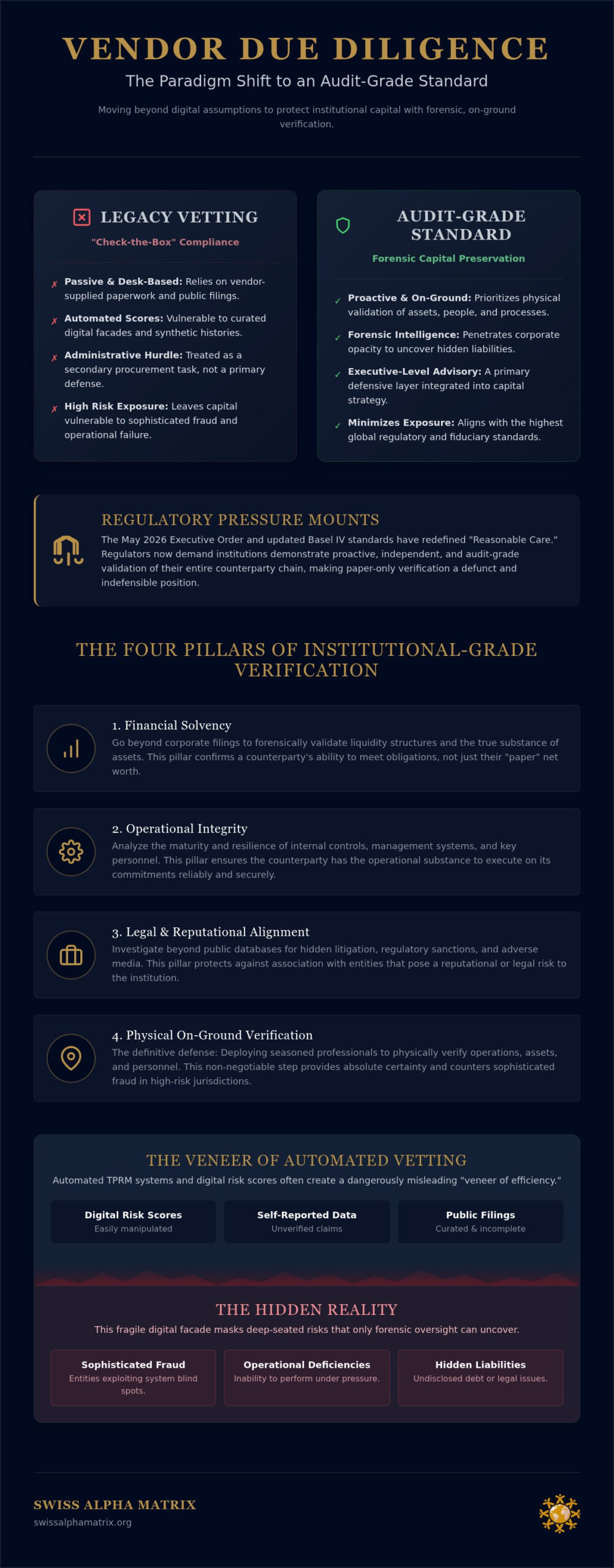
Within the architecture of high-stakes finance, due diligence isn’t a static checklist but a dynamic instrument of capital preservation. The traditional approach to vendor due diligence for financial services has historically focused on administrative compliance, often treating the process as a secondary procurement hurdle. However, the volatility of the 2026 global economy has exposed the structural fragility of these legacy “check-the-box” methodologies. Modern institutional risk necessitates a paradigm shift where vendor verification is viewed as a primary defensive layer against capital erosion. Unlike routine procurement reviews, executive-level advisory mandates prioritize the forensic validation of a counterparty’s operational substance. This ensures that entities entrusted with critical infrastructure or cross-border capital deployment possess the character and liquidity they claim.
The distinction between a standard procurement review and an executive-level advisory mandate lies in the depth of inquiry; the former seeks to satisfy a policy, while the latter seeks to protect a portfolio. In an environment where counterparty risk can escalate into systemic failure, relying on surface-level data is a strategic gamble. High-net-worth individuals and institutional entities now require a standard of oversight that mirrors the traditional discretion of private wealth management, focusing on long-term stability over short-term expediency.
The Limitations of Automated Risk Ratings
Digital risk scores, while efficient for low-tier vendors, frequently fail to capture the nuanced realities of sophisticated financial fraud. Automated systems often rely on self-reported data or public filings that fraudulent entities can meticulously curate to maintain a “paper-thin” facade of stability. These digital facades can mask deep-seated operational deficiencies or hidden liabilities that only a proactive, audit-grade validation process can uncover. Fraudulent entities in 2026 have become adept at exploiting the blind spots of automated TPRM software, creating synthetic histories that satisfy algorithmic triggers. Relying solely on reactive monitoring is a strategic vulnerability; true institutional security requires a move toward on-ground, physical verification of assets and personnel.
Regulatory Pressures on Counterparty Oversight
The landscape of international finance has been fundamentally altered by the 2026 regulatory updates, including the implementation of Basel IV standards and the May 19, 2026 Executive Order on financial fraud safeguards. These mandates have heightened the definition of “Reasonable Care” in capital deployment, requiring institutions to demonstrate a deeper level of operational transparency than previously expected. Regulators now demand evidence that firms aren’t merely monitoring vendors but are actively validating the integrity of their entire supply chain. It’s no longer enough to trust the data provided by a third party without independent, audit-grade verification. The Swiss Standard of VDD precision in 2026 is defined by a refusal to accept digital representations of reality, opting instead for the absolute certainty of on-ground, executive-led verification.
The Four Pillars of Institutional-Grade Vendor Verification
To establish a standard of vendor due diligence for financial services that withstands the scrutiny of sophisticated executive stakeholders, one must move beyond the superficial review of corporate filings. The pursuit of institutional-grade verification requires a departure from passive observation toward a methodology rooted in forensic skepticism and a commitment to capital preservation. This framework rests upon four distinct pillars, each designed to penetrate the layers of corporate opacity that often characterize international counterparties. By addressing solvency, integrity, alignment, and intelligence with equal rigor, a firm can ensure that its interests are protected by more than just contractual language.
- Financial Solvency: This pillar scrutinizes the underlying liquidity and capital structure, ensuring that a vendor’s financial health is resilient enough to withstand the stresses of a volatile cross-border environment, rather than merely relying on the static figures of a historical balance sheet.
- Operational Integrity: Assessment involves a forensic review of internal controls and project management maturity, a necessity underscored by historical oversights, such as the $60 million penalty Morgan Stanley faced due to a third party’s failure to secure customer data.
- Regulatory Alignment: It’s imperative to ensure that cross-border entities don’t just meet current local standards but are fully prepared for the evolving complexities of Basel IV and international transparency mandates.
- Reputational Intelligence: This requires leveraging executive-level networks to identify hidden political risks and counterparty associations that standard digital background checks inevitably miss.
Audit-Grade Instrument Validation
The validation of financial instruments represents a critical juncture in the due diligence process, particularly when dealing with complex guarantees that serve as the foundation for large scale mandates. Utilizing professional bank instrument validation services is essential when verifying Standby Letters of Credit (SBLCs) or other sophisticated instruments. The increasing prevalence of high-fidelity forgeries in the global market has rendered traditional desk reviews obsolete, necessitating a verification process that confirms the authenticity of the issuing institution and the specific terms of the instrument itself. For institutions seeking to fortify their counterparty oversight, engaging with Swiss Alpha Matrix provides the necessary on-ground verification to mitigate such systemic exposure.
Operational Due Diligence (ODD) Frameworks
Operational Due Diligence (ODD) serves as the human-centric counterpart to financial auditing, focusing on the “human factor” that often dictates the success or failure of a partnership. By conducting structured, senior-level interviews, a firm can evaluate the project management maturity and the inherent stability of vendor-managed financial programs. This rigorous ODD approach, which assesses scalability and internal governance, is a fundamental component of a broader financial advisory methodology designed for the protection of institutional capital in opaque jurisdictions. Modern vendor due diligence for financial services demands this level of qualitative analysis to ensure that a vendor’s operational reality matches its institutional promises.
The Fragility of Paperwork: Why Physical Verification is Non-Negotiable
In the pursuit of absolute precision, the reliance on digital documentation represents a significant vulnerability in modern vendor due diligence for financial services. While automated platforms promise unparalleled efficiency, they often serve as the primary vector for sophisticated financial fraud by providing a platform for fabricated credentials. Documentation, no matter how official it appears, can be manipulated with alarming sophistication; consequently, a “desk assessment” remains a fundamentally insufficient safeguard for protecting institutional capital. We’ve encountered scenarios where corporate filings, tax records, and even bank references were immaculately presented, yet the physical entity was entirely non-existent or lacked the claimed infrastructure. Physical oversight provides the executive-level intelligence that no digital dashboard can replicate, ensuring that capital deployment is based on reality rather than a curated digital facade.
The necessity of “On-Ground” verification is particularly acute in opaque or high-risk jurisdictions where local regulatory oversight may be inconsistent. Relying on paperwork in these environments is often a precursor to significant capital loss, as it fails to account for the operational substance of the counterparty. By moving beyond the screen, firms can uncover hidden risks that digital filters are programmed to ignore, such as the absence of key personnel or the lack of physical security controls at critical facilities. This level of scrutiny is no longer optional; it’s a mandatory requirement for those who prioritize long-term preservation over short-term administrative ease.
The On-Ground Verification Methodology
A rigorous methodology requires the physical inspection of assets and facilities alongside the interviewing of key personnel in their actual operational environment. This on-ground verification acts as a definitive deterrent to counterparty malfeasance, as fraudulent actors rarely maintain the physical infrastructure they claim in their digital profiles. By utilizing local intelligence and regional expertise, particularly within Swiss-led mandates, firms can validate the moral character and operational capacity of a vendor before any capital is committed. The May 2026 Executive Order on financial fraud safeguards underscores the necessity of these measures, as federal agencies now demand more than just passive compliance. Seeing the facility and meeting the leadership team ensures that the vendor isn’t merely a paper construct designed to siphon off institutional resources.
Balancing Speed with Precision
Critics of physical verification often argue that on-site visits are cumbersome; however, this perspective overlooks the catastrophic cost of a failed mandate. Integrating deep-dive verification into independent financial project management allows for a more streamlined approach than traditional bank bureaucracy. Senior-led teams, composed of former Tier-1 executives, can execute Operational Due Diligence (ODD) with a level of focus that accelerates the timeline without compromising technical accuracy. When conducting a cost-benefit analysis, the moderate investment in “slow” vendor due diligence for financial services is negligible compared to the total loss of capital resulting from a fraudulent cross-border partnership. Precision, in this context, is the ultimate form of speed.
Executing a Complex VDD Mandate: An Executive Framework
The execution of a high-stakes mandate requires a departure from the fragmented checklists typically utilized by procurement departments, favoring instead a centralized Project Management Office (PMO) structure. Effective vendor due diligence for financial services requires this level of strategic governance to synchronize cross-border oversight and ensure that disparate intelligence streams are synthesized into a single, actionable perspective. The mandate’s scope must be defined with surgical clarity, focusing specifically on high-risk deliverables such as the underlying liquidity of a counterparty or the technical validity of a bank instrument, which could jeopardize the entire program if left unverified. By deploying former Tier-1 executives to lead these investigations, an institution ensures that the verification process is conducted with a level of forensic skepticism that automated systems simply cannot replicate.
The culmination of this rigorous framework is the delivery of an audit-grade executive report, a document that serves as the definitive record of a vendor’s operational and financial integrity. This report doesn’t merely list findings; it provides a logical argument for or against capital deployment based on verified data and on-ground observations. For institutions navigating high-stakes cross-border mandates, engaging a partner for Complex Project Management ensures that every operational vulnerability is addressed with the necessary technical precision.
Stakeholder Management and the RACI Matrix
Accountability is the cornerstone of any successful investigation, and utilizing a RACI matrix ensures that every stakeholder understands their specific role within the VDD lifecycle. This structured approach is particularly vital when managing the news cycle and maintaining deal integrity during the sensitive investigation phase, where leaks or miscommunications can have significant reputational consequences. The Master Planner acts as the central strategic architect, harmonizing disparate intelligence streams into a cohesive risk mitigation strategy that protects the institution’s long-term interests. By establishing clear lines of responsibility, the PMO can navigate the complexities of international jurisdictions without losing the steady, logical pace required for institutional-grade verification.
From Due Diligence to Strategic Execution
The insights gathered during the vendor verification phase are not isolated data points; they are essential components that inform the final cross-border investment due diligence report. Moving from mere risk identification to active risk mitigation strategies allows an institution to adjust its engagement terms or implementation timelines based on the vendor’s actual maturity levels. This transition often leads to ongoing regulatory oversight or retainer-based consulting, ensuring that the standards established during onboarding are maintained throughout the life of the partnership. This evolution from a one-time event to a continuous governance model reflects the sophisticated reality of 2026 financial standards, where stability is a product of constant, expert-led vigilance.
Securing Capital through Independent Institutional Oversight
The efficacy of a risk management framework is fundamentally tethered to the caliber of the individuals executing the protocols. In the context of vendor due diligence for financial services, the prevailing reliance on large-scale, multi-disciplinary consultancies often introduces a “junior associate risk,” where critical mandates are delegated to staff who lack the deep transactional experience required to identify sophisticated irregularities. An independent, boutique perspective provides a necessary counterweight to this trend, offering a level of discretion and hyper-personalization that mirrors the traditional standards of high-end private wealth management. This approach prioritizes long-term capital preservation over the high-volume, standardized output typical of broader market participants who may prioritize speed over forensic depth.
Former Tier-1 bank executives bring a unique, insider’s understanding of global financial instruments, making them uniquely qualified for audit-grade validation. They’ve navigated the intricate internal controls of the world’s most significant institutions; consequently, they possess the technical intuition to identify when a vendor’s documentation deviates from established institutional norms. At Swiss Alpha Matrix, this expertise is coupled with a commitment to regional precision and on-ground verification, ensuring that every strategic pillar of your mandate is supported by forensic-level evidence rather than digital assumptions. This specialized oversight is the only definitive way to move beyond “paper-only” verification in an era of increasing counterparty complexity.
The Advantage of Senior-Level Advisory
Engaging with a boutique advisory firm ensures direct access to decades of regulatory and transactional expertise, eliminating the layers of bureaucracy that often dilute the quality of investigation in larger firms. Engagement structures are typically customized and milestone-based, aligning perfectly with the specific timelines of complex cross-border deals. This structure allows for an agile response to emerging risks, providing executive stakeholders with the technical accuracy needed to make informed decisions without the delays of traditional bank departments. By removing the disconnect between the client and the senior expert, the integrity of the investigation is maintained, and the potential for oversight is significantly reduced.
Protecting the Future of Your Capital
Establishing a robust risk management framework is not merely a defensive measure; it’s a strategic investment in the long-term stability of your institutional interests. Independent oversight ensures the integrity of global financial programs, shielding them from the systemic vulnerabilities inherent in opaque jurisdictions and volatile markets. As we move further into 2026, the ability to validate counterparties with absolute certainty remains the primary differentiator between successful capital deployment and catastrophic loss. Consult with our senior experts to secure your cross-border mandates.
Elevating Institutional Resilience through Forensic Oversight
The transition toward a forensic standard for vendor due diligence for financial services represents a fundamental pivot from administrative compliance toward active capital preservation. By prioritizing on-ground verification and the validation of complex instruments by those with deep institutional backgrounds, your organization can effectively mitigate the systemic risks inherent in opaque international markets. Relying on digital representations is no longer a defensible strategy when the integrity of your cross-border mandates is at stake. Precision is the ultimate form of security.
Our methodology, led by former Tier-1 global bank executives, ensures that your interests are protected through audit-grade reports designed specifically for C-suite stakeholders who require absolute technical precision and specialized cross-border risk mitigation expertise. We invite you to Engage Swiss Alpha Matrix for Audit-Grade Vendor Due Diligence to secure your next specialized mandate with the discretion and expertise your capital deserves. Establishing this standard of oversight today provides the logical foundation for long-term strategic growth and institutional stability. Your interests are in capable hands.
Frequently Asked Questions
What is the primary difference between standard and audit-grade vendor due diligence?
The primary difference lies in the depth of technical validation and the seniority of the individuals conducting the inquiry. Standard reviews often rely on self-reported data and automated scores, whereas audit-grade vendor due diligence for financial services utilizes forensic methodologies to validate operational substance. This higher standard involves on-ground verification and senior-led analysis, moving beyond mere administrative compliance to provide executive stakeholders with a definitive record of a counterparty’s actual financial and moral character.
How do you verify the authenticity of complex bank instruments like SBLCs?
Authenticity is established through Audit-Grade Instrument Validation, a process that penetrates beyond the superficial appearance of documentation. This involves direct verification with the issuing institution to confirm the instrument’s specific terms and the bank’s underlying capacity to honor the guarantee. In an environment where sophisticated forgeries are increasingly prevalent, this forensic approach ensures that Standby Letters of Credit (SBLCs) and other complex guarantees are technically sound and legally enforceable before any capital is committed.
Why is physical on-ground verification necessary for international vendors?
On-ground verification is the only definitive method to confirm that a vendor’s physical infrastructure matches its digital profile. In opaque or high-risk jurisdictions, corporate filings can be meticulously curated to mask operational deficiencies or non-existent assets. By conducting in-person inspections of facilities and interviewing key personnel, firms create a robust deterrent against malfeasance. This physical presence provides the executive-level intelligence required to ensure that institutional capital is deployed based on reality rather than fabricated paperwork.
What are the common red flags during a financial vendor due diligence process?
Common red flags include a vendor’s resistance to physical site visits, inconsistencies between corporate filings and operational claims, or opaque beneficial ownership structures. Additionally, a lack of verifiable senior-level personnel or an absence of historical transactional data in specific jurisdictions should trigger deeper inquiry. These indicators often suggest a “paper-thin” corporate facade. Identifying such anomalies early through rigorous vendor due diligence for financial services is essential for maintaining the long-term integrity of complex financial programs.
How does vendor due diligence fit into a broader risk management framework?
Vendor due diligence acts as a primary defensive layer within a comprehensive Risk Management Framework, specifically focusing on counterparty and operational risk. It serves as a critical component of Complex Project Management, ensuring that the entities supporting a mandate are resilient enough to withstand market volatility. By integrating VDD into broader strategic oversight, institutions move from reactive monitoring to proactive capital protection, aligning their operational activities with the high-level standards of institutional-grade financial advisory.
Can automated software replace the need for independent financial advisory in VDD?
While automated TPRM software offers efficiency for routine monitoring, it cannot replace the technical intuition and forensic skepticism of independent financial advisory. Software frequently fails to identify synthetic histories or the nuanced risks of cross-border financial fraud that former Tier-1 executives are trained to detect. Specialized mandates require senior-level experts who can conduct on-ground verification and provide the hyper-personalized analysis needed to protect institutional capital in complex, high-stakes transactions where software falls short.
What regulatory standards govern vendor due diligence for financial services in 2026?
The 2026 regulatory landscape is defined by the implementation of Basel IV standards and the May 19, 2026 Executive Order regarding financial fraud safeguards. These mandates have heightened the requirements for “Reasonable Care,” demanding deeper operational transparency and more rigorous Customer Due Diligence (CDD). Additionally, FinCEN’s April 2026 proposed rule on AML/CFT programs shifts the focus toward overall program effectiveness, requiring institutions to demonstrate active validation of their vendor networks rather than passive, checklist-based monitoring.
How long does a complex cross-border vendor due diligence mandate typically take?
The duration of a complex cross-border mandate is typically milestone-based and depends on the opacity of the jurisdiction and the complexity of the instruments involved. While standard procurement reviews might take weeks, a deep-dive investigation led by senior experts is designed to align with deal timelines without compromising technical accuracy. These engagements focus on delivering audit-grade reports at critical junctures, ensuring that stakeholders have the necessary intelligence to make informed decisions at each phase of the capital deployment lifecycle.