

In the upper echelons of institutional finance, a report is never merely a summary of activities; it is a sophisticated instrument of risk mitigation and the primary defense against professional liability. You likely recognize that as regulatory frameworks like the 2026 IFRS amendments and the SEC’s revised filer status thresholds introduce new layers of complexity, the margin for error in cross-border communication has effectively vanished. It’s no longer enough to present data. You must curate intelligence that survives the scrutiny of the most demanding boards. This discipline requires a transition from passive observation to active, senior-led oversight that prioritizes the long-term preservation of capital.
This article provides an institutional-grade framework for executive stakeholder reporting that transcends simple data aggregation, ensuring your capital deployment decisions are anchored in on-ground verification and absolute technical precision. By mastering this methodology, you’ll learn to translate intricate financial risks into strategic intelligence while establishing the rigorous documentation standards necessary to protect institutional interests. We’ll examine the transition from raw, unverified data to the high-level transparency that seasoned experts require for strategic growth, moving from broad philosophical principles toward the specific strategic pillars of audit-grade validation.
Key Takeaways
- Transition from standard project status updates toward the synthesis of complex data into audit-grade strategic intelligence, ensuring every disclosure serves as a tool for capital preservation.
- Implement a structured executive stakeholder reporting framework that integrates financial discipline with Swiss precision to establish a definitive “Single Source of Truth” for high-stakes programs.
- Address the critical necessity of instrument validation and on-ground verification within the reporting cycle to confirm the authenticity of financial instruments and mitigate institutional liability.
- Navigate the intricacies of cross-border reporting by aligning communication strategies with local regulatory nuances, thereby maintaining high-level transparency across global jurisdictions.
- Utilize senior-led oversight to bridge the gap between technical financial risk and strategic impact, fostering a culture of trust and professional calm among elite stakeholders.
The Evolution of Executive Stakeholder Reporting in 2026
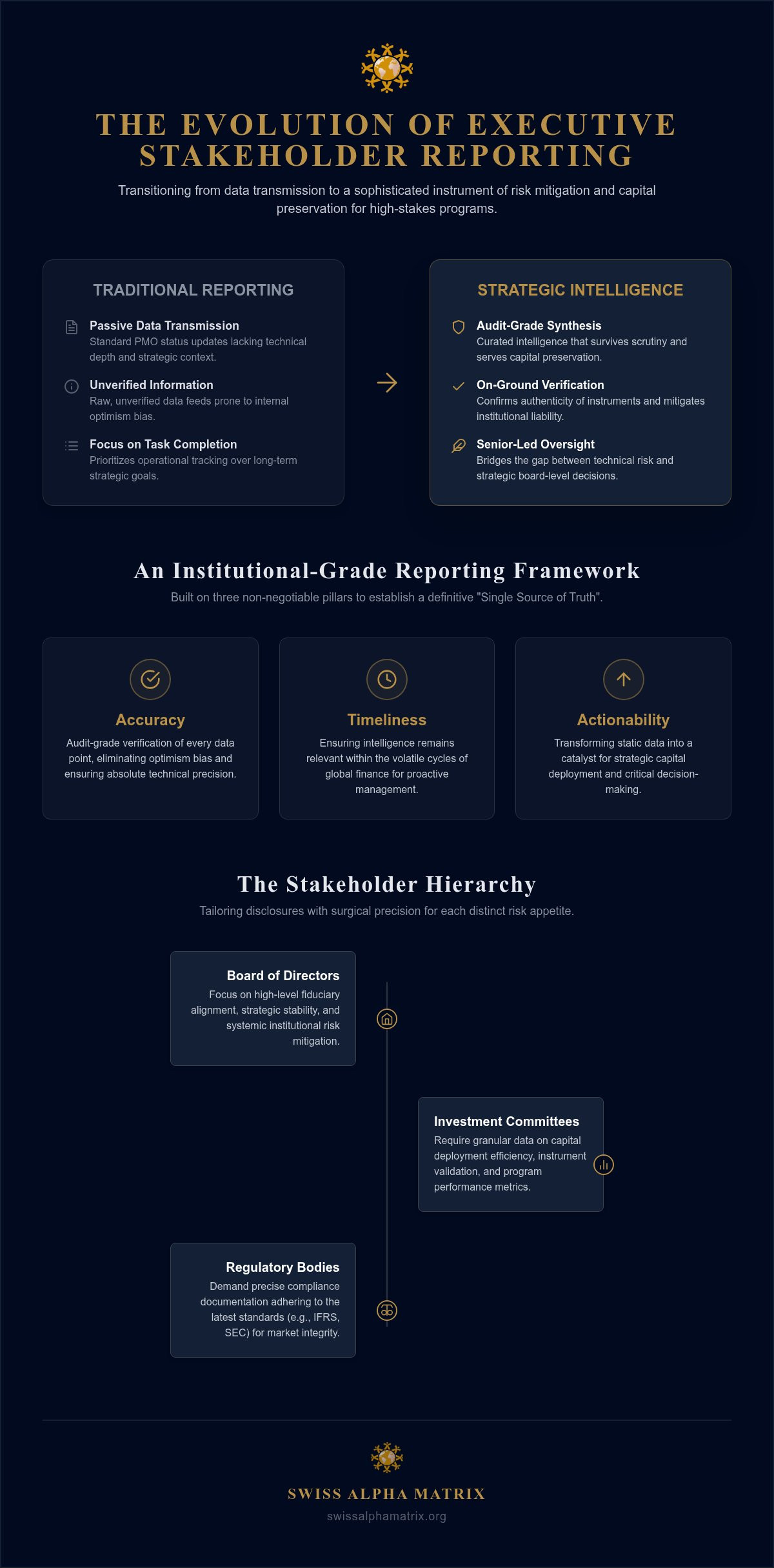
Executive stakeholder reporting has transitioned from a routine administrative necessity into a rigorous, risk-mitigation discipline. In the current financial environment, defined by the 2026 IFRS amendments and the SEC’s proposed overhaul of filer status thresholds, the demand for transparency has reached an institutional peak. Traditional Project Management Office (PMO) status updates, while useful for internal operational tracking, typically lack the technical depth required for high-stakes financial oversight. True oversight necessitates the synthesis of disparate project data into audit-grade strategic intelligence, a process that prioritizes the long-term preservation of capital over mere task completion. By aligning with evolving international financial regulations, organizations can transform their reporting into a protective shield against both personal and institutional fiduciary liability.
From Data Transmission to Strategic Intelligence
Senior leaders don’t require more data; they require more sophisticated synthesis. The modern executive suite is frequently overwhelmed by raw data feeds that lack the necessary context to drive critical capital deployment decisions. High-level executive stakeholder reporting now centers on predictive risk modeling, where technical financial indicators are translated into strategic impact assessments. Establishing an “Audit-Grade” standard ensures that every figure within a report has been subjected to rigorous validation, providing a level of reliability that matches the traditional discretion of private wealth management. This shift moves the conversation from what has happened to what is likely to occur, allowing for a proactive rather than reactive management style that mirrors the precision of a master planner.
The Stakeholder Hierarchy in Complex Transactions
Effective communication requires a nuanced understanding of the corporate stakeholder hierarchy. Each tier of the organization, from the Board of Directors to specialized Investment Committees and external regulatory bodies, possesses distinct information requirements and specific risk appetites that must be addressed with surgical precision.
- The Board of Directors: Focuses on high-level fiduciary alignment, long-term strategic stability, and the mitigation of systemic institutional risk.
- Investment Committees: Require granular data regarding capital deployment efficiency, instrument validation, and the immediate performance metrics of complex programs.
- Regulatory Bodies: Demand precise compliance documentation that adheres to the latest reporting standards to ensure market integrity.
Tailoring the granularity of disclosures based on a stakeholder’s proximity to capital deployment ensures that reporting remains relevant without becoming cumbersome or distracting. Executive reporting is the bridge between operational complexity and fiduciary clarity.
Architecting an Institutional-Grade Reporting Framework
Architecting a framework for executive stakeholder reporting requires a departure from standard administrative updates, favoring instead a rigorous methodology grounded in three non-negotiable pillars: accuracy, timeliness, and actionability. Accuracy, in this context, implies an audit-grade verification of every data point to eliminate the inherent optimism bias often found in internal project narratives. Timeliness ensures that intelligence remains relevant within the volatile cycles of global finance, while actionability transforms static data into a catalyst for strategic capital deployment. By integrating financial discipline with Swiss precision, an organization can establish a definitive “Single Source of Truth” that serves as the bedrock for all institutional disclosures. Maintaining this integrity frequently necessitates independent financial project management, as third-party oversight provides the unemotional distance required to challenge unverified assumptions. The transition from qualitative narratives to quantitative performance metrics is essential for providing the intellectual depth that sophisticated stakeholders demand. If you require assistance in establishing these rigorous standards, exploring specialised risk management frameworks can ensure your reporting remains beyond reproach.
The Deliverable Review Matrix
A robust deliverable review matrix functions as a protective gatekeeper, validating every project milestone against predefined, audit-grade criteria before it reaches the executive level. This structure ensures that reporting reflects actual progress, effectively stripping away the “green-status” veneers that often mask underlying technical risks. Senior-level oversight plays a pivotal role here. Seasoned experts can identify the subtle nuances in deliverable quality that automated systems or junior staff might overlook, ensuring that the documentation survives the scrutiny of rigorous due diligence. This process mirrors the traditional discretion of private wealth management, prioritizing long-term preservation over short-term speculation.
Frequency and Format: Striking the Executive Balance
Striking the balance between depth and brevity is a hallmark of elite executive stakeholder reporting. For multi-year financial programs, the optimal cadence typically involves monthly strategic syntheses supplemented by quarterly deep dives into regulatory and counterparty exposure. The executive summary remains the primary vehicle for high-level decision support, distilling complex dynamics into a logical, measured narrative. Utilizing visual risk heatmaps further enhances this process, allowing stakeholders to perceive complex counterparty threats and jurisdictional risks at a glance, fostering a sense of inevitable logic and professional calm.
Integrating Instrument Validation and On-Ground Verification
The primary objection raised by seasoned executives when reviewing complex program data centers on a single, fundamental question: how can we be certain that the underlying financial instruments are authentic? In an era where digital sophistication has made financial fraud increasingly difficult to detect through traditional audits, executive stakeholder reporting must incorporate a layer of physical, on-ground verification to maintain its institutional credibility. This process moves beyond the mere review of electronic trails, necessitating the integration of bank instrument validation services directly into the reporting cycle. By positioning the final report as the culmination of an exhaustive, senior-led due diligence process, a master planner ensures that every capital deployment decision is defended by a bedrock of verified truth rather than optimistic assumptions. Reporting, in this context, serves as the final layer of a deep-dive discipline designed to protect capital from the inherent risks of cross-border transactions.
Verifying the Unverifiable
Validating Standby Letters of Credit (SBLCs), Letters of Credit (LCs), and other complex instruments requires more than a cursory glance at a SWIFT message. Digital trails are insufficient. While electronic communication protocols offer a baseline of security, they often fail to capture the nuances of jurisdictional risk or the moral character of the counterparty involved. Our methodology incorporates physical, on-ground confirmation to ensure that the instruments presented in the monthly stakeholder pack are not only legally binding but also liquid and accessible. This audit-grade approach provides the intellectual depth necessary for stakeholders to proceed with confidence, knowing that the documentation has been vetted by seasoned experts who prioritize long-term preservation over speculative speed.
Operational Due Diligence as a Reporting Feed
On-site investigations provide the raw intelligence that informs the risk assessment section of every high-stakes report. These investigations allow for the detection of operational red flags, such as inconsistencies in site management or discrepancies in local regulatory filings, which are then translated into specific financial impact projections. This level of detail ensures that executive stakeholder reporting remains a dynamic tool for decision-making rather than a static record of past events. It creates a sense of professional calm by demonstrating that the interests of the institution are in the hands of unemotional experts who value regional precision. In cross-border finance, a report is only as credible as the physical verification that supports it.
Managing Stakeholder Dynamics in Cross-Border Projects
Managing executive stakeholder reporting across disparate international jurisdictions introduces a unique set of complexities that demand a heightened level of strategic precision. Each sovereign territory brings its own regulatory nuances and institutional expectations, requiring a reporting framework that is both flexible and uncompromisingly accurate. The integration of cross-border investment due diligence into the communication stream ensures that stakeholders are apprised of local risks before they manifest as institutional liabilities. Diverse cultural and institutional standards can often lead to misaligned expectations, making it essential to move with a measured, steady pace that fosters trust among all parties involved. This deliberate complexity serves to demonstrate intellectual depth and a refusal to oversimplify dynamics, catering to a sophisticated audience that values regional precision. Establishing a standard of service that is both broad in reach and meticulous in its attention to detail remains the only viable path for protecting interests in the global theater.
The RACI Model for Executive Clarity
Ambiguity is the primary catalyst for failure in high-stakes capital protection. By defining precisely who is Responsible, Accountable, Consulted, and Informed within the reporting chain, a master planner eliminates the friction inherent in global deal-making. This structured approach prevents reporting bottlenecks, particularly in complex M&A scenarios where multiple entities must coordinate on capital deployment decisions. When ownership is clearly established, the decision-making process gains an inevitable logic that encourages confidence among elite stakeholders. It’s a method that ensures interests are in the hands of seasoned, unemotional experts who prioritize long-term preservation over speculative speed, providing the fiduciary clarity necessary for complex transactions.
Navigating Regulatory Reporting Requirements
Institutional mandates, such as Form PF filings and Anti-Money Laundering (AML) protocols, must be seamlessly integrated into the stakeholder reporting cycle to ensure full compliance without compromising technical accuracy. Independent advisory plays a critical role here, providing the objective perspective that regulators require while maintaining the Swiss-level discretion that high-net-worth individuals and institutional entities value. Fulfilling global transparency obligations doesn’t necessitate the oversimplification of complex dynamics; rather, it requires a sophisticated synthesis of data that demonstrates intellectual depth. This level of professional competence distinguishes a performance-oriented mindset from passive participants in the global market. To ensure your global projects meet these exacting standards, our regulatory compliance advisory provides the senior-led precision necessary for complex financial oversight.
The Swiss Alpha Matrix Approach: Senior-Led Precision
Swiss Alpha Matrix represents a pinnacle of discretion and technical accuracy in the field of high-stakes financial oversight. By positioning executive stakeholder reporting as a strategic asset rather than an administrative burden, the firm allows institutional partners to operate with a sense of professional calm. Our leadership, composed of former senior executives from Tier-1 global banks, brings a level of intellectual depth that mass-market providers cannot replicate. This senior-led approach ensures that every report is a synthesis of verified intelligence, merging rigorous financial discipline with the absolute necessity of on-ground verification. We don’t merely transmit data; we curate the strategic intelligence required to protect interests in an increasingly volatile global landscape.
Boutique Advisory vs. Mass-Market PMO
Complex transactions, particularly those involving cross-border capital deployment, require the nuanced touch of seasoned financial veterans who understand the subtle indicators of risk. Unlike mass-market Project Management Offices (PMOs) that often rely on templated updates and junior-level oversight, a boutique advisory focuses on hyper-personalization and regional precision. We utilize fixed-fee or milestone-based structures to ensure our interests are perfectly aligned with the long-term preservation of your capital. This transparency eliminates the conflict of interest often found in commission-heavy environments, ensuring that every decision is anchored in absolute precision. It’s an elite standard of service that caters to a specific caliber of audience valuing nuance and thoroughness.
The Path to Fiduciary Certainty
Engaging with an independent partner for audit-grade instrument validation provides a level of fiduciary certainty that protects both personal and institutional liability. A retainer-based strategic consulting relationship offers ongoing access to elite master planners who act as protective authorities over your most complex programs. This partnership ensures that your executive stakeholder reporting survives the most rigorous external audits while providing the strategic impact necessary for institutional growth. By merging modern strategies with concepts of regional excellence, we ensure that your methodology is as logical as it is unwavering. Explore our Complex Project Management services at Swiss Alpha Matrix to begin establishing a new standard of institutional transparency and capital protection.
Securing Fiduciary Clarity in a Volatile Global Market
The transition from passive data aggregation to the synthesis of strategic intelligence is the hallmark of sophisticated capital protection. By establishing a framework that prioritizes audit-grade instrument validation and on-ground verification, institutional leaders ensure their decisions are anchored in reality rather than optimistic projections. This rigorous discipline in executive stakeholder reporting effectively mitigates personal and institutional liability while fostering a sense of professional calm across complex, cross-border transactions. It’s a methodology that demands the nuanced touch of seasoned veterans who understand the intricate relationship between operational transparency and fiduciary duty.
To achieve this level of institutional transparency, you require a partner that mirrors the traditional discretion of high-end private wealth management. Secure your capital with Swiss Alpha Matrix independent advisory to leverage decades of experience from former Tier-1 global bank executives. Our firm delivers global reach with Swiss precision, ensuring your interests remain in the hands of master planners dedicated to long-term preservation and strategic growth. We invite you to embrace a standard of service that is as logical as it is unwavering.
Frequently Asked Questions
What are the key components of an executive stakeholder report?
An institutional-grade report comprises a high-level executive summary, quantitative performance metrics, and a visual risk heatmap that identifies complex counterparty threats. It must also include verified status updates on financial instruments and jurisdictional risk assessments. These components provide the intellectual depth required for senior leaders to make informed capital deployment decisions with absolute precision and professional calm.
How does audit-grade instrument validation improve stakeholder trust?
Validation improves trust by eliminating the inherent risks of digital financial fraud through direct, senior-led confirmation of instrument authenticity. When stakeholders see that SBLCs or other complex instruments have been vetted by seasoned experts, it creates an underlying current of stability. This process ensures that every strategic disclosure is anchored in verified truth rather than unverified electronic trails.
What is the difference between a project status update and executive reporting?
Traditional status updates focus on administrative task completion and internal operational tracking. In contrast, executive stakeholder reporting synthesizes disparate project data into strategic intelligence designed for fiduciary clarity. It prioritizes the long-term preservation of capital and provides a measured, logical narrative that addresses the specific concerns of the Board and Investment Committees.
How can on-ground verification be integrated into monthly reporting cycles?
On-ground verification is integrated by using on-site investigations as a primary intelligence feed for the risk assessment section of the monthly pack. These physical investigations allow for the detection of regional red flags that are then translated into financial impact projections. This ensures that the report reflects the physical reality of cross-border projects rather than relying on optimistic projections.
Why is independent oversight critical for cross-border financial projects?
Independent oversight provides the unemotional distance necessary to challenge unverified assumptions and identify jurisdictional risks that internal teams might overlook. In complex global deals, an independent advisor acts as a master planner, ensuring that reporting remains objective and beyond reproach. This senior-led oversight is essential for mitigating personal and institutional liability in high-stakes environments.
How does a RACI matrix improve stakeholder management in global deals?
A RACI matrix improves management by eliminating ambiguity through the clear definition of who is responsible, accountable, consulted, and informed. In the context of global transactions, this structure prevents reporting bottlenecks and ensures that capital deployment decisions follow a steady, logical path. It provides the elite level of clarity necessary to coordinate multiple entities across diverse jurisdictions.
What role does regulatory compliance play in executive stakeholder reporting?
Regulatory compliance ensures that executive stakeholder reporting aligns with institutional mandates such as Form PF, AML protocols, and the latest IFRS amendments. By integrating these requirements into the reporting framework, an organization fulfills its global transparency obligations without oversimplifying complex dynamics. This alignment protects the institution from fiduciary exposure while demonstrating a high level of professional competence to regulators.
How can I ensure my reporting framework satisfies institutional-grade requirements?
Ensuring your framework meets institutional standards requires adopting a methodology grounded in Swiss levels of precision and audit-grade validation. Every data point must be technically accurate and subjected to senior-level synthesis before being presented to the C-suite. Moving from broad philosophical principles to specific strategic pillars allows for a structured argument that encourages confidence in the decision-making process.