

A merger preserves operational stability only when continuity is built into the integration, not treated as a separate exercise. Ensuring business continuity during a merger means assessing recovery capability before closing, protecting critical records and operations, and setting clear interim controls while systems and teams change. The work is complete only when both organizations can operate within one coherent continuity program.
Deal milestones, systems migration, and expected synergies naturally draw attention first. Yet disruption often occurs at the handoffs: unclear ownership, undocumented processes, incompatible recovery plans, or employees unsure how procedures have changed. A disciplined approach makes these dependencies visible and assigns responsibility before they threaten service delivery.
This guide explains how to assess continuity plans, testing history, risks, and recovery objectives; protect operational and financial records; and communicate changes to employees and other stakeholders. It also covers interim safeguards and how to bring incident reporting, escalation routes, and recovery steps into a dependable shared framework. The aim is a measured transition in which essential operations remain understood, accountable, and recoverable as the combined business takes shape.
Key Takeaways
- Communicate changes to continuity procedures clearly, keeping employees and key stakeholders informed about the transition’s objectives and responsibilities.
- Assess recovery plans, testing history, incident records, dependencies, and recovery objectives as part of continuity due diligence.
- Document essential processes, key roles, customer information, and recurring obligations so critical operations remain understood through the transition.
- Use interim safeguards and clear decision-making routes to manage operational and technology changes without losing sight of service continuity.
- Bring continuity information into a shared framework with consistent incident reporting, escalation paths, and recovery steps.
1. Communicating with employees and stakeholders
Communication should begin once the acquisition contract is signed, when significant continuity risks may emerge. Explain the deal’s rationale, intended operating changes, and decisions that remain unresolved. Employees need to know which procedures continue, which change, and where to report interruptions. A concise transition brief can identify accountable managers, approved communication channels, and the next update, giving staff a practical reference rather than leaving them to rely on informal interpretations.
Set a predictable cadence for updates, then tailor messages to each audience. Employees need role-specific instructions; customers and suppliers need clarity about service contacts, delivery arrangements, and existing commitments. Managers should explain objectives without presenting expected synergies as completed outcomes. If a merger may change invoice processing, for example, state the current submission route and how to report errors. Consistent reporting helps leaders detect confusion early.
Retaining experienced employees also supports continuity: they hold operational knowledge and customer relationships. Identify roles whose vacancies could interrupt essential work, then arrange direct conversations with those employees and their managers. Explain responsibilities, decision rights, and the expected transition sequence. Where appropriate, incentive compensation or stay bonuses can form part of a retention plan. Track potential departures and knowledge-transfer gaps in management reporting rather than treating retention as a separate HR concern.
Employee resilience depends on clear procedures, accessible managers, and practical safety communication. Before changing a worksite, system, or reporting line, explain how employees should raise hazards, incidents, or access problems. Provide role-specific training on revised procedures, including escalation contacts and temporary operating safeguards. A short scenario exercise can test whether employees know whom to notify during a disruption. Managers should also make room for questions about workload, uncertainty, and support needs.
Build communication into an integration roadmap from Day One through the first 100 days, with staged deliverables and named owners. At each stage, specify what employees must know, what managers must confirm, and how unresolved issues reach leadership. Owners and senior managers should remain involved in these discussions; visible participation helps retain trust and preserve operating knowledge. A missed update can create avoidable failure when teams act on conflicting instructions.
Keep stakeholder messages aligned with operational readiness. Assign one accountable lead to reconcile updates from both organizations, maintain a decision record, and correct inconsistent instructions. For customers, communicate transition details once service arrangements are settled, including any new contact or process. For employees, reinforce procedural changes through team briefings and written guidance. These steps link communication to execution and make continuity responsibilities visible across the combined business.
2. Continuity due diligence and recovery capability assessment
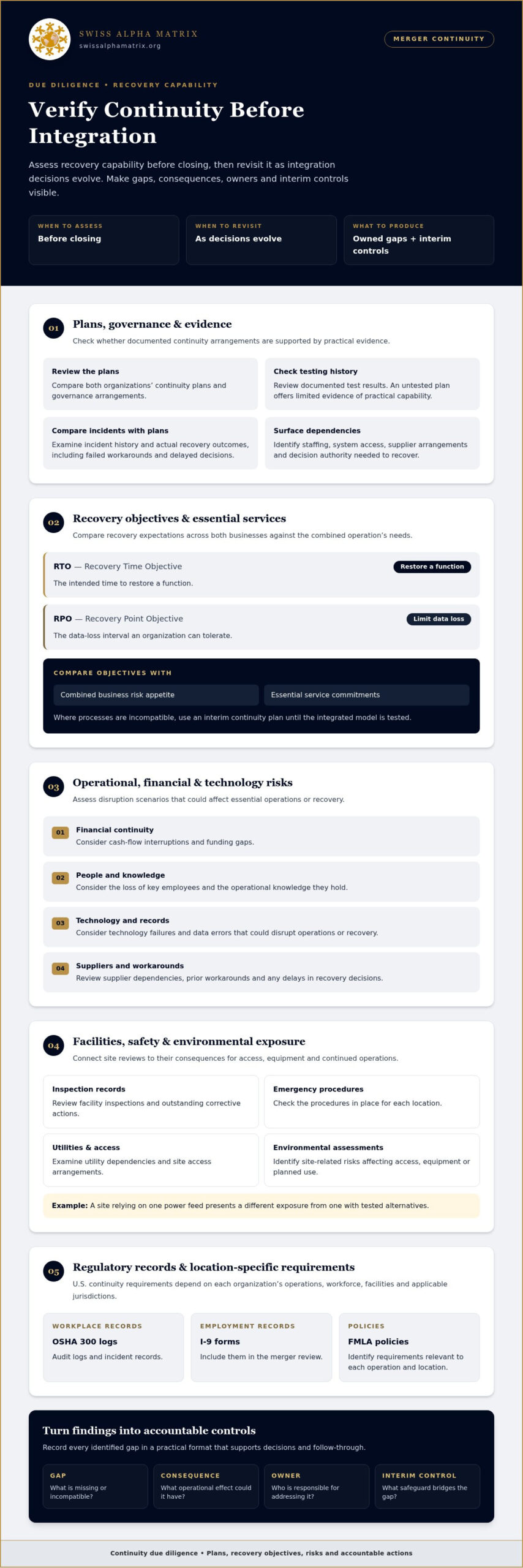
Begin continuity due diligence before closing, then repeat the assessment as integration decisions evolve. Review each organization’s plans, governance, incident history, recovery objectives, and documented test results. An untested plan offers limited evidence of practical capability. Compare planned recovery with actual outcomes from previous incidents, including failed workarounds and delayed decisions. Record each gap, its operational consequence, its owner, and the interim control required.
U.S. regulatory requirements affecting continuity depend on the organizations’ operations, workforce, facilities, and applicable jurisdictions. During the merger review, audit OSHA 300 logs and incident records, I-9 forms, and FMLA policies, while identifying the requirements relevant to each operation and location.
Assess recovery time objectives (RTOs) and recovery point objectives (RPOs) across both businesses. RTO describes the intended time to restore a function; RPO concerns the data-loss interval an organization can tolerate. Compare these objectives with the combined business’s risk appetite and essential service commitments. If one company expects faster recovery, identify the staffing, system access, supplier arrangements, and decision authority needed to achieve it. Use an interim continuity plan to bridge incompatible processes until the integrated model is tested.
Connect facility and environmental reviews to continuity consequences. Examine inspection records, emergency procedures, utility dependencies, access arrangements, and outstanding corrective actions at each location. A site relying on one power feed, for example, presents a different exposure from one with tested alternatives. Record the responsible owner and the action needed to preserve operations. Environmental assessments can also identify site-related risks affecting access, equipment, or planned use.
Risk assessments should cover disruption scenarios across operations and finances. Consider cash-flow interruptions, funding gaps, loss of key employees, technology failures, data errors, supplier dependencies, customer dissatisfaction, and resistance to new procedures. Compare each risk by likelihood, business impact, existing controls, and recovery options. Review both organizations’ safety cultures through incident reporting practices, training records, employee feedback, and management response. Where requirements differ, adopting the higher standard across both organizations can simplify security and compliance policies.
Track integration performance through measurable indicators, including recovery-test results, unresolved continuity gaps, incident frequency, time to escalate, service interruptions, and completion of corrective actions. Compare actual recovery with each function’s RTO and data restoration with its RPO. These measures reveal whether controls work in practice, not merely whether plans exist. Regular reassessment matters because system changes, role transfers, and supplier decisions can alter dependencies. For complex reviews, operational due diligence can help structure the examination of risks, controls, and readiness.
3. Strengthening operations and financial records
Start by identifying essential operations and the people, records, and systems they depend on. Build a process inventory naming accountable owners, substitutes, critical inputs, and customer-facing outputs. Document client histories, pricing agreements, recurring expenses, approval paths, and key supplier dependencies. For example, record how an urgent customer request moves from intake to delivery, including who can resolve an exception. This makes operational knowledge usable beyond individual owners or teams.
Reconcile financial and operational records before combining reporting structures. Establish consistent definitions for revenue, obligations, recurring costs, open commitments, and service performance. Keep source records traceable to the transactions or systems that created them, and document who can approve changes. A shared view of cash-flow dependencies can reveal timing risks, such as an essential supplier payment falling due before a planned funding transfer. Assign an owner to each unresolved discrepancy and track its operational effect.
There is no single standard cost for merger integration and continuity planning; the price depends on the case and is given after a quote request, with cost factors including deal complexity, operational scope, systems changes, geographic footprint, and testing requirements.
A merger or acquisition plan should also establish what happens if the transaction fails or integration objectives cannot be achieved. Define which operations must remain separable, who controls critical records, and how each organization could restore its prior arrangements. Map shared suppliers, systems, staff, and customer commitments that could complicate separation. This contingency planning helps leaders identify dependencies before they obstruct orderly operations.
Protect customer continuity by mapping each important service from request to completion. Identify the teams, records, systems, and suppliers supporting each commitment, then note where a transition could delay delivery or change a contact route. Preserve agreed service levels during integration. If two teams use different complaint-handling processes, for example, designate the interim process and escalation owner before combining workflows.
To create the plan, begin with a joint business impact analysis, then rank essential activities by the consequences of interruption. Assign accountable owners, document recovery actions, and set milestones for the integration team. The plan should connect operational priorities with funding, staffing, data access, and supplier arrangements. A staged activity plan from Day One to the first 100 days gives leaders a structure for monitoring deliverables and resolving gaps.
Include alternative operating plans for critical activities, with clear activation criteria and return-to-normal steps. A backup process might route orders through a separate team when a primary system is unavailable; its instructions should identify required records, approvals, and customer communication. Test alternatives through exercises, record failures and corrective actions, and update plans when roles or dependencies change. This makes continuity an operating discipline, not a document prepared only for the transaction.
4. Communications, operational structure, and systems
Day One planning should connect communications, operational structure, systems, and controls. Define who owns each critical decision, how teams escalate incidents, and which executive can authorize a workaround. If a payment platform becomes unavailable during migration, for example, staff need a clear process for suspending affected transactions and notifying accountable leaders. Document authority before integration begins so teams can act without waiting for conflicting approvals.
Prioritize the functions and systems that protect essential services, customer transactions, financial processing, employee access, and incident response. Rank them by their effect on the organization’s mission, customer commitments, and ability to recover. A customer-support platform, for example, may depend on identity systems, case records, and telephony. Assess that chain together rather than treating each application as an isolated asset.
Before combining technology environments, build an accurate, normalized network map for both organizations. Identify devices, data paths, configurations, application dependencies, and security controls. Compare the maps to detect overlapping address ranges, incompatible configurations, or routes that could expose production systems. Manual documentation can take a full network team months or years, depending on network complexity, so prioritize accurate records for critical paths first.
Use the maps to distinguish systems that should remain isolated from those ready to connect. IT teams can identify critical network and application paths to preserve, then document potential connection points and required controls. During consolidation, retain interim safeguards such as parallel systems, rollback plans, or enhanced monitoring. For example, keep a legacy workflow available until the replacement completes transaction testing and responsible owners approve migration.
Communication should reflect the operating model. Give employees a single reference for revised reporting lines, incident contacts, system access procedures, and service responsibilities. Anyone encountering a failed login should know whether to contact local support or the integration help route. Keep messages consistent across organizational levels, and preserve the acquired business’s identity where it supports customer relationships or established operating practices.
Structure integration governance around regular reporting, reviews against strategic objectives, and feedback from operating teams. A shared platform can track decisions, dependencies, risks, and deliverables more reliably than scattered emails and static spreadsheets. It should show owners and current status, helping leaders spot stalled approvals or unresolved system conflicts. Include operational managers in reviews so reported progress reflects actual service conditions.
Protect the handoff from deal team to integration team with a concise record of deal strategy, objectives, assumptions, and critical dependencies. An incomplete transfer can leave integration staff unclear about priorities, wasting resources or overlooking essential issues. On Day One, confirm system ownership, escalation routes, and customer-facing responsibilities. Review these controls as milestones advance, updating access, communications, and rollback procedures whenever the operating structure changes.
5. Consolidation of business continuity programs
Consolidation should create one workable framework, not simply select one organization’s existing plan. Compare governance, plan ownership, incident definitions, escalation routes, recovery steps, and reporting practices. Record where the programs align and where they conflict. One organization may classify a technology outage as an incident, while the other treats it as a service issue. Agreeing on shared definitions helps teams assess events consistently.
Establish a single source of truth for continuity plans, incident records, dependencies, decisions, and corrective actions. Assign an owner to maintain each record, control revisions, and communicate approved changes. Employees and response teams should be able to identify the current procedure without comparing conflicting files. A shared register can link each critical service to its owner, recovery instructions, escalation route, and latest test result.
Next, implement a common incident reporting process for both organizations. Specify what employees report, where the report goes, who assesses severity, and which decision-maker authorizes recovery actions. A practical workflow might move from initial notification to impact assessment, escalation, response, and documented closure. Preserve details needed for follow-up, including affected operations, decisions, service impact, and outstanding corrective work.
Align the combined framework with regulatory and operational requirements applicable to each business. Compare the controls, records, reporting duties, and approval processes used across relevant operations. Where requirements differ, adopting the higher standard across both organizations can simplify security and compliance policies. Document the rationale for each common control, while retaining distinct procedures where locations or business activities require different responses.
Prepare a controlled transition instead of replacing both programs at once. Keep necessary interim procedures active until owners have tested the combined process and resolved critical gaps. Use tabletop exercises to examine realistic scenarios, such as unavailable customer records or a disrupted supplier service. Record decisions, escalation delays, unclear roles, and missed recovery steps. Assign corrective actions and update the shared framework before retiring superseded procedures.
Governance should make integration progress visible from Day One to the first 100 days, with staged deliverables, accountable owners, and regular reviews. Track open gaps, incidents, test outcomes, and overdue corrective actions in the shared source of truth. Leadership can then distinguish completed integration work from unresolved exposure. A successful consolidation preserves operationally effective practices while removing duplication and clarifying accountability. For a structured review of compliance considerations, engage regulatory compliance advisory as the combined framework takes shape.
Swiss Alpha Matrix: Audit-Grade Instrument Validation
Swiss Alpha Matrix supports merger stakeholders who need independent scrutiny of financial instruments, operational dependencies, or implementation risks. Its Audit-Grade Instrument Validation can assess instruments as part of transaction review, while Operational Due Diligence examines operational exposures relevant to continuity planning. For integration involving multiple stakeholders and dependencies, Complex Project Management provides structured execution support.
These services are particularly relevant when decision-makers need evidence-based assessment before integrating critical processes or relying on complex instruments. They complement internal continuity planning with focused validation and operational review of defined areas of exposure.
To discuss your merger requirements, contact Swiss Alpha Matrix.
Make continuity part of the merger’s long-term governance
Closing a transaction marks a handover, not the end of continuity planning. The combined organization’s governance should keep operational resilience visible as leadership priorities, dependencies, and integration decisions evolve. Assign an executive owner to review whether continuity controls remain aligned with the business’s strategic direction, and include unresolved issues in routine oversight. This discipline helps make business continuity during a merger an enduring management capability, not a temporary integration task.
Where independent review or coordinated execution would strengthen the work, Swiss Alpha Matrix offers Audit-Grade Instrument Validation, On-Ground Verification Services, and Complex Project Management. These capabilities support stakeholders assessing instruments, verifying operational conditions, or managing complex workstreams. Their contribution depends on the transaction’s requirements and defined scope of work.
Contact Swiss Alpha Matrix today to discuss your merger requirements. A considered next step can help your organization carry continuity priorities into its next phase of growth.
Frequently Asked Questions
What are the key steps to maintain business continuity during a merger?
Start by assigning an executive accountable for continuity decisions, then connect that authority to operational leaders who can act during disruption. Ensuring business continuity during a merger also requires a decision log: record each unresolved dependency, its owner, the interim measure, and the condition for closure. Review the log at integration meetings so exceptions remain visible rather than disappearing into separate workstreams.
How can companies minimize customer disruption and retain customers during a merger?
Protect the customer experience by identifying accounts that depend on specialized knowledge, bespoke delivery, or a single relationship manager. Assign a named successor for each relationship before responsibilities shift, and preserve access to relevant service history and commitments. If a customer raises a concern, route it to an owner empowered to coordinate across both organizations. This prevents customers from repeating their situation to multiple teams or receiving conflicting answers.
How should leaders communicate merger changes to employees, customers, and suppliers?
Use one approved message framework, then adapt practical details for each audience. Employees need to understand changes to authority and daily work; customers need clarity on service ownership; suppliers need accurate ordering, invoicing, and payment contacts. If purchasing approval moves to a new team, for example, communicate the effective process and escalation contact together. Keep a record of messages so managers can promptly correct inconsistent guidance.
How can companies manage employee retention and workforce changes during a merger?
Manage retention by identifying roles where a departure could interrupt service, remove scarce expertise, or weaken key customer relationships. Hold individual discussions with affected employees, explain what is decided, and distinguish those decisions from matters still under review. Pair knowledge holders with colleagues who can assume critical responsibilities, and capture essential procedures in accessible records. Stay bonuses or incentive compensation may support retention where appropriate to the transition plan.
What are the main operational, financial, cybersecurity, and compliance risks during a merger?
Key risks include interrupted essential work, cash-flow or funding gaps, loss of expertise, customer dissatisfaction, data exposure, technology failure, and incompatible controls. Assess cybersecurity exposure by mapping sensitive data, system access, third-party connections, and recovery dependencies across both organizations. Prioritize remediation according to potential business impact, assign an accountable owner, and track unresolved issues through integration governance. This keeps cyber risk visible alongside operational and financial exposure.
How should companies integrate IT systems and protect data during a merger?
Integrate systems in controlled stages, beginning with documented ownership, access permissions, data flows, and critical application dependencies. Before transferring records, define who can authorize access, how integrity will be tested, and how teams will respond to errors. For instance, reconcile a sample of migrated customer records against the source system before changing the primary workflow. Set explicit rollback criteria and retain monitoring until the new environment performs as intended.