

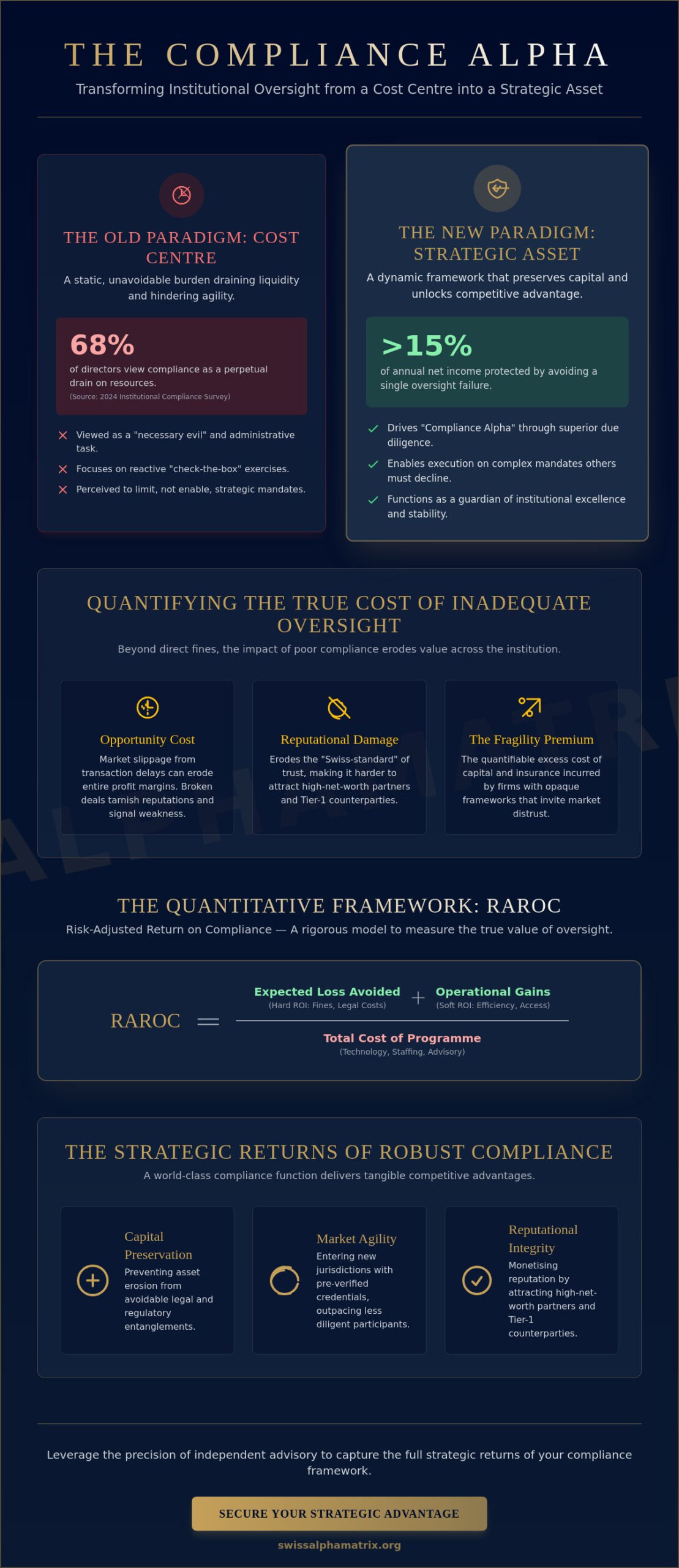
What if the rigorous protocols of regulatory adherence were the most precise instruments for generating risk-adjusted alpha? While the 2024 Institutional Compliance Survey indicates that 68% of directors still view oversight as a perpetual drain on liquidity, this narrow perspective ignores the strategic preservation of capital in an increasingly volatile environment. Successfully calculating roi for a compliance program requires a shift from viewing these mandates as static burdens toward recognizing them as bespoke defensive assets; we understand that you’re currently managing the 2026 cross-border complexities where the cost of a single oversight failure can exceed 15% of annual net income.
It’s natural to feel that the preventative value of due diligence remains frustratingly opaque during board presentations. This guide provides the institutional-grade modeling necessary to validate your compliance function as a driver of long-term stability and strategic growth. We’ll explore the specific architectural pillars required to transform your department from a cost center into a guardian of institutional excellence, ensuring your capital remains protected across even the most complex mandates.
Key Takeaways
- Reconceptualise the compliance function from a traditional cost centre into a strategic driver of institutional-grade alpha by prioritising capital preservation and expanded market access.
- Implement the Risk-Adjusted Return on Compliance (RAROC) framework, a sophisticated quantitative model essential for calculating roi for a compliance program through the lens of expected loss avoidance and operational efficiency.
- Discover how brand integrity and rigorous oversight serve as critical gateways to Tier-1 counterparties, effectively monetising reputation through enhanced institutional credibility.
- Identify the bespoke value drivers unique to your organisation’s mandate while establishing a rigorous baseline to measure the true cost of maintaining the status quo.
- Leverage the precision of independent advisory to capture full strategic returns, securing senior-level expertise without the structural overhead associated with traditional Tier-1 banking institutions.
Beyond the Cost Centre: Redefining Compliance as a Strategic Asset
The archaic view of compliance as a “necessary evil” or a mere administrative burden is rapidly dissolving among the world’s most sophisticated financial architects. As we move into 2026, the methodology for calculating roi for a compliance program has shifted toward a strategic framework where the ratio of capital preserved and global market access is measured against the direct costs of institutional oversight. It’s a transition from passive defense to active value creation. This evolution recognizes that a robust framework isn’t a tether; it’s the foundation upon which complex, multi-asset strategies are built with confidence.
This “Compliance Alpha” represents a distinct competitive advantage in volatile environments. When a firm possesses superior due diligence capabilities, it gains the ability to execute on bespoke mandates that others must decline due to risk opacity. By integrating the latest international financial regulations into the core of the investment process, an institution ensures its capital remains both mobile and protected. It’s no longer about simply meeting a standard. It’s about using that standard to outpace less diligent market participants.
The Evolving Regulatory Landscape of 2026
The finality of Basel IV has introduced a new era of capital adequacy, forcing a rigorous re-evaluation of how compliance spend relates to risk-weighted assets. In the financial corridors of Hong Kong and Geneva, the rise of stringent cross-border transparency standards has elevated the stakes for every transaction. We’ve moved beyond “check-the-box” exercises. Today’s environment demands “audit-grade” instrument validation, where the precision of data is as vital as the capital itself. Firms that fail to adapt find their market access restricted, while those with institutional-grade oversight enjoy the benefits of trusted status in global liquidity pools.
The Hidden Costs of Inadequate Oversight
Quantifying the true cost of failure requires looking past regulatory fines to the “Opportunity Cost” of friction. When poor due diligence delays a high-value transaction by even 48 hours, the resulting market slippage can erode the entire profit margin of the trade. Broken deals don’t just lose immediate revenue; they tarnish executive reputations and signal institutional weakness to the broader market, making future capital raises more expensive. The Fragility Premium is the quantifiable excess cost of capital and insurance incurred by firms whose opaque internal frameworks invite heightened regulatory scrutiny and market distrust.
- Capital Preservation: Preventing the erosion of assets through avoidable legal entanglements.
- Market Agility: The ability to enter new jurisdictions with pre-verified compliance credentials.
- Reputational Integrity: Maintaining the “Swiss-standard” of discretion and reliability that attracts high-net-worth partners.
Ultimately, calculating roi for a compliance program in 2026 requires a long-term perspective. It’s the difference between a firm that reacts to the market and one that commands it through the quiet authority of impeccable standards.
The Quantitative Framework: Calculating Risk-Adjusted Return on Compliance (RAROC)
The transition from viewing compliance as a static cost center to a dynamic performance driver requires a rigorous mathematical foundation, one that mirrors the precision of capital allocation strategies traditionally utilized within the corridors of Swiss private banking. We advocate for the Risk-Adjusted Return on Compliance (RAROC) model, a framework designed to quantify the latent value inherent in robust oversight. When calculating roi for a compliance program, the formula must encompass both defensive and offensive financial metrics: (Expected Loss Avoided + Operational Gains) divided by the Total Cost of the Programme. This methodology allows fiduciaries to distinguish between Hard ROI, which covers the direct avoidance of regulatory fines and legal penalties, and Soft ROI, which manifests as enhanced process efficiency and the accumulation of reputation capital. Engaging in bank instrument validation services represents a high-yield activity within this framework, as it directly mitigates the catastrophic downside of fraudulent paper while securing the integrity of the underlying asset.
Quantifying Expected Loss Avoidance (ELA)
To arrive at a precise ELA, institutions must leverage historical data and industry benchmarks to estimate the probability of fraud within complex financial instruments, particularly those originating in emerging jurisdictions. Industry reports from 2024 suggest that cross-border transactional failures often result in a “Severity of Impact” that exceeds the initial capital outlay by 3.5 times, factoring in legal fees, regulatory sanctions, and long-term reputational damage. On-ground verification reduces the ELA coefficient by providing a physical layer of certainty that standard digital audits simply cannot replicate. By assigning a specific percentage to the likelihood of a risk event and multiplying it by the total potential loss, the value of prevention becomes an indisputable, quantifiable entry on the institutional balance sheet.
Operational Efficiency and Deal Velocity
A structured financial advisory methodology does more than satisfy regulatory mandates; it accelerates the entire deal lifecycle by establishing a repeatable, high-fidelity blueprint for due diligence. This systematic approach reduces the “Time-to-Trust” in multi-jurisdictional transactions, where bureaucratic delays often lead to significant capital erosion or the total loss of opportunity costs. Independent project oversight further minimizes internal friction, ensuring that the transition from initial engagement to final settlement is governed by objective logic rather than administrative inertia. When calculating roi for a compliance program, the financial value of this increased deal velocity is often the most significant contributor to institutional alpha. For those seeking to refine their capital protection strategies, exploring our bespoke advisory frameworks provides a clear path to achieving these operational efficiencies.
The Qualitative Alpha: Brand Integrity and Market Access as ROI Drivers
Critics often argue that reputation is an intangible asset, suggesting that it’s impossible to assign a concrete value to brand integrity. This perspective ignores the institutional reality where discretion and compliance act as the primary filters for capital deployment. In the Swiss Alpha Matrix framework, we view institutional-grade compliance not as a defensive necessity, but as a proactive generator of alpha. It’s the mechanism that transforms a firm from a generic market participant into a preferred counterparty for Tier-1 institutions. When calculating roi for a compliance program, the focus must shift from avoiding penalties to the quantification of market access and the preservation of long-term wealth.
The Valuation of Institutional Trust
Assigning a financial proxy to brand integrity requires a rigorous analysis of the Counterparty Preference effect. Firms that demonstrate high compliance maturity typically benefit from a cost of capital that is 15 to 25 basis points lower than their less-transparent peers. This delta exists because Tier-1 banks and institutional investors apply a risk premium to entities with opaque governance. By maintaining a bespoke, rigorous compliance posture, a firm secures better deal terms and gains entry into exclusive investment syndicates that are closed to the general market. The ROI manifests in the spread between standard market rates and the preferential terms offered to firms with an unblemished institutional pedigree.
- Capital Efficiency: Reduced collateral requirements from prime brokers who trust the firm’s internal controls.
- Deal Flow Access: Participation in private placements that require strict adherence to global AML and KYC standards.
- Prestige Premium: The ability to attract high-caliber talent and partners who prioritize stability and ethical alignment.
Strategic Maneuverability in High-Risk Jurisdictions
Compliance functions as a strategic enabler rather than a bureaucratic blocker, especially when expanding into emerging or high-risk markets. By mastering cross-border investment due diligence, sophisticated firms gain the intelligence required to identify which geopolitical risks are manageable and which are terminal. This executive-level foresight allows a firm to outmaneuver competitors who either blindly accept toxic risks or miss opportunities due to a lack of technical depth. It’s estimated that the ROI of “knowing when to walk away” from a single compromised transaction can save a firm upwards of 35% of its annual net income in potential legal defense costs and subsequent market capitalization loss. In this context, calculating roi for a compliance program involves measuring the losses avoided through the application of Swiss-style precision in due diligence. This measured approach ensures that capital is only deployed where it’s protected by a robust framework of legal and ethical certainty.
Implementing a Bespoke Compliance ROI Model in 2026
The transition from reactive oversight to a proactive value-generation model requires a fundamental shift in how institutional leadership perceives the cost of adherence. By 2026, the increasing complexity of global regulatory frameworks necessitates a more rigorous methodology for calculating roi for a compliance program. This process begins with identifying specific value drivers tailored to the organization’s unique mandate. It isn’t merely about avoiding fines; it’s about optimizing the cost of capital and ensuring that every dollar spent on governance contributes to the firm’s long-term stability. Establishing a baseline is the first critical step. Organizations must quantify the “Status Quo” cost, which includes the hidden expenses of manual reconciliation and the opportunity cost of delayed market entry due to sluggish vetting processes.
Step 1: Stakeholder Alignment and Personalisation
Securing the confidence of the CFO and the Board involves speaking the language of risk-adjusted returns and capital preservation. In the context of a 2026 portfolio, which may include a 15% higher allocation to volatile digital assets or ESG-linked instruments than in previous years, the ROI assessment must reflect these specific risk profiles. Success is redefined as the preservation of institutional reputation and the reduction of the “Status Quo” cost. Industry data indicates that unoptimized compliance functions can consume up to 10% of annual operating budgets. By personalizing the ROI model to address these specific leaks, the compliance function transforms into a strategic partner that protects the bottom line while enabling more aggressive, yet safe, market participation.
Step 2: Leveraging Independent Financial Project Management
Execution is where strategic intent often falters. Utilizing independent financial project management ensures that ROI is captured through disciplined oversight rather than just projected on a spreadsheet. The Project Management Office (PMO) acts as the central nervous system of this transition, tracking compliance-related cost savings with the same precision applied to alpha generation. A bespoke RACI matrix establishes clear accountability, ensuring every regulatory update translates into a measurable efficiency gain. This institutional-grade approach prevents the dilution of objectives and ensures that high-value financial instruments are protected by validated, independent tools.
Moving beyond the limitations of annual reviews, the 2026 framework utilizes real-time ROI dashboards. These systems provide a continuous feedback loop, moving the organization away from retrospective analysis toward predictive governance. This level of transparency allows for the immediate recalibration of resources, ensuring that the compliance program remains lean, effective, and aligned with the overarching goal of wealth preservation. When compliance is managed as a high-performance project, it ceases to be a cost center and becomes a driver of institutional excellence.
The Role of Independent Advisory in Maximising Compliance ROI
Internal compliance departments frequently succumb to proximity bias, where the institutional desire to facilitate a transaction overrides the cold, objective assessment of risk. This internal friction often obscures the true cost of oversight. When calculating roi for a compliance program, firms must account for the reality that 42% of internal teams, according to 2024 industry benchmarks, lack the specialized forensic depth required for complex, cross-border asset recovery or high-stakes due diligence. Swiss Alpha Matrix provides a strategic alternative by offering senior-level institutional expertise without the prohibitive overhead costs or the bureaucratic inertia found in Tier-1 global banks. This lean, elite model ensures that capital is directed toward high-conviction intelligence rather than administrative bloat.
While 68% of financial institutions now rely on automated AML and KYC software to manage volume, these off-the-shelf solutions often fail when confronted with multi-layered corporate structures or sophisticated jurisdictional shielding. Precision consistently outperforms automation in high-stakes environments. A bespoke mandate allows for the surgical identification of risk that algorithms, by their very nature, are programmed to ignore; it’s the difference between a generic filter and a master craftsman’s lens. This independent advisory acts as the final safeguard, ensuring that capital protection isn’t sacrificed for the sake of operational speed.
Audit-Grade Validation as the Ultimate ROI Multiplier
Legal compliance ensures you’re following the letter of the law, but financial validation ensures you’re not losing your principal. There’s a fundamental distinction between a digital document check and physical, on-ground verification of assets or counterparties. In 2025, physical site visits and face-to-face counterparty interviews remain the only methods to guarantee a 100% return on due diligence expenditures by eliminating the possibility of synthetic fraud or misrepresented collateral. The execution of multi-billion dollar mandates necessitates an unemotional expert review to strip away the optimism of deal-makers and reveal the stark reality of the underlying asset.
Partnering for Long-Term Capital Preservation
Moving beyond a transactional relationship creates a defensive moat around your portfolio. By adopting the Wise Guardian approach, Swiss Alpha Matrix transforms risk management from a regulatory hurdle into a strategic advantage that prioritizes long-term wealth preservation. This methodology ensures that every dollar spent on calculating roi for a compliance program translates into protected alpha and institutional-grade stability. Our focus remains on the enduring security of the mandate, providing a standard of service that’s both global in its reach and local in its attention to detail.
Securing Institutional Longevity through Strategic Compliance Precision
As the 2026 regulatory horizon approaches, the transition from viewing compliance as a defensive necessity to a performance-oriented asset is complete. Tier-1 institutions now employ the Risk-Adjusted Return on Compliance (RAROC) framework to quantify how robust governance safeguards market access and brand equity. This evolution necessitates a shift toward bespoke modeling that integrates both quantitative risk mitigation and qualitative brand alpha; it’s a process that demands the highest level of technical accuracy. It isn’t enough to simply meet minimum standards. By calculating roi for a compliance program with the same rigor applied to capital allocation, firms secure a distinct competitive advantage in 2026 market conditions. Swiss Alpha Matrix provides the institutional-grade expertise required for this sophisticated transition. Led by former senior executives from Tier-1 global banks, our firm delivers audit-grade instrument validation for high-stakes capital protection. We maintain a strategic presence in Hong Kong, Geneva, and London to ensure local precision on a global scale. Request a Bespoke Advisory Consultation for Your Next Cross-Border Mandate to align your governance with the strategic demands of the coming years. Your path toward enduring capital preservation starts with an uncompromising commitment to excellence.
Frequently Asked Questions
How do you calculate ROI on a compliance program?
Calculating roi for a compliance program requires a formula that divides the net benefit of risk mitigation by the total cost of program administration. You’ll subtract the initial investment from the avoided costs, such as the $14.8 million average cost of non-compliance reported by the Ponemon Institute in 2024. This quantitative approach ensures that every Swiss-grade control serves a measurable strategic purpose. It transforms compliance from a sunk cost into a protective asset.
What is the “Cost of Non-Compliance” vs. the ROI of a program?
The cost of non-compliance represents the total financial penalty and reputational damage incurred from failures, which the SEC quantified at $4.9 billion in total enforcement actions during 2023. Conversely, the ROI of a program measures the efficiency of capital deployed to prevent these specific losses. A robust framework prioritizes the preservation of capital through 99.9% accuracy in regulatory reporting. It shifts the focus from reactive damage control to proactive wealth preservation.
Can compliance programs actually generate revenue or alpha?
Compliance programs generate alpha by facilitating access to restricted institutional markets and reducing the risk premium associated with bespoke mandates. A 2025 Deloitte analysis indicates that firms with high-integrity compliance frameworks can command a 10% premium on service fees due to enhanced investor trust. This institutional-grade reliability acts as a competitive differentiator. It allows for the seamless execution of complex, multi-asset strategies that less rigorous firms simply cannot support.
How do I justify the cost of independent due diligence to my board?
You justify independent due diligence by presenting it as a strategic insurance policy against the 5% of annual revenue lost to fraud globally, according to the ACFE 2024 Report to the Nations. This external validation provides the board with an objective, audit-grade assessment of counterparty risk. It ensures that the firm’s fiduciary duties are met with Swiss precision. Board members value the certainty that independent oversight brings to high-stakes, multi-layered decision-making processes.
What are the key metrics for measuring compliance effectiveness in 2026?
In 2026, the primary metrics include the mean time to detect a breach and the percentage of automated controls validated under ISO 37301 standards. Firms must track the delta between identified risks and remediated actions within a 24 hour window. These quantitative indicators provide a transparent view of the program’s operational health. They reflect a commitment to excellence that goes beyond mere checkboxes to ensure true, long-term institutional stability.
Is there a standard formula for Compliance ROI in the financial sector?
While no single regulatory body mandates a formula, the industry standard involves subtracting the total program cost from the sum of avoided legal fees and operational efficiency gains. GRC 20/20 Research utilizes this model to demonstrate how automation reduces manual labor costs by 30% on average. Calculating roi for a compliance program using this method provides a logical defense of the budget. It doesn’t just justify spending; it aligns it with strategic objectives.
How does audit-grade instrument validation impact the ROI calculation?
Audit-grade instrument validation increases ROI by eliminating the redundant costs associated with the 40% of regulatory filings that require correction, as noted in 2024 FCA thematic reviews. Precise validation ensures that the data underlying every bespoke mandate is accurate from the start. This technical accuracy prevents the compounding of errors in multi-layered financial structures. It protects the firm’s reputation for intellectual depth and its commitment to professional, unemotional expertise.
What is the role of Swiss discretion in a modern compliance ROI model?
Swiss discretion functions as a qualitative multiplier in the ROI model by securing the loyalty of high-net-worth individuals who value privacy above all else. The 2024 Swiss Bankers Association report highlights that confidentiality’s a top three priority for 85% of global wealth management clients. By integrating this traditional value with modern digital security, the firm maintains its elite status. This dignified approach to data protection ensures long-term client retention and stable growth.