

Research consistently demonstrates that between 70% and 90% of corporate acquisitions fail to create meaningful shareholder value, a sobering reality that underscores the precarious nature of inorganic growth in an increasingly volatile market. For the director tasked with fiduciary stewardship, the persistent information asymmetry between management’s optimism and a target’s underlying reality remains a profound source of institutional anxiety. You likely recognize that the pressure to execute must never supersede the mandate to protect capital from hidden liabilities or the intensifying regulatory scrutiny of 2026. This guide provides an institutional-grade framework for board oversight of m&a due diligence, offering directors the intellectual tools required to bridge the gap between executive summary and operational truth through precision-engineered inquiry and independent validation.
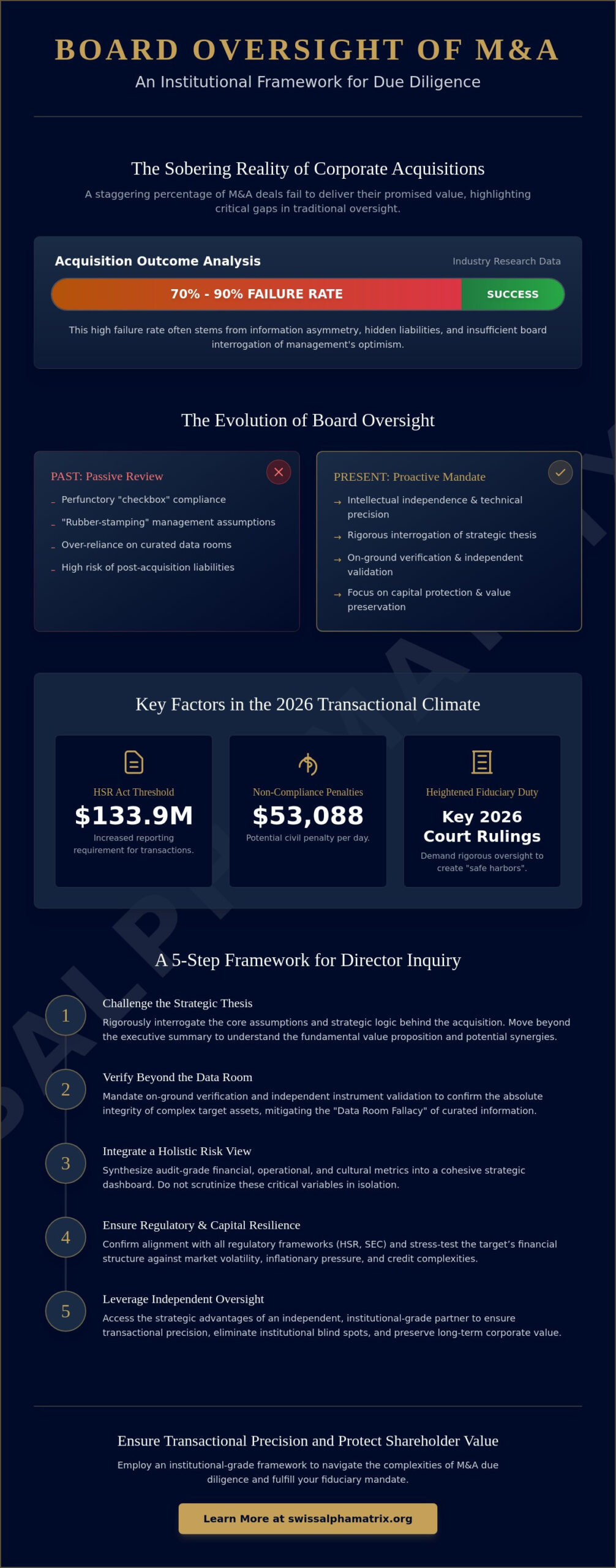
We’ll examine the strategic pillars of oversight, moving from the technical nuances of the updated Hart-Scott-Rodino Act thresholds, which now require reporting for transactions exceeding $133.9 million, to the qualitative assessment of cultural alignment. By adopting a methodology rooted in audit-grade rigor, your board can transform a passive review process into a robust mechanism for capital protection. This discussion outlines the necessary evolution of the director’s role; it ensures that every acquisition is anchored in strategic logic rather than short-term speculation, ultimately confirming that interests remain in the hands of seasoned experts who prioritize long-term stability.
Key Takeaways
- Transition from passive compliance toward a proactive fiduciary mandate, effectively mitigating the inherent information asymmetry that often obscures transactional reality.
- Establish a robust framework for board oversight of m&a due diligence by integrating audit-grade financial, operational, and cultural metrics into a cohesive strategic dashboard.
- Recognize the necessity of moving beyond the “Data Room Fallacy” through on-ground verification and instrument validation to ensure the absolute integrity of complex target assets.
- Employ a structured five-step inquiry framework designed to rigorously interrogate management’s strategic thesis and protect shareholder capital from post-acquisition liabilities.
- Access the strategic advantages of independent, institutional-grade oversight to ensure transactional precision and the preservation of long-term corporate value.
The Evolution of Board Oversight in M&A Due Diligence
Effective corporate governance in 2026 requires a fundamental departure from the traditional, often perfunctory, review of management’s findings. Modern board oversight of m&a due diligence is no longer a mere checkbox in a closing checklist; it’s a proactive fiduciary mandate that demands intellectual independence and technical precision. The paradigm has shifted. As global markets grapple with intricate capital structures and shifting regulatory frameworks, the board must act as the ultimate arbiter of value preservation. Traditional reporting models frequently fail. They often prioritize operational minutiae over strategic risk, leaving directors buried in data yet starved for actionable insight. This disconnect necessitates a clear distinction between management’s role in executing the due diligence process and the board’s responsibility to interrogate the underlying assumptions of the deal.
The Fiduciary Mandate for Capital Protection
Directors operate under a heightened legal and ethical obligation to ensure deal integrity, particularly following the Delaware Supreme Court’s February 27, 2026, decision in Rutledge v. Clearway Energy Group LLC. This ruling underscored the necessity for “safe harbors” through rigorous oversight, especially when transactions involve conflicted fiduciaries. “Rubber-stamping” management assumptions is a high-stakes gamble that often leads to significant litigation risk and the erosion of shareholder trust. When a board fails to challenge the narrative presented by executive teams, it risks inheriting hidden liabilities that may not surface until years after the integration. Board oversight serves as the final, uncompromising safeguard against institutional blind spots and the inherent optimism bias of executive teams.
Market Volatility and the 2026 Transactional Climate
The current financial landscape is characterized by credit complexities and fluctuating interest rates that demand deeper financial scrutiny than in previous cycles. With the Hart-Scott-Rodino Act filing threshold raised to $133.9 million as of February 2026, even mid-market transactions now face increased regulatory visibility and potential civil penalties of $53,088 per day for non-compliance. Directors must look beyond the immediate balance sheet to assess “black swan” risks, particularly in acquisitions that span multiple jurisdictions. This level of scrutiny is inextricably linked to cross-border investment due diligence, where geopolitical instability can rapidly devalue physical assets or disrupt supply chains. To maintain stability, boards must adopt a methodology that prioritizes:
- Regulatory Alignment: Adhering to the SEC’s early 2026 Compliance and Disclosure Interpretations regarding share registration and lock-up agreements.
- Capital Preservation: Validating the quality of earnings against a backdrop of inflationary pressure and volatile currency markets.
- Strategic Resilience: Ensuring the target’s debt structure doesn’t compromise the parent company’s long-term credit rating.
By moving from a reactive stance to a position of quiet, authoritative inquiry, boards ensure that interests remain in the hands of experts who value long-term growth over short-term speculation.
Architectural Pillars of Institutional-Grade Oversight
Constructing an institutional-grade framework for board oversight of m&a due diligence requires the synthesis of disparate data streams into a unified, strategic dashboard. This architectural approach ensures that financial performance, operational resilience, and cultural compatibility are not scrutinized in isolation but as interdependent variables of long-term value. Directors must look beyond the surface of standard accounting, interrogating the Quality of Earnings (QofE) to identify non-recurring gains or aggressive revenue recognition that may artificially inflate a target’s valuation. By maintaining this level of technical skepticism, the board upholds its role as the ultimate guardian of corporate resources, ensuring that every dollar of shareholder capital is deployed with absolute precision.
Audit-Grade Instrument Validation
Standard financial audits, while necessary, frequently lack the specialized methodology required to detect sophisticated irregularities within complex bank instruments. When a transaction involves standby letters of credit, performance bonds, or sovereign guarantees, the risk of institutional fraud necessitates a more rigorous approach. The board’s fiduciary responsibility demands bank instrument validation services that provide independent, third-party verification of a target’s underlying assets. This process transforms raw financial data into executive-level intelligence, allowing directors to make decisions based on verified reality rather than management’s optimistic projections. It’s a standard of care that distinguishes a performance-oriented board from one that simply participates in the process.
Operational and Regulatory Resilience
In the current transactional climate, the board’s role in M&A necessitates a deep dive into a target’s operational scalability and technological debt. A target might show strong current performance while masking an obsolete IT infrastructure that requires significant post-acquisition capital expenditure to maintain growth. Simultaneously, the board must ensure strict adherence to international financial regulations, particularly when dealing with multi-jurisdictional entities where compliance gaps can lead to severe penalties or reputational damage. Boards often find that partnering with seasoned risk management experts provides the necessary clarity to navigate these multifaceted regulatory landscapes with confidence.
Beyond the balance sheet, the board must evaluate the target’s human capital and cultural synergy with the same level of analytical rigor applied to financial assets. If the leadership styles or organizational values are fundamentally incompatible, the projected synergies of the deal will likely remain unmaterialized. This evaluation requires a structured inquiry into the target’s retention rates, incentive structures, and internal governance frameworks. It’s through this meticulous attention to detail that a board ensures a transaction isn’t just a strategic fit on paper, but a sustainable addition to the corporate portfolio that will thrive under the weight of integration.
Beyond the Data Room: The Necessity of On-Ground Verification
While the digital evolution of the Virtual Data Room (VDR) has streamlined the exchange of information, it has simultaneously birthed what seasoned directors recognize as the “Data Room Fallacy.” This phenomenon occurs when a board mistakes a high volume of digital documentation for a comprehensive understanding of a target’s physical and operational reality. For effective board oversight of m&a due diligence, one must acknowledge that digital records are, by their nature, curated representations of a company’s state, often polished to minimize perceived risk. In the complex transactional climate of 2026, where capital structures are increasingly opaque, relying solely on paper-based diligence is a dereliction of fiduciary duty that leaves shareholder capital exposed to post-acquisition hidden liabilities.
The Limits of Digital Due Diligence
Sophisticated entities, particularly those operating in jurisdictions with less stringent regulatory oversight, can manipulate digital records to mask significant operational weaknesses or inflate asset values. For instance, a target might report state-of-the-art manufacturing capacity while concealing the fact that a substantial portion of the machinery is non-functional or technologically obsolete. Physical verification serves as the only definitive antidote to “paper-only” asset inflation, ensuring that the assets appearing on the balance sheet exist in the physical world with the described utility. This “boots on the ground” approach is particularly critical in cross-border acquisitions where local regulatory environments may lack the transparency required for remote validation. Without physical inspection, the board remains vulnerable to information asymmetry that no amount of digital encryption can resolve.
Mitigating Information Asymmetry
The deal team’s inherent drive to close a transaction can occasionally result in a filtered narrative reaching the boardroom, where the nuances of operational risk are smoothed over in favor of strategic synergy. Management bias is an inherent risk in high-pressure environments. To maintain an objective stance, the board requires access to unvarnished, third-party intelligence that bypasses internal management bias. Leveraging independent financial project management allows the board to oversee the diligence timeline with a degree of precision that internal teams, often stretched thin by operational demands, cannot match. This independent oversight ensures that every discrepancy between reported capacity and physical reality is documented and addressed before the final commitment of capital. By reducing exposure through meticulous on-ground verification, directors fulfill their mandate to protect the long-term preservation of corporate value.
Executing the Oversight Mandate: A Framework for Director Inquiry
A rigorous board oversight of m&a due diligence requires directors to move beyond the passive consumption of management presentations toward a structured, five-step inquiry framework. This methodology is designed to bridge the gap between executive optimism and operational reality, ensuring that every acquisition is anchored in the long-term preservation of shareholder capital. By adopting a posture of quiet, authoritative skepticism, the board can effectively interrogate the strategic logic of a transaction before resources are irrevocably committed. This framework provides the intellectual tools necessary to navigate the intricate nature of 2026’s global financial landscape, where traditional metrics may fail to capture the full scope of institutional risk.
- Step 1: Interrogating the Strategic Thesis. Directors must ask why this specific target is necessary now and whether the acquisition aligns with the board’s established philosophy of strategic growth or if it represents a deviation toward short-term speculation.
- Step 2: Scrutinizing Financial Integrity. This step requires specific, audit-grade proof of asset validity, moving beyond high-level balance sheets to verify the quality of earnings and the legitimacy of complex financial instruments.
- Step 3: Assessing Integration Feasibility. The board must determine if projected synergies are based on verifiable operational data or if they rely on the unbridled optimism of a deal team focused on closing the transaction.
- Step 4: Evaluating Tail Risks. Inquiry should focus on low-probability, high-impact threats, such as geopolitical shifts or regulatory changes, that could compromise the stability of the combined entity.
- Step 5: Post-Closing Accountability. Success must be defined by objective performance metrics that will be monitored long after the initial news cycle has faded, ensuring management remains accountable for the promised value.
Challenging Management Assumptions
Constructive skepticism is the hallmark of an effective M&A committee, necessitating a shift in questioning from “What are the synergies?” to “What specific operational milestones must occur for these synergies to exist?” This transition ensures that management has considered the intricate difficulties of post-merger integration rather than just the strategic fit on paper. To maintain clarity and prevent the blurring of fiduciary boundaries, boards often utilize a RACI matrix. This tool clarifies that while management is responsible for execution, the board remains the ultimate authority for strategic interrogation and risk validation, fostering a culture where challenging the status quo is viewed as a fundamental duty of care.
Identifying Red Flags in Complex Transactions
Directors must remain vigilant for signs of “deal fever,” a state where executive over-commitment can lead to the dismissal of critical warning signs in a target’s profile. Inconsistencies in financial instrument documentation or a lack of transparency regarding cross-border asset locations often serve as early indicators of underlying instability. Monitoring these signals requires a level of transactional precision that standard due diligence teams may overlook. To ensure your organization maintains the highest standard of fiduciary stewardship, it is often prudent to implement independent Risk Management Frameworks that provide unvarnished intelligence before significant capital is committed.
Strategic Alignment with Swiss Alpha Matrix
Swiss Alpha Matrix serves as the essential bridge between institutional ambition and the uncompromising reality of global finance, providing the technical depth and unemotional objectivity required to validate complex capital structures. For directors seeking to formalize a robust framework for board oversight of m&a due diligence, our firm offers an institutional-grade perspective that transcends the standard advisory model. Our methodology is deeply rooted in the traditional discretion of Swiss financial excellence, yet it is meticulously engineered to meet the rigorous demands of the 2026 regulatory environment. By positioning ourselves as a dedicated partner rather than a mere service provider, we ensure that your board’s decisions are anchored in verified truth, effectively bridging the gap between historical reliability and modern transactional precision.
By leveraging the specialized expertise of former Tier-1 bank executives, we provide a level of analytical rigor that is specifically tailored to the needs of high-net-worth individuals and sophisticated institutional entities. These seasoned experts bring a master planner’s perspective to every engagement, ensuring that the board’s confidence is reinforced by audit-grade validation rather than management’s internal projections. This standard of service is designed to protect interests through every phase of the deal lifecycle, prioritizing the long-term preservation of capital over the short-term energy of the news cycle. Our presence in the diligence process signals to shareholders and regulators alike that the board has exercised the highest standard of fiduciary stewardship.
The Value of Independent Oversight
An external, unemotional partner is essential for maintaining objectivity during the high-pressure environment of a multi-billion dollar acquisition, where management teams may inadvertently overlook the subtle warning signs of asset inflation. Our financial advisory methodologies are structured to eliminate this inherent optimism bias, providing a protective layer of scrutiny that safeguards shareholder capital in cross-border transactions. This peace of mind is achieved through a combination of audit-grade instrument validation and on-ground verification, ensuring that the physical reality of a target’s assets mirrors its digital representation. Such meticulous attention to detail ensures that the board is never left vulnerable to the information asymmetries that frequently lead to post-acquisition value erosion.
Next Steps for the Board
To effectively integrate these standards into your corporate governance structure, the M&A committee should establish a formal protocol for the independent review of all complex financial instruments and cross-border asset claims. This protocol ensures that every standby letter of credit or sovereign guarantee undergoes a rigorous validation process before the board grants its final approval for capital deployment. By incorporating independent advisory into the governance framework, directors demonstrate a standard of care that is both broad in reach and meticulous in its execution. We invite you to engage Swiss Alpha Matrix for executive-level M&A oversight to ensure your next transaction is executed with the highest level of professional competence and strategic alignment.
Advancing Fiduciary Excellence in a Complex Global Landscape
The mandate for the modern director is clear; the transition from passive review to a proactive framework for board oversight of m&a due diligence is a fundamental requirement for capital preservation. By prioritizing on-ground verification and audit-grade validation over curated digital records, your board can effectively bridge the information gap that often leads to post-acquisition value erosion. This methodology ensures that every strategic move is anchored in verified reality, protecting the long-term interests of shareholders against the inherent volatility of the global market.
Swiss Alpha Matrix stands ready to assist your board in navigating these intricate dynamics. Managed by former senior executives from Tier-1 global financial institutions, our firm brings decades of cross-border transactional and regulatory experience to every engagement. We specialize in audit-grade financial instrument validation, providing the unvarnished intelligence required for sophisticated decision-making. Secure your transaction with Swiss Alpha Matrix’s independent M&A oversight and ensure your organization’s growth remains both resilient and strategically sound.
Frequently Asked Questions
What is the board’s primary responsibility in M&A due diligence?
The board’s primary responsibility is the preservation of shareholder capital through rigorous fiduciary stewardship. While management focuses on the transactional mechanics, the board must ensure that the acquisition remains tethered to long-term strategic growth rather than short-term speculation. This involves a high-level interrogation of the target’s value proposition to confirm that all identified synergies are anchored in operational reality and documented evidence.
How does board oversight differ from management’s role in a transaction?
Management is tasked with the execution of the transaction, whereas the board’s role is one of strategic interrogation. Management handles the exhaustive day-to-day data room analysis; however, the board must provide the quiet, authoritative challenge necessary to bridge the information asymmetry that often exists between the deal team and the directors. Effective board oversight of m&a due diligence requires this clear distinction to prevent institutional blind spots from compromising the deal.
What are the most common pitfalls in board-level M&A governance?
Common pitfalls often include “deal fever,” a state where the momentum of a transaction leads to the dismissal of critical red flags by executive teams. Boards also frequently succumb to the “Data Room Fallacy,” assuming that a high volume of digital documentation equates to a complete understanding of the target. This over-reliance on management’s filtered narrative can result in the inheritance of hidden liabilities that only surface post-integration.
Why is physical on-ground verification necessary in a digital age?
Physical on-ground verification is the only definitive antidote to “paper-only” asset inflation. Digital records, while efficient, are easily curated to present an optimistic view of a target’s operational state. By deploying experts to physically inspect machinery, inventory, and facilities, a board ensures that the assets described in the data room actually exist with the utility and value claimed on the balance sheet, especially in opaque jurisdictions.
How can a board validate complex financial instruments during a deal?
Validating complex financial instruments requires audit-grade validation services that go beyond standard accounting practices. When dealing with standby letters of credit or sovereign guarantees, boards should engage independent third parties to verify the legitimacy and liquidity of these assets. This process provides the technical precision required to ensure that the target’s financial foundations are as robust as they appear in the executive summary presented to the board.
What questions should a board ask about cultural integration?
Boards should move beyond asking if a cultural fit exists and instead ask what specific operational milestones must occur for cultural synergies to materialize. Inquiry should focus on leadership retention strategies, incentive structures, and historical organizational values. Understanding how these human capital elements will be synthesized post-acquisition is vital for ensuring that the deal’s projected value isn’t eroded by internal friction or the loss of key talent.
How does an independent advisor complement the work of Big-4 firms?
While Big-4 firms excel at standard financial and tax audits, independent advisors provide a specialized layer of executive-level intelligence and on-ground verification. These advisors, often former Tier-1 bank executives, offer an unemotional perspective that is untethered from the pressures of the deal team. They provide the unvarnished truth necessary for a board to fulfill its mandate of capital protection in multi-jurisdictional transactions where standard audits may fall short.
What role does the board play in post-merger integration (PMI) oversight?
The board’s role in post-merger integration is centered on accountability and the long-term monitoring of success against the original strategic thesis. Directors must ensure that management adheres to a structured integration timeline and that the strategic goals established during the board oversight of m&a due diligence phase are actually achieved. This oversight continues long after the initial closing, focusing on the sustainable growth and preservation of the corporate portfolio.