
What if the most dangerous document in your next cross-border transaction is the one that looks completely legitimate? In an era where AI-generated forgeries and sophisticated instrument misrepresentation have rendered standard digital screenings categorically insufficient, the question serious capital allocators are asking is no longer what the documentation says, but whether the underlying reality it purports to describe actually exists. On-ground verification services have moved, quietly but decisively, from a supplementary precaution to the definitive standard of pre-deployment due diligence.
You already understand the inadequacy of remote validation. You’ve seen counterparties present immaculate digital documentation that unravels only when someone physically stands in the room, asks the right questions, and applies the institutional judgment that no algorithm can replicate. That instinct is correct, and it deserves a rigorous methodology to match it.
This article examines precisely why physical, senior-led verification has become the only defensible safeguard against cross-border financial fraud, what constitutes audit-grade intelligence in practice, and how organisations managing significant capital are structuring their verification protocols to satisfy both internal risk committees and mounting regulatory scrutiny.
Key Takeaways
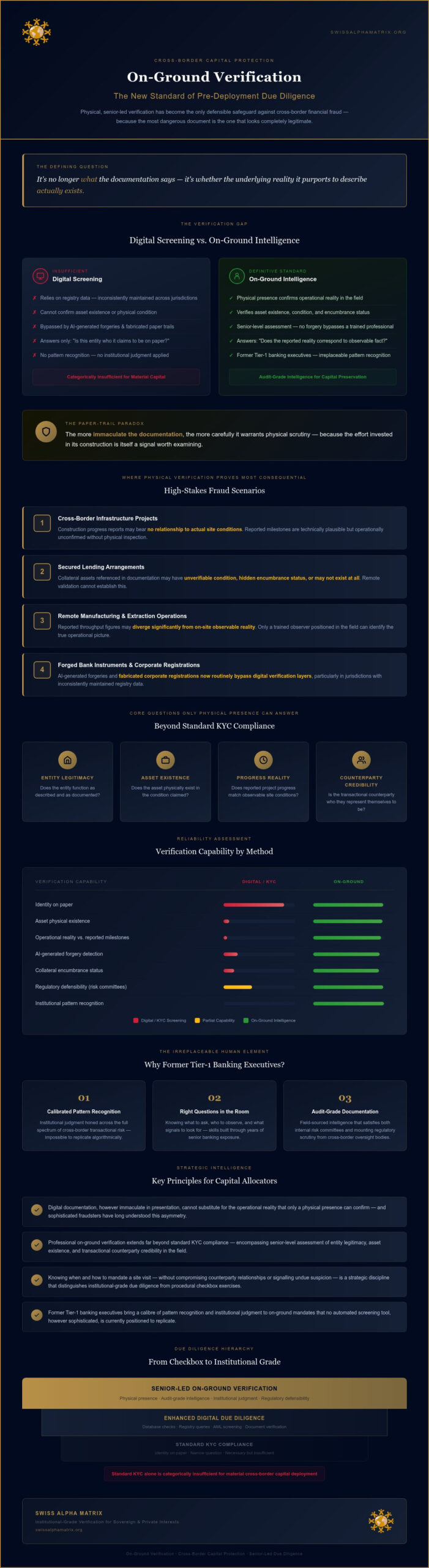
- Digital documentation, however immaculate in presentation, cannot substitute for the operational reality that only a physical presence can confirm — and sophisticated fraudsters have long understood this asymmetry.
- Professional on-ground verification services extend far beyond standard KYC compliance, encompassing senior-level assessment of entity legitimacy, asset existence, and transactional counterparty credibility in the field.
- A structured framework for comparing digital screening against physical intelligence reveals measurable gaps in reliability that carry direct implications for capital preservation and regulatory defensibility.
- Knowing precisely when and how to mandate a site visit — without compromising counterparty relationships or signalling undue suspicion — is a strategic discipline that distinguishes institutional-grade due diligence from procedural checkbox exercises.
- Former Tier-1 banking executives bring a calibre of pattern recognition and institutional judgment to on-ground mandates that no automated screening tool, however sophisticated, is currently positioned to replicate.
Defining On-Ground Verification in the Context of Global Capital Protection
On-ground verification is, at its most precise definition, a senior-led physical audit of a project’s operational reality, conducted in the field by professionals whose institutional judgment has been calibrated through years of exposure to the full spectrum of cross-border transactional risk. This definition matters, because the term is routinely conflated with employment background screening, identity checks, and database queries — services that, however competently executed, address an entirely different category of risk than the one facing capital allocators operating across multiple jurisdictions.
The distinction is not merely procedural. It is structural. Background screening services are designed to answer questions about individuals. On-ground verification services are designed to answer questions about operational realities: does the asset exist, does the entity function as described, and does the project’s reported progress correspond to observable fact? These are questions that no database, however comprehensive, is positioned to answer with the reliability that significant capital deployment demands.
The Limitations of Digital-First Due Diligence
Sophisticated financial misrepresentation has evolved considerably faster than the automated screening tools designed to detect it. Forged bank instruments, fabricated corporate registrations, and artificially constructed paper trails now routinely bypass digital verification layers, particularly in jurisdictions where registry data is inconsistently maintained or selectively accessible. This creates what practitioners in complex transaction environments recognise as the paper-trail paradox: the more immaculate the documentation, the more carefully it warrants physical scrutiny, because the effort invested in its construction is itself a signal worth examining. Audit-grade intelligence, in this context, is not a function of database access; it’s a function of physical presence combined with the pattern recognition that only senior institutional experience can provide.
Verifying the Unverifiable: High-Stakes Scenarios
The scenarios where physical verification proves most consequential tend to share a common characteristic: reported milestones that are technically plausible but operationally unconfirmed. Cross-border infrastructure projects may present construction progress reports that bear no relationship to site conditions. Secured lending arrangements may reference collateral assets whose condition, encumbrance status, or even existence cannot be established remotely. Remote manufacturing or extraction operations may report throughput figures that diverge significantly from what a trained observer would identify on-site.
In each of these scenarios, the value of on-ground verification services lies not simply in detecting discrepancies, but in providing the calibre of documented, field-sourced intelligence that satisfies both internal risk committees and the increasingly rigorous expectations of regulatory bodies overseeing cross-border capital flows.
The Mechanics of Physical Asset and Entity Validation for Complex Transactions
Standard KYC compliance frameworks were designed to answer a narrow question: is this entity who it claims to be on paper? That question, while necessary, is categorically insufficient when the capital at stake is material and the jurisdiction is complex. The more consequential question, the one that determines whether a transaction is structurally sound or fundamentally compromised, is whether the operational reality behind the documentation corresponds to anything that would survive scrutiny from a senior professional standing in the room. This is precisely the territory that professional on-ground verification services are designed to occupy, and it’s a territory that no API-driven screening tool has yet managed to credibly enter.
The distinction matters because sophisticated misrepresentation rarely fails at the identity layer. It fails at the operational layer, where reported throughput diverges from observable activity, where reported leadership doesn’t correspond to the individuals who actually exercise authority, and where the cultural signals that experienced practitioners learn to read are invisible to any automated process. This is why cross-border investment due diligence at an institutional standard cannot be reduced to a checklist, however comprehensive.
Verifying entity leadership in the field involves considerably more than confirming that a named director holds the title attributed to them. It requires structured physical interviews conducted by professionals with the seniority to recognise inconsistency, supplemented by discreet reputation audits conducted within local professional and commercial networks. A counterparty’s standing in their own market, assessed through the informal channels that only a physical presence unlocks, frequently reveals material information that no registry search or digital background report would surface.
Bank Instrument Validation on Location
Standby Letters of Credit and comparable financial instruments represent one of the highest-risk categories in cross-border structured finance, precisely because their apparent legitimacy is so readily manufactured. Validating an SBLC at source requires direct bank-to-bank verification conducted through established institutional channels, bypassing intermediary documentation entirely. When former Tier-1 banking executives conduct this process in person, they bring an understanding of the precise procedural markers that distinguish a performing instrument from a non-performing or fraudulent one, markers that exist below the threshold of what any document review could detect. Protecting capital against instrument fraud is not a compliance exercise; it’s a senior-judgment exercise.
Site Audits and Operational Due Diligence
A physical site audit conducted by a seasoned professional reveals dimensions of organisational risk that financial statements are structurally incapable of capturing. Management culture, often described in governance literature as “tone at the top,” is observable in person in ways that no board resolution or policy document can replicate. Hidden liabilities, whether environmental, contractual, or reputational, tend to manifest in operational behaviours and site conditions that a trained observer identifies immediately. The intersection of physical security posture and financial risk is equally telling: how an operation protects its assets in the field is frequently a reliable proxy for how rigorously it manages its obligations to capital partners.
For allocators structuring mandates where operational integrity is a prerequisite for deployment, engaging senior-led operational due diligence at the site level is the standard that risk committees are increasingly requiring, not requesting.
Digital Screening vs. On-Ground Intelligence: A Framework for Risk Assessment
Digital screening provides compliance. On-ground verification provides certainty. That distinction, understated in most due diligence conversations and largely absent from the marketing materials of automated platform providers, is the axis around which the entire debate between digital-first and physical-first verification methodologies turns. For institutional allocators managing material capital across complex jurisdictions, the difference between the two is not a matter of preference; it is a matter of recoverable versus irrecoverable loss.
The shift toward high-touch verification that has characterised institutional practice in 2026 reflects a sober reassessment of what automated platforms were ever designed to do. Platforms built around speed and efficiency, however sophisticated their underlying algorithms, are structurally optimised for a different problem than the one facing capital allocators in high-risk cross-border environments. Speed is the enemy of thoroughness when the transaction is complex, the jurisdiction is opaque, and the counterparty has had sufficient time to construct a credible digital presence.
The Failure Points of Automated Verification
The vulnerability of automated verification is not theoretical. High-value cross-border transactions have been compromised by forged documentation that passed initial digital screening precisely because the screening tools were interrogating the document rather than the underlying reality. In structured finance environments, the specific failure mode tends to follow a recognisable pattern: a data room is provided, its contents appear internally consistent, and the automated screening returns no flags because the forgery has been calibrated to the known parameters of the screening tool itself.
This creates what practitioners describe as confirmation bias by design. When the due diligence process begins with a counterparty-provided data room, every subsequent analysis is implicitly anchored to the narrative that data room was constructed to support. A senior professional conducting physical verification carries no such anchor. The field assessment begins with observable reality and works outward, rather than beginning with provided documentation and working inward.
Database lag compounds this vulnerability in ways that are rarely acknowledged. Registry data in many target jurisdictions reflects conditions that may be months or years out of date, which means that an automated screening returning a clean result is, in material respects, describing a historical entity rather than a current operational one. Real-time on-ground intelligence has no equivalent lag.
Cost vs. Consequence: The ROI of Physical Presence
The cost-benefit calculus of physical verification resolves quickly when framed against the alternative. The fee associated with a senior-led on-ground mandate is a defined, bounded expenditure. The consequence of deploying significant capital against a misrepresented counterparty or non-existent asset is neither defined nor bounded; it is, in the most serious cases, a total loss of principal. Understood in those terms, on-ground verification services are not a cost centre; they are a loss-prevention instrument with a calculable return.
Physical verification reports also carry negotiating utility that digital screening outputs simply don’t. A documented field assessment identifying operational discrepancies provides a substantiated basis for renegotiating deal terms, adjusting collateral requirements, or securing more favourable insurance premiums from underwriters who recognise the evidential weight of audit-grade field intelligence. For mandates involving financial instruments, the same principle applies at the instrument level; understanding the bank instrument validation services framework that governs this process is essential for any allocator structuring exposure through SBLCs or comparable instruments.
Swiss discretion adds a dimension to this calculus that is difficult to quantify but impossible to ignore. Sensitive mandates, particularly those involving politically connected counterparties, contested assets, or jurisdictions where the act of verification itself carries reputational risk, require a handling standard that combines operational precision with absolute confidentiality. That combination is not incidental to the Swiss institutional tradition; it is foundational to it, and it is the reason that capital allocators with the most complex mandates continue to route their most sensitive verification requirements through practitioners operating within that tradition.
Strategic Implementation: Integrating Physical Verification into the Investment Lifecycle
Knowing that physical verification is necessary is one discipline. Knowing precisely when to trigger it, how to commission it without disrupting the transactional relationship, and how to translate field findings into investment committee decisions is an entirely different one. This is the operational layer of due diligence that most guidance fails to address, and it is where institutional-grade practice separates itself from procedural compliance.
Trigger points for a physical mandate are rarely arbitrary. The decision to commission on-ground verification services is most defensible when it is tied to observable deal characteristics rather than general caution. Specific triggers include: reported project milestones that cannot be independently corroborated through third-party sources; collateral assets located in jurisdictions with inconsistent registry maintenance; counterparty leadership structures that have changed materially since initial engagement; and any transaction where the documentation package appears notably more polished than the underlying commercial relationship would ordinarily produce. Each of these conditions represents a structural signal, not a suspicion.
Mandating the Investigation
The scope of a physical mandate must be defined before the verification team deploys, not discovered in the field. A properly structured mandate specifies which assets must be physically inspected, which individuals must be interviewed and at what level of seniority, and which operational functions must be tested against reported performance. Audit-grade reporting requires that every material finding be documented with field evidence, contextualised against the counterparty’s own representations, and summarised in an executive format that a risk committee can act on without interpretation. Critically, the mandate must also define what constitutes a satisfactory result, establishing the evidentiary threshold in advance rather than applying retrospective judgment to ambiguous findings.
Commissioning a site visit without alerting counterparties to the nature of the scrutiny is a discipline that experienced practitioners handle through positioning rather than concealment. Physical verification is most effectively framed as a standard element of the investor’s internal governance framework, which, for institutions operating at this level, it genuinely is. Counterparties who resist this framing are, themselves, providing a signal worth examining.
Interpreting the Findings
Not every discrepancy identified during a site visit represents a terminal deal-breaker. Operational friction, the ordinary inefficiencies and minor inconsistencies that characterise any functioning organisation, is categorically different from structural misrepresentation. The professional judgment required to distinguish between the two is precisely why senior-led verification carries a premium over junior-staffed alternatives. A finding that headcount is fifteen percent below reported levels warrants a different response than a finding that the physical asset referenced in the collateral agreement does not exist in the form described.
Field findings are most valuable when they are integrated into the broader independent financial project management framework governing the transaction. When on-ground intelligence flows directly into the project management architecture, it informs not only the Go/No-Go decision but the ongoing risk monitoring protocols, collateral adjustment triggers, and milestone verification requirements that govern the post-deployment phase. A site visit that produces a standalone report, disconnected from the transaction’s governance structure, delivers a fraction of its potential value.
For investment committees, the field report should arrive structured around three actionable categories: confirmed representations, identified variances with proposed mitigants, and unresolvable discrepancies that warrant deal restructuring or withdrawal. This Deliverable Review Matrix approach ensures that the committee is deliberating on a defined set of options rather than interpreting raw field data under time pressure. Mitigation plans for identified risks should be developed in parallel with the verification process itself, so that the committee meeting is a decision point rather than a discovery session.
Capital allocators who have embedded this discipline into their pre-deployment protocols consistently report that the verification process strengthens, rather than complicates, counterparty relationships with legitimate operators, because it establishes a standard of rigour that credible counterparties recognise and respect. Commission a senior-led field assessment before your next deployment decision, and ensure your investment committee is working from field intelligence rather than counterparty narrative.
Swiss Alpha Matrix: Institutional-Grade Verification for Sovereign and Private Interests
There is a meaningful difference between a firm that conducts verification and a firm whose principals have spent careers on the other side of the transaction, inside the institutions that sophisticated fraud is specifically designed to deceive. Swiss Alpha Matrix was built around that distinction. Managed by former Tier-1 global bank executives, the firm brings a calibre of institutional pattern recognition to complex mandates that no mass-market background screening provider, however expansive its database, is structured to replicate.
The Swiss dimension is not incidental. Precision, discretion, and absolute independence are not values that Swiss Alpha Matrix adopted as a brand position; they are operational requirements that the firm’s client base, spanning sovereign interests, private capital structures, and cross-border project finance, demands as a baseline. Sensitive mandates, particularly those involving politically connected counterparties or contested jurisdictions, require a handling standard where confidentiality is treated as a structural feature rather than a courtesy. That standard is foundational to how every engagement is conducted.
Global reach does not dilute that precision. Complex mandates in challenging jurisdictions, whether emerging market infrastructure projects, secured lending arrangements in regions with inconsistent registry maintenance, or financial instrument validation requiring direct bank-to-bank engagement, are managed with the same methodological rigour applied to transactions in more transparent environments. The jurisdiction’s complexity adjusts the operational approach; it does not adjust the evidentiary threshold.
Senior-Led Intelligence
Swiss Alpha Matrix does not outsource verification to junior staff or local sub-contractors. Every mandate is led by principals whose Tier-1 banking backgrounds equip them to identify the specific markers of sophisticated institutional fraud that exist below the threshold of any automated screening process. The intelligence produced is formatted for executive decision-making: structured, actionable, and calibrated to the risk committee’s actual deliberative requirements rather than to a generic compliance template. When capital is material and the jurisdiction is complex, that distinction is the difference between due diligence and genuine protection.
Securing Your Next Transaction
Engaging Swiss Alpha Matrix begins with a preliminary review of your deal’s specific risk profile, assessing counterparty structure, asset location, instrument type, and jurisdictional complexity before a verification scope is defined. This preliminary assessment ensures that the on-ground verification services deployed are precisely matched to the mandate’s actual risk architecture rather than applied as a standard package.
For allocators who have followed the argument this article has developed, the next step is straightforward. Contact Swiss Alpha Matrix to secure your cross-border interests before your next deployment decision, and ensure your investment committee is deliberating on field intelligence rather than counterparty narrative.
The Standard Your Capital Deserves
The argument this article has developed resolves to a single, actionable principle: in complex cross-border transactions, the gap between what documentation claims and what physical reality confirms is precisely where capital is lost. Digital screening identifies who a counterparty claims to be. On-ground verification services establish whether the operational reality behind that claim is one you can deploy against with confidence.
Two disciplines separate institutional-grade allocators from those who learn this lesson at cost: knowing when to trigger a physical mandate, and ensuring the professionals who execute it carry the pattern recognition that only senior Tier-1 banking experience produces. Both conditions matter. Neither is optional when the capital is material and the jurisdiction is complex.
Swiss Alpha Matrix brings former Tier-1 global bank executives, audit-grade instrument validation expertise, and Swiss precision to mandates where the evidentiary standard cannot be compromised. If your next deployment decision deserves that standard, the next step is straightforward: secure your capital with senior-led verification from Swiss Alpha Matrix and ensure your investment committee deliberates from field intelligence, not counterparty narrative.
Frequently Asked Questions About On-Ground Verification Services
What exactly is included in an on-ground verification service for financial deals?
A professional on-ground verification service encompasses physical asset inspection, structured in-person interviews with entity leadership, discreet reputation audits conducted through local professional networks, and operational assessment of reported project milestones against observable site conditions. The scope is defined before deployment and tailored to the transaction’s specific risk architecture, whether that involves collateral assets, corporate entity legitimacy, or counterparty authority structures.
At the institutional level, deliverables take the form of audit-grade field reports structured for executive decision-making, documenting confirmed representations, identified variances, and unresolvable discrepancies alongside proposed mitigants. Every material finding is supported by field evidence rather than inference.
How does on-ground verification differ from a standard financial audit?
A standard financial audit interrogates historical records, testing whether reported figures conform to accepted accounting standards. On-ground verification interrogates current operational reality, testing whether the entity, asset, or project described in documentation corresponds to what a trained observer finds in the field. The two disciplines answer fundamentally different questions and are not substitutes for one another.
Where a financial audit works backward from numbers, physical verification works outward from observable conditions, including management culture, site activity, physical asset condition, and the informal commercial reputation signals that no ledger captures. For capital allocators, both disciplines have their place; conflating them creates a material blind spot.
Is physical verification necessary if we have a comprehensive digital data room?
A comprehensive data room is precisely the scenario that warrants the most careful physical scrutiny. Sophisticated misrepresentation is rarely constructed from thin documentation; it’s constructed from immaculate documentation calibrated to pass the screening tools most allocators use. The effort invested in assembling a polished data room is itself a signal that experienced practitioners are trained to examine rather than accept.
Digital data rooms establish a counterparty’s narrative. On-ground verification services establish whether the operational reality behind that narrative exists. These are sequential disciplines, not competing ones, and treating a well-organised data room as a substitute for physical verification is the precise error that has preceded most material losses in complex cross-border transactions.
Can you verify the existence and validity of bank instruments like SBLCs on-ground?
Yes. Bank instrument validation conducted on location involves direct bank-to-bank verification through established institutional channels, bypassing intermediary documentation entirely. This process confirms whether a Standby Letter of Credit or comparable instrument is performing, non-performing, or fraudulent, by examining the procedural markers that exist below the threshold of any document review.
This is a discipline that requires genuine Tier-1 banking experience to execute credibly. Professionals who have operated inside the institutions these instruments are drawn on understand the precise procedural signatures that distinguish a legitimate performing instrument from one that has been constructed to appear legitimate. That pattern recognition isn’t replicable through document analysis alone.
How long does a typical on-ground verification mandate take to complete?
Duration depends on mandate scope, jurisdictional complexity, and the number of assets or entities requiring physical assessment. A focused single-asset site visit in an accessible jurisdiction may be completed within several days. A multi-entity mandate spanning multiple locations in jurisdictions with restricted access or inconsistent infrastructure requires proportionally more time to execute to an audit-grade standard.
What doesn’t vary is the principle that scope is defined before deployment. Attempting to compress timelines by narrowing field work after the mandate begins introduces exactly the kind of evidentiary gaps that compromise a report’s value to a risk committee. Allocators should treat the timeline as a function of the mandate’s requirements, not the other way around.
In which jurisdictions does Swiss Alpha Matrix provide physical verification services?
Swiss Alpha Matrix operates across complex international jurisdictions, with particular expertise in cross-border mandates where registry maintenance is inconsistent, counterparty structures span multiple legal environments, or the transaction involves politically sensitive contexts requiring absolute discretion. The firm’s principals bring global risk management experience from Tier-1 banking careers that encompassed precisely these environments.
Prospective clients with mandates in specific jurisdictions are encouraged to discuss their requirements directly with the firm during the preliminary risk profile review. Jurisdictional complexity adjusts the operational approach; it doesn’t adjust the evidentiary standard applied to every engagement.
How do you maintain discretion during a physical site visit or entity audit?
Discretion is managed through professional positioning rather than concealment. Physical verification is most effectively framed as a standard component of an investor’s internal governance framework, which, for institutions operating at this level, it genuinely is. Counterparties who are accustomed to institutional-grade capital partners expect this standard; it rarely disrupts legitimate commercial relationships.
For mandates involving politically connected counterparties or contested jurisdictions, Swiss Alpha Matrix applies a handling standard rooted in the Swiss institutional tradition of operational precision and absolute confidentiality. Sensitive field intelligence is managed with the same structural discretion that the firm’s sovereign and private capital clients require as a baseline, not as an accommodation.
What are the common red flags that only a physical on-ground visit can reveal?
Several categories of risk are effectively invisible to remote screening. These include headcount that diverges materially from reported staffing levels, physical assets in a condition inconsistent with reported operational throughput, leadership figures whose actual authority within the organisation doesn’t correspond to their documented titles, and site security postures that signal a different risk profile than the documentation suggests. Each of these conditions is observable in person and undetectable through any database query.
Subtler signals matter equally. Management culture, the informal dynamics between senior personnel and operational staff, and the observable condition of working environments all provide pattern-recognition inputs that experienced professionals interpret in real time. These aren’t marginal details; they’re frequently the earliest indicators of the structural misrepresentation that materialises as capital loss later in the transaction lifecycle.