

In the high-stakes arena of cross-border acquisitions, a pristine legal title to a patent portfolio often masks a deeper, more corrosive reality of latent financial liability. While legal teams confirm ownership, the more critical task of assessing financial risk of intellectual property in m&a requires a shift from qualitative checklists to rigorous, institutional quantification. You’re likely aware that as TMT deal values surged by 49% in 2025, the complexity of protecting capital against hidden litigation and jurisdictional shifts became increasingly paramount. Overpayment isn’t just a valuation error; it’s a failure of strategic alignment that often stems from a lack of audit-grade validation in the pre-close phase.
This article promises to equip you with the sophisticated methodologies necessary to master the mitigation of these risks in complex global transactions. We’ll examine a robust framework that moves beyond superficial due diligence, offering a measured approach to operational verification and risk management. By tethering modern valuation strategies to concepts of regional excellence and technical precision, you’ll learn how to ensure that every intangible asset serves as a stable pillar for long-term growth rather than a source of post-acquisition volatility.
Key Takeaways
- Distinguish between mere legal title and actual financial utility by applying probability-weighted models to future royalty streams and licensing revenue.
- Implement institutional frameworks for assessing financial risk of intellectual property in m&a to prevent capital erosion and ensure accurate enterprise valuation.
- Utilize on-ground verification services to reconcile “on paper” IP rights with the practical realities of enforcement across complex international jurisdictions.
- Integrate IP risk assessment into a centralized project management office to align technical data with broader operational due diligence and strategic investment goals.
- Secure capital protection through unemotional, independent validation that prioritizes long-term stability and historical reliability over short-term deal momentum.
The Paradigm Shift in M&A: Why IP Financial Risk Dominates the 2026 Landscape
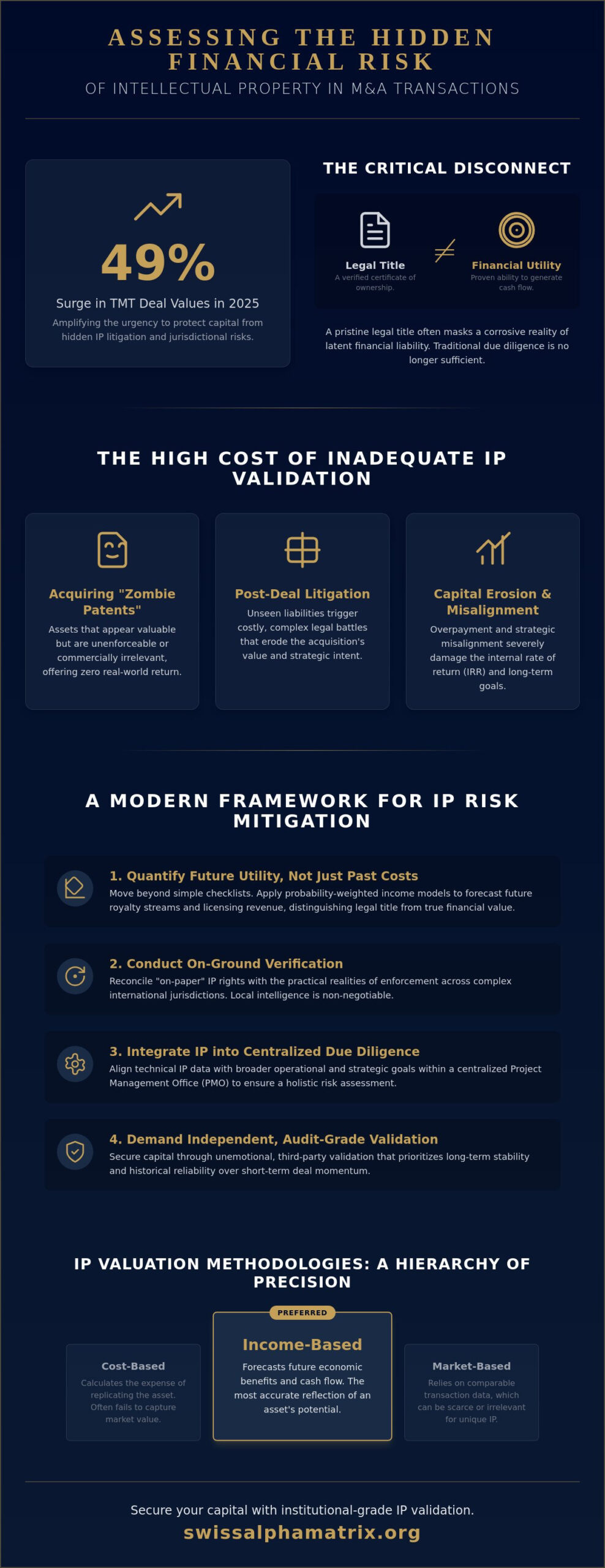
The global transaction environment has undergone a fundamental transformation, where the center of gravity has shifted from physical infrastructure to the ephemeral yet potent realm of intangible assets. In 2025, global M&A deal value reached approximately $4.9 trillion, a figure heavily influenced by a 49% growth in the technology, media, and telecommunications sector. This surge underscores a reality where intellectual property (IP) is no longer a peripheral legal concern but the primary engine of enterprise value. Consequently, assessing financial risk of intellectual property in m&a has evolved into a mandatory discipline for institutional entities seeking to preserve capital in a fragmented global economy. Traditional financial statements, while useful for auditing tangible assets, frequently fail to capture the latent financial exposures inherent in proprietary algorithms or cross-border trademark portfolios.
Modern valuation requires a departure from surface-level due diligence. While a legal audit might confirm that a target entity holds the title to a patent, it rarely addresses the financial utility of that asset under varying market conditions. By utilizing established Intellectual Property Valuation Methodologies, institutions can begin to bridge the gap between historical cost and future economic utility. This distinction is vital because the mere existence of a patent does not guarantee its defensibility or its ability to generate a sustained competitive advantage in diverse jurisdictions. It’s about the cash flow, not just the certificate.
From Tangible to Intangible: The Asset Transition
The historical shift from physical factories to “knowledge capital” has redefined the parameters of successful acquisition. In 2026, market dynamics prioritize proprietary data sets and trade secrets over traditional book value, necessitating a more sophisticated approach to risk. Executive stakeholders now demand a Risk-Adjusted IP Valuation that accounts for technological obsolescence and shifting regulatory environments. This methodology ensures that the price paid reflects the asset’s actual capacity for revenue generation, rather than an inflated perception of its market position. It requires a mindset that values regional precision over broad assumptions.
The Consequences of Inadequate IP Validation
Ignoring the intricacies of IP financial risk often leads to the acquisition of “zombie patents,” which are assets that appear valuable on paper but are unenforceable or commercially irrelevant. Such oversights can trigger post-deal litigation that severely erodes the internal rate of return (IRR) and destabilizes the strategic alignment of the investment. To safeguard interests, legal due diligence must be augmented by audit-grade instrument validation. This rigorous process provides the technical accuracy needed to confirm that the financial instruments and IP assets underpinning a deal are resilient, verified, and capable of supporting long-term strategic growth without the threat of hidden liabilities.
Quantifying Exposure: Methodologies for IP Valuation and Financial Risk Assessment
Precise capital preservation in the wake of an acquisition demands a transition from speculative appraisal to rigorous, institutional-grade quantification. When assessing financial risk of intellectual property in m&a, practitioners typically deploy a triad of methodologies: the income-based approach, which forecasts future economic benefits; the cost-based approach, which calculates the expense of replicating the asset; and the market-based approach, which relies on comparable transaction data. While each has its merits, the sophisticated investor prioritizes the income-based model, as it most accurately reflects the asset’s potential to generate sustainable cash flow. However, these projections remain fragile without the application of a probability-weighted model, a technique that discounts future royalty streams and licensing revenue based on the likelihood of market adoption, regulatory interference, or litigation headwinds. This mathematical rigor ensures that the valuation is not merely a reflection of optimistic growth but a grounded assessment of risk-adjusted returns.
Beyond revenue projections, an expert analysis must scrutinize the “encumbrance risk” associated with the target’s portfolio. Existing liens, restrictive covenants, or non-exclusive licenses can significantly devalue an acquisition by limiting the buyer’s freedom to operate or by diverting future income to third parties. Identifying these Key Intellectual Property Issues early in the due diligence phase prevents the inadvertent assumption of liabilities that could impair the deal’s long-term viability. Additionally, the concept of technical obsolescence must be integrated into the financial model to determine the “half-life” of the IP. In sectors driven by rapid innovation, such as AI or biotechnology, a patent with ten years of legal life may only possess three years of financial utility before a superior technology renders it irrelevant. For those requiring absolute certainty, engaging in operational due diligence provides the necessary oversight to validate these complex variables before capital is committed.
Institutional-Grade Valuation Frameworks
The Relief from Royalty (RFR) method serves as a cornerstone for valuing proprietary technology, operating on the premise that the asset’s value is equivalent to the capitalized royalty payments a company is “relieved” from paying by owning the IP. For primary intangible assets that drive the bulk of a firm’s value, the Multi-Period Excess Earnings Method (MPEEM) is often preferred, as it isolates the cash flows attributable specifically to the IP after deducting returns for contributory assets. These sophisticated models must be rigorously stress-tested against extreme market volatility and shifting interest rate environments to ensure they remain resilient under duress.
Identifying Hidden Financial Liabilities
Hidden costs often reside in the maintenance of global patent families, where the cumulative expense of annuities and legal filings may eventually outweigh the projected revenue of the assets themselves. Sophisticated due diligence also requires a meticulous review of “change of control” clauses within existing licensing agreements, which can trigger substantial financial penalties or the outright termination of critical rights upon the close of a deal. Finally, the adequacy of the target’s IP insurance must be evaluated; a lack of robust coverage for infringement defense can transform a minor dispute into a catastrophic financial drain on the newly formed entity.
Cross-Border Jurisdictional Hazards and the Necessity of On-Ground Verification
The assumption that intellectual property rights are uniformly enforceable across global markets is a dangerous fallacy that often precipitates significant capital loss during international acquisitions. A patent registered in a primary market may possess significant “paper value,” yet the actual efficacy of that asset in practice varies dramatically according to local judicial reliability and administrative transparency. Consequently, assessing financial risk of intellectual property in m&a requires an institutional commitment to verifying that theoretical protections align with on-ground realities. Swiss discretion and a commitment to regional precision are vital when navigating the clandestine complexities of emerging market IP laws. By employing on-ground verification services, investors can move beyond the limitations of digital due diligence to confirm the existence, security, and exclusive use of proprietary trade secrets. This level of scrutiny is particularly critical in mitigating the risk of “IP leakage” within decentralized R&D facilities, where local operational habits may inadvertently compromise the exclusivity of the asset.
Navigating the Global Regulatory Patchwork
The enforcement landscape remains highly fragmented; for instance, the robust protections traditionally afforded in Geneva often stand in stark contrast to the shifting administrative priorities found in other financial hubs like Hong Kong or London. Navigating these disparities requires a deep understanding of how international financial regulations influence the transfer and valuation of IP assets across borders. From an institutional perspective, the level of jurisdictional risk inherent in a target entity’s geographic footprint must directly inform the discount rate applied to its intangible assets. It’s a matter of professional calm to acknowledge that a higher risk of local infringement or weak judicial recourse necessitates a more conservative valuation to safeguard the acquiring entity’s capital against unforeseen volatility.
The Criticality of Physical Verification
Institutional oversight requires a physical audit to ensure that proprietary software and technical processes are not merely “paper-only” assets designed to inflate enterprise value during a transaction. This involves on-ground inspections to verify that claimed technologies are actively integrated into the target company’s operations and that patent families are not obsolete husks. Additionally, the methodology for assessing financial risk of intellectual property in m&a should include structured interviews with key technical personnel. This ensures that the “human capital”—the specialized knowledge required to maintain and evolve the IP—is both retained and strategically aligned with the acquirer’s long-term investment goals. Such a measured approach prevents the loss of critical expertise during the post-merger integration phase, ensuring that the acquired assets continue to perform as projected.
Operational Due Diligence: Integrating IP Risk into the Broader M&A Framework
Successful capital deployment in high-growth sectors requires that intellectual property be viewed as a core operational component rather than an isolated legal footnote. When assessing financial risk of intellectual property in m&a, the most resilient strategies align these technical assessments with independent financial project management. This alignment ensures that technical data doesn’t remain trapped in silos but instead informs the broader economic narrative of the transaction. A centralized Project Management Office (PMO) becomes indispensable in this context, serving as the master planner that synthesizes legal, financial, and technical data into a coherent risk profile. This structured oversight allows for the development of a “Risk Mitigation Matrix,” specifically designed to protect assets that are commercially critical but legally vulnerable, such as trade secrets in jurisdictions with evolving enforcement standards.
Beyond ownership, the framework must confirm the “freedom to operate” (FTO) in new markets post-acquisition. An asset’s value is effectively zero if its deployment triggers immediate litigation in a key growth region or if it’s encumbered by unforeseen licensing restrictions. For entities seeking this level of technical accuracy and capital protection, our operational due diligence services provide the on-ground verification required to validate operational claims before the close. It’s about ensuring that the path to market is as clear as the title on the patent certificate.
The Multi-Disciplinary Approach to IP DD
A unified framework necessitates the seamless coordination of financial advisors, technical experts, and specialized counsel. Utilizing a RACI matrix clarifies these roles throughout the deal cycle, preventing the duplication of efforts and ensuring that no technical liability remains unaddressed. Institutional-grade oversight of complex IP portfolios isn’t a luxury; it’s the fundamental safeguard that distinguishes a strategic partner from a passive participant. This approach ensures that every deliverable is stress-tested against the overarching financial objectives of the acquisition.
Post-Acquisition Integration and Capital Protection
The true test of a transaction’s success occurs during the first 100 days post-close. During this critical window, the acquiring entity must secure technical assets and establish continuous monitoring frameworks to preserve their financial utility. These protocols should be seamlessly integrated into the parent company’s existing risk management frameworks. This ensures that the acquired IP continues to align with long-term investment goals while remaining protected against technological obsolescence or jurisdictional shifts. By maintaining this steady, logical pace of oversight, institutions can lead through technical complexity with the calm confidence of a master planner.
Strategic Capital Protection: Independent Oversight as the Final Safeguard
In the concluding stages of a high-stakes acquisition, the collective desire to finalize the transaction often generates a momentum that can, if left unchecked, marginalize critical risk factors. It’s during this phase that the discipline of assessing financial risk of intellectual property in m&a must be most rigid to ensure that capital deployment remains rooted in validated intelligence rather than the psychological weight of deal completion. Independent oversight acts as a necessary circuit breaker, providing a layer of protection that prioritizes the long-term preservation of capital over short-term speculative gains. By merging uncompromising financial discipline with a meticulous attention to technical detail, we ensure that every intangible asset is scrutinized not just for its current market value, but for its resilience against future litigation and technological shifts. The ultimate objective is to transform the IP portfolio into a stable pillar for strategic growth, providing the acquiring entity with a clear, defensible advantage in a crowded global marketplace.
The Value of Independent Financial Project Management
Internal M&A teams, while technically proficient, are frequently susceptible to confirmation bias, a cognitive hurdle where the focus shifts toward justifying the deal rather than critically evaluating its flaws. Independent advisory provides the “unemotional expert” review required to navigate these high-pressure environments with a singular focus on fiduciary duty. This level of executive-level intelligence is essential for making definitive “go/no-go” decisions, especially when jurisdictional complexities or technical obsolescence threaten the projected internal rate of return. Our methodology is deeply rooted in a legacy of Tier-1 global bank expertise, where the protection of client interests is viewed as a master planning exercise that requires both historical reliability and regional precision. It’s a standard of service that ensures every decision is backed by a standard of validation that internal teams, burdened by operational deal flow, may lack the capacity to provide.
Securing the Future of the Transaction
The transition of an intellectual property portfolio from a potential liability into a verified strategic advantage is only achieved through audit-grade validation. This rigorous process ensures that the intellectual depth of the target entity is not merely a surface-level claim but a robust, defensible foundation capable of supporting the parent company’s long-term investment goals. By applying the Swiss Alpha Matrix approach, we bring a sense of quiet authority and technical accuracy to the due diligence process, ensuring that no detail is overlooked in the pursuit of capital protection. Precision, discretion, and a refusal to oversimplify the intricate nature of intangible assets are the hallmarks of our institutional framework. To secure your cross-border transaction with audit-grade IP validation, consult with our senior advisory team. We’re dedicated to ensuring that your interests are managed with the professional calm and technical excellence that your capital deserves.
Safeguarding Enterprise Value Through Institutional Precision
The transition toward an intangible-heavy economy demands a departure from the superficialities of traditional due diligence. By prioritizing probability-weighted valuation models and rigorous on-ground verification, sophisticated investors can successfully navigate the jurisdictional hazards that often erode post-acquisition value. The discipline of assessing financial risk of intellectual property in m&a serves as the final bridge between speculative deal momentum and the long-term preservation of capital. It’s a process that requires the unemotional oversight of seasoned experts who understand the intricate interplay between technical assets and global financial regulations.
Our advisory team, composed of former Tier-1 global bank executives, provides the technical accuracy and regional precision necessary to validate complex portfolios in Swiss, UK, and Asian markets. Through audit-grade instrument and asset validation protocols, we ensure that your strategic alignment remains uncompromised by hidden liabilities or technical obsolescence. Secure your next high-stakes M&A with institutional-grade IP validation. Lead your organization toward sustainable growth with the confidence that your most vital interests are protected by a standard of service that is both broad in reach and meticulous in its attention to detail.
Frequently Asked Questions
What is the primary difference between legal and financial IP due diligence?
Legal due diligence focuses on the chain of title, the validity of filings, and the absence of infringement, whereas financial due diligence prioritizes the economic utility and risk-adjusted revenue potential of the assets. While a legal team ensures you own the patent, the financial assessment determines if that patent can actually sustain a competitive advantage or generate a probability-weighted royalty stream. It’s the difference between confirming ownership and validating the asset’s capacity to generate future cash flow.
How do you value an intellectual property portfolio when there are no comparable market transactions?
When comparable market transactions are absent, practitioners utilize the income-based approach, specifically the Relief from Royalty or Multi-Period Excess Earnings Method. These frameworks estimate the future cash flows directly attributable to the IP, which are then discounted to present value while accounting for technical obsolescence and market volatility. This methodology requires a measured, logical pace to ensure that the final valuation reflects a realistic economic benefit rather than speculative optimism.
Can IP assets be used as collateral for acquisition financing in cross-border deals?
Intellectual property assets can indeed serve as collateral, provided they undergo assessing financial risk of intellectual property in m&a through audit-grade validation protocols. Lenders in cross-border transactions require absolute certainty regarding the asset’s enforceability and its unencumbered status across multiple jurisdictions before accepting it as a security interest. This ensures that the collateral remains a stable pillar of the financing structure, even in the event of shifting market dynamics.
What are the most common ‘red flags’ in a target company’s patent portfolio?
Common red flags include a high volume of “zombie patents” that lack commercial application, undisclosed licensing encumbrances, and a history of unresolved litigation or administrative challenges. Additionally, if a portfolio relies heavily on a single key inventor without adequate knowledge transfer protocols, the risk of technical decay post-acquisition increases significantly. Meticulous attention to these details prevents the inadvertent assumption of liabilities that could impair the deal’s long-term viability.
How does the 2026 regulatory environment in Switzerland affect IP protection in M&A?
Switzerland maintains its status as a premier jurisdiction for IP protection due to its historical commitment to stability, precision, and administrative discretion. In 2026, the Swiss regulatory environment continues to favor the secure transfer of intangible assets, offering a reassuringly formal framework for holding companies that prioritize the long-term preservation of knowledge capital. This regional excellence provides a sense of quiet authority for institutional entities navigating complex international IP transfers.
What role does on-ground verification play in validating proprietary software or trade secrets?
On-ground verification serves to bridge the gap between digital documentation and the actual operational utilization of trade secrets or proprietary software. By conducting physical audits and interviewing technical personnel, investors can confirm that the IP is actively integrated into the firm’s workflow and isn’t merely a paper-only asset designed to inflate valuation. This level of scrutiny is particularly critical in decentralized environments where digital records may not reflect the operational reality.
Is it possible to mitigate IP risk through insurance or contractual indemnities?
Insurance and contractual indemnities provide a secondary layer of protection, but they don’t replace the necessity of rigorous pre-deal validation. While IP insurance can mitigate the financial drain of infringement defense, it’s the assessing financial risk of intellectual property in m&a that prevents the acquisition of fundamentally flawed assets in the first place. These contractual tools should be viewed as supplementary safeguards within a broader, institutional risk management framework.
How does a PMO structure improve the accuracy of IP-related financial risk assessment?
A Project Management Office structure improves accuracy by centralizing legal, financial, and technical data into a single, unified risk profile that informs the broader economic narrative. This institutional framework prevents the formation of information silos, ensuring that every technical vulnerability is immediately translated into its potential financial impact on the deal’s internal rate of return. It allows for a master planner perspective that aligns IP risk with the parent company’s long-term investment goals.