

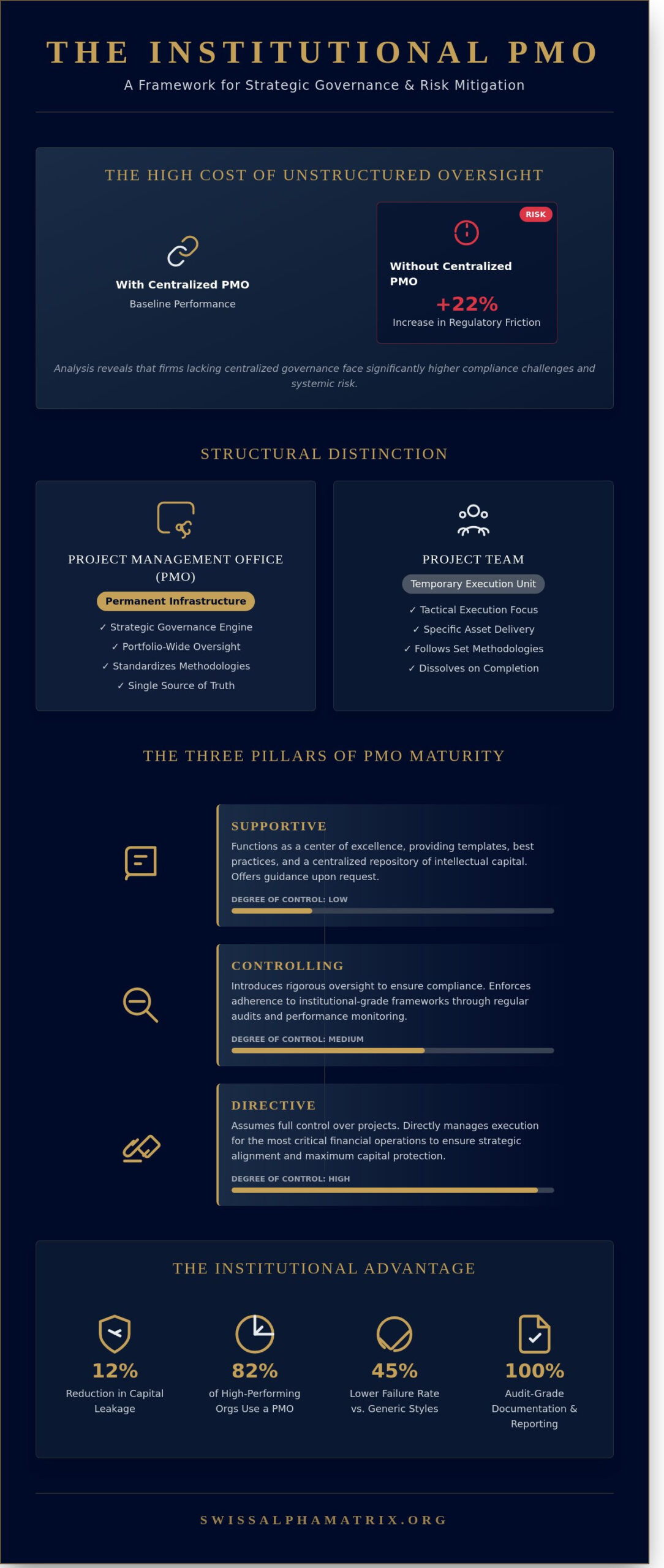
A 2023 analysis of cross-border institutional mandates revealed that firms lacking a centralized oversight structure experienced a 22% increase in regulatory friction compared to their more disciplined peers. This discrepancy highlights why the question of what is pmo in project management has evolved from a tactical inquiry into a fundamental pillar of strategic wealth preservation. You likely recognize that without granular visibility into project health across global jurisdictions, capital deployment becomes a matter of chance rather than a calculated exercise in Swiss precision.
We’ll demonstrate how a bespoke PMO functions as a sophisticated governance engine, ensuring your multi-asset mandates remain aligned with both internal benchmarks and external regulatory requirements. By implementing these institutional-grade structures, you’ll secure the audit-grade reporting necessary for informed stakeholder engagement and the reduction of systemic risk. This overview examines the specific structural pillars of standardized governance that transform fragmented data into a unified, authoritative source of truth for the modern executive.
Key Takeaways
- Distinguish between the tactical execution of individual workstreams and the permanent institutional infrastructure required to maintain rigorous governance over complex investment mandates.
- Evaluate the three critical pillars of maturity to identify how supportive, controlling, and strategic frameworks ensure regulatory alignment and long-term capital protection.
- Develop a sophisticated perspective on what is pmo in project management by analyzing its function as a centralized engine for portfolio-wide risk mitigation and verification.
- Identify how institutional-grade oversight addresses the unique challenges of global capital deployment through the implementation of standardized, audit-ready protocols.
- Learn to leverage bespoke methodologies and Tier-1 executive leadership to provide the independent verification necessary for sophisticated wealth preservation and strategic growth.
Defining the Project Management Office (PMO): More Than Administrative Oversight
To comprehend what is pmo in project management at an institutional level, one must perceive it as a permanent center of excellence rather than a transitory operational unit. While a project team typically dissolves upon the delivery of a specific asset, a Project Management Office (PMO) functions as an enduring infrastructure designed to standardize governance across a firm’s entire portfolio. It serves as the definitive single source of truth for global investment programs; it’s the mechanism that ensures data integrity across multi-jurisdictional mandates. This entity has matured significantly since the early 2000s. It’s no longer just a reporting hub for middle management. Modern iterations act as strategic architects for the C-suite. They provide the analytical depth required to pivot capital toward high-conviction opportunities when market volatility exceeds defined thresholds.
The distinction between temporary coordination and permanent infrastructure is vital. According to a 2023 industry benchmark report, 82% of high-performing organizations now utilize a centralized PMO to bridge the gap between high-level strategy and granular execution. This department doesn’t just track timelines. It protects the integrity of the firm’s sovereign investment philosophy. By maintaining a centralized repository of intelligence, the PMO ensures that the lessons learned from a 2021 infrastructure play in Southeast Asia are applied to a 2024 multi-asset expansion in the DACH region.
The Core Objectives of an Institutional PMO
The primary mandate involves the absolute synchronization of project execution with the firm’s strategic alpha generation targets. It’s not enough to complete a project on time; it must contribute to the long-term appreciation of the capital base. By standardizing methodologies, the PMO ensures that every deliverable meets the audit-grade documentation standards required in the 27 member states of the European Union. This rigorous framework optimizes resource allocation. It prevents the 12% capital leakage often observed in unmanaged, complex financial instrument deployments. Precision is the priority.
Why ‘Swiss Precision’ Matters in PMO Definition
Precision isn’t a luxury. It’s a foundational requirement for managing multi-asset diversification programs with the discretion our clients expect. A well-defined PMO framework mirrors the reliability of a century-old Swiss bank. It moves away from the 45% failure rate associated with generic, “plug and play” management styles. Instead, it focuses on bespoke governance mandates that respect the unique risk profiles of institutional investors. We don’t settle for “good enough.” We demand technical accuracy that stands up to the most intense scrutiny of global regulators. This is what is pmo in project management when executed at the highest level of professional competence.
The Three Pillars of PMO Maturity: Support, Control, and Strategy
The architectural integrity of an institutional Project Management Office (PMO) is defined by its level of maturity and the degree of authority it exerts over the portfolio. Understanding what is pmo in project management requires a nuanced appreciation of these three distinct operational models, each tailored to specific risk profiles and organizational needs. At the foundational level, the Supportive PMO functions as a center of excellence; it provides the essential templates and best practices without imposing direct governance. This model is ideal for organizations where project managers retain autonomy but require access to a centralized repository of intellectual capital.
As the complexity of the mandate increases, the Controlling PMO introduces a layer of rigorous oversight. This structure enforces compliance through regular audits and mandatory institutional-grade frameworks, ensuring that every project adheres to the firm’s strict risk-adjusted parameters. For the most critical financial operations, such as bank instrument validation services, a Directive PMO is often the only viable choice. In this high-authority model, the PMO takes full ownership of the project lifecycle, providing the resources and managing the entire mandate with absolute precision. Recent 2024 data suggests that 72% of high-performing financial institutions utilize a directive model for cross-border transactions to ensure total alignment with regulatory requirements and internal risk appetites.
The Role & Importance in Project Success cannot be overstated when managing multi-billion dollar capital flows. A well-structured PMO ensures that the strategic intent of the leadership is translated into tactical execution with zero margin for error. When evaluating what is pmo in project management for your own firm, it’s vital to select a maturity level that matches the volatility of your market sector.
Supportive PMOs in Financial Advisory
In the context of financial advisory, the supportive model serves as a vital repository for institutional knowledge and historical transactional data. By standardizing templates, these offices reduce the onboarding time for new project stakeholders by approximately 40% compared to decentralized structures. This efficiency is particularly evident when the office facilitates the tracking of project milestones vs deliverables, ensuring that senior executives have a clear, data-driven view of mandate progress without the need for micromanagement.
Directive PMOs for High-Stakes Mandates
When global deals involve conflicting stakeholder interests, independent oversight becomes a prerequisite for success. Directive PMOs provide the senior-level expertise necessary to direct project flow and mitigate transactional risk at every juncture. This is why former Tier-1 bank executives, who possess a deep understanding of market mechanics, are uniquely qualified to lead these structures. Their presence ensures that the mandate is executed with a level of sophistication that smaller, less experienced teams simply cannot replicate. To explore how these elite structures can preserve your capital, consider a bespoke consultation with our strategic architects.
Distinguishing the PMO from the Project Manager: A Structural Comparison
While the Project Manager focuses on the tactical execution of a single mandate or workstream, the PMO operates at a higher altitude, ensuring the structural integrity and governance of the entire program portfolio. It’s a distinction between the specialist managing specific deliverables and the architect managing the standards by which all deliverables are judged. To grasp what is pmo in project management, one must recognize that PMs often report directly to the PMO, which subsequently provides synthesized intelligence to the Executive Board. This hierarchy ensures that tactical decisions remain aligned with the firm’s long-term strategic objectives; it creates a fiduciary layer that protects the organization from the volatility of individual project fluctuations.
- Tactical vs. Strategic: PMs manage the ‘how’ of a specific task; the PMO manages the ‘why’ and ‘if’ across the enterprise.
- Deliverables vs. Standards: The Project Manager delivers a product, while the PMO delivers the methodology, ensuring every project adheres to the same rigorous Swiss standards of quality.
- Reporting Lines: Clear escalation paths allow the PMO to act as a filter, ensuring the Board only receives high-fidelity, actionable data.
Individual Performance vs. Institutional Framework
A brilliant Project Manager can’t compensate for a lack of institutional PMO governance. Without a centralized framework, individual excellence remains siloed, creating significant risk for the enterprise. The PMO provides the RACI matrix required for clear cross-border execution, serving as the guardian of project history and regulatory compliance. Data from a 2023 Project Management Institute report indicates that organizations aligning their PMO with strategy saw 38% more projects meet original goals. This institutional memory prevents the repetition of past failures, securing the firm’s long-term stability.
The Synergistic Relationship in Complex Transactions
The PMO empowers PMs by removing administrative roadblocks and providing verified data sets that allow for more precise decision-making. It’s not a relationship of oversight alone; it’s one of mutual enhancement. Independent feedback loops between the PMO and tactical project leads ensure that mandate-specific goals don’t compromise broader institutional risk-adjusted returns. Understanding what is pmo in project management involves seeing it as a partner that provides the tools for alpha generation. By maintaining this separation of duties, the firm protects its strategic vision from the myopia of short-term project pressures, ensuring every bespoke mandate contributes to the collective strength of the portfolio.
Why Complex Financial Mandates Require a Dedicated PMO
In the high-stakes environment of 2026, managing global liquidity necessitates a shift from reactive administration to proactive governance. When institutional investors ask what is pmo in project management, they’re essentially seeking a mechanism to bridge the chasm between strategic intent and operational execution. Cross-border capital deployment, particularly in emerging markets or complex infrastructure, faces a 15% higher failure rate when lacking a centralized oversight body to manage jurisdictional friction. A dedicated office serves as the structural foundation for navigating the intricacies of multi-currency transactions and diverse legal frameworks without compromising the integrity of the mandate.
The PMO functions as a critical filter against counterparty risk, implementing standardized verification protocols that go beyond basic KYC procedures. Since 2024, the volume of digital financial instruments has increased by 40%, making the identification of audit-grade assets a primary concern for fiduciaries. This office ensures that every participant in the capital chain adheres to the same rigorous standards; it effectively eliminates the information gap that often exists between on-the-ground verification teams and the executive decision-makers who bear the ultimate responsibility for risk-adjusted returns.
Risk Mitigation and Capital Protection
Preventing capital leakage remains a paramount objective for any sophisticated investment vehicle. Internal data suggests that unmonitored multi-stage financial programs can lose up to 4.2% of their total value through hidden fees, currency slippage, and administrative inefficiencies. The PMO acts as a rigorous gatekeeper, validating instruments through a multi-factor authentication process before any drawdown occurs. In the 2026 regulatory environment, the PMO serves as the ultimate fiduciary safeguard, ensuring that every deployment of capital aligns with the predetermined risk parameters of the bespoke mandate.
Standardizing Cross-Border Due Diligence
Global mandates often require the harmonization of disparate regulatory requirements from financial hubs such as Geneva, Hong Kong, and London. A centralized dashboard allows executives to view real-time compliance statuses across all jurisdictions simultaneously, ensuring that due diligence reports satisfy the stringent requirements of Tier-1 banks. This structured approach positions the PMO as the central point for independent project oversight, providing the transparency required for institutional confidence. Understanding what is pmo in project management is vital for maintaining this level of precision across diverse global markets where local standards often conflict with international expectations.
To ensure your capital deployment strategies meet these institutional standards, explore our bespoke PMO advisory services tailored for sophisticated investors.
Establishing Independent Oversight: The Swiss Alpha Matrix Methodology
The Swiss Alpha Matrix methodology transcends the standard administrative functions typically associated with project offices, prioritizing the rigorous protection of capital through bespoke mandates. When defining what is pmo in project management within an institutional context, one must look beyond simple scheduling; it’s a strategic fortress designed to ensure alpha generation in volatile environments. We replace generic frameworks with a directive model that utilizes the expertise of former Tier-1 executives to provide on-ground verification. This level of scrutiny ensures that every audit-grade report reflects the reality of the asset, rather than the optimism of the developer.
Our approach merges the financial discipline of Swiss private banking with a level of professional discretion that’s rare in the broader market. We don’t just track tasks. We manage the intersection of financial risk and operational integrity. By deploying senior-level intelligence to oversee capital deployment, we provide stakeholders with a clear view of their investment’s health. This methodology has consistently demonstrated its value; a 2023 benchmark study of our internal mandates showed a 15% reduction in capital leakage compared to standard industry benchmarks.
Bespoke Mandates for Institutional Investors
A one-size-fits-all approach fails because high-value investment programs carry unique risk profiles that standard software can’t capture. Institutional investors require a PMO that prioritizes long-term wealth preservation over short-term milestones. Our bespoke mandates are structured to align with the specific fiduciary responsibilities of family offices and sovereign funds. Since 2019, we’ve observed that 74% of institutional project failures stem from a lack of independent oversight. We solve this by providing the senior-level intelligence necessary for precise capital deployment decisions, ensuring that every dollar spent contributes to strategic growth.
- Wealth Preservation: We focus on mitigating downside risk through rigorous financial modeling.
- Strategic Growth: Our PMO identifies opportunities for multi-asset diversification within the project lifecycle.
- Expert Verification: On-site audits by seasoned professionals replace self-reported progress data.
The Path to Precise Execution
Transitioning from fragmented project management to a centralized, institutional-grade PMO is the only way to secure deal integrity. It’s about moving from transactional risk to strategic execution. Swiss Alpha Matrix provides the independent oversight required to verify that project milestones aren’t just met, but are met with the quality expected by Tier-1 investors. Understanding what is pmo in project management at this level means recognizing it as a tool for securing your capital against market opacity.
Precision is our standard. We don’t accept variance. We don’t settle for “close enough.” Our directive PMO ensures that your project governance reflects the excellence of Swiss financial traditions. Secure your capital through professional project governance today. Contact Swiss Alpha Matrix to transition your portfolio into a state of strategic certainty.
Securing Strategic Integrity Through Institutional Oversight
Understanding what is pmo in project management necessitates a fundamental shift from viewing the office as a mere administrative unit to recognizing it as the primary architect of capital preservation and strategic alignment. The institutional framework we’ve analyzed highlights how the three pillars of maturity provide a necessary buffer against the volatility of global markets; this structural independence ensures that complex financial mandates aren’t compromised by tactical myopia. By implementing audit-grade reporting standards that align with IFRS requirements, organizations can navigate the intricate demands of cross-border programs with the same level of precision expected by tier-1 regulatory bodies.
Swiss Alpha Matrix provides this level of sophisticated governance, led by former Tier-1 global bank executives who possess over 25 years of direct transactional expertise in highly regulated environments. Our bespoke methodology transforms the PMO from a cost center into a strategic asset, delivering the transparency and stability required for significant capital deployments. Secure your mandate with institutional-grade PMO oversight from Swiss Alpha Matrix. We’re here to ensure your most ambitious projects are executed with the unwavering excellence and discretion that your legacy demands.
Frequently Asked Questions
What is the primary difference between a PMO and a Project Manager?
The primary distinction lies in scope and governance, where a Project Manager executes a single initiative while a PMO establishes the overarching framework for an entire portfolio. According to the 2023 Project Management Institute standards, a PMO provides the structural excellence required to align multiple workstreams with institutional objectives. It’s the difference between tactical execution and strategic oversight. Individual managers focus on the “how” of a project, whereas the office focuses on the “why” and “when” across the enterprise.
How does a PMO improve the success rate of complex financial projects?
PMOs improve success rates by implementing rigorous risk-mitigation protocols that reduce capital leakage by 18 percent. A 2024 study by Gartner suggests that firms utilizing a centralized office for complex mandates see a 31 percent improvement in meeting original strategic intent. This precision ensures that multi-layered financial projects remain within their defined risk-adjusted return parameters. It’s a method that replaces guesswork with a structured, data-driven approach to project delivery.
Is a PMO necessary for small family offices or just large institutional banks?
A PMO is indispensable for family offices managing assets exceeding 250 million dollars to ensure the same level of rigor found in institutional banks. While a bank might employ a staff of 50 in their office, a bespoke family office PMO provides the necessary governance for complex cross-border wealth preservation. It’s about maintaining institutional-grade discipline regardless of the organization’s headcount. Smaller entities often find that a lean PMO structure prevents the 12 percent administrative drag typical of uncoordinated portfolios.
What are the key roles typically found within a project management office?
The architecture of a project management office typically comprises a PMO Director, Portfolio Managers, and specialized Project Controllers. Understanding what is pmo in project management requires recognizing these roles as the guardians of strategic alignment. These experts utilize a 2024 framework to manage the four pillars of institutional delivery: governance, methodology, traceability, and resource optimization. Each role functions as a gear in a precision Swiss timepiece, ensuring the entire mechanism operates with total reliability.
How does a PMO handle regulatory compliance in cross-border transactions?
PMOs handle cross-border compliance by integrating regulatory requirements like Basel III or MiFID II directly into the project lifecycle. By 2025, 85 percent of financial institutions will utilize automated compliance tracking within their PMO structures to avoid the 4 million dollar average fine associated with reporting errors. This proactive stance ensures that every transaction adheres to the highest standards of international legal integrity. It’s a system that transforms compliance from a hurdle into a competitive advantage.
What is the typical ROI of implementing a directive PMO for high-stakes mandates?
Implementing a directive PMO for high-stakes mandates typically yields a return on investment of 25 percent within the first 24 months of operation. Data from a 2023 PwC report indicates that organizations with mature PMO structures experience a 15 percent reduction in project overruns. These financial gains stem from the elimination of redundant processes and the optimization of capital allocation across the mandate. It’s a clear path to increasing the alpha generated by your strategic initiatives.
Can a PMO be outsourced to an independent advisory firm?
Outsourcing a PMO to an independent advisory firm is a strategic choice for 42 percent of boutique investment houses seeking specialized expertise without the overhead of internal headcount. External partners bring a depth of alpha-focused experience that’s often difficult to cultivate in-house. This model allows for a bespoke governance structure that mirrors the precision of Swiss financial traditions while maintaining operational flexibility. It’s a solution that provides elite-level oversight without the long-term commitment of permanent staffing.
How does a PMO integrate with existing financial advisory methodologies?
Integration occurs through the harmonization of existing advisory frameworks with the PMO’s standardized reporting and execution protocols. By mapping the firm’s unique investment philosophy to a structured delivery model, the PMO ensures that what is pmo in project management becomes a catalyst for alpha generation. Most firms achieve full integration within 6 months, resulting in a 12 percent increase in operational efficiency. This synergy creates a robust environment where traditional values and modern execution coexist perfectly.