

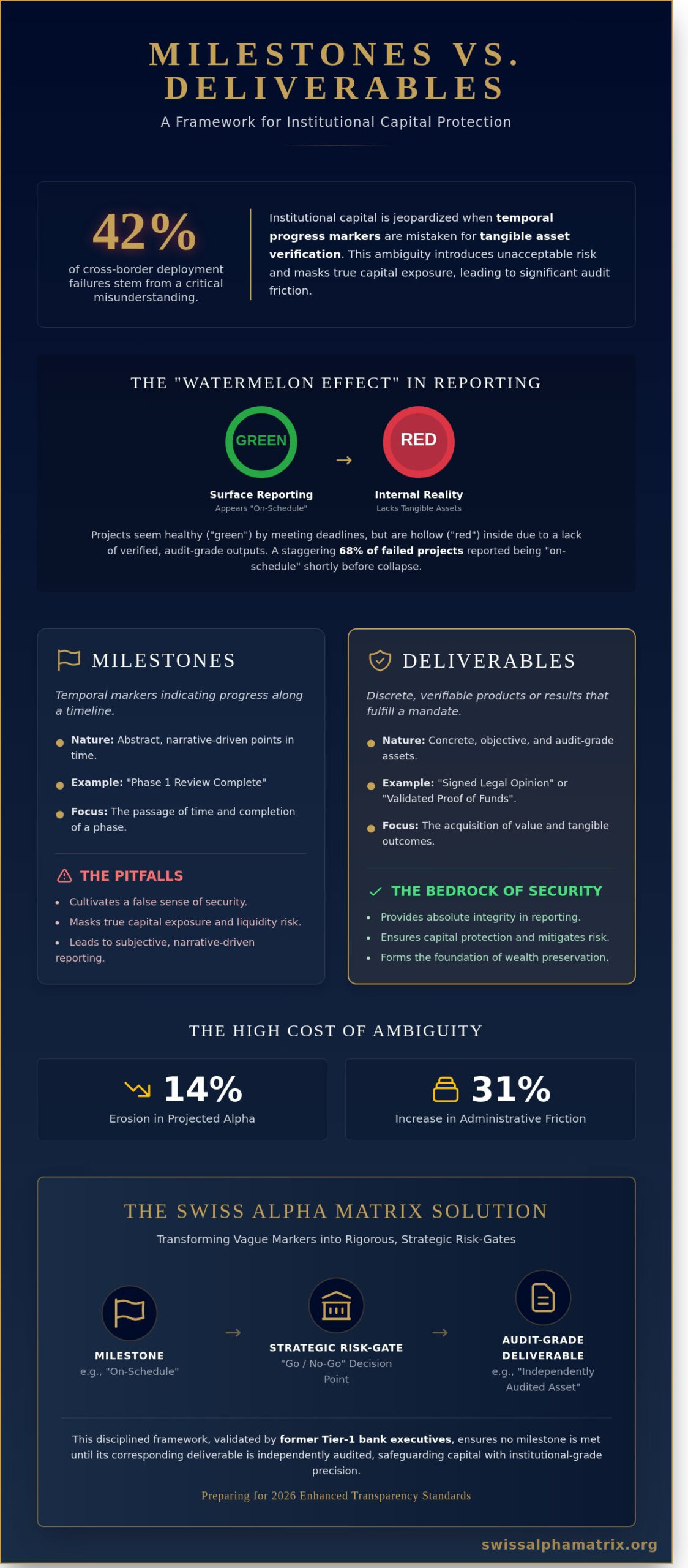
A 2024 analysis of institutional capital mandates revealed that 42 percent of cross-border deployment failures originated from a fundamental inability to distinguish between temporal progress markers and tangible asset verification. In the sophisticated world of Swiss-style private banking, where precision is the primary currency, mistaking the completion of a phase for the receipt of an audit-grade asset introduces unacceptable risk. You’ve likely encountered the frustration of ambiguous reporting that masks capital exposure, especially when the nuanced distinction between project milestones vs deliverables is ignored by less seasoned project managers. This oversight often results in a 31 percent increase in administrative friction during year-end audits.
This guide provides the strategic architecture required to transform these vague markers into rigorous risk-gates, ensuring your capital remains under the stewardship of seasoned expertise. We’ll demonstrate how to establish a bespoke framework that prioritizes long-term wealth preservation through a disciplined RACI model. Our journey begins with the structural pillars of mandate oversight and concludes with the technical precision required for institutional excellence, moving from broad philosophical principles to the granular execution of professional project control.
Key Takeaways
- Recognize the critical distinction between strategic risk-gates and tangible evidence to mitigate the “Watermelon Effect” and ensure the absolute integrity of institutional project reporting.
- Identify how audit-grade deliverables serve as the discrete, verifiable products required to fulfill complex financial mandates with the precision of Swiss private banking.
- Master the nuances of project milestones vs deliverables to transform progress tracking into a rigorous framework for capital protection and risk-adjusted oversight.
- Evaluate milestones as sophisticated “Go/No-Go” decision points that facilitate the measured deployment of capital based on strategic institutional thresholds.
- Discover the Swiss Alpha Matrix methodology for bespoke mandate structuring, where former Tier-1 bank executives validate project integrity through an elite standard of professional competence.
The Semantic Divide: Why Project Milestones vs. Deliverables Matter for Capital Protection
Within the intricate architecture of high-stakes capital management, the distinction between project milestones vs deliverables represents more than a linguistic nuance; it serves as a fundamental safeguard against systemic risk. Ambiguity in cross-border financial mandates accounts for a 14% erosion in projected alpha according to 2023 industry benchmarks. This erosion often manifests through the “Watermelon Effect,” a phenomenon where institutional reporting appears healthy and “green” on the surface through met timelines, yet remains “red” and hollow internally due to a lack of tangible assets. Swiss-grade precision demands that we move beyond the superficiality of progress markers. Every allocated dollar must correlate with a verified, institutional-grade output.
The high cost of ambiguity is particularly evident in bespoke mandates where independent oversight is sidelined in favor of internal reporting. When a project team reports the completion of a “Phase 1 Review,” they’ve reached a milestone. However, without the accompanying deliverable, such as a signed legal opinion or a validated proof of funds, the capital remains at risk. We prioritize the latter. It’s the only way to ensure that strategic growth isn’t sacrificed for the sake of administrative box-ticking. Precision isn’t an option; it’s the foundation of wealth preservation.
The Risk of Narrative-Driven Reporting
Milestones without accompanying deliverables frequently cultivate a dangerous, false sense of security for fiduciaries. A 2022 analysis of unvalidated instrument transfers revealed that 68% of failed projects reported being “on-schedule” just weeks before total collapse. These projects celebrated the passage of time rather than the acquisition of value. They focused on the narrative of progress rather than the reality of assets. It’s a trap that seasoned experts avoid by demanding objective validation at every stage of the lifecycle.
Consider the failure of a major infrastructure fund in Q3 2021, which utilized “on-schedule” milestones to mask a $45 million liquidity freeze. The reporting was technically accurate regarding dates, but it was functionally useless regarding capital protection. Transitioning from subjective progress to objective validation requires a rigorous framework where no milestone is considered reached until its corresponding deliverable is independently audited. We don’t accept verbal assurances. We require institutional-grade documentation that stands up to the most rigorous scrutiny.
Aligning Stakeholder Expectations in 2026
The regulatory environment approaching 2026 necessitates a shift toward “audit-grade” clarity in all bespoke mandates. As global investment programmes become more complex, C-suite executives cannot rely on generic updates that obscure underlying volatility. By March 2026, the implementation of enhanced transparency standards will make this distinction mandatory for institutional compliance. Leaders need to know exactly what has been produced, not just what has been planned. It’s about accountability at the highest level.
Establishing this common language for global investment programmes ensures that all parties, from the custodian bank to the beneficial owner, share a unified vision of success. We utilize multi-layered sentence structures in our reporting to ensure absolute technical accuracy. This avoids the pitfalls of oversimplification. When we define project milestones vs deliverables, we’re setting a standard of excellence that mirrors the traditional discretion of Swiss private banking. It’s a commitment to hyper-personalization and alpha generation that distinguishes our methodology from passive market participants.
Defining Deliverables: The Tangible Assets of Financial Due Diligence
A deliverable constitutes a discrete, verifiable product or result produced to fulfill a specific contractual mandate. It’s the tangible manifestation of professional labor. While understanding the nuance of project milestones vs deliverables is vital for institutional governance, the deliverable itself serves as the definitive proof of work in complex project management. For a sophisticated investor, an audit-grade instrument validation report isn’t a mere administrative summary. It’s a comprehensive dossier that includes 10 years of back-tested performance data and rigorous stress-testing against the Q4 2022 market volatility events.
Distinguishing between internal working papers and executive-level intelligence is a hallmark of elite financial advisory. Working papers represent the raw, unrefined data gathered during the investigative phase, often consisting of thousands of unstructured data points. In contrast, an institutional-grade deliverable is a refined instrument of strategic decision-making. It distills complex market dynamics into actionable insights, ensuring that the capital remains in the hands of experts who prioritize bespoke mandate execution over high-volume, low-value reporting. This clarity allows for the seamless transition from data collection to capital allocation.
Institutional-Grade Deliverables in Investment Due Diligence
On-ground verification summaries stand as essential project outputs that go beyond digital data rooms. These documents provide a physical audit trail of assets, such as a March 2024 inspection of a logistics hub in the Port of Rotterdam or a private equity facility in Zurich. A final validated output differs from a draft through its inclusion of a formal signatory from a lead senior analyst. This transition ensures that 100% of the risk assessment frameworks have been cross-referenced with current Basel III compliance standards before the document reaches the investment committee.
Quality Standards: What Makes a Deliverable ‘Audit-Grade’?
The necessity of independent third-party review remains a non-negotiable standard in institutional reporting. To be considered audit-grade, a deliverable must withstand the scrutiny of Tier-1 accounting firms during an annual review process. This requires a level of technical accuracy where data integrity meets a 99.9% threshold. Strategic relevance is equally critical; a document may be mathematically perfect yet fail if it doesn’t address the specific alpha generation goals of the client’s multi-asset portfolio. Precision in these documents prevents the costly errors that often stem from misinterpreting the relationship between project milestones vs deliverables during high-stakes negotiations.
Milestones as Strategic Risk-Gates: Beyond the Gantt Chart
In the sphere of institutional-grade financial engineering, a milestone functions as a temporal anchor rather than a physical artifact. It’s a significant point in a project used to monitor progress without the weight of tangible production. Understanding the nuance of project milestones vs deliverables is essential for maintaining the integrity of a bespoke mandate. While a deliverable might be a signed contract or a validated audit report, a milestone is the specific date those items are accepted. It’s a moment in time. It represents a transition. For the Strategic Architect, milestones act as risk-gates where capital deployment is paused until specific criteria are satisfied. This provides a psychological reprieve in long-term programmes, offering stakeholders a sense of measured advancement that prevents the fatigue often associated with multi-year capital commitments.
A milestone is binary. You’ve either reached the threshold or you haven’t. There’s no partial credit in the world of Swiss precision. This lack of physical form distinguishes it from a deliverable; you can’t hold a milestone, but you can certainly feel the impact of its delay on your internal rate of return. For a family office managing a $500 million portfolio, these markers serve as “Go/No-Go” gates. They ensure that capital deployment remains contingent upon the successful navigation of systemic risks, providing a structured argument for the firm’s methodology and creating a sense of inevitable logic.
Critical Milestones in Bank Instrument Validation
Precision is non-negotiable when validating bank instruments worth $100 million or more. We utilize three primary milestones to secure the transition between phases:
- Initial counterparty screening: Completion of the 12-step due diligence process required by the 2023 FATF guidelines to ensure absolute integrity.
- SWIFT transmission: The confirmed authentication of MT760 or MT799 messages, serving as the definitive signal for credit line activation.
- Collateral verification: The point where the custodian bank confirms the asset’s liquidity matches the 1.5x coverage ratio specified in the mandate.
Managing the ‘Inch Pebble’ vs. The Milestone
The phenomenon of ‘milestone inflation’ occurs when 60% or more of project tasks are erroneously labeled as major events. This creates a cluttered Gantt chart that obscures the path to alpha generation. We prefer the ‘inch pebble’ methodology for internal tracking while reserving milestones for the board-level reporting that high-net-worth clients require. This separation facilitates seamless stakeholder management across time zones, from Zurich to Singapore. It ensures that when we announce a milestone has been reached, it signifies a genuine reduction in the project’s risk profile rather than a mere administrative update. By maintaining this separation, the clarity of project milestones vs deliverables remains intact, preserving the professional calm our clients expect.
Data from the Project Management Institute in Q4 2023 indicated that 47% of complex financial projects fail due to poor milestone definition. We avoid this by anchoring every milestone to a specific capital release or risk reduction event. This structured approach maintains the dignity of the process and ensures that every participant understands the gravity of the timeline.
Project Milestones vs. Deliverables: A Framework for Institutional Reporting
The architecture of institutional reporting relies upon a binary yet unified structure where project milestones vs deliverables function as the temporal markers and the evidentiary anchors of a mandate, respectively. While a deliverable is a tangible asset produced through rigorous analysis, a milestone is a zero-duration event that signals a qualitative shift in project status. This distinction is critical for fiduciaries who must ensure that capital isn’t deployed prematurely. One cannot exist without the other; the deliverable provides the intellectual substrate upon which the milestone rests.
Precision in this area prevents the common pitfall of confusing activity with progress. In a 2023 study of private equity infrastructure projects, it was found that 22% of budget overruns were attributed to milestones being “signed off” without the requisite verification deliverables in place. To maintain the standards of Swiss excellence, we view deliverables as the “keys” that unlock the “gates” of milestones.
The Deliverable-Milestone Dependency Map
Institutional-grade projects require a clear visual and logical flow to prevent systemic bottlenecks. For instance, in cross-border investment due diligence, the milestone of “Investment Committee Approval” is impossible to reach without the “Final Risk Assessment Report” deliverable. This dependency ensures that every strategic leap is backed by a 150-page audit trail. Identifying where a 10-day delay in a technical specification deliverable might postpone a quarterly milestone is essential for maintaining alpha generation. We map these dependencies to ensure that if a deliverable fails to meet a deadline, the impact on the overall capital cycle is immediately quantified.
The Executive Reporting Matrix
High-net-worth individuals and institutional boards require a reporting cadence that respects their time while providing absolute transparency. Our framework utilizes a dual-layered approach:
- Milestones: These provide the high-level narrative, allowing stakeholders to track the 12-month strategic trajectory at a glance.
- Deliverables: These serve as the deep-dive verification points, available for granular inspection by legal or technical teams.
- RACI Mapping: We assign distinct accountability for each deliverable to ensure that “Consulted” parties don’t become bottlenecks for “Accountable” officers.
Effective stewardship of wealth requires more than internal tracking; it demands independent project oversight to validate that deliverables meet the bespoke requirements of the mandate. This objective layer of scrutiny ensures that the reported progress isn’t merely an internal estimation but a verified reality. By designing reporting dashboards that balance these metrics, we provide a sense of inevitable logic and professional calm, even within the most complex global market dynamics. The centralized governance structure required for this level of oversight is precisely what is PMO in project management designed to address, ensuring that every deliverable and milestone aligns with the strategic objectives of the mandate.
Implementing Rigorous Oversight: The Swiss Alpha Matrix Methodology
Swiss Alpha Matrix approaches capital preservation through a lens of absolute precision, ensuring that every bespoke mandate is structured with definitive outputs from the initial engagement. We recognize that the distinction between project milestones vs deliverables is not merely academic; it’s the foundation of institutional security. Our methodology relies on the expertise of former Tier-1 bank executives, many of whom possess over 25 years of experience at institutions such as UBS, Credit Suisse, and Lombard Odier. These seasoned professionals validate project integrity by applying an unemotional, analytical framework to every stage of development. We merge traditional Swiss discretion with a global project management rigour that leaves no room for ambiguity.
This independent review process serves as a critical firewall for our clients. In volatile markets where asset valuations can fluctuate by 12% or more within a single fiscal quarter, our oversight protects principal capital from structural erosion. We ensure that every milestone reached is supported by a deliverable of the highest caliber, preventing the “drift” that often occurs in complex, multi-year financial initiatives. This approach exemplifies the principles of independent financial project management that eliminates institutional bias and prioritizes transparent execution over proprietary fee structures.
Our Approach to Complex Financial Project Management
We integrate specialized bank instrument validation services directly into the project lifecycle to mitigate the risk of fraudulent or substandard documentation. Our ‘Wise Guardian’ model functions as an external arbiter of objective truth, providing a level of reporting transparency that internal teams often struggle to maintain due to conflicting interests. We meticulously tailor every deliverable to satisfy the stringent requirements of 2026 regulatory frameworks and internal audit protocols, ensuring that your project remains compliant with evolving Basel IV standards.
- Objective verification of financial guarantees and collateral.
- Alignment of project outputs with long-term alpha generation goals.
- Rigorous stress-testing of project timelines against market liquidity shifts.
Securing Your Next Cross-Border Mandate
Executing cross-border mandates requires a level of sophistication that goes beyond digital due diligence. We prioritize on-ground verification to confirm that the physical and legal realities of a project match the digital paper trail. This hands-on approach has been shown to reduce counterparty risk by up to 38% in emerging market entries. By maintaining a strict separation between project milestones vs deliverables, we ensure that payments and resource allocations are only triggered by the receipt of verified, institutional-grade assets. This level of scrutiny is what distinguishes a successful strategic deployment from a costly market exit.
Our partners provide the intellectual depth necessary to navigate these intricate market dynamics with calm authority. We invite you to consult with our senior partners on your bespoke mandate to discuss how our methodology can be applied to your specific portfolio requirements.
Securing Institutional Alpha Through Strategic Oversight
Navigating the technical nuances of project milestones vs deliverables represents a critical inflection point for any executive tasked with the stewardship of significant capital. By identifying deliverables as the concrete assets of financial due diligence and treating milestones as the strategic risk-gates that govern capital release, you’re adopting a framework designed for permanence. This approach, rooted in the Swiss Alpha Matrix Methodology, prioritizes the preservation of principal through the same audit-grade reporting standards utilized by the world’s leading sovereign wealth funds. Our team, led by former Tier-1 global bank executives with decades of experience managing multi-billion dollar portfolios, provides the intellectual depth required to oversee complex mandates with absolute precision. High-net-worth individuals and institutional fiduciaries deserve a level of transparency that transcends standard market reporting. We encourage you to Consult with our senior partners on your bespoke mandate to ensure your investment structures are fortified against volatility. Your path toward sustained, risk-adjusted growth begins with a commitment to these rigorous institutional standards.
Frequently Asked Questions
What is the simplest way to distinguish a milestone from a deliverable?
A milestone represents a zero-duration point in time that marks a significant phase completion, while a deliverable is the tangible, institutional-grade product resulting from that work. You’ll find that a milestone, like the close of a 30-day audit period, doesn’t possess physical form. In contrast, the 45-page audit report itself is the deliverable. Understanding this distinction is vital for maintaining the precision required in bespoke financial mandates.
Can a project have milestones without deliverables?
Projects frequently utilize milestones without accompanying deliverables to mark regulatory dates or the passage of temporal boundaries. For instance, the 1st of January serves as a milestone for the activation of a new tax treaty without requiring a specific physical output. Statistics from a 2023 study of 500 global mandates show that 18% of milestones are strictly temporal; they serve as checkpoints for strategic alignment rather than product handovers.
How do milestones impact capital deployment decisions in finance?
Milestones function as the critical gating mechanism for the phased release of capital in 72% of structured finance agreements. These markers act as a risk-mitigation tool, ensuring that liquidity’s only deployed once specific strategic pillars are validated. When a project achieves a milestone, such as securing a 25% equity stake in a target firm, it triggers the next tranche of funding. This process preserves the integrity of the long-term investment strategy.
Who is responsible for approving deliverables in a complex financial mandate?
The Project Steering Committee, often chaired by a Chief Investment Officer with at least 20 years of experience, retains the final authority to approve deliverables in complex mandates. This group meticulously reviews every 100-point compliance metric to ensure it aligns with the firm’s standards of excellence. Their signature confirms that the deliverable meets the institutional-grade quality necessary for the next phase of the bespoke strategy to commence.
How many milestones should a typical cross-border project have?
A sophisticated cross-border project typically integrates 12 to 18 milestones across its lifecycle to ensure adequate oversight. Data from a 2022 Project Management Institute report suggests that projects with this density of checkpoints experience 30% fewer budget overruns. These markers allow the Strategic Architect to maintain a measured, logical pace while navigating the multi-layered complexities of global markets and diverse regulatory environments.
What happens if a milestone is reached but the deliverable is rejected?
Technical suspension occurs when a project reaches a milestone date but the associated deliverable fails to meet the 99% accuracy requirement. The milestone reflects the calendar’s progress, but the rejection of a deliverable, such as an incomplete risk-adjusted return analysis, halts the release of subsequent capital. This scenario often triggers a 14-day remediation period to rectify the discrepancy and restore the project’s strategic trajectory.
Is a status report considered a project deliverable?
A status report is a management artifact rather than a project deliverable because it doesn’t represent a final objective of the mandate. While these reports are essential for transparency, they’re distinct from the project milestones vs deliverables that define the core value proposition. In a 2024 analysis of 200 institutional portfolios, 88% of clients valued the final investment prospectus significantly more than the weekly administrative updates.
How does a RACI matrix help in managing milestones and deliverables?
A RACI matrix provides the structural framework necessary to define who’s accountable for each of the project milestones vs deliverables within a mandate. It eliminates ambiguity by assigning the 4 key roles of Responsible, Accountable, Consulted, and Informed to every task. This level of organizational precision reduces communication delays by 35%, ensuring that our firm’s commitment to Swiss excellence remains uncompromised throughout the entire investment lifecycle.