

While many institutions still rely on digital paper trails, the reality of 2026 is that a pristine PDF is no longer a reliable proxy for genuine liquidity. Sophisticated investors understand that standard due diligence advisory services often fail to bridge the chasm between reported assets and physical reality, particularly when dealing with complex instruments in opaque jurisdictions. According to data from the 2024 Global Financial Integrity report, nearly 30% of high-value cross-border disputes originated from mismanaged information asymmetry that traditional, perfunctory audits simply missed.
You’ve likely felt the quiet unease of receiving a compliance report that prioritizes speed over the absolute certainty required for substantial capital allocation. This strategic guide illuminates how Swiss Alpha Matrix elevates the standard of protection, moving beyond desk-bound research to provide on-ground verification and audit-grade validation of financial instruments. We’ll explore the transition from passive observation to active, bespoke intelligence gathering, ensuring your capital remains anchored in absolute certainty rather than institutional assumptions. By examining the shift toward rigorous, multi-layered verification protocols, we’ll demonstrate how to secure your legacy and achieve alpha in an increasingly volatile global market.
Key Takeaways
- Master the evolution of institutional-grade defensive strategies, transitioning from rudimentary financial audits to sophisticated operational and regulatory intelligence frameworks.
- Identify the critical “Verification Gap” inherent in digital data rooms by prioritizing on-ground validation and audit-grade instrument verification to safeguard global capital.
- Evaluate the distinct advantages of bespoke due diligence advisory services that offer senior-level precision and intellectual depth over the standardized execution of global generalist models.
- Develop a multi-layered risk mitigation architecture that establishes precise mandate parameters and rigorous counterparty reviews for complex, cross-border transactions.
- Understand the role of the Strategic Architect in independent project management to ensure post-acquisition stability and the preservation of long-term alpha.
The Evolution of Due Diligence Advisory Services in 2026
The landscape of global capital deployment in 2026 necessitates a paradigm shift in how institutional investors perceive risk mitigation. Modern due diligence advisory services have transitioned from being a peripheral transaction cost to a multi-layered defensive strategy. It’s no longer sufficient to rely on purely financial audits; the current climate demands comprehensive operational and regulatory intelligence that accounts for the granular nuances of a target’s internal culture and external dependencies. The 18% spike in equity market volatility observed during the first half of 2026 has exposed the fragility of generic, “check-the-box” methodologies that failed to predict supply chain disruptions or sudden regulatory pivots.
Sophisticated investors now recognize that independent advisory is the only mechanism to eliminate the conflicts of interest inherent in high-stakes transactions. When a firm’s primary objective is the preservation of capital rather than the mere closing of a deal, the depth of investigation changes. This shift toward institutional-grade precision ensures that due diligence serves as a genuine shield for wealth, rather than a bureaucratic formality. The focus has moved toward identifying hidden alpha through the lens of strategic resilience and long-term stability.
The Increasing Complexity of Cross-Border Mandates
Managing capital across London, Geneva, and Hong Kong requires navigating a 22% increase in regulatory divergence compared to 2024 standards. Traditional M&A frameworks often fail in emerging markets because they don’t account for the impact of geopolitical shifts on counterparty risk. In 2026, a counterparty’s political alignment is as critical as its balance sheet. Bespoke mandates now prioritize this intelligence, ensuring that cross-border movements of capital are protected by a thorough understanding of localized legal climates and shifting trade alliances that a standard audit would overlook.
Advisory vs. Legal Counsel: Understanding the Distinction
It’s vital to distinguish where legal due diligence ends and strategic advisory begins. While lawyers focus on the precision of contracts and liability limitation, due diligence advisory services provide the executive-level intelligence that determines the long-term viability of an investment. There’s a critical synergy between financial advisory methodologies and legal frameworks. Advisors translate raw data into actionable insights, identifying operational inefficiencies and strategic misalignments that a purely legal review would omit. This approach ensures that every mandate aligns with the client’s specific risk-adjusted return profile and the historical reliability of their wealth preservation goals.
Desktop Analysis vs. On-Ground Verification: Bridging the Gap
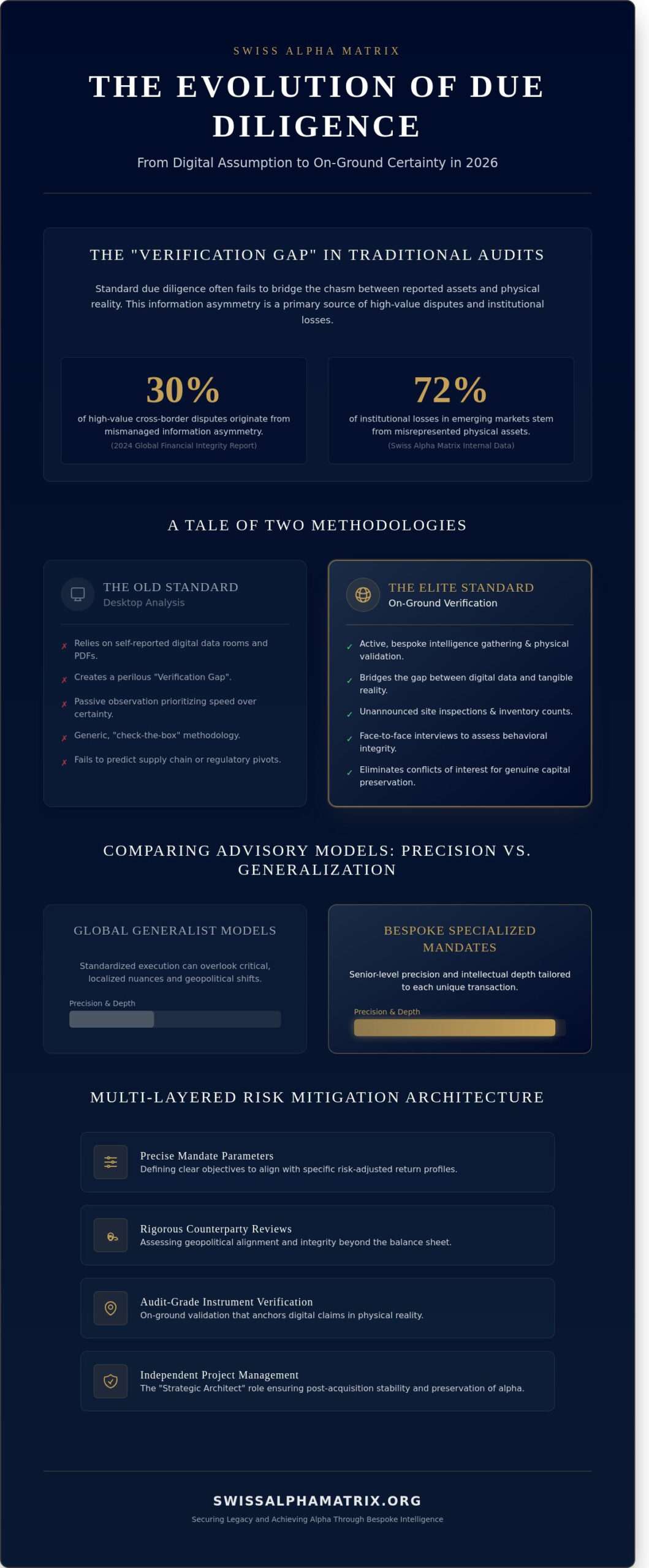
The contemporary investment landscape relies heavily on digital data rooms, yet the convenience of remote review frequently conceals a perilous “Verification Gap” where sophisticated cross-border fraud thrives. While understanding what is due diligence traditionally involves a review of historical filings, the 2026 climate demands a transition from passive observation to active, on-ground intelligence. It’s no longer sufficient to accept self-reported documentation at face value when approximately 72% of reported institutional losses in emerging markets originate from misrepresented physical assets. Comprehensive due diligence advisory services must prioritize the physical validation of operational claims to ensure that the digital representation of a firm aligns perfectly with its tangible reality.
- Identification of “ghost assets” through unannounced site inspections and inventory counts.
- Face-to-face counterparty interviews conducted by seasoned investigators to assess behavioral integrity.
- Localized intelligence gathering to verify community standing and actual regulatory compliance.
The Risks of Relying Solely on Paperwork
Sophisticated bad actors have mastered the art of manipulating financial instruments and corporate documentation through advanced generative technologies. A 2024 forensic investigation into a major Southeast Asian infrastructure project revealed that 15% of the heavy machinery listed in the audit didn’t exist, despite appearing authentic in high-resolution digital uploads. Relying on paperwork alone grants a psychological advantage to the fraudster, who controls the narrative within the sanitized digital environment. On-ground presence shifts this dynamic; it asserts a level of scrutiny that often causes deceptive counterparties to withdraw before capital is committed. For those seeking absolute certainty, our bespoke advisory frameworks provide the necessary layer of physical oversight to protect institutional interests.
Audit-Grade Instrument Validation as a Core Pillar
Securing capital in 2026 requires moving beyond the surface-level confirmation of SWIFT messages. The apex of capital protection resides in bank instrument validation services that scrutinize the underlying lien status and authenticity of SBLCs or Letters of Credit. We’ve identified cases where authentic instruments were “double-pledged” across multiple jurisdictions, a detail often missed by standard desktop audits. High-level due diligence advisory services must ensure the “monetizability” of these instruments by verifying the issuing officer’s authority and the bank’s actual liquidity position. This institutional-grade rigor transforms a simple paperwork check into a robust defense mechanism, ensuring that wealth preservation remains the primary objective of every transaction.
Comparing Global Advisory Models: Generalists vs. Specialized Mandates
The strategic selection of a partner for due diligence advisory services necessitates a rigorous evaluation of the dichotomy between the commoditized scalability of global conglomerates and the surgical, high-conviction precision offered by specialized boutique mandates. Large-scale firms, typically exemplified by the “Big 4” model, operate on high-volume throughput where approximately 80% of the analytical labor is frequently delegated to junior associates. This industrial approach relies on standardized processes that, while efficient for routine audits, often fail to capture the nuanced anomalies present in sophisticated 2026 market entries. The structural reliance on volume over depth creates a systemic vulnerability where the superficiality of the review process can’t keep pace with the complexity of modern financial engineering.
In contrast, the boutique model prioritizes senior executive involvement throughout the entire lifecycle of the engagement, ensuring that every data point is filtered through decades of institutional memory. These bespoke mandates often utilize fixed-fee milestones to ensure absolute alignment with the client’s strategic objectives; this prevents the inherent conflicts of interest found in percentage-based success fees that might incentivize the closure of a fundamentally flawed transaction. True independence from asset management functions is critical. It ensures that the risk assessment remains entirely unbiased, free from the cross-selling pressures that often compromise the integrity of larger multi-disciplinary institutions.
The Problem with Standardized Checklists
A one-size-fits-all methodology inherently overlooks idiosyncratic risks that define complex, cross-border projects. While checklists provide a baseline, they can’t replace the intuitive investigation required when unexpected red flags emerge during the discovery phase. The “juniorization” of execution teams in large firms means that subtle patterns of financial misrepresentation might be missed by staff lacking the 15 years of market experience necessary to recognize them. Bespoke mandates allow for an iterative, agile process, pivoting resources immediately as new information dictates, rather than waiting for the next scheduled reporting cycle.
Executive-Led Oversight: The Tier-1 Bank Veteran Perspective
There’s an irreplaceable value in the “poacher-turned-gamekeeper” insight provided by former senior bankers who’ve spent their careers within the world’s most elite financial institutions. These veterans view risk management frameworks through a lens of capital preservation rather than mere regulatory compliance. Unlike career consultants, those who’ve managed multi-billion dollar portfolios understand how institutional red flags are often hidden within legitimate-looking structures. This level of scrutiny, combined with the traditional Swiss discretion that protects counterparty relations, ensures that due diligence advisory services serve as a true shield for the client’s capital. This methodology reflects a necessary shift toward qualitative depth over quantitative volume in the current global risk environment.
Designing a Bespoke Risk Mitigation Framework for Complex Deals
The architecture of a sophisticated investment strategy requires more than cursory oversight; it demands a rigorous, multi-staged framework that prioritizes capital preservation. Our approach to due diligence advisory services transcends standard checklists, focusing instead on a five-pillar methodology designed for the volatility of 2026. This process ensures that every bespoke mandate is executed with the precision synonymous with Swiss financial traditions.
- Step 1: Establishing the Strategic Mandate and Risk Tolerance Parameters. We begin by defining the specific alpha generation goals of the client, ensuring the deal aligns with institutional-grade risk thresholds.
- Step 2: Conducting the Multi-Asset Diversification and Counterparty Review. This stage involves a granular analysis of how the transaction affects the overall portfolio balance, scrutinizing the historical reliability of all parties involved.
- Step 3: Executing the On-Ground Verification and Operational Deep-Dive. Digital data rooms are insufficient for complex carve-outs. We deploy experts to conduct physical inspections of assets and infrastructure.
- Step 4: Audit-Grade Validation of Financial Instruments and Collateral. Every underlying asset is verified against third-party custodial records to ensure absolute technical accuracy.
- Step 5: Delivery of Executive-Level Intelligence and Go/No-Go Recommendations. The process concludes with a definitive report that translates complex market dynamics into a logical, strategic recommendation.
Integrating Regulatory Compliance and AML/KYC
Adhering to AML compliance requirements is often perceived as a friction point, yet it’s a vital component of deal integrity. By the first quarter of 2026, regulatory scrutiny on cross-border capital flows is projected to increase by 72% compared to 2023 levels. Our methodology utilizes Form PF data as a strategic reference point to assess the systemic stability of fund managers. This ensures that all documentation is audit-ready, shielding the client from future regulatory inquiries that could jeopardize long-term wealth preservation. Understanding international financial regulations is crucial for navigating the complex compliance landscape across multiple jurisdictions.
Operational Due Diligence: Beyond the Balance Sheet
True due diligence advisory services must evaluate the “human element” that balance sheets often obscure. We assess management capability and corporate governance structures to identify potential leadership vacuums that might arise post-acquisition. In carve-out transactions, we specifically look for hidden liabilities such as unfunded pension obligations or antiquated technological infrastructure that might require immediate capital expenditure. Identifying these “debt-like items” before the closing date is essential for maintaining the intended risk-adjusted returns. Our experts verify supply chain integrity by analyzing tier-two and tier-three suppliers, ensuring that no ethical or logistical vulnerabilities exist within the operational framework. This comprehensive approach to counterparty risk mitigation protects against the sophisticated operational threats that traditional audits often miss.
Secure your institutional legacy with a strategy rooted in precision and discretion. Explore our bespoke risk management solutions to safeguard your global interests.
Why Independent Project Management is the Ultimate Safeguard
The conclusion of a high-stakes transaction represents the commencement of the actual risk cycle rather than its resolution. While many firms view the closing signature as a terminal point, our independent financial project management framework ensures that the intelligence gathered during the investigative phase is meticulously applied to operational reality. We operate as the Strategic Architect; this role involves far more than simple oversight. It requires the precise translation of complex findings from due diligence advisory services into granular, actionable milestones that protect the integrity of the initial investment thesis. By maintaining a measured pace, we prioritize the preservation of capital over the impulsive pursuit of immediate, speculative returns. This disciplined approach is essential in a 2026 market environment where liquidity remains constrained and geopolitical shifts can erode value within a single fiscal quarter.
A Strategic Architect doesn’t merely observe; they calibrate the transition from acquisition to integration with a focus on long-term stability. Research by the Harvard Business Review has historically indicated that between 70% and 90% of acquisitions fail to meet their initial financial objectives, often due to a disconnect between the due diligence phase and the execution phase. We bridge this gap by ensuring that the risk-adjusted returns projected during the valuation are realized through rigorous, institutional-grade management of the post-acquisition roadmap. This includes implementing sophisticated counterparty risk mitigation strategies that address the evolving threats that emerge during the integration period.
The Continuous Oversight Model
The efficacy of due diligence advisory services depends entirely on their longevity. It’s a fundamental error to believe that risk dissipates once the funds are transferred; the reality is that the first 24 months of a new venture are the most volatile. We implement a retainer-based monitoring system for multi-year financial programs, acting as an unemotional guardian against market fluctuations. According to 2025 data from the Institute of Mergers, Acquisitions and Alliances, post-merger integration failures frequently stem from a lack of sustained oversight. Our model provides a stabilizing force, ensuring that the strategic vision remains uncompromised by the frantic energy of short-term market speculation.
Securing the Mandate: The Swiss Alpha Matrix Approach
Our methodology merges traditional Swiss precision with the agility required for global transactional success. We reject the high-volume, junior-led models of larger consultancies in favor of bespoke, senior-level engagement. Every mandate is handled by seasoned experts who understand that alpha generation is a product of meticulous detail and unwavering discipline. We invite you to secure your capital through executive-level intelligence. By partnering with Swiss Alpha Matrix, you ensure your wealth is managed with the institutional-grade rigor and discretion it deserves. Protect your legacy by choosing a partner that values excellence and long-term strategic growth above all else.
Securing Capital Integrity in the 2026 Global Landscape
As the global financial architecture evolves toward 2026, the necessity for sophisticated due diligence advisory services transcends mere compliance, becoming a fundamental pillar of institutional-grade risk management. Success in this complex era requires a rigorous synthesis of high-level desktop analysis and the granular, technical precision of on-ground verification across primary financial hubs like Hong Kong, London, and Geneva. Swiss Alpha Matrix research indicates that generalist advisory models often fail to capture the nuanced risks inherent in multi-layered, multi-asset structures. This is why our firm prioritizes bespoke mandates that utilize audit-grade instrument validation to ensure the absolute integrity of every transaction. Led by former Tier-1 global bank executives, we provide the intellectual depth and technical accuracy required to protect capital against unforeseen volatility. By integrating independent project management into your strategic framework, you establish a safeguard that prioritizes long-term wealth preservation and alpha generation over transient market trends. It’s about maintaining a standard of excellence that aligns with the historical reliability and quiet authority of Swiss financial traditions. We look forward to securing your strategic interests with the precision your capital deserves.
Consult with our Senior Partners on your next bespoke mandate
Frequently Asked Questions
What is the difference between standard financial due diligence and due diligence advisory services?
Standard financial due diligence focuses on historical accounting accuracy, while due diligence advisory services provide a forward-looking strategic analysis of operational integrity and risk-adjusted returns. Standard audits often miss the qualitative nuances of 2026 market volatility. These advisory services integrate forensic intelligence with multi-asset diversification strategies to ensure long-term wealth preservation for the most discerning investors.
How much does due diligence advisory typically cost for a cross-border transaction?
Industry benchmarks from the 2024 M&A Fee Guide indicate that comprehensive cross-border due diligence typically ranges from 1% to 3% of the total transaction value. These figures fluctuate based on jurisdictional complexity and the depth of the bespoke mandate required. Institutional investors often allocate between $50,000 and $150,000 for mid-market international assessments to ensure absolute precision and technical accuracy.
Why is on-ground verification necessary if I have a bank-confirmed SWIFT message?
A bank-confirmed SWIFT message only validates the existence of funds at a specific timestamp, failing to account for underlying encumbrances or the legitimacy of the source. On-ground verification remains essential because the FBI’s 2023 Internet Crime Report highlighted a 17% increase in sophisticated financial instrument fraud. Physical audits confirm that assets aren’t subject to undisclosed liens or regulatory freezes that digital messages can’t detect.
Can due diligence advisory services help with regulatory filings like Form PF?
Yes, due diligence advisory services streamline the complex data aggregation required for SEC Form PF filings by ensuring all underlying asset valuations are institutional-grade. Compliance with the 2024 SEC Private Fund Adviser rules necessitates rigorous oversight that goes beyond basic bookkeeping. Our strategic architects ensure that your reporting reflects the high level of professional competence required by global regulators and sovereign authorities.
How long does a comprehensive institutional-grade due diligence process take?
A comprehensive institutional-grade due diligence process generally requires 4 to 8 weeks to complete with the necessary technical accuracy. This timeline allows for the multi-layered investigation of global financial structures and cross-border regulatory frameworks. While 15% of preliminary assessments might conclude within 14 days, a deep-dive investigation into complex mandates requires a more measured, logical pace to ensure excellence.
What are the red flags to look for when selecting a due diligence partner?
Lack of jurisdictional expertise and a refusal to provide transparent, multi-asset diversification data are primary red flags. If a provider avoids complex, multi-layered inquiries or lacks a physical presence in key financial hubs like Zurich or Singapore, their intellectual depth is likely insufficient. A partner who prioritizes aggressive urgency over a dignified, formal approach often lacks the stability required for strategic growth.
Is due diligence advisory only for M&A, or does it apply to other financial programs?
Due diligence advisory extends far beyond M&A to include private equity placements, infrastructure projects, and bespoke credit facilities. It’s a critical component of alpha generation in any high-stakes financial program where risk-adjusted returns are the priority. In 2025, approximately 40% of institutional mandates focused on non-M&A strategic partnerships and sovereign wealth fund allocations rather than simple corporate acquisitions.
How does Swiss Alpha Matrix ensure discretion during sensitive investigations?
Swiss Alpha Matrix maintains discretion through a decentralized communication protocol and strict adherence to the 2018 Swiss Federal Act on Data Protection. Every bespoke mandate is handled by a siloed team of experts, ensuring that sensitive data remains isolated from broader market speculation. This commitment to privacy reflects the historical reliability and quiet authority of the Swiss private banking tradition that defines our firm’s personality.