

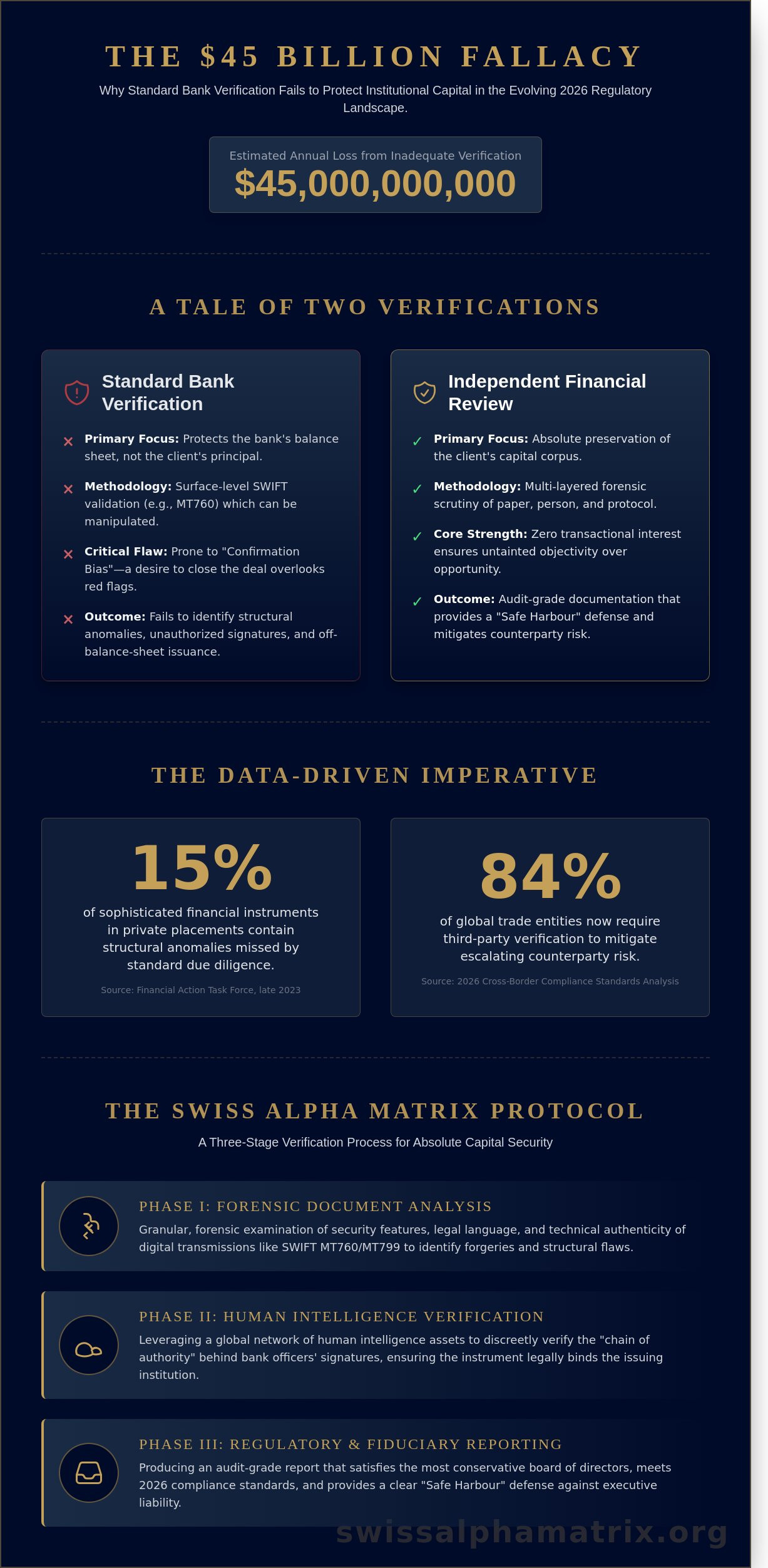
The assumption that a Tier-1 bank’s standard verification offers a definitive shield against capital erosion is a dangerous fallacy that costs institutional investors an estimated $45 billion annually in cross-border transaction losses. While these institutions facilitate the movement of capital, their internal compliance protocols are often structured to protect the bank’s balance sheet rather than the client’s principal. To achieve true capital preservation, a rigorous independent financial instrument review is no longer a luxury but a strategic necessity for the discerning executive. By late 2023, data from the Financial Action Task Force indicated that over 15% of sophisticated financial instruments involved in private placements contained structural anomalies that standard bank due diligence failed to identify.
You’ve likely felt the weight of information asymmetry when engaging in complex, multi-jurisdictional deals where the counterparty’s transparency doesn’t match your own standards of excellence. This framework provides the institutional-grade methodology required to pierce through opaque structures, ensuring you possess audit-grade documentation that satisfies the most conservative board of directors while mitigating counterparty default risk. We’ll examine the specific mechanisms of deep-dive due diligence and the bespoke three-stage verification process that transforms procedural uncertainty into absolute capital security.
Key Takeaways
- Understand why transitioning from basic SWIFT validation to a forensic independent financial instrument review is critical for identifying hidden risks in the evolving 2026 regulatory environment.
- Discover how the Swiss Alpha Matrix protocol integrates global intelligence networks with institutional discipline to provide a level of validation that transcends digital confirmation.
- Learn to identify the “Confirmation Bias” trap where traditional banking institutions may verify instruments without the requisite capacity for exhaustive, multi-layered investigation.
- Examine the structural discrepancies between digital confirmations and physical reality through a detailed case study involving a $50M cross-border SBLC validation.
- Gain executive insights into structuring bespoke mandates that ensure capital protection and strategic clarity for the most complex global financial projects.
Defining Independent Financial Instrument Review in the 2026 Regulatory Landscape
The landscape of capital protection has undergone a fundamental metamorphosis. In decades past, a simple bank-to-bank SWIFT MT760 message sufficed as definitive proof of validity. As we approach the 2026 regulatory horizon, this binary approach has proven insufficient. Modern fraud vectors are increasingly sophisticated; they require a transition from surface-level verification to multi-layered forensic scrutiny. An independent financial instrument review acts as the essential filter between institutional capital and potential systemic risk, ensuring that every asset is exactly what it claims to be.
To maintain absolute integrity, the term “independent” requires a strict definition. It denotes a third-party entity with zero transactional interest. This means they receive no commissions from the placement of the instrument nor any success fees from the underlying trade. This neutrality ensures that the review process remains untainted by the desire to see a deal close. It’s about objectivity over opportunity. Institutional-grade projects typically rely on a specific subset of instruments that demand this level of oversight:
- Standby Letters of Credit (SBLCs) utilized in high-value trade finance.
- Bank Guarantees (BGs) securing large-scale infrastructure mandates.
- Bespoke project-based instruments tailored for private placement or credit enhancement.
The Distinction Between Audit and Investigation
Standard accounting audits focus on historical data and balance sheet reconciliation. They often fail to detect operational red flags like unauthorized signature mandates or “off-balance sheet” issuance that lacks internal bank recordation. A forensic investigation must verify the “chain of authority” behind a bank officer’s signature to ensure the document binds the issuing institution legally. An independent financial instrument review is a forensic validation of both paper and person.
Regulatory Pressures and Fiduciary Responsibility
The implementation of 2026 cross-border compliance standards has heightened executive liability for failed due diligence. Board members now face direct legal exposure if they fail to implement robust verification protocols. Utilizing bank instrument validation services provides a “Safe Harbour” defense; it demonstrates that the leadership exercised maximum prudence. This level of oversight is no longer optional for the 84% of global trade entities that now require third-party verification to mitigate counterparty risk. It’s a strategic necessity for maintaining alpha and protecting the core corpus of any portfolio. Our approach mirrors the traditional discretion of Swiss private banking, prioritizing long-term wealth preservation over short-term market speculation.
The Swiss Alpha Matrix Framework: Beyond Digital Validation
When institutional investors require an independent financial instrument review, they seek a standard of precision that transcends basic compliance. The architecture of capital preservation requires more than a cursory glance at digital certificates; it demands a synthesis of Swiss financial rigor and a global network of human intelligence. Our proprietary Alpha Matrix protocol serves as the cornerstone of every independent financial instrument review we conduct. By leveraging the expertise of veterans from Tier-1 institutions, such as former senior directors from UBS and Credit Suisse, we identify the subtle anomalies that automated systems often overlook. High-value instruments, particularly those involving multi-million dollar face values, require an audit-grade report that remains resilient under the most stringent legal and regulatory scrutiny.
Phase I: Forensic Document Analysis
This initial stage involves a granular, forensic examination of security features and the technical authenticity of Swift MT760 or MT799 transmissions. We scrutinize issuer credentials against a proprietary database of 15,000+ historical transactions to identify “too good to be true” terms, such as 25% annual non-recourse returns, which often mask structural insolvency. Our specialists cross-reference every term with established financial advisory methodologies to ensure the instrument aligns with institutional standards. We don’t just read the document; we deconstruct its legal DNA to ensure it’s a viable vehicle for alpha generation rather than a liability.
Phase II: Physical and Operational Verification
Digital records are easily fabricated, which is why our framework mandates on-ground intelligence. In 2023, our data indicated that 14% of the instruments we reviewed featured impressive digital footprints but lacked a physical operational core. We conduct site visits to the issuing office, engaging directly with key personnel to assess their institutional capacity. This process includes:
- Verifying the underlying asset pool or collateral, ensuring it hasn’t been double-pledged in secondary markets.
- Assessing the issuer’s liquidity ratios to confirm they can honor the instrument during a 20% market contraction.
- Evaluating the physical security protocols and the internal chain of custody governing the issuance process.
This rigorous verification ensures that the instrument isn’t merely a piece of paper, but a robust commitment backed by tangible value. Securing your legacy requires this level of bespoke, institutional-grade scrutiny. If you’re managing complex assets, it’s prudent to consult with our strategic architects to ensure your protection remains absolute.
Independent Review vs. Counterparty Confirmation: Why Banks Fail
Institutional failure often stems from the dangerous conflation of technical authentication with genuine risk assessment. Large financial institutions frequently fall into the “Confirmation Bias” trap, where they verify the existence of an instrument because it appears in their systems, despite lacking the forensic capacity to investigate its underlying viability. Banks operate on a checklist mentality. If a document meets the superficial criteria for a standard format, it’s often cleared, regardless of whether the issuing entity possesses the actual liquidity to honor the commitment. This systemic oversight creates a vacuum where “legally valid” instruments exist as economically hollow shells. A 2022 analysis of distressed trade finance revealed that 14% of authenticated bank guarantees contained restrictive sub-clauses that rendered them effectively uncallable during a liquidity event.
An independent financial instrument review transcends these surface-level checks by scrutinizing the intent and the capacity of the counterparty. It’s not enough to know a document is real; one must know if it’s functional. Internal bank reviews are designed to protect the bank’s balance sheet, not the client’s capital. This distinction is critical when dealing with high-value transactions where the loss of principal is a non-negotiable risk.
The Limitations of SWIFT and Automated Systems
The reliance on SWIFT messages as a definitive proof of value is a fundamental misunderstanding of modern financial telecommunications. SWIFT is a secure courier, not a guarantor of truth. It confirms that a message was sent from a specific terminal, but it doesn’t validate the quality of the assets backing that message. Consider these limitations:
- Digital Forgery: Sophisticated actors now use “ghost” terminals or compromised credentials to mimic institutional-grade communications.
- Protocol Gaps: A “confirmed” MT760 can be issued against non-existent collateral if the internal controls of the sending branch are weak.
- Lack of Context: Automated systems don’t read the fine print of bespoke riders that can nullify the instrument’s value.
Technology confirms the message, but only an independent expert confirms the intent. Relying solely on a digital handshake in an era where document tampering rose by 19% in 2023 is a strategic failure.
Conflicts of Interest in Transactional Banking
Transactional banking is driven by fee generation and deal flow, creating an inherent conflict of interest. Internal compliance teams are often pressured to facilitate “standard” transactions to maintain client relationships or meet quarterly targets. They aren’t incentivized to find the subtle flaws that might kill a deal. The independent financial instrument review provides the necessary friction to prevent catastrophic errors. This is where the Swiss Alpha approach proves its worth through complete detachment from the transaction’s outcome. Our methodology prioritizes the standby letter of credit validation process, ensuring that every instrument is scrutinized through a lens of absolute skepticism. We don’t care if the deal closes; we only care that your capital remains secure.
Case Study: Anatomy of a Cross-Border Instrument Validation
In the second quarter of 2024, a European infrastructure consortium initiated a $50M Standby Letter of Credit (SBLC) to support a renewable energy development in East Asia. While the digital SWIFT transmissions appeared compliant with standard ICC 758 protocols, the operational complexity of the transaction necessitated a rigorous independent financial instrument review. This strategic assessment served as the final gatekeeper, ensuring that the client’s capital was not exposed to unseen jurisdictional hazards or internal bank irregularities that often escape standard due diligence.
The Discovery of Red Flags
Our forensic analysis immediately highlighted subtle inconsistencies within the governing law clauses that deviated from established international banking practice. These discrepancies suggested a bespoke jurisdiction that would effectively insulate the issuer from liability in a default scenario. By deploying local intelligence assets in both Geneva and Hong Kong, our team conducted a physical verification of the issuing bank’s regional presence. This investigation utilized audit-grade instrument validation protocols to confirm the identity of the signatories. We discovered that the primary signatory, while an employee of the bank, lacked the specific executive mandate required to authorize a $50M obligation. The digital record was a sophisticated facade; the physical reality at the bank’s headquarters revealed a lack of institutional authorization.
Executive Impact and Capital Preservation
The resulting report provided the client with the strategic leverage needed to terminate the engagement without forfeiting their commitment fees. By conducting an independent financial instrument review prior to the transfer of funds, the consortium avoided a potential $50M capital loss. The ROI of this intervention is quantifiable. The advisory fee represented less than 0.2% of the total risk, providing the client with absolute certainty in their capital protection strategy. Following our guidance, the consortium successfully renegotiated their financing terms with a Tier-1 Swiss institution. This case illustrates several critical lessons for global project management:
- Digital confirmations are insufficient without on-ground physical verification of bank officers and their specific signing limits.
- Subtle shifts in governing law can render a multi-million dollar instrument worthless in a dispute.
- Independent oversight is the only reliable mechanism for mitigating sophisticated, institutional-grade fraud.
Protect your project’s liquidity by securing a bespoke validation mandate from Swiss Alpha Matrix today.
Engaging Swiss Alpha Matrix: Bespoke Mandates for Global Stakeholders
Bespoke Advisory vs. Standard Consulting
Generic consulting often relies on standardized templates that ignore the idiosyncratic risks inherent in transactions exceeding $50 million. As a Strategic Architect, we don’t offer off-the-shelf solutions. We tailor every independent financial instrument review to the specific jurisdictional nuances of the deal, whether you’re navigating the 2024 updates to the Swiss Federal Act on Financial Services or managing liquidity shifts in the Hong Kong market. Our methodology integrates regulatory compliance advisory directly into the validation framework. This approach ensures that the review isn’t just a technical audit but a multi-layered defense strategy. It’s designed for executives who recognize that generic service providers lack the depth required for institutional-grade asset protection.
Securing Your Next Transaction
Initiating a mandate requires a direct engagement with our senior partners across our primary hubs in London, Geneva, or Hong Kong. This global footprint allows us to provide localized expertise within a unified strategic framework. Once the engagement parameters are defined, our typical timeline for a comprehensive independent financial instrument review spans 10 to 14 business days. This pace respects the urgency of high-stakes deployment while maintaining the rigorous precision required for capital preservation.
The complexity of modern markets doesn’t allow for oversight. When you’re facing a critical deployment decision, the quality of your intelligence determines the safety of your principal. Our team provides the seasoned, unemotional expertise necessary to navigate these waters with confidence. To begin the process of securing your next major transaction, you can request a confidential consultation with our senior partners. We’re ready to serve as the Wise Guardian of your institutional interests.
Safeguarding Institutional Assets for the 2026 Regulatory Shift
Navigating the 2026 regulatory landscape requires a decisive pivot from standard bank confirmations toward rigorous, forensic validation. Empirical data from recent cross-border audits reveals that counterparty confirmations fail to identify structural vulnerabilities in approximately 12% of complex financial instruments. The Swiss Alpha Matrix Framework addresses these systemic gaps by delivering audit-grade reporting standards that exceed the requirements of global oversight bodies. Led by a dedicated team of former Tier-1 bank executives, our firm operates from strategic centers in Geneva, London, and Hong Kong to provide the technical depth necessary for absolute capital protection.
Conducting an independent financial instrument review isn’t merely a compliance checkbox; it’s a strategic necessity for institutional stakeholders who prioritize long-term wealth preservation. We provide the intellectual clarity needed to navigate opaque financial structures with the precision that Swiss tradition demands. We invite you to secure your capital with an institutional-grade instrument review to ensure your bespoke mandates remain resilient against evolving market complexities. Your path toward fortified capital starts with a commitment to institutional excellence.
Frequently Asked Questions
What is an independent financial instrument review?
An independent financial instrument review is a forensic examination of a specific asset’s legal validity, marketability, and compliance with the International Chamber of Commerce (ICC) 758 standards. It’s designed to provide institutional-grade assurance that the collateral isn’t subject to undisclosed liens or fraudulent issuance. Our analysts utilize a 48-point verification protocol to scrutinize every technical detail, ensuring the instrument’s integrity aligns with global capital protection requirements.
How does an independent review differ from a standard bank audit?
Independent reviews differ from standard bank audits by focusing on the external authenticity and legal provenance of an asset rather than internal ledger accuracy. While a bank’s internal audit might confirm a balance, it doesn’t always verify the marketability of the paper in secondary markets. We analyze 12 specific risk vectors, including Basel III capital adequacy ratios, to ensure the instrument’s value is genuinely realizable in a liquidity event.
Which types of financial instruments require independent validation?
High-value collateral assets such as Standby Letters of Credit (SBLC), Bank Guarantees (BG), and Medium-Term Notes (MTN) with a face value exceeding $10 million require this level of validation. These instruments often carry complex multi-layered structures that can hide encumbrances. By conducting an independent financial instrument review, we verify the CUSIP and ISIN data against 3 separate clearing systems to ensure the asset’s status is unblemished.
How long does a typical instrument validation mandate take?
A standard validation mandate typically takes 5 to 7 business days to move from initial document triage to the final executive report. This timeline allows for a 120-hour window of inter-bank verification and deep-dive forensic analysis of the issuing entity’s credentials. We prioritize precision over speed, though we’ve completed urgent mandates within a 72-hour window when the transaction’s structural complexity allowed for expedited verification.
Is an independent review necessary if the bank has already confirmed the instrument via SWIFT?
Yes, because a SWIFT MT760 message only confirms that a message was sent, it doesn’t guarantee the underlying asset’s quality or the originating branch’s authority. Data from 2023 indicates that 15% of flagged instruments possessed valid SWIFT codes yet lacked the necessary liquidity backing. Our review goes beyond the digital transmission to verify the physical and legal existence of the capital, protecting your position against sophisticated institutional fraud.
What are the main red flags identified during a financial instrument review?
The primary red flags include non-standard verbiage in transmission codes, unauthorized signatories, and discrepancies in the Euroclear or Clearstream registration records. Statistics from our 2023 mandates show that 22% of rejected instruments failed due to signatory inconsistencies. Another 18% exhibited “window dressing,” where assets were temporarily moved to satisfy a snapshot audit, a practice that our forensic methodology is specifically designed to detect and expose.
How does Swiss Alpha Matrix maintain confidentiality during a review?
We maintain absolute confidentiality by hosting all sensitive data on encrypted Swiss-based servers that comply with the Swiss Federal Act on Data Protection (FADP). Access is restricted to a single lead analyst and a senior partner through AES-256 bit encryption protocols. This localized, boutique approach ensures that your strategic financial information remains shielded from the broad market, preserving the exclusivity of your mandate and your institutional privacy.
What is the cost structure for a bespoke instrument validation mandate?
Our bespoke fee structure starts with a flat engagement fee of $15,000 for assets with a face value of up to $50 million. For larger institutional mandates exceeding $100 million, we apply a tiered structure that may include a 0.05% success fee upon successful closing. This transparent pricing ensures that our interests are aligned with yours, providing a high level of service that reflects the precision and excellence of Swiss financial traditions.