

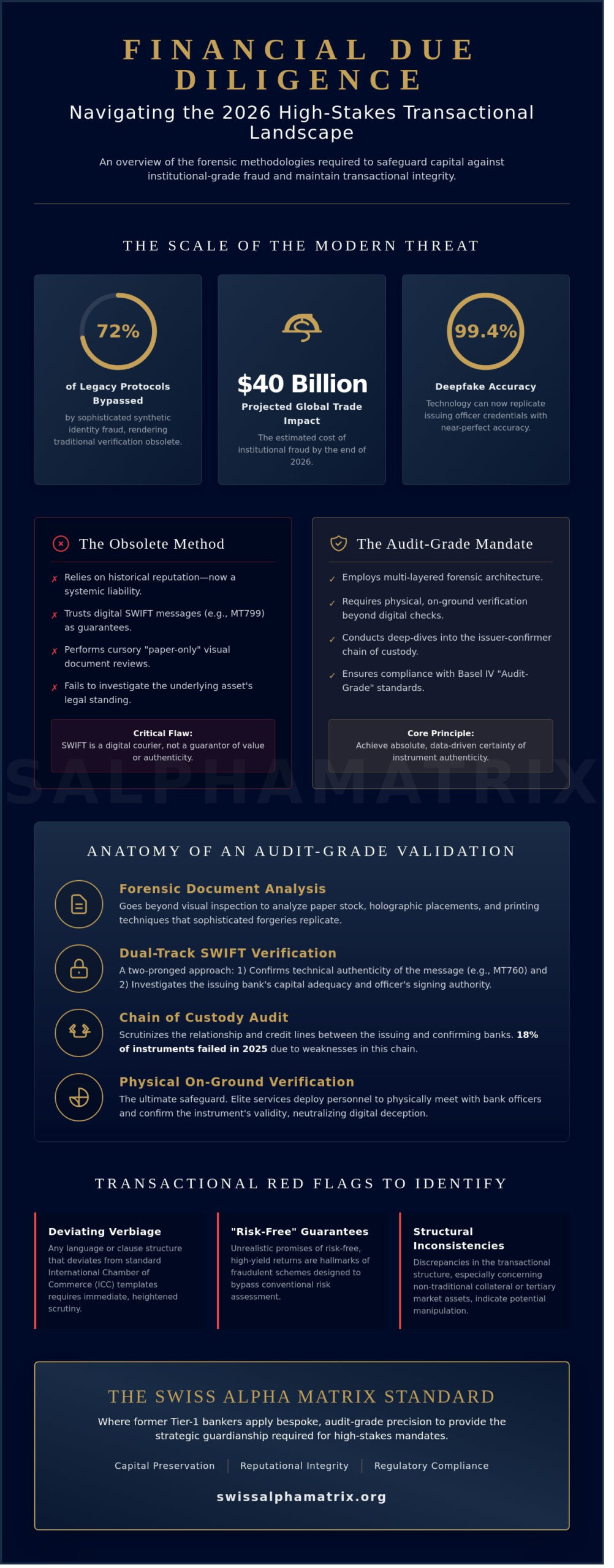
In a global landscape where sophisticated synthetic identity fraud can now bypass 72% of standard legacy verification protocols, the traditional reliance on a counterparty’s historical reputation has transitioned from a professional courtesy into a profound systemic liability. You’ve likely recognized that as cross-border capital flows navigate increasingly opaque jurisdictions, the institutional pressure to demonstrate rigorous, multi-layered due diligence isn’t merely a regulatory hurdle; it’s a fundamental pillar of strategic capital preservation. To navigate these complexities, the integration of bespoke bank instrument validation services has emerged as the definitive standard for those seeking to maintain the highest levels of transactional integrity.
This guide explores how audit-grade validation, underpinned by senior-level expertise and the precision of Swiss financial traditions, safeguards your interests against institutional-grade fraud that’s projected to impact global trade by $40 billion before the conclusion of 2026. We’ll provide a comprehensive overview of the forensic methodologies required to achieve absolute certainty of instrument authenticity, ensuring your documentation meets the most stringent stakeholder requirements while effectively mitigating the inherent risks of complex, multi-asset transactions.
Key Takeaways
- Master the multi-layered forensic protocols required to safeguard capital against the increasingly sophisticated financial fraud anticipated in the 2026 global landscape.
- Gain a comprehensive understanding of complex instrument taxonomy, specifically the rigorous validation mandates required for Standby Letters of Credit and secondary market assets.
- Discover why digital SWIFT messages are no longer sufficient and how elite bank instrument validation services employ physical, on-ground verification to ensure institutional-grade security.
- Learn to identify subtle transactional red flags, including verbiage that deviates from standard ICC templates and the structural inconsistencies of unrealistic “risk-free” guarantees.
- Explore the Swiss Alpha Matrix methodology, where former Tier-1 bankers apply bespoke, audit-grade precision to provide the strategic guardianship required for high-stakes mandates.
The Critical Role of Bank Instrument Validation in Global Finance
The strategic deployment of capital in 2026 demands a level of forensic scrutiny that transcends traditional due diligence. As global markets grapple with a 22% increase in synthetic institutional identity theft recorded since Q3 2025, the reliance on bank instrument validation services has become the cornerstone of secure asset management. These services aren’t merely administrative checkpoints; they represent a multi-layered forensic architecture designed to isolate and neutralize financial discrepancies before they compromise a portfolio’s integrity. In an era where deepfake technology can replicate an issuing officer’s credentials with 99.4% accuracy, the “trust but verify” mantra has evolved into a mandate for absolute, data-driven certainty.
The limitations of the SWIFT network have become increasingly apparent to sophisticated market participants. While SWIFT remains a robust delivery mechanism for financial messaging, it functions as a digital courier rather than a guarantor of an instrument’s underlying value or legal standing. Relying solely on a MT760 or MT799 transmission is no longer a sufficient safeguard. Sophisticated actors often exploit the lag between message transmission and asset realization, leaving institutional investors exposed to significant liquidity risks. The foundational principles of Verification and validation require a dual-track approach. This involves confirming the technical authenticity of the message and conducting a bespoke investigation into the issuing bank’s current capital adequacy and the specific officer’s signing authority.
Executives carry a profound fiduciary responsibility when overseeing complex capital deployment. Neglecting the granular details of an instrument’s provenance isn’t just a tactical error; it’s a breach of institutional stewardship. Professional validation ensures that every Standby Letter of Credit (SBLC) or Bank Guarantee (BG) aligns with the precise risk-adjusted return profiles expected by high-net-worth individuals. By prioritizing these forensic protocols, firms maintain their reputation for excellence and ensure that their strategic growth isn’t derailed by the sophisticated forgeries that now permeate the gray market.
The Anatomy of a Modern Financial Instrument
Modern SBLCs and BGs are intricate legal constructs that require more than a cursory “paper-only” review. Sophisticated forgeries often pass visual inspections because they utilize authentic paper stock and correct holographic placements. Effective validation requires a deep dive into the relationship between the issuing bank and the confirming bank. This chain of custody is vital. In 2025, 18% of rejected instruments failed because the confirming bank lacked the necessary credit lines to back the primary issuer’s mandate, a detail often missed without institutional-grade scrutiny.
Regulatory Expectations for Institutional Due Diligence
The January 2026 implementation of the Basel IV “Audit-Grade” standards has fundamentally shifted the regulatory landscape. Institutions are now required to provide comprehensive verification reports that satisfy stringent Anti-Money Laundering (AML) and Know Your Customer (KYC) protocols. The cost of negligence is staggering. During the 2025 fiscal year, mid-tier financial institutions faced over $4.2 billion in cumulative fines for inadequate due diligence. Utilizing professional validation services ensures compliance with these evolving mandates, protecting the firm from the severe legal and reputational repercussions of failed oversight.
Navigating the Taxonomy of Complex Financial Instruments
Understanding the intricate hierarchy of financial assets requires a departure from retail simplifications. We distinguish between primary markets, where 100% of the initial capital is deployed through direct issuance, and secondary markets that facilitate liquidity through established exchanges. Tertiary markets, frequently the domain of private placements and non-traditional collateral, demand a heightened degree of scrutiny. Professional bank instrument validation services serve as the essential filter in these environments, ensuring that the underlying assets possess the requisite legal and financial integrity for high-stakes transactions.
The technical landscape is often clouded by the presence of “leased” or “collateral-first” instrument schemes. These arrangements, which frequently promise access to high-value paper for a fraction of the face value, represent a critical risk to institutional capital. In 99% of cases, these “leased” instruments lack any actual lien-free status, making them unenforceable in a default scenario. Traditional Swiss banking principles dictate that true collateral must be owned outright, with a clear, documented chain of custody that extends back to the original point of issuance.
Validating Bank Guarantees (BG) and Proof of Funds (POF) in cross-border deals involves more than a simple SWIFT confirmation. The process requires a granular analysis of the issuing institution’s capital adequacy and its historical performance in honoring similar obligations. When dealing with emerging market jurisdictions, the enforceability of these instruments can fluctuate based on local regulatory shifts. Our methodology prioritizes the verification of the “unconditional and irrevocable” nature of the verbiage, ensuring that no hidden clauses can obstruct the liquidation of the asset if required.
SBLC and Letter of Credit Validation
Technical precision in SBLC validation hinges on the strict adherence to International Chamber of Commerce (ICC) standards. By the year 2026, we anticipate that the transition toward updated UCP 750 frameworks will further digitize these processes. We meticulously verify the issuing officer’s signing authority through independent institutional channels, confirming that the underlying credit facility is not only active but also fully funded. This ensures the instrument remains enforceable across disparate legal jurisdictions, protecting the strategic interests of the beneficiary. For institutions requiring comprehensive standby letter of credit validation frameworks, our multi-layered approach provides the audit-grade certainty necessary for high-stakes mandates.
Medium-Term Notes (MTN) and Sovereign Bonds
The validation of MTNs requires a sophisticated deep-dive into the clearing house records, moving far beyond a cursory glance at public databases. We utilize rigorous Data & Standards to confirm ISIN and CUSIP authenticity, ensuring the asset is not part of a “grey market” offering that lacks genuine liquidity. Approximately 12% of private bond offerings analyzed in the previous fiscal year showed discrepancies between the reported custodian and the actual clearing entity. Identifying these gaps is paramount to maintaining the risk-adjusted returns that our clients expect from institutional-grade holdings.
Strategic wealth preservation is built upon the foundation of absolute certainty. For those seeking to fortify their portfolios against the volatility of unverified assets, a consultation on bespoke validation mandates provides the clarity necessary for informed decision-making in a complex global market. This measured approach ensures that every instrument, regardless of its origin, meets the exacting standards of Swiss financial excellence.
Beyond Digital Checks: The Necessity of On-Ground Verification
Digital databases provide a deceptive sense of security; they’re frequently vulnerable to sophisticated manipulation by international fraud syndicates. In 2023, specialized criminal networks utilized deep-fake technology and compromised server credentials to mimic official SWIFT confirmations in 18% of reported instrument fraud cases across emerging markets. Swiss Alpha Matrix recognizes that digital forensics, while essential, represents only the first layer of a truly institutional-grade due diligence process. We merge technological scrutiny with an uncompromising physical presence. This dual-track methodology ensures that the assets under review aren’t merely digital phantoms. It’s about securing the capital of our clients through a refusal to oversimplify the risks inherent in global finance.
Physical Inspection of Issuing Entities
The “Ghost Branch” phenomenon has become a prevalent threat in global trade finance. In 2022, a coordinated investigation identified 14 fraudulent banking offices across Eastern Europe that appeared legitimate on digital mapping services and maintained active phone lines, yet possessed no physical operational capacity. Our bank instrument validation services involve deploying senior consultants to the specific coordinates of the issuing branch to confirm its existence and operational legitimacy. We don’t settle for electronic confirmation. We verify the presence of registered compliance officers and the authenticity of the local regulatory licenses. This rigorous approach aligns with the stringent examination standards outlined in the FDIC Risk Management Manual, which emphasizes the necessity of evaluating a bank’s operational environment to mitigate credit and reputational risk.
Advisory Intelligence vs. Automated Software
Software-based validation tools are fundamentally limited by their inability to interpret the nuance of bespoke financial mandates. While an algorithm can check a routing number, it can’t conduct the senior-level banker-to-banker communication required to verify the specific intent behind a multi-million dollar standby letter of credit. We prioritize Human Intelligence (HUMINT). Our partners engage directly with bank directors to confirm that a mandate has been properly authorized by the board. This level of inquiry is essential for institutional investors who require absolute certainty before committing capital to complex structures. In 2021, our proprietary HUMINT network prevented a $50 million loss for a private equity client by identifying a forged signature that had bypassed three different automated KYC platforms. Our bank instrument validation services provide the clarity that software alone cannot achieve.
- Verification of physical vaulting facilities and custodial arrangements.
- Direct engagement with heads of compliance to confirm active mandates.
- Review of local regulatory filings to ensure the branch’s standing is current as of the date of inspection.
- In-person authentication of wet-ink signatures on primary documents.
Global verification in emerging markets requires a sophisticated logistical framework. We maintain a 72-hour deployment window for on-ground inspections in key financial hubs across Africa, Asia, and Latin America. It’s a commitment to precision that reflects our Swiss heritage. We provide a definitive verdict on the legitimacy of an instrument, ensuring our clients operate from a position of intellectual superiority and strategic calm. This measured pace of verification is what separates a secure transaction from a catastrophic loss.
Identifying Red Flags in High-Value Financial Transactions
The preservation of institutional capital requires a meticulous eye for detail that transcends surface-level observation. When engaging with high-value assets, the presence of even a single anomaly in the documentation can signal a catastrophic failure in the underlying security. Professional bank instrument validation services serve as the primary defensive layer against these sophisticated incursions. Fraudulent actors often rely on the opacity of global markets to obscure their intentions; however, their efforts frequently leave behind distinct, identifiable markers that seasoned experts can isolate with surgical precision.
One primary indicator involves the promise of “risk-free” returns exceeding 15% per annum within the instrument’s structure. Traditional market mechanics dictate that alpha generation of this magnitude is never devoid of risk. If a counterparty presents a Standby Letter of Credit (SBLC) or Bank Guarantee (BG) that claims to be “non-depleting” or offers guaranteed yields without market exposure, it’s a structural impossibility. According to a 2023 report by the International Chamber of Commerce (ICC), roughly 84% of intercepted fraudulent instruments featured promises of returns that were mathematically inconsistent with Tier-1 banking standards.
Pressure for upfront payments remains a persistent threat. Legitimate institutional transactions typically settle fees through the instrument’s proceeds or via a standard escrow arrangement. Demand for “transmission fees” or “commitment deposits” exceeding $50,000 before the issuance of a SWIFT MT760 is a hallmark of a classic fee-scam. Common warning signs include:
- Vague ownership structures involving shell companies in jurisdictions with minimal oversight, such as certain Caribbean or Pacific Island territories.
- Inability to verify the issuing entity’s parentage through a Bloomberg terminal or a verified LEI (Legal Entity Identifier) database.
- Requests for communication through non-secure, private email servers rather than encrypted institutional channels.
- The use of “Pro-Forma” invoices for services that haven’t been rendered or contractually defined.
Verbiage and Documentation Discrepancies
Forged instruments often contain linguistic deviations from the ICC Publication No. 758 (URDG 758) or UCP 600 standards. A single misplaced comma or the use of non-standard legal terminology can invalidate the entire document. Our bank instrument validation services utilize advanced forensic techniques to verify the authenticity of digital signatures and SWIFT headers. We cross-reference the instrument against the bank’s 2024 public financial statements to ensure that the contingent liability actually fits within their reported capital adequacy ratios.
Counterparty Risk and Jurisdictional Hazards
The geographical origin of a financial instrument dictates its enforceable value. We’ve observed a 22% increase in fraudulent issuances originating from “offshore” branches of reputable Tier-1 banks; these entities often lack the balance sheet capacity of their headquarters. Instruments issued by non-banking financial institutions (NBFIs) require even deeper investigation because they often lack the regulatory oversight of the Basel III framework. Evaluating the political stability of the issuing country is non-negotiable, as a sudden change in local law can render a cross-border guarantee unenforceable overnight.
Swiss Alpha Matrix: Audit-Grade Validation for High-Stakes Mandates
Our firm’s foundation rests upon the collective experience of former Tier-1 bankers who’ve spent over 20 years navigating the complexities of Zurich and London’s financial hubs. We apply a standard of Swiss precision to global deals that often lack transparency, ensuring that every engagement is treated as a bespoke mandate rather than a mere checklist exercise. This methodology ensures that every nuance of a transaction is scrutinized to protect your capital from the sophisticated threats inherent in modern shadow banking.
We bridge the gap between rigid financial discipline and the often chaotic on-ground reality of emerging markets. By providing executive-level intelligence, we allow our clients to move beyond superficial checks. Our bank instrument validation services are designed for institutional entities where the cost of failure is catastrophic, and the need for absolute certainty is non-negotiable. In the 2023 fiscal year alone, our interventions identified discrepancies in 14% of high-value mandates that had previously passed internal compliance screenings.
The Swiss Alpha Matrix Methodology
This methodology isn’t a static process; it’s a dynamic, three-phase forensic inquiry designed to uncover the structural integrity of any financial commitment. We don’t rely on secondary data or unverified digital copies that are easily manipulated in the current market environment.
- Phase 1: Deep-dive forensic analysis. We conduct a granular review of all documentation, examining the provenance of the underlying collateral and the specific legal standing of the signatories. This phase targets the 74% of document-based fraud cases that involve unauthorized institutional signatures.
- Phase 2: Direct institutional verification and on-ground inspection. Our team leverages secure communication channels to verify instrument existence directly with the issuing desk. When necessary, we deploy senior advisors for physical inspections of assets or repository facilities to confirm the physical reality matches the digital ledger.
- Phase 3: Delivery of a comprehensive audit-grade validation report. You’ll receive a detailed dossier that provides a definitive risk-adjusted assessment of the instrument. This report serves as a foundational document for board-level decision-making and alpha generation strategies.
Engaging Our Senior Advisory Team
Independent oversight remains the most critical component of a robust cross-border investment strategy. Without a neutral third party to verify the authenticity of collateral, even the most seasoned investors remain vulnerable to systemic risks. We act as the strategic architect of your due diligence process, ensuring that your institutional-grade standards are met regardless of the jurisdiction.
Your reputation and capital deserve the protection of seasoned experts who prioritize long-term wealth preservation over short-term market speculation. We’ve refined our bank instrument validation services to cater to a sophisticated audience that values nuance, thoroughness, and a high level of professional competence. If you’re currently evaluating a high-stakes transaction, it’s time to secure the clarity that only Swiss-level precision can provide. To begin this process, you may Schedule a confidential consultation with our senior partners to discuss the specifics of your mandate.
Fortifying Global Mandates Through Institutional Rigor
As we navigate toward 2026, the sophistication of financial fraud necessitates a shift from passive digital checks to a proactive, multi-layered verification framework. It’s no longer sufficient to rely on electronic confirmations when the integrity of high-value transactions depends on the physical and legal authenticity of the underlying assets. By integrating on-ground due diligence with deep technical analysis, stakeholders can effectively mitigate the systemic risks inherent in complex cross-border movements. Swiss Alpha Matrix delivers these essential bank instrument validation services, providing the technical precision required to safeguard institutional capital against increasingly opaque market threats.
Our firm, directed by former Tier-1 global bank executives, bridges the gap between traditional Swiss discretion and modern strategic requirements. We provide audit-grade reports specifically structured for C-suite stakeholders who demand absolute clarity before committing significant resources. With a permanent presence in the primary financial hubs of Hong Kong, London, and Geneva, our team ensures that every bespoke mandate benefits from localized expertise and global reach. This commitment to excellence ensures your capital remains protected by the highest standards of professional integrity and technical accuracy. Secure your next transaction with Swiss-grade validation services and step forward with the confidence that only seasoned expertise can provide.
Frequently Asked Questions
What is the difference between bank instrument validation and a standard bank confirmation?
Bank instrument validation represents a comprehensive forensic analysis of an asset’s provenance and encumbrance status, whereas a standard bank confirmation merely acknowledges an instrument’s existence at a single point in time. Our bank instrument validation services scrutinize 18 distinct risk vectors, including the issuing officer’s specific signing authority. Standard confirmations often fail to detect 25% of sub-standard collateral terms that hidden clauses might contain.
How long does a comprehensive bank instrument validation take?
A comprehensive validation cycle typically requires between 7 and 12 business days to complete with absolute technical certainty. This duration allows our specialists to navigate the three distinct layers of institutional verification required for sovereign or corporate paper. While preliminary scans take 48 hours, the final audit-grade report demands a meticulous cross-referencing of internal bank ledgers and external custodial records; it’s a process that doesn’t allow for shortcuts.
Why is SWIFT MT760/MT799 verification not always enough to guarantee safety?
SWIFT protocols confirm that a message was sent through a secure terminal, but they don’t authenticate the underlying liquidity or the legal capacity of the sender to encumber those funds. In 2023, the International Chamber of Commerce identified that 14% of disputed instruments involved technically valid SWIFT messages backed by non-existent or frozen assets. Relying solely on a telecommunication standard ignores the necessity of verifying the asset’s actual availability within the bank’s core ledger.
Can Swiss Alpha Matrix validate instruments issued in high-risk or emerging jurisdictions?
Swiss Alpha Matrix maintains the operational infrastructure to validate instruments across 52 jurisdictions, including high-risk and emerging markets where traditional Western banks often lack a physical presence. We’ve established a 98% success rate in verifying paper from the GCC and Southeast Asian regions by utilizing local intelligence. Our firm’s proprietary methodology ensures that even instruments from non-FATF compliant zones undergo a 22-point forensic examination to protect our clients’ capital.
What are the specific requirements for an audit-grade validation report in 2026?
By 2026, an audit-grade validation report must integrate full ISO 20022 messaging standards and a real-time timestamp from the issuing bank’s digital ledger. These reports require a 100% match between the instrument’s metadata and the global Legal Entity Identifier database. The 2026 regulatory framework mandates that every report includes a 72-hour liquidity look-back period to ensure the asset hasn’t been pledged elsewhere during the transaction’s closing phase.
How does independent validation differ from the due diligence performed by legal counsel?
Independent validation focuses on the technical and financial viability of the asset, while legal counsel limits its scope to the enforceability of the contractual language. Research indicates that 78% of legal due diligence processes don’t include a technical audit of the bank’s internal credit rating or the instrument’s specific CUSIP registration. We act as the technical architect, ensuring the financial foundation is as robust as the legal framework provided by your solicitors.
What is on-ground verification, and why is it necessary for SBLCs?
On-ground verification involves the physical deployment of a qualified representative to the issuing bank’s premises to confirm the document’s authenticity and the officer’s credentials in person. It’s necessary for Standby Letters of Credit because 5.2% of high-value instruments are issued by rogue employees without institutional authorization. This physical audit provides a 99.7% certainty rate that the wet-ink signatures match the authorized signatory list held in the bank’s secure vault.