

A fairness opinion is not a verdict on whether a transaction is strategically wise. Understanding what a fairness opinion in M&A is begins with its narrower purpose: a financial advisor’s assessment of whether the consideration is fair, from a financial point of view, to a particular party’s shareholders. It can inform a board’s deliberations, but it doesn’t decide how shareholders should vote or whether the deal is better than other strategic alternatives.
The distinction matters when a transaction has significant financial or governance implications. This article explains what a fairness opinion evaluates, how it can inform a board without replacing its judgment, and what an adviser contributes. It also explains why the fee depends on factors such as deal complexity, analytical scope, available information, and time required, rather than deal value alone.
Key Takeaways
- Distinguish an advisor’s financial-fairness assessment from advice on whether the transaction is the best strategic choice.
- Consider how an advisor’s other roles, incentives, or financing relationships may affect the perceived independence of an opinion.
- Use an opinion as one input to informed board deliberations, not as a substitute for directors’ own judgment.
- Assess the likely scope and cost of the work by examining the deal’s complexity, required analysis, available information, and timing.
Investment Banking Fairness Opinions: Profitable and Prestigious, or Glamorless Gruntwork?
A fairness opinion can inform decisions about mergers, acquisitions, and other transactions affecting shareholder value. Its usefulness depends on the circumstances of the deal and the adviser’s independence.
Transactions That Use Fairness Opinions
A fairness opinion assesses whether the consideration in a transaction is financially fair to a specified party. Requests commonly arise in public-company sales, mergers, and divestitures of substantial business divisions. Opinions may also be used for management buyouts, recapitalizations, bankruptcies, liquidations, restructurings, employee stock ownership plans, and private companies with varied ownership.
Directors typically receive the opinion shortly before deciding whether to approve a definitive acquisition agreement. This gives the board financial analysis to consider as part of its decision. Depending on the circumstances and governing arrangements, a fairness opinion may also be sought for a debt-for-equity exchange or a private transaction.
Related-Party Terms and Arm’s-Length Deals
A related-party transaction involves parties whose existing relationship may influence the proposed terms. A fairness opinion can help assess whether those terms are comparable to terms negotiated at arm’s length by independent parties.
This comparison matters when a seller, buyer, controlling shareholder, or affiliate has interests that differ from those of other shareholders. The analysis gives directors and stakeholders a financial basis for considering the proposed consideration. It does not establish that every term matches what independent parties would negotiate: transaction structure, contingencies, and financial assumptions can all affect the assessment.
Conflicts Involving Transaction Advisers
An adviser’s other financial roles can create an actual or perceived conflict. For example, concerns may arise if the investment bank leading the deal earns a significant contingent fee or provides financing to potential buyers.
A board may select a separate fairness opinion provider to add independence from the adviser negotiating the acquisition agreement. In the United States, FINRA Rule 2290 requires its members to make disclosures intended to minimize abuses involving fairness opinions. This answers the disclosure question at the member-rule level, rather than treating it as a general SEC requirement. Disclosure of relevant relationships helps readers understand the opinion’s context.
Valuation Methods in Fairness Opinions
A fairness opinion uses valuation methods to assess the transaction’s financial consideration. These may include discounted cash flow analysis, comparable-company analysis, and precedent transaction analysis. Each method provides a different perspective on value.
Other approaches may include leveraged buyout, break-up, historical stock-price, and comparable-company premium analyses. An adviser may also review financial projections, historical statements, business strategy, and transaction documents. The selected methods and their assumptions matter: comparing analyses can show how different inputs affect estimated value, rather than reducing the conclusion to a single figure.
Definition and purpose of a fairness opinion
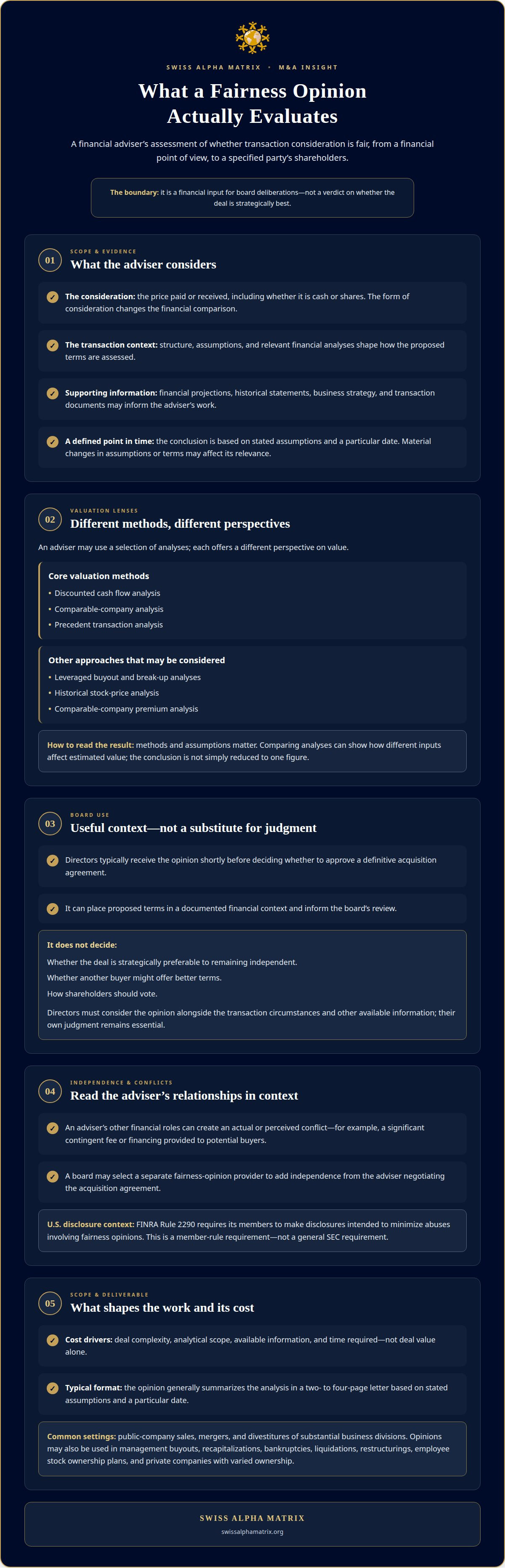
A fairness opinion is a financial adviser’s assessment of whether specified transaction consideration is fair from a financial point of view. In an acquisition or merger, it addresses whether the price paid or received is financially fair to the relevant shareholders. The opinion generally summarizes the analysis in a two- to four-page letter based on stated assumptions and a particular date.
A fairness opinion differs from a valuation, appraisal, or solvency opinion in its purpose. A valuation or appraisal estimates value for a defined purpose; a fairness opinion evaluates the transaction’s financial terms in light of that analysis. A solvency opinion addresses a separate question: whether the company can meet its obligations after the transaction. These documents may relate to the same deal, but they answer different questions.
A fairness opinion focuses on financial fairness, not every strategic or legal aspect of a deal. An adviser may consider the proposed consideration, transaction structure, assumptions, and relevant financial analyses. For example, assessing cash consideration in a merger differs from assessing shares, because the form of consideration changes the financial comparison.
It does not determine whether a merger is preferable to remaining independent, whether another buyer might offer better terms, or how shareholders should vote. Nor does it replace board deliberations or the fiduciary judgment directors must exercise. A favorable opinion is a financial input, not a comprehensive endorsement of the transaction.
For boards and shareholders, the opinion places proposed terms in a documented financial context. In a private acquisition or a public-company merger, the adviser’s analysis can help directors assess how the consideration relates to the company’s financial position and prospects. The conclusion speaks as of its stated date, so material changes in assumptions or transaction terms may affect its relevance.
Board fiduciary duties and the business judgment rule
A fairness opinion can inform a board’s financial review, but it does not discharge directors’ responsibilities. Its value depends on how directors consider it alongside the circumstances of the transaction and other available information.
Supporting Informed Board Decisions
A fairness opinion provides directors with an adviser’s financial analysis to consider before approving a transaction. It can add context about the target and highlight financial implications that deal-motivated parties might overlook.
It remains one input, not a substitute for an informed, well-reasoned decision. Directors should examine the assumptions, scope, and conclusion, then consider how the findings relate to the proposed purchase. If market conditions change materially between signing and the shareholder vote, the board may consider requesting an updated opinion. The opinion speaks only as of its date.
Opinions for Target and Buyer Boards
A target board may use an opinion to assess the consideration shareholders would receive; a buyer’s board may use one to examine the financial terms of its acquisition. In either case, the analysis gives fiduciaries a defined financial perspective for deliberation, not a recommendation to proceed.
That distinction matters where a conflict of interest or other transaction-specific concern may warrant closer review. The Delaware Supreme Court’s 1985 decision in Smith v. Van Gorkom helped make fairness opinions prominent in M&A. The opinion can support a record of careful consideration, but it doesn’t establish that the board fulfilled its duties by itself.
Directors’ duties depend on applicable law and the circumstances of the corporate decision. As one state example, the North Carolina Business Corporation Act says directors should act in good faith, with the care an ordinarily prudent person in a like position would exercise under similar circumstances, and in a manner they reasonably believe serves the corporation’s best interests.
For public-company boards, the practical discipline is to scrutinize an investment bank’s opinion as analysis, not treat it as a shield from judgment. Directors should weigh its assumptions and limitations against the transaction record, including material changes before a vote. A considered process matters, but an opinion alone cannot guarantee a particular legal outcome.
Advisor expertise and opinion costs
A fairness opinion’s reliability depends on the adviser’s financial judgment, analytical discipline, and understanding of the transaction. The work may involve reviewing historical financial statements, projections, strategy, transaction documents, and management input. Directors should understand which analyses support the conclusion and which assumptions shape it.
Timing also affects the assignment. Fairness opinion work may take a few days, sometimes up to a week or longer. A compressed timetable can intensify the work needed to assess projections, transaction structure, and market evidence. Selecting an adviser early gives the board more opportunity to define the scope and address information needs before making its decision.
Opinion fees depend on the engagement’s scope and circumstances, not simply the transaction’s headline value. Relevant factors include business complexity, the depth of valuation analysis, the quality of available information, and the time available. Fee arrangements also vary. In LinkedIn’s engagement, Qatalyst Partners was paid upon delivering its opinion regardless of its conclusion, while the remaining advisory fee depended on closing.
Consider independence alongside expertise. If an investment bank leads negotiations, receives a contingent fee, or provides financing to a potential buyer, its other roles may affect how shareholders perceive its opinion. A separate adviser can help the board demonstrate greater independence, though directors still need to understand the adviser’s relationships and disclosures. Regulatory Compliance Advisory can help assess relevant compliance considerations within a transaction’s broader control environment.
For a transaction involving complex financial or regulatory considerations, explore Regulatory Compliance Advisory with Swiss Alpha Matrix as part of a disciplined review.
Swiss Alpha Matrix
Swiss Alpha Matrix supports stakeholders who need rigorous diligence for complex financial and investment programmes. A fairness opinion addresses financial fairness; complementary review can examine operational and execution risks that valuation analysis alone may not resolve.
For transactions involving instruments, cross-border activity, or demanding coordination, Audit-Grade Instrument Validation, Operational Due Diligence, On-Ground Verification Services, and Complex Project Management can contribute to a broader view of the transaction. These services do not replace a fairness opinion or the board’s decision. They address related questions about instrument integrity, operations, and implementation, adding context to the financial assessment.
Contact Swiss Alpha Matrix to discuss the diligence and project-management support relevant to your transaction.
Carry the analysis into execution
A transaction decision is one point in a longer process. As diligence moves toward implementation, attention may shift from the opinion’s financial conclusion to instrument integrity, the reliability of on-ground information, and coordination across workstreams. Understanding what a fairness opinion in M&A can establish helps decision-makers identify where additional operational review may be useful, without treating that review as a substitute for valuation or board judgment.
Swiss Alpha Matrix supports transaction stakeholders through Audit-Grade Instrument Validation, On-Ground Verification Services, and Complex Project Management. These capabilities address practical diligence and execution considerations alongside the board’s financial analysis, keeping attention on both transaction assumptions and operational realities.
For a considered discussion of how these areas relate to your transaction, contact Swiss Alpha Matrix today. A measured next step can help bring greater structure to the work ahead.
Frequently Asked Questions
What types of deals use fairness opinions?
Fairness opinions may be used in mergers, company sales, recapitalizations, restructurings, employee stock ownership plans, and related-party transactions. They can also arise outside a conventional acquisition: a bond indenture or debt covenant may call for an opinion in specified circumstances. The key practical point is to consider the transaction’s structure and governing arrangements early, since those can affect whether an opinion is requested or required.
What is a fairness opinion in an M&A transaction?
Understanding what a fairness opinion in M&A is means identifying whose financial interests the adviser assesses and which transaction terms are under review. For example, an opinion may address whether shareholders of a target company receive fair consideration in a proposed sale. Its conclusion is tied to its assumptions and date, so it is not an ongoing assessment as negotiations or market conditions change.
Who prepares a fairness opinion and who is it addressed to?
A financial adviser, often acting as a third-party expert, prepares the opinion for a defined transaction constituent. It may be addressed to a board of directors or a special committee evaluating a proposal for a company or shareholder group. The intended recipient matters: the opinion is prepared for that party’s decision-making context, not as a general recommendation to every investor or as voting advice.
How much does a fairness opinion cost, and how are advisory fees structured?
Fees depend on the assignment’s scope, analytical complexity, available information, and time pressure. The opinion work may be priced separately from broader transaction advice, while advisory compensation can include a component tied to closing. These arrangements have different implications for adviser incentives, so the board should understand what each fee covers and how payment relates to the transaction’s outcome.
How do fairness opinions relate to directors’ fiduciary duties and shareholder litigation?
A fairness opinion can form part of the materials directors consider and document, but it does not by itself establish that they fulfilled their fiduciary responsibilities. In a shareholder challenge, the opinion and the process behind it may be scrutinized alongside the board’s deliberations and disclosures. Directors should treat it as one element of an informed decision record, not as protection from litigation or a substitute for judgment.
What conflicts of interest and limitations should boards consider when reviewing a fairness opinion?
Boards should consider whether the adviser also negotiates the deal, receives compensation tied to closing, or has a financing relationship with a potential buyer. These roles may create actual or perceived conflicts and affect how shareholders view the opinion’s independence. Directors should also examine the opinion’s assumptions, scope, and date: it does not compare every strategic alternative, determine whether the deal is best, or recommend how shareholders should vote.