

A project can be aligned on paper and still begin with different assumptions. Understanding what a project kick-off meeting is starts with its purpose: it is the first structured discussion that brings the project team and, where applicable, the client together to confirm goals, scope, responsibilities, and how the work will be coordinated. It establishes a shared point of departure before delivery begins.
A project kick-off meeting matters because internal teams and clients need alignment on different but closely connected questions. Team members need clarity on ownership and collaboration; clients and stakeholders need a clear view of outcomes, milestones, communication, and how issues will be raised. A well-run kick-off makes these expectations explicit instead of leaving them to inference.
This guide explains how to prepare for and lead a project kick-off meeting, from setting its purpose and choosing participants to agreeing on communication and follow-up. You’ll learn how to keep the discussion focused, distinguish internal alignment from client coordination, and leave with clear actions to carry the project into its next phase.
Key Takeaways
- Shape the agenda around the people in the room: align the internal team on ownership and collaboration, and give clients a clear view of outcomes and decision points.
- Translate the project scope into defined deliverables and milestones so participants can distinguish agreed work from open questions.
- Set communication channels, progress updates, and issue-escalation steps before delivery begins, then close with named actions and follow-up.
- For complex financial or investment programmes, consider how Complex Project Management can coordinate work alongside validation, verification, or due diligence needs.
What’s the difference between a project kick-off meeting with your team and with customers or clients?
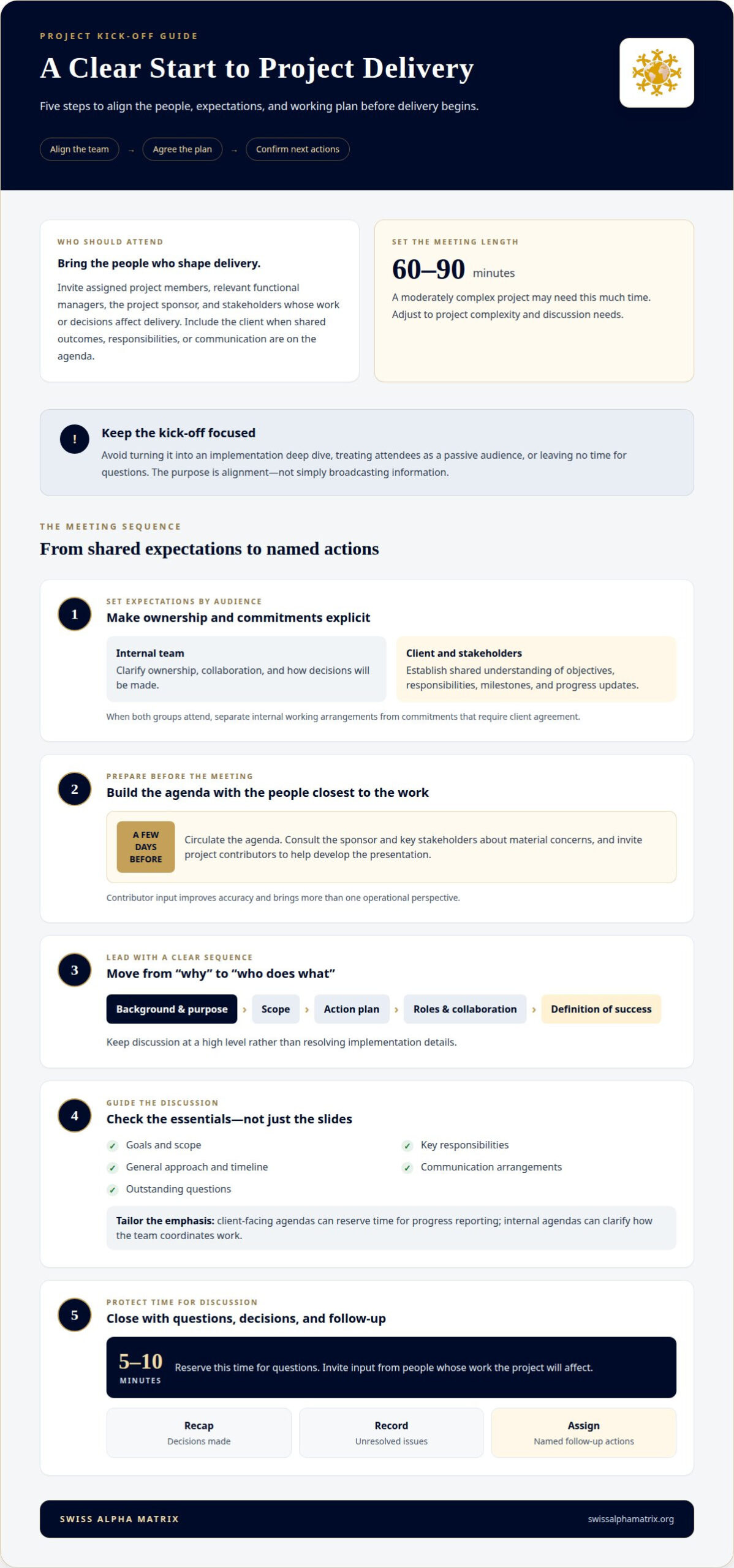
Who should attend? Invite assigned project members, relevant functional managers, the project sponsor, and stakeholders whose work or decisions affect delivery. Include the client when the meeting covers shared outcomes, responsibilities, or communication. How long should it last? A moderately complex project may need 60 to 90 minutes; adjust the duration to project complexity and discussion needs. Common mistakes include turning the kickoff into an implementation deep dive, treating attendees as a passive audience, and leaving no time for questions.
- Set separate expectations for each audience. In an internal kickoff, clarify team ownership, collaboration, and how decisions will be made. In a client kickoff, establish shared understanding of objectives, responsibilities, milestones, and progress updates. When both groups attend, distinguish internal working arrangements from commitments that require client agreement.
- Prepare and circulate the agenda a few days before the meeting. Consult the sponsor and key stakeholders beforehand about material concerns, so the discussion can address them directly. Ask project contributors to help develop the presentation; their input improves accuracy and gives the agenda more than one operational perspective.
- Lead with a clear sequence. Open with project background and purpose, then cover scope, the action plan, roles, collaboration, and the definition of success. This order takes attendees from why the work matters to who will do what. Keep the meeting at a high level rather than resolving implementation details.
- Use an agenda checklist to guide discussion. Confirm goals and scope, key responsibilities, the general approach and timeline, communication arrangements, and outstanding questions. For example, a client-facing agenda can reserve a point for progress reporting, while an internal agenda can clarify how the team coordinates work.
- Protect time for discussion and close with decisions. Reserve five to 10 minutes for questions, then recap unresolved issues and assign follow-up actions. A kickoff meeting should align participants, not simply broadcast information; invite input from people whose work the project will affect.
Why should you have a project kickoff?
Hold the kick-off after the statement of work or project charter is finalized and the parties are ready to begin. Use the meeting to establish the project’s purpose, clarify its scope, and ensure everyone shares the same basis for delivery.
-
Clarify Project Goals and Scope
Start by stating the outcome the project is intended to achieve, then define the work required to reach it. Compare the proposed scope with the statement of work so attendees can distinguish agreed activities from assumptions or requests that still need discussion. For example, if a deliverable is a completed review, specify its boundaries and intended use rather than assuming related follow-on work is included.
-
Define Deliverables, Milestones, and Timeline
Translate the agreed scope into deliverables, then place each major milestone on a timeline. A deliverable is an item sent to the customer or client; milestones can mark points in the work where progress is reviewed. Check that each milestone supports an intended outcome and that the timeline makes dependencies visible. Avoid listing dates without explaining what completion means at each point.
- Use the agenda to discuss the project charter, including purpose, scope, major deliverables, risks, assumptions, estimated effort and budget, and deadline. This gives everyone a shared reference for decisions and helps expose ambiguity before work proceeds. The kick-off serves four basic functions: formally state the start, outline goals and roles, clarify expectations, and build commitment among people who influence the outcome.
- Establish how the team will report status against tasks, milestones, and timeline. If a requested change affects a deliverable or deadline, record the question and its impact for review rather than silently absorbing it into the plan. This distinction protects the project baseline and gives stakeholders a clear basis for discussing progress. For complex programmes with interdependent workstreams, Complex Project Management can support disciplined coordination.
Expectations, communication, and check-ins
Define how project members and stakeholders will exchange information before delivery begins. A clear plan connects communication, collaboration, progress updates, and issue handling.
-
Establish a Communication Plan
Agree who receives each update, who prepares it, and which channel carries it. For example, the project lead might give stakeholders a concise status summary, while members use a shared workspace for working documents. Set the reporting rhythm around milestones and decisions. Avoid relying on informal messages alone, since important decisions and open issues can become difficult to track.
-
Plan Collaboration and Check-Ins
Specify how members will coordinate tasks, share dependencies, and raise concerns. Choose collaboration tools that support the agreed workflow, then define how the team will use each one. For instance, record task ownership in the project workspace and reserve check-ins for progress, blockers, and decisions. Make the client’s participation purposeful by identifying which updates need review or input, rather than inviting them to every internal discussion.
-
Coordinate Follow-Up Actions and Communications
Close each meeting by recording decisions, action owners, due dates, and unresolved questions. Send attendees a concise summary and action-item list so members and stakeholders share the same understanding of next steps. Identify who will respond to each open issue and how that response will reach affected participants. This prevents questions raised in the meeting from disappearing into separate message threads.
- Review the communication plan as project conditions change. If a milestone shifts, explain the impact on tasks and stakeholders through the established channel, then update the relevant record. When an issue affects both the team and client, define the escalation path and who will coordinate the response. Keep the status format consistent, covering completed work, upcoming decisions, and risks that need attention.
Internal and client kick-off meetings
Separate internal alignment from client coordination, even when both meetings concern the same project. This distinction lets the project team resolve operational questions while clients focus on shared outcomes and decisions.
- Hold an internal session for delivery coordination. Bring team members together to clarify dependencies, decision-making, and how work moves between functions. For example, a technical contributor may need detail on handoffs that would distract from a client discussion. Keep the internal conversation focused on execution and the responsibilities that support delivery.
- Use the client meeting to establish shared understanding. Present the project purpose, intended outcomes, and key milestones in terms the client can assess. Invite discussion about priorities and open questions, then distinguish agreed commitments from matters requiring further decision. This creates a practical basis for collaboration without making the meeting a one-way presentation.
- Decide which participants need both sessions. Include people who connect internal work with external decisions, such as a project lead coordinating team progress and client updates. A team member assigned only 1% of their time may not need the full kickoff, while a contributor assigned 99% can benefit from the project context.
- Scale participation to the change in coordination. A project growing from one team member to two may not require a formal kickoff. A change from 20 to 40 people creates more dependencies, making shared roles and communication arrangements more important to address together.
- Make each session active, not a broadcast. Ask team members to identify handoff risks, and invite clients to clarify expectations for outcomes. For new members, explain relevant organizational processes and share a project document that captures decisions, responsibilities, and context.
- Close with a common record. Document decisions that affect both internal execution and client expectations, then circulate the relevant actions to each group. Keep confidential or operational detail within the appropriate audience, while ensuring the project team and client retain a consistent understanding of shared commitments.
Swiss Alpha Matrix: Complex Project Management
Swiss Alpha Matrix provides Complex Project Management for complex financial and investment programmes where coordinated delivery, clear accountability, and disciplined communication matter. Its services are relevant when a project involves cross-border stakeholders, interdependent workstreams, or significant verification and due diligence requirements.
Depending on the programme, the work may also involve Audit-Grade Instrument Validation, On-Ground Verification Services, or Operational Due Diligence. These offerings address distinct aspects of project oversight, from validating instruments to examining operational conditions, while keeping the wider project coordinated.
If your programme requires structured coordination across complex workstreams, contact Swiss Alpha Matrix to discuss the project.
Carry the project’s clarity into delivery
Understanding what a project kick-off meeting is provides a starting point; its lasting value depends on how decisions guide the work afterward. Treat the agreed objectives, responsibilities, and communication approach as a working governance reference. As conditions change, document decisions and assess their implications for delivery so the team and stakeholders can respond from a shared position rather than relying on assumptions.
For complex financial and investment programmes, Swiss Alpha Matrix offers Complex Project Management alongside Audit-Grade Instrument Validation and On-Ground Verification Services. These capabilities are relevant when delivery requires coordinated oversight as well as instrument validation or on-ground checks.
Contact Swiss Alpha Matrix to discuss your project and consider the coordination your programme requires. A carefully maintained decision framework can help keep the next phase deliberate and aligned.
Frequently Asked Questions
What is a project kick-off meeting?
A project kick-off meeting is the structured start of coordinated project work, bringing participants to a shared understanding before delivery proceeds. Unlike a routine status review, it addresses the project’s mandate and operating assumptions. For example, participants can identify a decision that depends on external input and assign responsibility for considering it before that dependency disrupts planned work.
What is the purpose of a project kick-off meeting?
The purpose is to establish a dependable basis for decisions and coordinated action. For example, if a project depends on information from another team, the kick-off can make that dependency visible and identify who will manage it. This helps participants distinguish decisions they can make immediately from matters requiring input, reducing the chance that separate interpretations shape early work.
What is the agenda for a project kick-off meeting?
The agenda is the meeting’s ordered plan for reaching a shared understanding and recording decisions. It should move from context to discussion, then to agreed next actions. For instance, a facilitator can first establish the decision the meeting must reach, invite relevant perspectives, and reserve time to capture outstanding questions. This keeps discussion purposeful without turning the meeting into a detailed work session.
What topics should be covered at a project kick-off meeting?
Cover the project’s assumptions, dependencies, decision points, and criteria for judging whether intended outcomes have been achieved. For example, if a deliverable relies on a third party, discuss what information is needed and how the dependency affects sequencing. Clarify unresolved questions too, so participants can distinguish settled parameters from topics requiring a later decision or further analysis.
How do you prepare for a project kick-off meeting?
Prepare by reviewing the project’s governing documents, identifying decisions the meeting needs to address, and matching invitees to those decisions. Assemble relevant materials, such as a current timeline or scope record, and note any conflicting assumptions. For example, if two documents describe different outcomes, make that discrepancy a discussion point rather than letting attendees leave with incompatible interpretations.
What are the key outcomes of a project kick-off meeting?
Key outcomes include a shared understanding of the project’s operating basis, recorded decisions, assigned follow-up, and a visible record of unresolved matters. A useful test is whether an absent team member could read the meeting notes and identify what was decided, what remains open, and who owns the next action. That record supports continuity when responsibilities or participants change.