
Risk assessment is necessary, but it cannot resolve uncertainty that the project team doesn’t yet understand. Understanding how to manage a project with high uncertainty means distinguishing measurable risks, which can be assessed by likelihood and impact, from ambiguity or incomplete knowledge, which calls for learning and adaptation as work progresses. Both require deliberate oversight, but not the same response.
A sound risk process can improve control, but only when the conditions behind a project are understood well enough to guide action. This article explains how to assess and prioritise risks, distinguish the sources and forms of uncertainty, and choose a response based on what is known and what remains unclear.
You’ll also learn how clear stakeholder communication, staged decisions, and regular reviews help teams adapt as assumptions change while keeping objectives, resources, and potential value in view.
Key Takeaways
- Match your project’s response to the degree of uncertainty, from conventional analysis to learning through staged decisions.
- Prioritise foreseeable risks by assessing their likelihood and impact, then maintain a register grounded in a clear view of the project.
- Keep stakeholders aligned through regular, candid communication about changing assumptions, emerging threats and potential opportunities.
- Separate measurable risks from uncertainty caused by incomplete knowledge or ambiguity so each receives an appropriate management response.
Applying uncertainty analysis to project functions
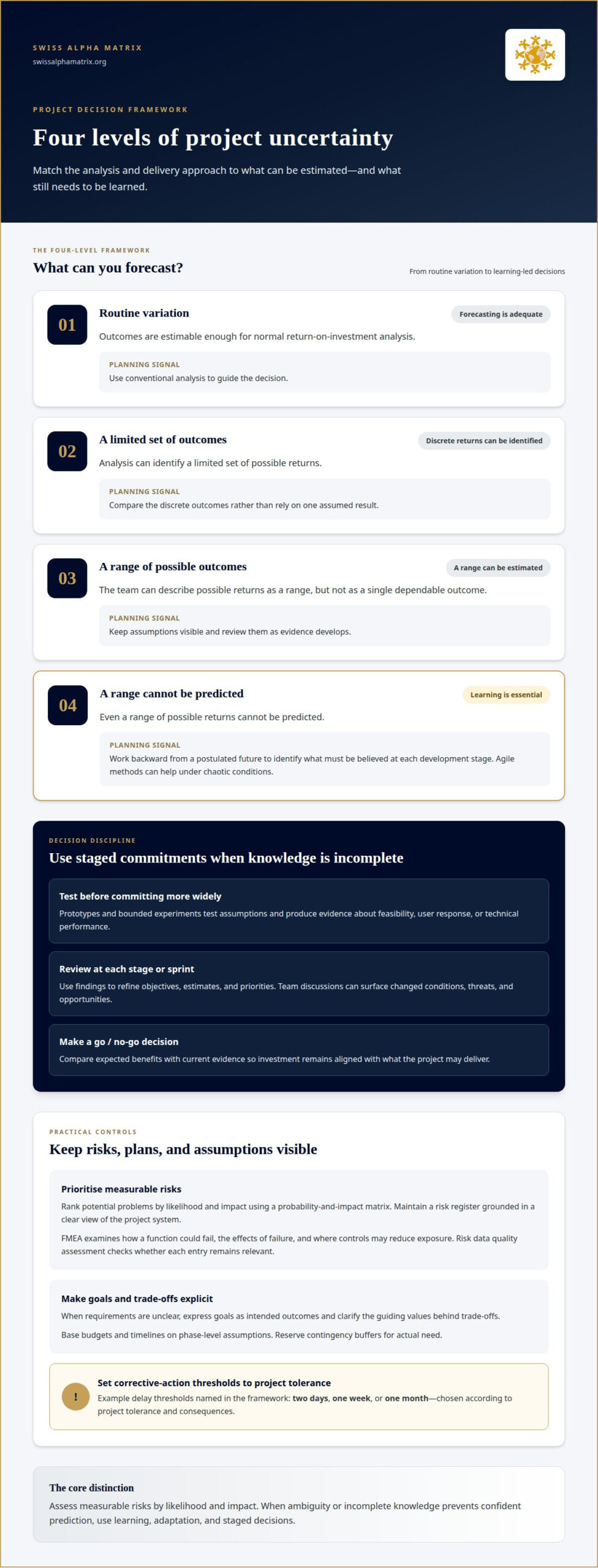
Uncertainty analysis connects project decisions to what the team can reasonably know, from investment returns to delivery assumptions. A four-level framework helps leaders decide how to manage a project with high uncertainty by distinguishing routine variation from conditions where learning is needed before commitments can be made with confidence.
Risk Analysis and Prioritization
Risk analysis identifies and ranks potential problems by likelihood and impact, helping teams focus on material exposures. A probability-and-impact matrix prioritises risks, while a register tracks them against a clear view of the project system. Failure Mode and Effects Analysis (FMEA) examines how a function could fail, the effects of failure, and where controls may reduce exposure. Risk data quality assessment checks whether each entry remains relevant to the project.
Project Methods for High Uncertainty
Project methods should reflect whether outcomes are estimable or still ambiguous, which determines how firmly plans can be set. At Level 1, normal return-on-investment analysis is adequate; at Level 2, analysis can identify a limited set of discrete returns. Level 3 supports only a range of possible returns, while Level 4 prevents prediction of even a range. For Level 4, teams can work backward from a postulated future; agile methods can help under chaotic conditions.
Goals, Budgets, and Timelines
When requirements are unclear, goals should express intended outcomes and clarify the guiding values behind trade-offs. For Level 4 uncertainty, working backward from a postulated future helps identify what must be believed at each development stage. Budgets and timelines should reflect phase-level assumptions, with contingency buffers reserved for actual need. Project leaders can set corrective-action thresholds, such as a two-day, one-week, or one-month delay, based on project tolerance and consequences.
Prototypes, Experiments, and Plan Reviews
Prototypes and bounded experiments test assumptions before they drive wider commitments, producing evidence about feasibility, user response, or technical performance. Teams can use the findings to refine objectives, estimates, and priorities. To manage a project with high uncertainty, review plans throughout its life cycle, including at the end of each stage or sprint. Regular team discussions can surface changed conditions, threats, and opportunities, while go/no-go decisions keep investment aligned with expected benefits.
What is the role of risk assessment in project managemen t?
Risk assessment helps project leaders weigh potential harm against expected value before committing resources. A value management workshop connects uncertainty analysis to the decision to proceed, adapt, or stop.
Project Uncertainty Profiles
An uncertainty profile describes how complexity and ambiguity affect the evidence available for project decisions. Assessing it during the initial information and identification phase of a value management workshop helps determine whether conventional forecasts are dependable. A project with unclear objectives needs a different decision process from one with stable objectives but uncertain delivery conditions. The profile also helps stakeholders distinguish knowledge gaps from competing priorities.
Risk Assessment Tools
Risk assessment tools organise evidence so leaders can compare potential threats and opportunities consistently. A probability-and-impact matrix ranks risks by likelihood and consequence, while a risk register records exposures, assumptions, and planned responses. Risk data quality assessment tests whether potential-risk information is relevant to the project. For proposed changes, milestone comparisons and benchmarks can test whether the development plan remains robust. A value management workshop can evaluate 10-15 improvement options.
Methods for Uncertain Projects
Project methods organise delivery according to how stable requirements are and how quickly the team needs to learn. Traditional management suits work with defined scope and predictable dependencies. Agile supports iterative adjustment when markets or technology change. Lean management focuses on value and reducing work that does not advance it. Choose a method based on the source of uncertainty, decision constraints, and how quickly new evidence can inform the next commitment.
Decisions with Incomplete Information
Decision frameworks make assumptions, objectives, and trade-offs explicit when evidence is incomplete. The Strategic Choice Approach matches responses to the uncertainty: acquire information about the working environment, clarify guiding values, or widen the view of related decisions. At each stage or sprint, leaders compare expected benefits with current evidence. They can pause for information, change scope or direction, or cancel when the project no longer offers appropriate benefits. Structured risk oversight can support those assessments.
How professional project managers communicate and lead stakeholders through uncertainty
In complex projects, decisions can face competing pressures: urgency, uncertainty, and blurred political and technical considerations. About 38% of uncertainty situations identified in the cases related to project stakeholders’ characteristics or activities. Communication therefore belongs within active project governance, not simply in periodic status reporting. A project manager should make decision ownership clear, distinguish evidence from assumptions, and explain how each unresolved issue affects the next commitment.
A disciplined update gives stakeholders a shared view of the project. It should explain what has changed, what remains uncertain, which decision is needed, and who owns the next action. For example, if local infrastructure may affect a delivery milestone, state the dependency, its possible schedule effect, and what evidence is still needed. This helps sponsors and technical teams discuss the same issue without treating an estimate as a confirmed outcome.
Regular conversations with team members can reveal changes that formal reports miss. Invite staff to raise emerging threats, observed changes, and potential opportunities, then record the resulting actions and decision owners. This makes escalation part of normal work rather than something reserved for a crisis. When a decision has both political and technical dimensions, clarify which considerations inform the recommendation and who has authority.
Trust supports collaboration when unexpected changes arise. Managers build it through consistent explanations, prompt disclosure of material changes, and follow-through on agreed actions. They should also tailor the detail to the audience: a sponsor may need implications for objectives and investment, while a delivery team needs to know which tasks and dependencies are affected. At each stage or sprint review, stakeholders can assess new evidence, revise assumptions, and decide whether priorities remain aligned. This cadence supports informed decisions without presenting uncertainty as certainty.
Distinguishing risk from uncertainty
A project risk is an identifiable event whose likelihood and impact can be assessed. Uncertainty arises when outcomes are difficult to predict because knowledge is incomplete, the project system is unpredictable, or the situation is ambiguous. A possible supplier delay may be a risk if its probability and schedule effect can be estimated. Demand in a new market may remain uncertain when outcomes cannot yet be bounded reliably.
The distinction affects the quality of decisions. In 14 of 41 cases, or 32% of those interviewed, project managers mistook risks for uncertainties. Treating an unknown as a measurable risk can create false precision, while calling an assessable risk “uncertainty” may delay practical controls. Project leaders should identify what is known, what evidence supports an estimate, and what remains unresolved.
Start classification by examining the cause. A contract clause with a defined consequence may allow likelihood-and-impact assessment. Changing political conditions, unfamiliar infrastructure, or unclear objectives may leave outcomes open-ended. Internal factors, such as team competence or resources, can also create uncertainty when their effect on delivery is not understood. Describe the evidence rather than simply assigning a label.
Then match the response to the knowledge gap. For an identified risk, assign an owner, assess its impact, and determine an appropriate response. For uncertainty, specify what information could narrow the range of outcomes, who can obtain it, and which decision depends on it. Reassess the classification as evidence changes: an ambiguous issue may become a quantifiable risk, while a presumed risk may prove less predictable than expected.
The practical test is straightforward: can the team estimate likelihood and impact using relevant evidence? If so, manage the issue as a risk. If not, treat it as uncertainty and organise decisions around learning. For projects where both conditions intersect, seek structured project risk support to clarify exposures and decision requirements.
A risk impact/probability chart can help prioritise identified project uncertainties, while a project risk register tracks potential risks that may arise during the project.
Swiss Alpha Matrix: Complex Project Management
Swiss Alpha Matrix provides Complex Project Management for programmes where interconnected decisions, uncertain assumptions, and multiple stakeholders require coordinated oversight. It is a natural next step when internal teams need structured management to keep objectives, dependencies, and emerging risks visible as work develops.
For investment-related programmes, Audit-Grade Instrument Validation, On-Ground Verification Services, and Operational Due Diligence address distinct information and execution needs. The right support depends on project requirements: validation focuses on instrument review, while on-ground verification and operational due diligence address other aspects of project assessment. These services can complement project management when evidence and operating conditions inform key decisions.
Contact Swiss Alpha Matrix to discuss your project management requirements.
Turn uncertainty into a disciplined next decision
Deciding how to manage a project with high uncertainty is ultimately a governance question: which assumptions can guide action, who has authority to revise them, and what evidence should prompt a change in direction. Make these decision conditions explicit before commitments accumulate. This gives the team a clear basis for reassessing priorities as the project develops, rather than allowing early assumptions to become fixed by default.
This discipline also preserves strategic flexibility. Project leaders can define the information needed for the next decision, the stakeholders responsible for interpreting it, and when continued investment should be reconsidered. A structured review process gives emerging evidence a defined role in decision-making while keeping accountability and intended outcomes in view.
For support in assessing your project’s requirements and management needs, contact Swiss Alpha Matrix. A measured next step can bring greater clarity to complex decisions and help your team proceed with purpose.
Frequently Asked Questions
How can a project manager identify and prioritize risks in an uncertain project?
Start by examining key project assumptions and dependencies, then identify what could disrupt each one. For example, if a launch depends on a supplier’s technical specifications, uncertainty about those specifications could affect design approval and procurement sequencing. Prioritise issues by their potential effect on project objectives and the urgency of the decision. Assign an owner to each priority so follow-up is clear.
How can a project manager manage stakeholders and communicate uncertainty in a project?
Tailor each update to the stakeholder’s decision-making role, and keep a shared record of assumptions, decisions, and unresolved matters. A sponsor deciding whether to release resources needs to understand the implications for objectives and commitments; a technical lead needs to know which dependencies are affected and what evidence is required. If an assumption changes, explain what prompted the change, which decisions it affects, and what action follows, using consistent language across groups.