

A disruption is a poor time to decide what matters most. Understanding what a business continuity plan is begins with its purpose: a documented set of actions and processes that helps an organization maintain stability when operations are interrupted. It sets out response and recovery steps, communication processes, and the responsibilities of those expected to carry them out.
Preparation matters because a plan is useful only when it reflects an organization’s actual dependencies and can be put into practice. Risk assessment identifies plausible threats, while a business impact analysis clarifies which functions and resources are most critical and what interruptions could mean for operations and finances.
This article explains how these assessments shape a business continuity plan, what it typically covers, and how testing and review keep it relevant. It also outlines practical benefits: clearer decisions under pressure, more coordinated communication, and a considered path to restoring essential activities. The goal is not to predict every disruption, but to establish a disciplined framework for responding when normal operations are affected.
Key Takeaways
- Understand how a continuity plan defines response, recovery, communication, and accountability when operations are interrupted.
- Use risk assessment and business impact analysis to identify critical functions, dependencies, and potential disruption effects.
- Distinguish organization-wide continuity planning from disaster recovery focused on restoring technology and data access.
- See how preparation can support clearer decisions, coordinated responses, and more resilient operations.
Business Continuity Plan (BCP): What is it & How Does it Work?
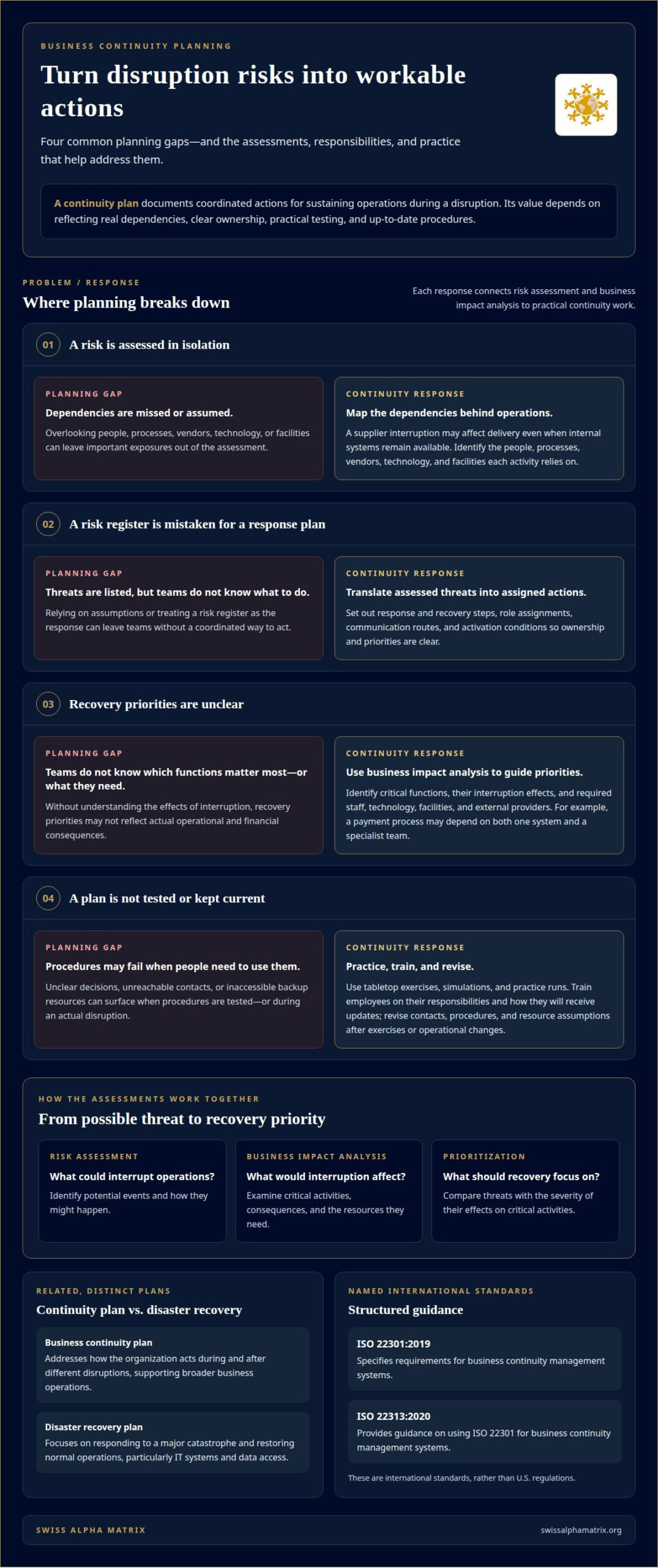
A business continuity plan documents coordinated actions for sustaining operations during a disruption. Its effectiveness depends on clear ownership, practical testing, and up-to-date procedures.
Plan Development and Implementation
A plan translates assessed threats into assigned actions that help maintain critical operations. Clear ownership lets teams act without confusion over authority or priorities. Developing the plan means identifying potential threats, essential activities, dependencies, safeguards, and recovery steps. Leaders assign roles, communication routes, and activation conditions, then incorporate procedures into operational decisions. A disaster recovery plan may support technology restoration, while continuity planning addresses broader business operations.
Testing, Training, and Plan Updates
Testing evaluates procedures, while training prepares staff to carry out their responsibilities. Tabletop exercises, simulations, and practice runs can expose unclear decisions, unreachable contacts, or inaccessible backup resources. Employees beyond the continuity team should know the plan and how they will receive updates. After exercises or operational changes, plan owners should revise contacts, procedures, and resource assumptions. Regular updates keep the document relevant as systems, staff, suppliers, and threats change.
Plan Contents, Templates, and Tools
A useful plan records activation criteria, response and recovery actions, role assignments, and communication procedures. It can include emergency contacts, continuity-team resources, backup-data locations, and vendor details. Templates offer a repeatable structure; document repositories, contact directories, dependency maps, and exercise logs help organize plan information. The aim is an actionable reference, not simply a list of risks. Development and maintenance costs depend on scope, complexity, technology, staffing, and testing; a provider’s price depends on the case and is given after a quote request.
Applicable Regulations and Standards
The named references are international standards, rather than U.S. regulations. The International Organization for Standardization states that ISO 22301:2019 specifies requirements for business continuity management systems. It also states that ISO 22313:2020 provides guidance on using ISO 22301 for business continuity management systems. Together, these standards offer organizations a structured basis for developing and maintaining continuity arrangements.
Risk assessment and business impact analysis
Risk assessment considers potential threats, while business impact analysis examines their consequences for critical activities. Together, they guide continuity planning, preparedness, and recovery priorities.
Risk Assessment
Risk assessment identifies events that could interrupt operations and considers how they might happen. It examines dependencies involving people, processes, vendors, technology, and facilities. For example, a supplier interruption may affect delivery even when internal systems remain available. Common mistakes include overlooking dependencies, relying on assumptions, or treating a risk register as a response plan. These gaps can leave teams without a coordinated way to act.
Business Impact Analysis
Business impact analysis identifies critical functions and evaluates how interruption could affect finances and operations. It considers the resources each function needs, including staff, technology, facilities, and external providers. If a payment process depends on one system and a specialist team, both dependencies shape recovery planning. According to the International Organization for Standardization, ISO/TS 22317:2021 provides guidelines for business impact analysis in business continuity management systems. The analysis informs realistic recovery priorities and helps clarify the consequences of downtime.
Prioritizing Risks and Impacts
Prioritization compares potential threats with the severity of their effects on critical activities. Teams can assess which functions have the greatest operational or financial consequences, then map the dependencies that could prevent their recovery. A technology outage and a supplier failure may require different responses, even if both interrupt the same service. Risk Management Frameworks can support a structured view of interconnected exposures; a disciplined risk assessment approach can help align analysis with operational priorities.
Common planning risks include overlooking reliance on a key supplier, underestimating technology downtime, and failing to account for staffing or facility constraints. Addressing these vulnerabilities early helps continuity and disaster recovery arrangements reflect actual business impacts, rather than isolated lists of threats.
Why are business continuity plans important?
A disruption can affect more than the system or site where it begins. A power outage may interrupt production, while a cyberattack can disrupt customer service and access to information. Business continuity plans connect assessment with preparedness, response, and recovery, giving decision-makers a framework for preserving critical operations. They also help employees understand priorities, communication routes, and their responsibilities as circumstances change.
Continuity planning and disaster recovery serve related but distinct purposes. A business continuity plan addresses how an organization will act during and after different disruptions, including supply chain interruptions or public health emergencies. A disaster recovery plan focuses on responding to a major catastrophe and restoring normal operations, particularly IT systems and data access. Restoring a backup, for example, may recover records, while continuity procedures guide how staff serve customers during restoration.
Recovery objectives make these strategies more precise. A recovery time objective (RTO) is the time needed to restore business processes after an unplanned incident. A recovery point objective (RPO) is the amount of data an organization can afford to lose and still recover. For a payment process, the RTO shapes restoration priorities, while the RPO informs decisions about acceptable data loss and backup arrangements. These objectives translate operational needs into recovery criteria.
Preparedness depends on coordination, not documentation alone. Employees need to understand how their roles connect with response leads, communications, and recovery decisions. Testing can expose conflicting instructions, inaccessible backups, or dependencies missed during assessment. A business continuity plan cannot prevent every consequence of a disaster, and insurance alone may not cover all disruption-related costs or prevent customers from switching providers. The plan’s value lies in establishing a considered sequence of actions, clarifying authority, and helping the organization move from response toward stable operations.
Benefits of a business continuity plan
Business continuity planning turns risk management into practical decisions made before an emergency. For an organization that relies on a specialist supplier, procedures can identify alternative sources and define how staff communicate service changes. This preparation helps decision-makers determine which activities need protection first. It also connects resilience to operational dependencies, rather than treating each disruption as an isolated event, giving teams a more coherent basis for action.
Clear responsibilities can reduce confusion when rapid coordination is needed. If a facility becomes unavailable, employees need to know who activates the response, who communicates with customers, and which operations can continue elsewhere. Defined channels help prevent conflicting messages between teams and external stakeholders. Regular exercises show whether procedures work in practice and reveal gaps in authority, access, or information before an actual emergency tests them.
A continuity plan can also help limit the operational and financial consequences of an interruption. Insurance may not cover every disruption-related cost, and it cannot ensure customers stay when service falters. A plan that identifies alternative suppliers and communication channels gives the organization options if a supply chain interruption affects delivery. These alternatives support service continuity while teams assess the disruption, manage dependencies, and restore normal arrangements.
Its deeper benefit is institutional learning. Each exercise, supplier change, or operational review can refine assumptions and clarify which resources support essential activities. A living plan therefore connects preparedness with ongoing governance, rather than remaining a document consulted only during a crisis. For organizations assessing complex dependencies and exposure, discuss continuity risk priorities as part of a disciplined approach to resilience.
Swiss Alpha Matrix
Swiss Alpha Matrix supports organizations assessing the operational risks and dependencies that shape continuity priorities. Its Risk Management Frameworks and Operational Due Diligence help structure exposure assessments, while Complex Project Management supports coordination across demanding programmes. These services are relevant when continuity concerns intersect with complex financial or investment activity, cross-border arrangements, or multiple operational stakeholders. They complement an organization’s continuity planning by helping decision-makers examine how risks, processes, and dependencies connect.
For matters involving financial instruments or conditions on the ground, Audit-Grade Instrument Validation and On-Ground Verification Services can provide focused due diligence. The appropriate support depends on the challenge at hand, whether it involves assessing operational exposure or coordinating complex work. Contact Swiss Alpha Matrix to discuss your requirements.
Make continuity part of strategic decision-making
Understanding what a business continuity plan is provides a starting point. The next step is to keep continuity considerations connected to decisions as operations, counterparties, and priorities evolve. This requires sustained attention from leadership, not simply a document stored for emergencies. Revisit assumptions about critical activities when material changes affect the organization, and treat continuity as part of sound governance.
For complex financial or investment programmes with operational dependencies, Swiss Alpha Matrix provides Complex Project Management, Audit-Grade Instrument Validation, and On-Ground Verification Services. These services support work involving project coordination, instrument review, or on-site verification as part of broader risk oversight.
For a considered discussion of your requirements, contact Swiss Alpha Matrix. A deliberate next step can help bring greater clarity to the decisions ahead.
Frequently Asked Questions
Business Continuity Training Part 1: What is Business Continuity Planning?
Business continuity planning is the management discipline of preparing an organization to sustain priority work when normal conditions change. In an introductory training session, employees might review who can authorize a response, how internal updates are shared, and where role-specific instructions are kept. The purpose is to make continuity responsibilities understandable across teams, rather than leaving response decisions solely to specialists.
What is a business continuity plan (BCP)?
A business continuity plan is the documented reference an organization uses to coordinate its response during disruption. For example, a customer support team might use it to identify an authorized decision-maker, an approved communication channel, and the process for handling pending requests if its usual platform becomes unavailable. Its practical value comes from connecting these instructions to assigned roles and operational realities.
What are the steps to create a business continuity plan?
Start by establishing who owns the plan and which business activities it covers. Gather information about operational dependencies, define response authority, document communication and continuity procedures, and specify how records and resources can be accessed. Review the draft with the teams expected to use it, resolve unclear instructions, and run exercises to identify improvements. For instance, a customer service team can rehearse how to handle work during a platform outage.
How do you conduct a business impact analysis (BIA)?
Conduct a business impact analysis by speaking with people responsible for essential functions and documenting what each function needs to operate. Record dependencies such as specialist knowledge, facilities, suppliers, and information systems, then assess how an interruption could affect service, finances, or obligations. A purchasing function, for example, may rely on both an approval process and access to suppliers. Mapping these connections helps leaders see where a disruption could spread.
How do you identify and prioritize business continuity risks?
Identify risks by examining how internal and external events could interrupt specific activities, then assess their likely operational consequences. Prioritize risks based on the importance of affected functions, their dependencies, and whether an interruption could spread to other areas. For example, a communications failure could disrupt both customer updates and staff coordination. Recording these relationships helps distinguish isolated problems from exposures that could affect several functions.
What are recovery time objective (RTO) and recovery point objective (RPO)?
An RTO defines how quickly a business process needs to be restored after an unplanned incident. An RPO defines the amount of data loss the organization can tolerate and still recover. For an order system, its RTO informs restoration urgency, while its RPO guides how current recovered order records need to be. Together, these objectives align technology recovery decisions with operational requirements.