

Speed alone rarely rescues a compressed project; disciplined prioritization does. To understand how to manage a project with a tight deadline, define the required deliverable, rank tasks by impact and dependencies, then align the schedule and available resources with the work that matters most. Keep progress visible, communicate risks early, and cross-train where reliance on one person could create a bottleneck.
A demanding deadline can make every task feel urgent. The real challenge is distinguishing essential work from activity that can wait, change, or be removed. A clear plan helps the team make those decisions without losing sight of quality or accountability. This guide covers practical ways to prioritize tasks, build a workable schedule, collaborate around capacity, communicate issues to stakeholders, and manage resources more resiliently. The goal is not simply to move faster, but to direct effort toward what contributes most to delivery.
Key Takeaways
- Define the required deliverable, then rank tasks by impact, urgency, and dependencies so effort stays focused on essential work.
- Break large tasks into manageable phases, make milestones visible, and adjust the schedule as priorities or conditions change.
- Share risks early with stakeholders, clarify the decisions needed, and document agreed actions to prevent avoidable delays.
- Match work to team members’ strengths and cross-train where possible to reduce bottlenecks when key resources are unavailable.
1. Prioritizing work with MoSCoW and the Eisenhower Matrix
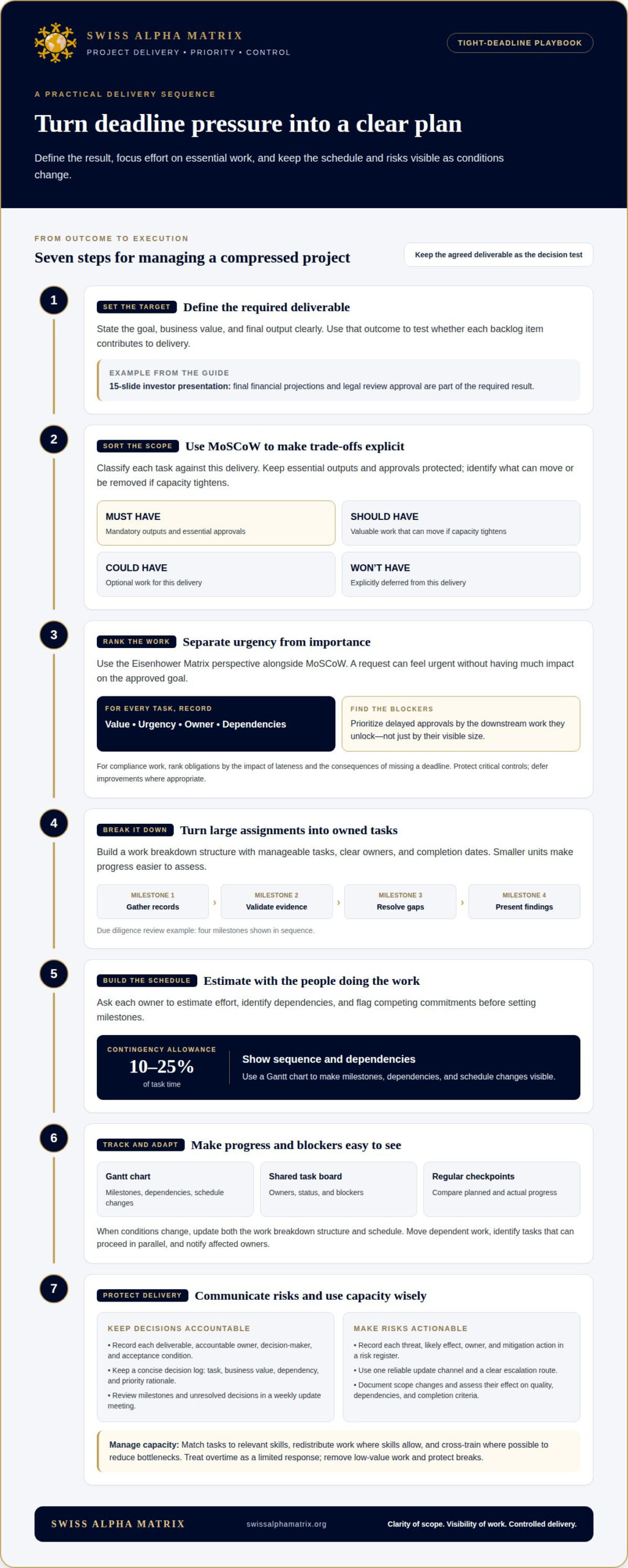
Knowing how to manage a project with a tight deadline begins with defining the goal, business value, and final deliverable. A 15-slide investor presentation, for example, might require final financial projections and legal review approval. That precise outcome gives the team a test for each backlog item: does it help deliver the agreed result? Without this structure, lower-value activity can crowd out work essential to project success.
Use MoSCoW to classify tasks as Must have, Should have, Could have, or Won’t have for this delivery. Treat mandatory outputs and essential approvals as Must haves; reserve Should haves for valuable work that can move if capacity tightens. Could haves are optional, while Won’t haves are explicitly deferred. The Eisenhower Matrix adds another perspective: distinguish urgent tasks from important ones. A stakeholder request may feel urgent but have little impact on the approved goal.
Teams deciding how to manage a project with a tight deadline can use both methods together. First, list each task in the backlog and record its value, urgency, owner, and dependencies. Then identify work that blocks others. A delayed approval, for example, may hold up several downstream tasks. Prioritize it by the work it unlocks, not just its visible size. Review the backlog at each planning meeting, and move or remove tasks when the delivery objective changes.
For compliance work, rank obligations by the impact of lateness and the consequences of missing a deadline, including possible fines for non-compliance. Separate tasks that protect a critical control from improvements that can follow later. Then assess whether urgent items all need to happen at once. Reducing or reorganizing scope may preserve the core outcome without treating every request as equally important.
Record the reason for each priority so the team can act consistently. A concise decision log should capture the task, its business value, key dependency, and priority rationale. This keeps the workflow coherent when new requests arrive and helps the team focus on work that supports the agreed result.
2. Adapting work schedules and collaborating creatively
Turn the prioritized backlog into a work breakdown structure, then divide large assignments into manageable tasks with clear owners and completion dates. For example, a due diligence review might have separate milestones for gathering records, validating evidence, resolving gaps, and presenting findings. Smaller units make progress easier to assess and show where the workflow needs adjustment.
Build the schedule with the people doing the work. Ask each owner to estimate effort, identify dependencies, and flag competing commitments before setting milestones. Include a contingency allowance of 10-25% of task time for unexpected delays, then show task sequence and dependencies in a Gantt chart. This makes expectations visible and helps the team distinguish a genuine delay from work that remains on track.
When circumstances change, update both the work breakdown structure and the schedule instead of patching dates in isolation. If a key source arrives late, move dependent review tasks, identify work that can proceed in parallel, and notify affected owners. Compare planned and actual progress at regular checkpoints. Assign tasks according to relevant skills, while clarifying decision rights and handoffs to avoid duplicated effort.
A Gantt chart can display milestones, dependencies, and schedule changes; a shared task board can show owners, status, and blockers. Choose tools that make the workflow visible and let the team update progress in one agreed place.
During a deadline crunch, treat overtime as a limited response, not the foundation of the schedule. Review workloads, remove low-value tasks, redistribute work where skills allow, and protect breaks so sustained effort does not become exhaustion. A team member stuck on a complex task may need focused support or a revised assignment, not simply longer hours.
Where interdependent work or shifting requirements make coordination difficult, structured project management support can help bring workstreams, milestones, and risk decisions into a coherent delivery plan.
3. Communicating with stakeholders and escalating issues
Base communication on the approved project plan, not informal assumptions. Record each deliverable, accountable owner, decision-maker, and acceptance condition so stakeholders know who is responsible for completion. A weekly update meeting can review milestones, unresolved decisions, and changes in delivery confidence. When responsibilities require particular skills, name the expertise needed and the person providing it.
To reduce scope without compromising essential requirements, separate mandatory outcomes from optional enhancements, then document what can move to a later phase. Use change control to assess each request’s effect on quality, dependencies, and agreed completion criteria before accepting it. This keeps deadline pressure from quietly removing a required control or approval.
Under pressure, establish one reliable update channel and a clear escalation route. Send the meeting agenda the day before, invite team members to suggest items, and close with assigned actions and owners. Use feedback loops to confirm everyone understands expectations. For example, ask a task owner to state the next decision needed and how it affects dependent work.
Manage risks by recording each threat, its likely effect, an owner, and a mitigation action in a risk register. The Internal Revenue Service describes the process as helping projects identify, analyze, validate, and mitigate risks. The U.S. Government Accountability Office explains that a risk management plan records known risk information and mitigation actions. Review blockers and related actions during project updates.
Escalate when a blocker threatens a milestone, essential requirement, or downstream team, rather than waiting for a deadline to pass. Present stakeholders with the issue, evidence, delivery impact, and decision required. Include options such as resequencing work or negotiating scope. Regular individual check-ins can reveal slippage early, while sponsor tolerance helps clarify whether a deadline adjustment is negotiable. Record each decision in the project plan.
4. Managing resources and cross-training team members
A project schedule is credible only when it reflects actual capacity, not just names assigned to tasks. Map each workstream to team members with the relevant skills, decision authority, and available time. Then compare assigned workloads with upcoming milestones. If one specialist owns every review, that person becomes a single point of failure, even when other tasks appear fully staffed.
Cross-training reduces that dependency. Pair a primary owner with a colleague who can handle defined supporting steps, such as preparing evidence, checking documentation, or maintaining a status log. Make the handoff explicit: record the process, quality criteria, access requirements, and escalation contact. This gives the backup a practical way to contribute without assuming they can replace specialist judgment.
Review capacity proactively at each schedule checkpoint. Ask team members which tasks are blocked, which commitments compete for their time, and where assistance could protect the timeline. Reassign work according to skills and capacity, not simply availability. A short-term transfer can create rework if the new owner lacks essential context. Encourage early requests for support, before a missed handoff affects dependent work.
When resources remain constrained, distinguish essential expertise from administrative effort. A specialist validating a critical document may delegate collection and indexing while retaining responsibility for the substantive review. This preserves decision quality and frees scarce expertise for work that depends on it. Record the reassignment in the project schedule, with a named owner and clear completion criteria.
Monitor workload sustainability, too. If progress depends on repeated overtime, revisit sequencing, scope, and resource allocation rather than treating extended hours as added capacity. Protect breaks, check whether responsibilities are concentrated, and adjust assignments when fatigue or stalled work threatens delivery. A resilient plan accounts for both the team’s capacity and the consequences of losing a key contributor.
For complex workstreams that require coordinated oversight, discuss project resource coordination as a way to align responsibilities, dependencies, and delivery priorities.
Swiss Alpha Matrix: Audit-Grade Instrument Validation
Swiss Alpha Matrix provides instrument validation and audit-grade due diligence for stakeholders assessing financial instruments within complex or time-sensitive programmes. This work can support project decisions when validation evidence is central to sequencing, risk assessment, or delivery readiness.
When execution also depends on evidence gathered across locations, on-ground verification can support those needs, while operational due diligence can help assess operational considerations. For programmes with interdependent workstreams, program oversight and complex project management support coordinated delivery. These services complement internal prioritization by addressing validation, verification, due diligence, or project coordination needs directly.
If your project requires support in one of these areas, contact Swiss Alpha Matrix to discuss the work.
Make the next decision with clarity
Turn deadline pressure into an explicit operating decision: what outcome must remain protected, what capacity can be redirected, and which unresolved dependency needs attention first? Use those decisions to establish a practical basis for action instead of letting urgency alone dictate the project’s direction. A deliberate approach to how to manage a project with a tight deadline connects the immediate delivery objective to sound oversight and longer-term priorities.
For complex financial or investment programmes, independent support may be appropriate when instrument validation, on-ground verification, or coordinated project management forms part of the delivery challenge. Swiss Alpha Matrix provides these services for stakeholders managing complex programmes. Begin a conversation about your project and consider the support that best fits its requirements. A measured next step can help your team move forward with greater definition and purpose.
Frequently Asked Questions
What Are the Best Strategies to Improve Project Performance and Meet Tight Deadlines?
Effective strategies combine focus with early visibility into delivery constraints. Limit parallel work so team members can finish assignments before opening additional workstreams, and compare actual progress with the next required outcome. For example, if a review is stalled by missing evidence, resolve that constraint before starting another review. This keeps attention on the work that directly affects delivery.
How Do You Handle Meeting a Tight Deadline?
Start by clarifying what “complete” means to the person receiving the deliverable, then identify the next decision or input needed. If a client expects a reviewed report, distinguish a polished draft from an approved final version and plan for the approval step. Tell affected colleagues promptly when an assumption changes, so they can adjust their work rather than rely on an outdated commitment.
What To Avoid When Working On A Tight Deadline?
Avoid treating every request as an immediate priority, switching repeatedly between unrelated tasks, or bypassing quality checks to create the appearance of speed. These choices can cause rework or leave an important issue undiscovered until handover. For example, confirm that a final document uses the approved source data before circulation. If new work is added, make its effect on existing commitments explicit.
What is deadline management?
Deadline management coordinates work, decisions, and available capacity around a required completion date. It involves setting clear expectations, monitoring delivery conditions, and responding when dependencies or assumptions change. In cross-functional projects, it also means allowing time for reviews and approvals, since a task can be technically finished while the deliverable remains unaccepted.
Best project management tools for tracking tight-deadline projects
A Gantt chart can show milestones, dependencies, and schedule changes, while a shared task board can track owners, status, and blockers. Choose tools that keep the workflow visible and let the team update progress in one agreed place.