

A sound deal thesis can still depend on an operating model built around one indispensable leader. M&A operational due diligence assesses whether a target’s people, processes, systems, and day-to-day operations can sustain its business plan and support growth. It tests not only what the company does, but whether its capabilities and leadership can endure, transfer, and scale.
Financial and strategic assessments can clarify a target’s performance and market position, but they do not establish whether its organization can execute the plan. That distinction matters when critical knowledge rests with a few employees, responsibilities are concentrated, or growth depends on systems and processes not yet tested at greater scale.
This article explains what operational due diligence assesses and how it complements strategic due diligence. It also explores how buyers can evaluate operational risks, scalability, team structure, and key-person exposure, then connect findings to integration priorities and future value creation.
Key Takeaways
- Test whether the target’s operating model can deliver its business plan, rather than relying on headline performance or strategic fit alone.
- Use operational findings alongside strategic analysis to distinguish market potential from the organization’s capacity to execute it.
- Examine systems, processes, and dependencies to identify where growth could require investment or create integration friction.
- Map critical responsibilities and decision-making authority to surface leadership gaps and reliance on key individuals before closing.
What is operational due diligence?
M&A operational due diligence assesses whether a target’s people, systems, and processes can deliver its business plan. It tests operational capability alongside strategic and financial assumptions.
Financial due diligence examines statements, cash flow, revenue, and profitability. Commercial due diligence assesses market attractiveness and competitive position; operational due diligence tests whether the business can execute its plan.
In the United States, requirements depend on the target’s industry, operating locations, contracts, and activities. A review may consider relevant licensing, data privacy, employment, environmental, and industry-specific compliance obligations.
The cost of operational due diligence depends on scope, operating footprint, document volume, and whether onsite assessment is needed. Pricing is case-specific and provided after a quote request.
Onsite Assessment and Integration Planning
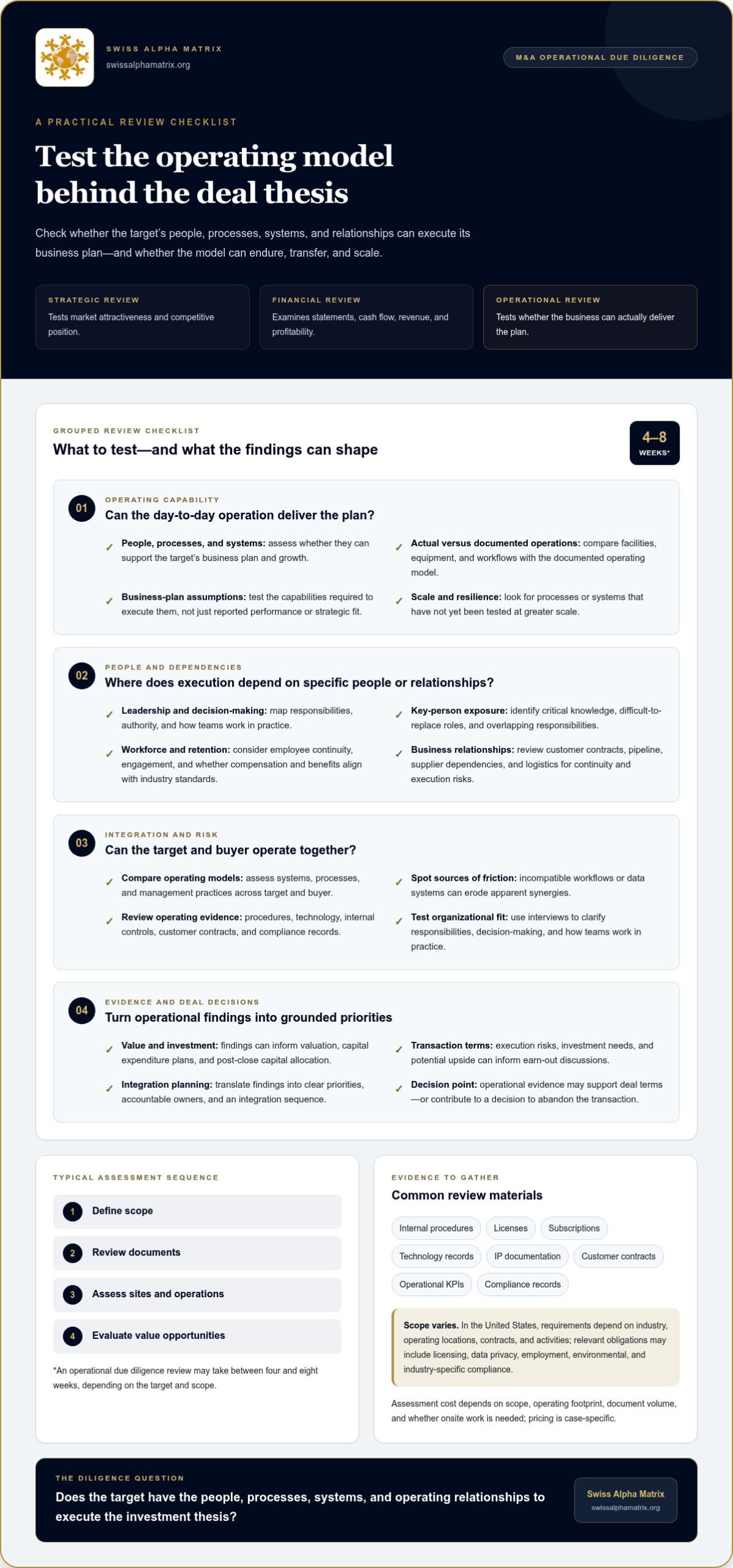
An onsite assessment compares the target’s actual facilities, equipment, and workflows with its documented operating model. It helps buyers test business-plan assumptions and shape post-merger integration planning. A typical process defines scope, reviews documents, assesses sites, and evaluates value opportunities. Operational due diligence may take between four and eight weeks, depending on the target and scope.
Integration Risks and Organizational Fit
An integration-risk assessment compares the target’s operating model with the buyer’s systems, processes, and management practices. It matters because incompatible workflows or data systems can erode apparent synergies. Review procedures, technology, customer contracts, internal controls, and compliance records; interviews can clarify how teams work in practice. Findings can inform deal pricing, earn-out structures, capital expenditure plans, or a decision to abandon the transaction.
In the United States, required documents depend on the business and review scope. Common materials include internal procedures, licenses, subscriptions, technology records, intellectual-property documentation, customer contracts, operational KPIs, and compliance records.
Buyer-Side and Investment Assessment
A buyer-side assessment tests whether the acquirer can integrate the target and support its growth plan. For a private equity investment, it helps distinguish forecast value from operational capability and identify assumptions that require investment. The buyer’s own systems, integration capacity, and management resources all affect the assessment. Findings can guide post-close priorities and capital allocation for operational improvements.
Operational findings inform valuation and purchase-agreement discussions by clarifying execution risks, investment needs, and potential upside. The assessment does not replace financial or legal review; it gives deal teams operational evidence to evaluate price, earn-outs, and planned capital expenditure.
Operational due diligence as a complement to strategic due diligence
Operational due diligence assesses a target company’s processes, supply chain, workforce, technology, risk management, and business relationships. Combined with strategic analysis, it tests whether the investment thesis can be delivered through the company’s actual capabilities.
Market Position and Business Relationships
Commercial analysis considers market attractiveness and the target’s position against competitors; operational analysis tests how the business serves customers and delivers its strategy. Reviewing customer contracts, the business pipeline, supplier dependencies, and logistics can show whether projected growth relies on durable relationships or fragile arrangements.
For a private equity investor, this distinction connects market opportunity with operating capacity. A strong market position may support the thesis, while concentrated sourcing or customer commitments can create execution risk. Assess how these relationships affect continuity, costs, and the target’s ability to meet its plan.
Human Capital and Retention
Human-capital analysis examines whether the workforce and leadership structure can turn the investment strategy into action. Interviews with operations managers can clarify responsibilities, decision-making, and employee engagement with the transaction. The review can also assess key-person exposure and whether compensation and benefits align with industry standards.
Retention matters when operational knowledge or customer relationships depend on specific individuals. Identify roles that are difficult to replace, understand where responsibilities overlap, and consider how employee continuity supports planned changes. This analysis helps investors connect capital allocation with the people needed to deliver operational priorities.
Strategic Fit and Management Buy-In
Strategic fit assesses how the target’s operating model aligns with the buyer’s systems, processes, and management approach. This comparison can reveal practical synergies and conflicts that could slow integration or disrupt business relationships. Management buy-in matters because target and divisional leaders often implement the value-creation plan.
Translate findings into clear priorities, accountable owners, and an integration sequence that reflects the deal rationale. This connects investment strategy with execution and helps mitigate resistance before it compromises planned changes. For transactions requiring a structured operational review, operational due diligence can help ground integration priorities in evidence about the target.
Operational risks, scalability, and value creation
Operational assessment weighs the target’s resilience against its capacity to improve performance. Buyers can then distinguish executable value-creation opportunities from assumptions that require further investment.
Balancing Risks and Opportunities
This assessment compares operational strengths and vulnerabilities with the acquisition thesis. That balance helps a potential buyer judge whether forecast growth is supported by real capacity.
For example, assess whether IT systems can scale with projected demand and whether data-management practices align with industry standards. Compare operational KPIs, supplier dependencies, and asset efficiency with relevant benchmarks. These checks can reveal process-improvement opportunities while showing where growth could strain existing systems or supply arrangements. The result is a more grounded view of execution risk and potential upside.
Hidden Liabilities and Operational Risks
Operational risks include weaknesses that reported performance or management presentations may obscure. Identifying them matters because deferred investment can undermine the target’s ability to sustain margins and deliver its business plan.
At a manufacturing site, examine equipment condition, material flow, work in process, and operator engagement. Review maintenance records and compare observed asset condition with reported needs. Map key suppliers, lead times, inventory practices, and single-source dependencies to identify continuity exposure. Assess whether sensitive data is protected and whether IT systems are secure and compatible with the acquirer’s infrastructure. These details can reveal liabilities and integration challenges before they affect performance.
Risk Mitigation and Value Creation
Mitigation turns identified risks into prioritized actions, owners, and investment decisions. An opportunity creates value only when management can execute it without overlooking delivery risks.
Develop the value-creation plan with the management team responsible for implementation after closing. Prioritize initiatives by expected operational benefit, required investment, dependencies, and execution exposure. For example, a supplier vulnerability may call for alternative sourcing, while deferred maintenance may require capital expenditure before capacity can expand. Track actions alongside post-merger integration priorities so buyers can distinguish achievable improvements from plans dependent on unresolved operational constraints.
Management team, organization, and key-person risk
A target’s operating model may depend on people whose knowledge, authority, or relationships are difficult to replace. Assessing management depth and organizational resilience helps buyers judge whether performance can continue through a merger, leadership change, or integration. The practical question is whether the organization can execute its plan without relying excessively on a few individuals.
Start by mapping decision rights, reporting lines, and responsibilities against essential operating activities. Compare the organization chart with management interviews and documented procedures. If one executive approves major customer terms, directs critical suppliers, and holds essential process knowledge, that concentration signals key-person exposure. Check whether responsibilities are documented, delegated, and supported by capable successors.
Interviews with operations managers can reveal how the team functions beyond formal job descriptions. Explore who resolves production delays, maintains customer relationships, and handles operational exceptions. Assess key employees’ engagement with the transaction, since integration uncertainty can affect their willingness to remain involved. These discussions help distinguish a capable management bench from an organization reliant on individual intervention.
Review compensation and benefits against industry standards, alongside leadership attrition risks. The aim is not to assume departures, but to identify roles where a change could disrupt continuity or delay planned improvements. For example, if a sales leader holds important account relationships, determine how the team manages those relationships. If a technical manager controls undocumented workflows, assess how knowledge transfer could support efficiency.
Translate findings into integration priorities: assign accountable owners, document critical processes, and plan knowledge transfer where responsibilities are concentrated. Retention measures and succession planning can then be evaluated against the deal’s operating priorities, rather than treated as generic human-resources actions. A successful integration depends on clear ownership and sustained management participation. Plan a structured assessment of operational risks to connect organizational findings with practical transaction priorities.
Swiss Alpha Matrix: Audit-Grade Instrument Validation
Swiss Alpha Matrix provides operational due diligence to help deal teams assess a target’s processes, systems, and organizational risks. This work is relevant when transaction findings need to inform integration priorities, operational assumptions, or decisions about execution capacity.
When an investment involves financial instruments or cross-border operations, Audit-Grade Instrument Validation and On-Ground Verification Services can complement the wider assessment. Complex Project Management can coordinate workstreams when transaction requirements involve multiple stakeholders and interdependent tasks. The right focus depends on the questions the deal team needs answered and the evidence available for review.
To discuss your transaction’s operational assessment needs, contact Swiss Alpha Matrix or visit swissalphamatrix.org.
Set the Next Decision on Stronger Ground
The next step is to turn diligence observations into a clear decision framework: which assumptions need adjustment, which actions belong in the integration plan, and where management accountability must be established. A focused M&A operational due diligence review can connect these judgments to transaction priorities without treating every finding as equally material.
Swiss Alpha Matrix supports relevant transaction work through Audit-Grade Instrument Validation, On-Ground Verification Services, and Complex Project Management. These capabilities are relevant when instrument review, onsite evidence, or coordination across workstreams informs the investment decision.
For a considered discussion of your transaction requirements, contact Swiss Alpha Matrix. With a clear view of the questions that matter most, your team can proceed with greater discipline and a more deliberate basis for action.
Frequently Asked Questions
What is operational due diligence in an M&A transaction?
M&A operational due diligence tests whether a target’s operating model supports the assumptions behind a transaction. It examines how work moves across functions, where decisions are made, and which dependencies could interrupt delivery. For example, a buyer can trace a key customer order from acceptance through fulfilment and invoicing to identify hand-offs, control gaps, or bottlenecks that headline performance measures may miss.
What operational risks and red flags should buyers look for in an acquisition?
Look for inconsistencies between management explanations, operating records, and observed practice. A process described as standardized may rely on individual workarounds, while performance reports may omit recurring service failures or unresolved system limitations. Buyers can compare exception logs, customer complaints, process documentation, and management responses. Repeated discrepancies, unclear ownership, or unresolved corrective actions can signal weaknesses that need closer analysis before the acquisition decision.
How do buyers quantify operational synergies and value-creation opportunities?
Buyers quantify opportunities by defining a measurable baseline, specifying the proposed operational change, and estimating its effect on revenue, cost, capacity, or required investment. For example, a shared process may reduce duplicated work, but the analysis should account for implementation resources, transition disruption, and timing. Assign an accountable owner, document assumptions, and track results against the baseline so projected value remains distinct from execution progress.