

What if the dependency most likely to interrupt a critical operation isn’t the obvious system outage, but the specialist, approval, control or counterparty one step upstream? Identifying single points of failure in operations starts with tracing a critical outcome back through the people, processes, technology and external parties needed to deliver it.
Risk reviews can produce lengthy inventories without showing which weaknesses could materially affect execution. A dependency deserves attention when its failure could interrupt a critical process and there are no effective alternatives or recovery arrangements to contain the impact.
This guide explains how to map dependencies around critical operations, assess their significance and rank vulnerabilities using evidence rather than assumption. It also shows how to turn the analysis into practical remediation options and clear executive decisions. By examining concentration, substitutes and recovery evidence, organisations can build a more disciplined basis for protecting capital and overseeing complex programmes.
Key Takeaways
- Start with the operational outcomes that matter, then trace the dependencies that enable them.
- Assess whether people, processes, controls, counterparties, data or technology have credible substitutes and recovery arrangements.
- Prioritise vulnerabilities by criticality, concentration and plausible impact. Record uncertainty instead of implying false precision.
- Use a structured review sequence to validate dependencies and convert findings into decision-ready remediation options.
- Identifying single points of failure in operations can strengthen due diligence and inform programme decisions tied to capital protection.
What Is a Single Point of Failure in Operations, and Why Does It Matter?
A single point of failure is a dependency whose loss prevents a critical operational outcome. More precisely, a single point of failure is one resource, decision or hand-off whose unavailability interrupts a specified critical outcome when no viable alternative can sustain it. This definition focuses the analysis on what the operation must deliver, rather than on whether a particular component seems technically important.
The dependency may be a person, process, control, counterparty, data source or technology platform. A payment process, for example, could depend on an authorised individual to release funds, a manual reconciliation control, accurate settlement data, an external bank or the system connecting them. The foundational idea behind a Single Point of Failure (SPOF) applies beyond technology: a business activity can be exposed wherever continuity rests on a concentrated dependency.
Exposure is not the same as a confirmed disruption. A dependency may be a vulnerability because its failure could interrupt an outcome, but that does not mean the failure has occurred or that every dependency deserves equal attention. Materiality depends on the outcome’s criticality, the availability of substitutes and the consequences of interruption. Identifying single points of failure in operations therefore requires context, not simply a long inventory of everything an activity uses.
How does an operational dependency become a point of failure?
Consider a hypothetical investment approval process. A critical decision may rely on a specialist’s analysis, a review control, a signed hand-off and information from an external counterparty. If another qualified individual can take over the analysis and the control can still operate, the dependency may be manageable. If no substitute can perform the analysis and the decision cannot proceed, it may become a point of failure. Its significance rests on the outcome at risk, such as a delayed approval or interrupted transaction, not merely on the fact that one person performs a task.
What forms can an operational SPOF take?
Operational concentrations can take several forms. These hypothetical examples illustrate different dependencies and are not descriptions of any particular organisation.
- Key individual: One employee holds specialist knowledge needed for a time-sensitive reconciliation, with no documented handover or capable substitute.
- Manual control: A single reviewer detects exceptions before a transaction proceeds, and there is no alternative review path during that person’s absence.
- System or data: A critical process depends on one platform or authoritative data feed, and a failure prevents staff from completing or verifying the work.
- Counterparty: One external provider performs an essential processing step, with no established alternative able to maintain the operational outcome.
These examples involve concentration in a particular resource. A different weakness may affect several resources at once, such as a shared access-control failure that prevents multiple employees from using separate systems. That broader vulnerability is not necessarily a single-resource SPOF, although it may still create material exposure. Making the distinction helps decision-makers describe the risk accurately before assessing its priority.
Map Operational Dependencies to Reveal Hidden Concentrations
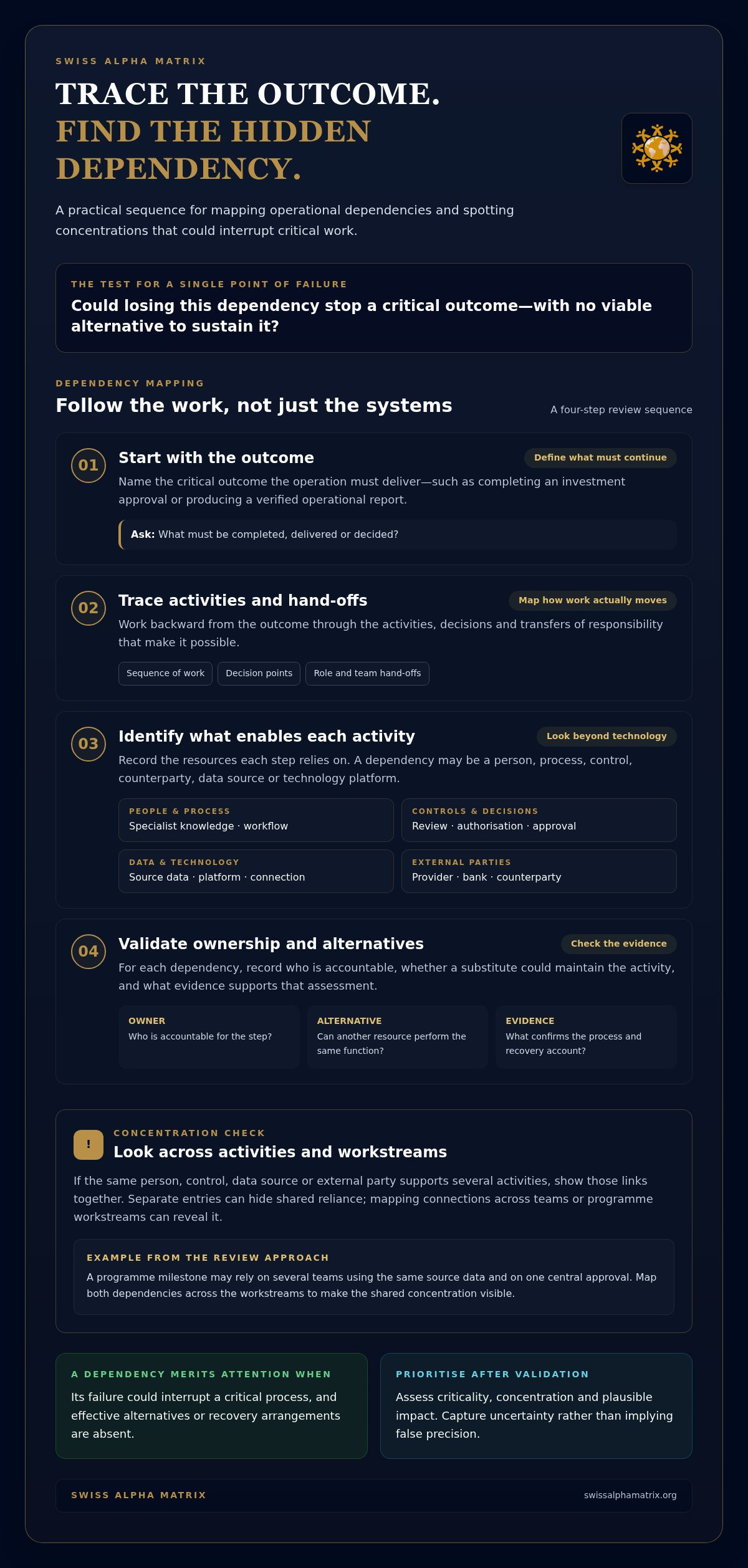
A useful dependency map starts with the outcome an operation must preserve, not a catalogue of systems or departments. Select a critical outcome, such as completing an investment approval or producing a verified operational report, then trace backward through the activities, decisions and resources that make it possible. This can reveal where separate teams or programme workstreams rely on the same person, control, data source or external party.
The aim is not to document every routine connection. Capture enough detail to see how work actually proceeds, who owns each step, where responsibility transfers and what evidence supports the account. A map should make concentrations visible while distinguishing a dependency from a material exposure. Prioritise once the links have been validated.
Build an outcome-to-dependency map
For each selected outcome, identify the activities required to deliver it and trace each activity to the resources that enable it. Record the accountable role, relevant control, system, data input and counterparty. Then note whether another resource can perform the same function. If a dependency serves several activities, show those connections rather than creating separate entries that conceal the shared reliance.
- Outcome: State what must be completed, delivered or decided.
- Activities and hand-offs: Record the sequence of work and the points where responsibility passes between roles or teams.
- Enabling dependencies: Identify the people, controls, systems, data and external parties each activity requires.
- Ownership and alternatives: Note who is accountable, what substitute could maintain the activity and what evidence supports that assessment.
For example, a programme milestone may depend on several teams using the same source data and on one central approval. Mapping both dependencies across workstreams can expose concentration that a process-by-process review might miss. Evidence may include process documentation, control records and stakeholder accounts. Record disagreements between sources for validation rather than resolving them through assumption.
Look beyond the formal organisation chart
Formal roles describe assigned responsibility, but they do not always show how work gets done. A specialist may hold undocumented knowledge, an informal approval may determine whether work proceeds, or a manual workaround may be the only option when a system is unavailable. Identify these dependencies through process walkthroughs and stakeholder evidence, then compare what people describe with documented procedures and available records.
Pay particular attention to shared access, hand-offs and information inputs. One data source may support several decisions; one administrator may control access across otherwise separate systems; or one counterparty may perform a step used by several teams. Represent each concentration clearly enough to assess its reach. If a map shows a substitute, establish whether it can perform the activity in practice rather than relying on its appearance in a procedure.
For transaction contexts, this dependency view can also inform operational due diligence for M&A, where execution dependencies may affect programme assessment and decision quality. Swiss Alpha Matrix provides operational due diligence and programme oversight for structured examination of complex operational exposure.
Prioritise Single Points of Failure Without Overengineering Resilience
A dependency map becomes useful for decision-making when it separates material exposure from ordinary operational weakness. Compare each dependency against the outcome it supports, the credibility of available substitutes, the extent of shared reliance and the plausible consequences of unavailability. A resource used by several programme milestones may merit closer scrutiny than one confined to a recoverable, low-impact task, even if both appear as single dependencies on a process map.
Remediation priority should reflect the materiality of the exposed outcome and the strength of available alternatives, not the mere presence of a single dependency. This avoids treating every identified SPOF as a reason to build identical or immediate redundancy. Some dependencies warrant prompt intervention; others may be managed through a tested contingency, clearer ownership or an informed acceptance of residual exposure.
Which dependencies merit priority attention?
Give greater scrutiny to dependencies that support critical outcomes and have limited substitutes, particularly where one failure could affect several processes or programme milestones. Assess the likely consequences of interruption in context. A delayed decision, missed operational hand-off or inability to complete a control may have different implications depending on timing and the decisions that rely on it.
Keep the assessment evidence-led. Record what supports the conclusion, such as an approved procedure, a demonstrated alternate workflow or stakeholder confirmation. Separate that evidence from assumptions that have not been tested. Where evidence is incomplete, state the uncertainty plainly instead of assigning a precise score that suggests more certainty than the review can justify. A ranked view should explain both the exposure and the basis for its position.
How should leaders compare remediation options?
For each priority dependency, compare options against the operational outcome they are intended to protect. Replacing a dependency may reduce concentration but introduce transition risk. An alternate workflow may preserve execution while adding manual steps. A contingency arrangement may enable a controlled response without duplicating the primary resource. In some cases, leaders may accept residual exposure, provided the decision and its rationale are explicit.
- Replacement: Consider whether another resource can assume the function and what transition or control changes that requires.
- Alternate workflow: Assess whether a different route can sustain the outcome, including any additional approvals, reconciliation or oversight it entails.
- Contingency arrangement: Define the response, decision authority and evidence needed to activate it.
- Residual exposure: Document what remains vulnerable, the rationale for acceptance and the conditions that would prompt review.
Weigh continuity benefits against operational complexity, control integrity and the practical demands of maintaining an alternative. Redundancy is not automatically feasible, necessary or proportionate. When identifying single points of failure in operations, use the evidence and decision context to determine which exposures merit action, which can be managed through contingency architecture and which require transparent acceptance rather than an unevaluated assumption.
How to Identify Operational SPOFs: A Practical Review Sequence
A disciplined review turns an initial view of operational dependencies into findings leaders can examine and act on. The sequence below focuses on execution: setting boundaries, testing evidence, resolving discrepancies and presenting decisions. Mapping and comparative prioritisation are distinct activities. Here, the aim is to establish whether the review’s conclusions are supported by what happens in practice.
Set the review scope and validate evidence
Begin by defining the critical outcome, the operational boundary under review and the stakeholders accountable for delivery. A scope that is too broad can dilute attention, while one that excludes linked programme work may miss shared dependencies. Gather relevant process maps, control records, contracts and project documentation. Then use focused discussions with accountable stakeholders to test how the work is performed.
- Set the review mandate. Specify the outcome under examination, its boundary and the decisions the review must inform. Identify accountable stakeholders across relevant teams and programme workstreams.
- Assemble source material. Collect current process documentation, control evidence, contracts and records describing operational arrangements. Note the date or version where available, so reviewers can distinguish current evidence from material that may no longer reflect practice.
- Test the documented process. Walk through key activities with the people responsible for them. Ask where approvals occur, what happens when a hand-off is delayed and which resources or parties are needed to complete each step.
- Corroborate or challenge the initial view. Compare stakeholder accounts with procedures, control records and other evidence. Where accounts conflict, preserve the discrepancy and establish what further evidence or decision is needed rather than treating one explanation as settled fact.
- Confirm substitutes and dependencies. Examine whether a proposed alternate resource or workflow can perform the required activity in practice. Check whether the same resource supports other processes or programme milestones, since shared reliance may change the reach of a potential interruption.
- Prepare the decision record. For each material dependency, capture the dependency, supporting evidence, exposure, accountable owner and next decision. Separate established findings from assumptions and unresolved evidence gaps, then present remediation options with their implications.
Convert findings into a decision-ready record
A concise record makes the review useful beyond the working team. State what the evidence demonstrates, what remains uncertain, who owns the dependency and what decision is needed next. Present ranked options without overstating confidence. Leaders should be able to distinguish verified exposure from assumption and understand the basis for proposed action or acceptance.
For complex programmes, identifying single points of failure in operations is most useful when the review connects evidence to accountable decisions instead of ending with an inventory. Swiss Alpha Matrix provides operational due diligence and risk management frameworks to support structured assessments. Discuss an operational due diligence review to examine dependencies in the context of a programme or investment decision.
Apply Operational Due Diligence to Complex Programmes
Dependency findings become strategically useful when connected to the decisions a programme must support. In a complex investment or transaction, a concentrated operational dependency may affect execution, oversight or the reliability of information used by sponsors and investors. Evidence-based analysis helps clarify where exposure resides, which outcomes it could affect and what remains uncertain, giving decision-makers a more considered basis for protecting capital and directing attention.
Operational due diligence can bring these findings into the wider assessment of a programme. Programme oversight and risk management frameworks can place identified exposure in a coherent decision context. When a programme crosses jurisdictions, dependencies may span counterparties, operating arrangements and governance structures. This wider lens can complement cross-border investment due diligence by connecting operational evidence to the broader investment assessment.
Connect operational findings to material risk exposure
For each evidence-backed dependency, consider the operational outcome it supports, the plausible consequences of interruption and the available remediation choices. Ranked strategies help sponsors and investors distinguish exposures that may warrant action from those that can be managed through contingency arrangements or accepted with a clear rationale. Keep the ranking traceable to its evidence so decision-makers can see both the exposure and any assumptions that still need resolution.
This discipline matters when dependencies intersect across programme milestones. An issue affecting one workstream may have implications for sequencing, oversight or confidence in a deliverable elsewhere. Audit-grade analysis can structure the evidence and exposure assessment without presenting uncertainty as certainty. The resulting view supports informed decisions and preserves a clear record of the basis for each option.
Present findings for executive action
Executive-level intelligence packs can consolidate exposure metrics, decision options and actionable next steps into a focused view for senior stakeholders. A useful pack makes clear what is established, where evidence remains incomplete, who owns the response and which decision is required. It should support deliberation, not obscure judgement behind a composite score or imply that a proposed intervention removes all operational uncertainty.
Swiss Alpha Matrix’s team includes former Managing Directors and senior executives from Tier-1 global banks, bringing transactional, regulatory and risk management expertise to complex programme considerations. Its approach combines financial discipline, commercial precision and Swiss discretion. For organisations identifying single points of failure in operations, precision-led assessment can connect dependency evidence to remediation choices and executive oversight, supporting considered capital-protection decisions in complex deals.
Explore Swiss Alpha Matrix advisory services to consider how operational due diligence, programme oversight and risk management frameworks can inform programme decisions.
Make Operational Resilience a Deliberate Decision
Operational resilience is not achieved by eliminating every dependency. It is strengthened when leaders understand which dependencies could materially affect execution, what evidence supports that assessment and which response best fits the programme’s objectives. Including this analysis in ongoing oversight can keep exposure visible as responsibilities, counterparties and operating arrangements change.
For complex deals, this discipline supports a clearer connection between operational risk and capital-protection decisions. Swiss Alpha Matrix provides audit-grade due diligence, instrument validation and programme oversight, combining financial discipline, commercial precision and Swiss discretion. Its team includes former Managing Directors and senior executives from Tier-1 global banks, bringing relevant experience to complex programme decisions.
Identifying single points of failure in operations is ultimately a matter of sound judgement: establish what is known, make uncertainty visible and choose responses proportionate to the exposure. A focused review can examine the dependencies most relevant to your investment or programme. Explore Swiss Alpha Matrix’s precision-led advisory for complex deals and connect dependency evidence to your next decision.
Frequently Asked Questions
What is an example of a single point of failure in business operations?
A business’s month-end close could depend on one finance specialist who alone can reconcile a particular ledger and submit the final package for management reporting. If that person is unavailable and no one else can complete the task, the reporting outcome may be interrupted. Materiality depends on the deadline, downstream decisions and whether another process can produce a reliable substitute, not simply on one specialist owning the task.
Can one employee be a single point of failure in an organisation?
Yes. An employee can become a single point of failure if an essential activity depends on their unique knowledge, authority or access. For example, if only one person can approve a payroll file and no authorised delegate can act during their absence, processing may be delayed. Review whether documented procedures, permissions and handover arrangements allow another qualified person to perform the task without weakening controls.
How do you identify a single point of failure in a process?
Start by identifying an outcome the process must deliver, then examine where work could stop if an input, approval or resource became unavailable. When identifying single points of failure in operations, compare process documentation with staff accounts and records, paying attention to exceptions and workarounds. Confirm that an alternate route is authorised and workable rather than assuming a written backup procedure can be used in practice.
What is the difference between an operational risk and a single point of failure?
An operational risk is the broader possibility of loss or disruption arising from how an organisation operates. A single point of failure is a specific concentration within that operation: one dependency whose loss could prevent a defined outcome. Inaccurate records, for instance, may be an operational risk across a department. Reliance on one irreplaceable data source for a critical reconciliation describes a concentrated dependency within that exposure.
Can a third-party provider become a single point of failure?
Yes. A third party may be a single point of failure if it performs a necessary activity and the organisation has no practical alternative to sustain the outcome if the provider becomes unavailable. Review both contractual and operational reliance: which processes use the provider, what information or access it controls, and whether an alternative arrangement is usable. A provider’s importance alone does not establish material exposure.
How often should an organisation review operational dependencies?
Review dependencies on a defined schedule that reflects the importance and pace of change in the operation, and reassess them when material changes occur. Examples include a significant process redesign, a new provider, a key role change, system migration or acquisition. These events can alter ownership, access and available alternatives. A review calendar helps maintain oversight, while change-triggered reviews reduce reliance on a map that no longer reflects actual operations.
Does adding a backup always eliminate a single point of failure?
No. A backup reduces exposure only if it can perform the required function under the relevant conditions. A secondary system may rely on the same data source, access credentials or infrastructure as the primary one; an alternate employee may lack approval authority. Assess whether the backup is sufficiently independent, available and understood, and whether its use preserves necessary controls. Otherwise, the apparent alternative may leave the underlying dependency intact.