

What should credible asset verification establish before capital is committed: that records describe an asset, or that the asset and the claim surrounding it withstand scrutiny? In complex transactions, statements, certificates and registry entries can create an impression of certainty without proving ownership, existence, control or availability on their own. Effective asset verification services examine how documentary evidence relates to the transaction, including where counterparties, instruments and jurisdictions intersect.
A well-documented asset may appear to support a sound decision. Yet records can be incomplete, inconsistent or difficult to reconcile across sources, and unresolved discrepancies can change the risk attached to a proposed investment or transaction. This article explains how to define the scope and limits of verification, distinguish records from decision-useful evidence, and identify material gaps before capital is committed. It also sets out how instrument validation, on-ground verification and program oversight contribute different forms of evidence, and how findings can be translated into ranked remediation priorities and clear decision options.
Key Takeaways
- Set the verification scope around the capital decision, materiality and accountable decision-maker before assembling evidence.
- Assess evidence by its source, consistency, relevance and limitations, distinguishing participant representations from independently assessed findings.
- Use asset verification services with a clear understanding of how inventory checks, instrument validation and broader due diligence answer different questions.
- Translate discrepancies into ranked remediation priorities and defined next steps, rather than treating every evidence gap as equally material.
- Understand how on-ground verification, instrument validation and program oversight can contribute distinct evidence to a complex-deal review.
What asset verification services mean in a complex financial deal
“Asset verification” can mean different things in different sectors. In a warehouse or corporate finance function, it may mean matching physical equipment to an asset register. In a complex financial transaction, it can mean examining evidence connected to assets, financial instruments, counterparties and the claims behind a capital decision. The right scope depends on the decision and the evidence needed to inform it, not on a single universal definition.
Checking records confirms what has been recorded; validating transaction evidence assesses whether the underlying support is credible, relevant and consistent enough for the decision at hand. That distinction matters because a document can be genuine as a record without proving the particular claim on which a transaction relies. A register entry, for example, may identify an asset without showing that a counterparty has authority to pledge it or that it is available as represented.
In auditing, verification can involve examining evidence against stated objectives, such as existence or ownership. The broader principles described in Verification in auditing provide useful context. In a complex deal, the evidence question must be tailored to the specific asset, instrument and transaction structure.
Fixed-asset verification and financial asset verification are not identical
Fixed-asset checks commonly compare a register with physical items. They may assess whether equipment exists, where it is located and whether its identifying details align with the recorded information. Asset-management software can support the register and reconciliation process, but the system itself does not prove that an asset exists or that a transaction claim is substantiated.
Financial asset verification concerns a different kind of evidence. A review may consider instrument documentation, counterparty representations, the source and consistency of records, and whether the available material supports the proposed transaction. Neither meaning is inherently more correct. Inventory verification fits questions about operational assets; instrument validation and broader due diligence are more relevant when a capital decision depends on financial claims and transaction evidence.
What decision-makers need verification to clarify
The purpose of asset verification services in a deal is to clarify what evidence supports the proposed capital decision and where that evidence has limits. Structure the review around questions rather than assumptions:
- Existence: What evidence supports the existence of the asset or instrument being represented?
- Authority: What material supports the relevant party’s authority to act, transfer or make the stated claim?
- Consistency: Do key details align across documents, counterparties and other available sources?
- Materiality: Could a gap or discrepancy affect valuation, exposure, transaction conditions or the decision to proceed?
These are lines of inquiry, not guaranteed findings or substitutes for legal conclusions. A document may answer one question while leaving another unresolved. A discrepancy also needs to be assessed in context, rather than treated automatically as proof of misconduct. For a closer examination of instrument-specific evidence, The Guide to Financial Instrument Validation provides relevant context. The central discipline is to distinguish what the records state from what the transaction evidence supports.
How evidence-based asset verification examines claims and exposure
Assess evidence by whether it supports a claim material to the transaction, not by how much of it is available. A complete document room may still leave economic substance, authority or an instrument’s validity unestablished. Records supplied by a transaction participant are relevant inputs, but their presence alone does not make them independent corroboration. A sound review distinguishes what a party represents from what the available evidence supports, and makes clear where that distinction remains unresolved.
Evidence quality depends on provenance, corroboration and decision relevance. Provenance concerns where a record came from and how it relates to the claim. Corroboration asks whether other evidence supports or conflicts with it. Decision relevance tests whether the material answers a question that could affect the proposed commitment. These tests keep asset verification services focused on evidentiary value, not simply on accumulating paperwork.
The meaning of electronic asset verification also varies by context. For example, Massachusetts describes electronic verification in a government program involving MassHealth applicants. That program-specific use, outlined in Electronic Asset Verification in Government Programs, is not a standard for validating financial instruments in a complex deal. The example shows why the review question and setting need to be explicit.
For each material claim, organize the evidence around four considerations:
- Source: Is the origin identifiable, and is the record attributable to the party or system represented?
- Consistency: Do relevant details align across records, or do differences need clarification?
- Relevance: Does the evidence address the precise claim or decision under review?
- Limitations: What does the record not establish, and what assumptions would be needed to rely on it?
Suppose transaction materials describe an instrument using details that differ across records. That inconsistency is an observation, not proof of invalidity or misconduct. It raises specific questions: which detail is supported, whether the variance can be reconciled, and whether the uncertainty matters to the decision. Recording the source and limitation alongside the observation helps preserve that distinction and keeps conclusions measured.
Materiality brings decision discipline to the analysis. A discrepancy in a detail peripheral to the transaction may warrant documentation, while a gap affecting authority, availability or a central valuation assumption may need resolution before reliance. The response depends on potential impact, not simply on how conspicuous the discrepancy appears. Findings should distinguish documented facts, analytical inferences and open questions, then rank exposures by their possible bearing on the capital decision.
This structure also makes remediation practical. Possible next steps include clarifying a representation, obtaining relevant corroboration, adjusting an assumption or recording the unresolved exposure for decision-makers. Swiss Alpha Matrix connects audit-grade due diligence and instrument validation with evidence-led remediation and executive-level intelligence. Its complex-deal due diligence and instrument validation support a disciplined assessment without treating documentation as a substitute for judgment.
How to assess asset verification scope, limits, and decision value
The right scope follows the decision at stake. Before commissioning or reviewing asset verification services, identify whether the central concern is a financial instrument, an asset register or operational exposure connected to a transaction. These questions can overlap, but they require different evidence and should not be treated as interchangeable workstreams.
The comparison below distinguishes common review types by what they examine and what their findings can reasonably inform.
| Review type | Object reviewed | Evidence question | Decision use | Important limitation |
|---|---|---|---|---|
| Fixed-asset inventory verification | Physical equipment and related register entries | Does the item exist, where is it, and does it align with the register? | Supports inventory control, register reconciliation and operational oversight. | A physical match does not by itself establish ownership, valuation or transaction availability. |
| Instrument validation | Instrument-related records, claims and supporting evidence | What does the available evidence support about the instrument and its relevance to the proposed transaction? | Informs assessment of reliance, exposure and questions requiring resolution before commitment. | Documentary review does not automatically establish economic substance, enforceability or future performance. |
| Broader due diligence | Relevant transaction, counterparty and operational evidence within a defined scope | How do identified facts and uncertainties affect the overall decision? | Helps decision-makers assess material exposures, conditions and possible next steps. | Conclusions remain bounded by scope, evidence access and the limitations recorded in the review. |
Software-based records and independent verification answer different questions. A system may organize asset data, record updates or support reconciliation; that functionality does not independently establish that the underlying asset or claim is accurate. Likewise, an inspection or document assessment addresses only the evidence examined. Its value depends on the question it was designed to answer.
Choose the scope by the decision being considered
Start with the capital deployment, transaction or oversight decision, then identify what could change it. If the concern is an instrument, focus the review on relevant instrument evidence. If it is a register, existence and record alignment may be central. If operational exposure matters, broader due diligence may be needed. Separate these workstreams, assign decision ownership and specify the evidence boundary before review begins.
Recognize what verification can and cannot establish
Findings depend on the evidence available and the scope defined. A document review is not a physical inspection, and neither should be described as legal certification. Verification can reduce information gaps by testing relevant claims, but it cannot remove all transaction uncertainty. If evidence is incomplete or a question remains unresolved, document the limitation and its potential bearing on the decision rather than presenting an inference as established fact.
This distinction makes the output more useful: decision-makers can see what was examined, what the evidence supports and which matters remain open. A material unresolved issue may call for further evidence, a revised transaction assumption or an explicit decision to proceed with the uncertainty understood. The appropriate response depends on context, not on the label attached to the review.
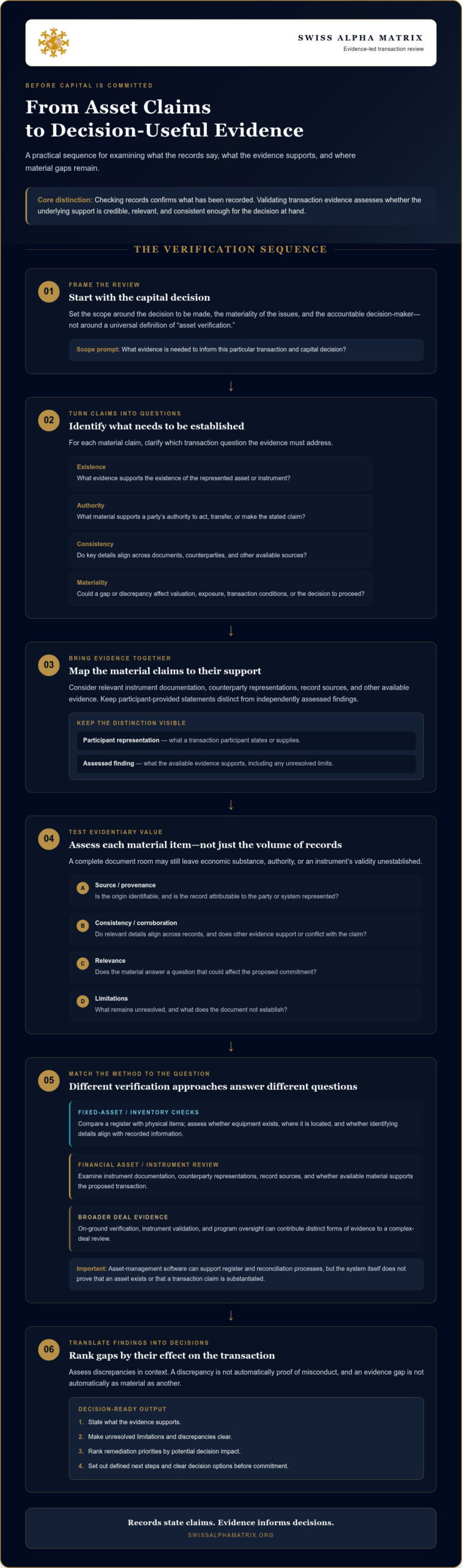
A practical sequence for using verification findings before commitment
Useful verification begins with the decision, not an indiscriminate document request. Before reviewing records, establish who owns the decision, what could change it and which uncertainties are material to the proposed commitment. This keeps asset verification services proportionate to the transaction and helps ensure the final analysis informs action rather than simply cataloguing documents.
Turn the transaction question into a defined review scope
Define the proposed capital deployment or transaction, the claims to assess and the audience for the findings. Specify the relevant instruments, counterparties and operational context at a level suited to the decision. Agree whether sponsors, investors or financial institutions need a concise executive summary, a detailed evidence record or both, so observations can be interpreted consistently.
- State the decision and its owner. Record what is being considered, who will decide and when the findings must inform that decision. For example, a review of an instrument supporting a proposed commitment should address the claims that bear directly on reliance, rather than collect unrelated records.
- Set scope and materiality. Identify the key claims, relevant parties and evidence boundaries. Define which discrepancies could affect a transaction assumption or decision, while keeping peripheral observations distinct from material exposures.
- Assess evidence against each claim. Record the source, date or version where available, what the item supports and any limitation. Distinguish participant representations from independently assessed evidence, and note where corroboration is absent or conflicting.
- Classify observations and open questions. Separate substantiated findings from analytical inferences and unresolved matters. A variance between records is first an observation; its meaning and possible decision impact require assessment, not assumption.
- Rank remediation and document the next action. Prioritize follow-up according to potential materiality. Options may include seeking relevant corroboration, revisiting an assumption, setting a decision condition or recording an unresolved exposure for the decision-maker. Document the rationale, accountable owner and intended next step.
Convert findings into executive decision options
An executive-level account should make the status of each material matter clear: what the evidence supports, what exposure may follow and what remains open. Ranked remediation strategies help distinguish issues that may warrant resolution before commitment from those that can be managed through a documented decision. They do not replace judgment; they provide a structured basis for it. For broader context on cross-border transaction considerations, Mastering Cross-Border Investment Due Diligence addresses the wider framework.
For complex transactions, Swiss Alpha Matrix connects audit-grade due diligence, instrument validation and program oversight with evidence-based remediation and executive-level intelligence. Review Swiss Alpha Matrix’s due diligence and instrument validation services for context on how these capabilities support complex-deal assessment.
How Swiss Alpha Matrix supports asset verification in complex deals
In a complex deal, verification is most useful when its findings sit within a wider view of transaction exposure and the capital decision. Swiss Alpha Matrix provides audit-grade due diligence, instrument validation, on-ground verification and program oversight, each with a distinct role. Instrument validation focuses on evidence relating to a financial instrument; on-ground verification can contribute relevant evidence from the operational context; due diligence considers how material findings relate to the broader transaction. Program oversight supports the consideration of these connected workstreams without treating them as interchangeable.
This distinction matters when a transaction depends on more than one kind of claim. Instrument documents may address one part of the picture, while operational evidence or counterparty information raises separate questions. Bringing relevant evidence into a defined review helps decision-makers see where it supports an assumption, where exposure warrants attention and what remains unresolved. The scope is shaped around the mandate and the decision it is intended to inform.
Combine verification with disciplined transaction oversight
Effective oversight requires financial discipline and commercial precision. The review must attend to the transaction’s economic context while making its evidentiary basis and limitations clear. On-ground verification can add a distinct evidence stream, but it does not replace instrument validation or broader due diligence. Swiss Alpha Matrix’s approach also reflects Swiss discretion, a considered approach to handling sensitive financial matters and communicating findings.
The team comprises former Managing Directors and senior executives from Tier-1 global banks, bringing decades of transactional, regulatory and risk management expertise. That experience supports a considered approach to complex claims. The objective is not simply to accumulate documents, but to assess material evidence in relation to the transaction and its risks.
Move from evidence to a clear next decision
Verification findings become actionable when decision-makers can distinguish substantiated evidence from material exposure and unresolved questions. Executive-level intelligence packs can consolidate exposure metrics, decision options and next steps, giving sponsors and other stakeholders a structured view of what the findings may mean. Ranked, evidence-based remediation strategies can organize potential responses by materiality, such as seeking additional support for a central assumption or recording an open issue for explicit consideration.
Audit-grade modeling and contingency architecture can support this process by examining exposure and structuring decision considerations around the capital-protection objective. They do not remove all uncertainty or determine the appropriate course. Instead, they help frame the implications of available evidence so decision-makers can consider whether to proceed, adjust assumptions, seek remediation or defer a commitment, as the mandate and findings warrant.
For complex financial transactions, Swiss Alpha Matrix brings these capabilities together through a mandate-specific review, with findings organized to support informed executive judgment. Explore Swiss Alpha Matrix’s complex-deal services.
Carry evidence discipline into the decision ahead
The value of a review lies not only in what it establishes before commitment, but also in how its findings remain visible as the transaction proceeds. A considered decision record can preserve the rationale, material limitations, unresolved matters and follow-up responsibilities, so important caveats do not disappear between approval and execution.
Investment committees and transaction sponsors can decide how to treat open matters: as issues to resolve before proceeding, assumptions to monitor or risks consciously accepted by the authorized decision-maker. Asset verification services are most useful when their findings support this disciplined judgment, rather than being mistaken for a binary seal of approval.
For a complex mandate, a focused discussion can help define the evidence questions, decision context and appropriate review scope. Swiss Alpha Matrix brings an evidence-led perspective to that work, with attention to the particular transaction and the interests it must protect. Discuss your complex deal with Swiss Alpha Matrix.
Frequently Asked Questions
Is asset verification the same as fixed-asset verification?
No. Fixed-asset verification and financial asset verification address different questions. Fixed-asset work typically reconciles physical items with register details, such as whether equipment can be located as recorded. In a financial transaction, the review concerns evidence for an instrument or asset claim and its relevance to a proposed commitment. An asset system may maintain useful records, but it does not independently establish the transaction claim.
Can asset verification establish whether a financial instrument is valid?
It can assess whether available evidence supports defined claims about an instrument, but findings should not be treated as an absolute certification of validity or enforceability. The conclusion depends on the instrument, the review’s scope and the evidence available. For example, a record may support that an instrument was issued while leaving a transaction-specific representation unresolved. Decision-makers should understand precisely what was examined and what the findings do not establish.
What evidence should investors review before committing capital?
Investors should focus on the material claims behind the proposed commitment, rather than gathering documents without a defined purpose. Relevant material may include instrument records, transaction terms, counterparty representations and supporting information about authority or ownership. Preserve the source and version of each key record, and note which assumptions rely on it. For example, if a valuation depends on a stated asset, identify what evidence supports that assumption and what remains unsubstantiated.
How does on-ground verification complement document-based due diligence?
On-ground verification can contribute evidence about operational circumstances that documents alone may not reveal. For instance, a written representation about an operating site can be considered alongside relevant observations from the ground. That evidence can inform due diligence, but it does not automatically establish ownership, instrument validity or the accuracy of every related claim. Its value depends on the question being tested and how the observations relate to the transaction’s other evidence.
What happens when verification identifies discrepancies?
A discrepancy should be documented and assessed, not automatically treated as proof of error or misconduct. Clarify which records differ, whether the difference could reflect timing or scope, and whether it affects a material transaction assumption. The response might involve obtaining clarifying evidence, revisiting an assumption or presenting the unresolved matter to the decision-maker. A clear record of the issue, its possible significance and its status supports proportionate follow-up.
Can asset verification remove all risk from a cross-border transaction?
No review can eliminate every transaction risk. Evidence may be incomplete, circumstances can change, and a finding about one claim does not settle every commercial or operational uncertainty. Asset verification services can help decision-makers understand the support for material claims and the limits of that support. In a cross-border deal, keep the review’s scope explicit and account for remaining uncertainties in the decision, rather than treating verification as a guarantee.
When should a sponsor commission asset verification during a deal?
Commission it early enough for findings to inform transaction structure, approval and any conditions under consideration, rather than after the commitment is effectively settled. The appropriate point depends on when material claims become clear and when decision-makers can still act on the evidence. If the deal changes or new information emerges, reconsider the review scope so conclusions remain relevant to the decision being made.