

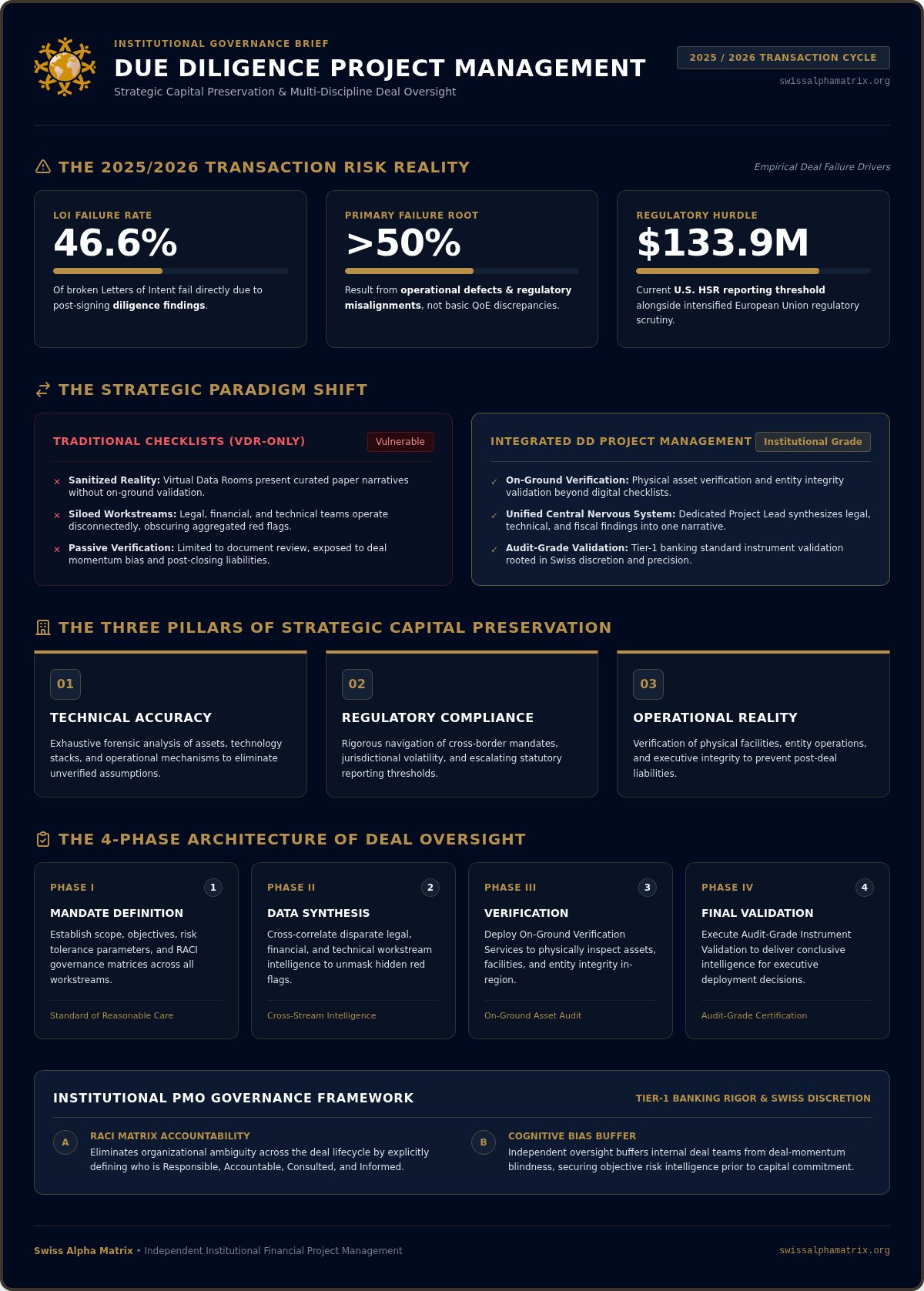
Analysis of the 2025/2026 transaction cycle indicates that 46.6% of broken letters of intent failed directly due to diligence findings, with over half of those failures resulting from operational defects and regulatory misalignments rather than simple quality of earnings discrepancies. You’ve likely encountered the limitations of the traditional virtual data room, which, despite its convenience, often presents a curated and sanitized version of reality that fails to address the lack of coordination between legal, technical, and financial workstreams. In an era where U.S. HSR reporting thresholds have climbed to $133.9 million and EU regulatory scrutiny has intensified, relying on paper-based verification is a vulnerability that seasoned fiduciaries can no longer afford.
Mastering due diligence project management as a formal, institutional discipline is the only reliable method to ensure precision in cross-border capital deployment. This article outlines a repeatable framework for deal oversight that moves beyond digital checklists to incorporate on-ground verification and audit-grade instrument validation. By the end of this discussion, you’ll understand how to implement a structured project management office that delivers the transparency required by executive stakeholders while significantly reducing post-closing transactional liabilities and mitigating the risks inherent in high-stakes global programmes.
Key Takeaways
- Learn how to transition from a static checklist to an institutional due diligence project management framework that synchronizes legal, financial, and technical workstreams.
- Move beyond the limitations of virtual data rooms by integrating On-Ground Verification Services to validate physical assets and entity integrity.
- Establish a formal Project Management Office (PMO) with clear RACI matrices to ensure absolute accountability across the entire cross-border deal lifecycle.
- Implement Audit-Grade Instrument Validation to achieve a superior standard of intelligence for complex capital deployment and risk mitigation.
- Leverage the precision of Swiss discretion and Tier-1 banking experience to oversee sophisticated mandates with institutional-grade rigor.
Defining the Discipline: The Convergence of Due Diligence and Project Management
The discipline of due diligence project management represents a fundamental departure from the reactive, checklist-driven approaches that have historically characterized transactional oversight. It’s defined as the systematic orchestration of multi-disciplinary workstreams to identify, quantify, and mitigate the myriad risks inherent in complex financial mandates. While traditional project management methodologies often falter within the opaque and high-velocity environments of global finance, this specialized framework prioritizes the long-term preservation of capital through a rigorous, three-pillared approach: technical accuracy, regulatory compliance, and operational reality. This doesn’t merely involve a passive review of documents. By shifting the foundational objective from mere negligence prevention to a more sophisticated ethos of strategic capital preservation, institutional actors ensure that every deployment of resources is anchored in verified data rather than speculative assumptions.
The Distinction Between Phase-Based DD and Integrated PM
Phase-based thinking inevitably results in fragmented risk intelligence, which is why a unified approach to due diligence project management is critical for identifying technical and financial vulnerabilities. Legal, financial, and technical findings often remain siloed and uncoordinated, obscuring the critical red flags that only become visible when disparate data points are viewed in aggregate. A dedicated Project Lead serves as the central nervous system of the transaction, unifying these workstreams into a single, coherent narrative that informs the final investment decision. For sophisticated entities, the implementation of independent financial project management is no longer optional; it’s the primary mechanism for maintaining objective oversight. It provides a necessary buffer in an environment where internal deal teams may be compromised by the momentum of a transaction or institutional cognitive bias.
Institutional-Grade Standards in 2026
In the current 2026 cycle, the threshold for what constitutes a sufficient due diligence framework has shifted decisively toward audit-grade precision. Cross-border investment programmes now face a confluence of global volatility and aggressive regulatory scrutiny, rendering the traditional tick-box mentality entirely obsolete. This evolution demands a transition to exhaustive verification processes, including On-Ground Verification Services, that account for the physical reality of assets and entities. Achieving this level of thoroughness requires a refusal to oversimplify the intricate dynamics of modern markets. Instead, the focus must remain on a methodology rooted in historical reliability and regional precision, utilizing Audit-Grade Instrument Validation to ensure that interests are protected across diverse jurisdictions. This approach provides a sense of inevitable logic and professional calm to stakeholders who value nuance, technical accuracy, and the standards established by former Tier-1 banking leadership.
The Architecture of Oversight: Managing the Full Lifecycle of Transactional Risk
The efficacy of due diligence project management is predicated on a structured lifecycle that transcends the limitations of ad-hoc investigative measures. This institutional architecture comprises four distinct phases: Mandate Definition, Data Synthesis, Verification, and Final Validation. Each stage serves as a critical filter, designed to ensure that the deployment of capital meets a rigorous standard of reasonable care. By treating these stages as interconnected workstreams rather than isolated tasks, stakeholders can achieve a level of transparency that traditional methods simply cannot provide. This methodology ensures that interests are in the hands of seasoned experts who prioritize long-term preservation over short-term speculation.
Central to this architecture is the Mandate, a governing document that dictates the scope and technical precision of the entire engagement. Without a clearly defined mandate, projects often suffer from scope creep or fragmented data, which undermines the stability of the final investment decision. To maintain professional calm, the reporting structure must be “audit-grade,” providing C-suite stakeholders with nuanced intelligence that is both broad in reach and meticulous in detail. Utilizing sophisticated financial advisory methodologies allows for the creation of a repeatable framework that withstands the scrutiny of global regulatory bodies and internal audit committees alike.
Stage 1: Mandate Alignment and Scope Definition
Precision begins with institutional alignment. The mandate must explicitly define the specific risks to be mitigated, whether they’re regulatory, counterparty-specific, or inherent to the financial instrument itself. Establishing clear communication protocols for cross-border stakeholders is essential to maintain the steady, logical rhythm required for successful oversight. Senior executives play a pivotal role here, validating project objectives to ensure the mandate reflects the firm’s strategic growth goals. It’s this phase that sets the standard for the entire project, ensuring that every subsequent action is tethered to the core principles of regional excellence and precision.
Stage 2: Technical Synthesis and Data Integrity
Data aggregation is not synthesis. True synthesis involves distilling multi-source data into a cohesive risk profile that accounts for the intricate nature of the industry. This stage requires meticulous adherence to international financial regulations, ensuring that every document is scrutinized for inconsistencies that might indicate underlying fraud or mismanagement. Identifying red flags in instrument documentation requires a master planner’s eye for detail, distinguishing between simple administrative errors and systemic integrity risks. Those seeking to refine their oversight of cross-border deals may benefit from exploring the complex project management capabilities offered by seasoned advisory partners who value privacy and exclusivity above all else.
Beyond the Virtual Data Room: Integrating On-Ground Verification into Project Workstreams
While the Virtual Data Room (VDR) has become a staple of modern transactions, its curated nature often masks the operational realities that determine a deal’s ultimate success or failure. Digital-only due diligence is fundamentally insufficient for high-stakes cross-border deals, as it relies on documentation that, while appearing compliant, may lack a physical correlate. Within a sophisticated due diligence project management framework, the transition from paper-grade to audit-grade intelligence requires the rigorous deployment of On-Ground Verification Services. This discipline involves the physical audit of assets, entities, and personnel in their local jurisdictions, ensuring that representations made in a digital environment align with reality on the ground. By identifying the “Paper vs. Reality” gap early, fiduciaries can prevent the erosion of capital that occurs when transactional assumptions fail to meet operational truths.
The Necessity of Physical Audit in Cross-Border Deals
Verifying the operational existence of counterparties in foreign jurisdictions is a prerequisite for capital protection. Remote document reviews and digital signatures are easily manipulated, creating a vulnerability that can lead to catastrophic post-closing liabilities. Research indicates that only approximately 35% of major international projects meet their baseline performance metrics without formal PMO intervention, highlighting the volatility of unverified mandates. Effectively mastering cross-border investment due diligence necessitates local, on-site intelligence to confirm that facilities, inventory, and leadership teams exist as described. These on-ground findings must be integrated into the central project management plan as primary data points, rather than secondary considerations, to provide a dignified level of security for institutional stakeholders who value thoroughness and professional competence.
Validating Financial Instruments with Precision
The validation of bank instruments represents another critical workstream that cannot be relegated to a simple checklist. Sophisticated financial fraud has evolved to mimic authentic documentation with alarming accuracy, requiring a master planner’s eye to detect subtle discrepancies. Utilizing specialized bank instrument validation services and Audit-Grade Instrument Validation allows deal teams to verify the provenance and encumbrance status of Standby Letters of Credit, Bank Guarantees, and other complex instruments. This process must be meticulously integrated into the broader M&A project timeline, ensuring that financial verification occurs in parallel with operational audits. By maintaining this steady, logical rhythm, due diligence project management ensures that capital deployment is supported by a foundation of absolute technical accuracy and regional precision, mirroring the traditional discretion of high-end private wealth management.
Executing the Mandate: A Governance Framework for High-Stakes Projects
The transition from investigative discovery to strategic execution requires a sophisticated governance structure that ensures every finding is processed within an institutional-grade hierarchy. Implementing a dedicated Due Diligence Project Management Office (PMO) provides the necessary oversight to manage the intersection of financial, legal, and operational workstreams without succumbing to the fragmented reporting that often plagues complex transactions. This framework isn’t merely about tracking tasks; it’s about safeguarding the deal’s integrity against external pressures and internal biases. By establishing a centralized authority, fiduciaries can maintain a sense of professional calm, knowing that every strategic pillar is supported by rigorous analysis and a master planner’s eye for detail.
Step 1: Establishing the Governance Structure
To achieve absolute precision, the appointment of an independent advisory lead, preferably one with former Tier-1 banking experience, is essential to maintain unbiased oversight. This individual orchestrates the RACI matrix, a critical tool for clarifying accountability in environments where cross-border interests may overlap. By explicitly defining who is responsible for specific verification tasks and who must be consulted during regulatory escalations, the PMO eliminates the ambiguity that leads to oversight failures. The cadence for executive risk briefings should be steady and measured, moving from broad strategic principles to specific, hyper-personalized risk pillars that distinguish a performance-oriented mindset from passive participation. This structured approach ensures that interests are in the hands of seasoned experts who prioritize long-term preservation.
Step 2: Milestone-Driven Execution and Risk Mitigation
Effective due diligence project management prioritizes milestone-based reporting over simple deliverable-based tracking. While a deliverable confirms the completion of a document, a milestone signifies the validation of a critical risk threshold, such as the successful completion of On-Ground Verification Services or the finality of Audit-Grade Instrument Validation. This distinction allows the C-suite to identify “Project Showstoppers” early in the investigation cycle, before significant capital is committed. A succinct risk register, tailored for executive stakeholders, ensures that intellectual depth is maintained without oversimplifying the intricate dynamics of the transaction. Managing deal integrity during high-pressure news cycles requires a master planner’s discretion, shielding the transaction from speculative volatility while ensuring all communications remain rooted in verified intelligence. If your organization requires institutional-grade oversight for a complex mandate, you may wish to engage our complex project management experts to ensure your interests are managed with Swiss precision.
The Swiss Alpha Matrix Advantage: Expertise-Led Project Oversight
The efficacy of due diligence project management is ultimately determined by the caliber of the minds overseeing the mandate, particularly when navigating the opaque environments of cross-border finance. Swiss Alpha Matrix bridges the gap between passive advisory and rigorous execution by pairing the intellectual depth of former Tier-1 bank executives with a boutique entity’s commitment to absolute privacy. This institutional DNA ensures that every project is managed with a sense of quiet authority, where strategic growth is never pursued at the expense of stability. By positioning ourselves as a dedicated partner rather than a mere service provider, we offer a standard of service that is both broad in reach and meticulous in its attention to detail, providing the inevitable logic required to secure complex capital deployments.
A Pedigree of Institutional Excellence
Former senior executives from Tier-1 global banks bring a unique perspective to transactional risk, one that’s rooted in historical reliability and a refusal to oversimplify complex dynamics. This pedigree allows for an independent, unemotional expert analysis that’s often missing in internal deal teams, where the momentum of a transaction can obscure critical vulnerabilities. We prioritize long-term capital preservation over short-term deal flow, ensuring that every recommendation is tethered to concepts of regional excellence and precision. It’s a persona of protective authority, catering to a sophisticated audience that values nuance and a high level of professional competence. In an industry often characterized by frantic energy, our measured and steady rhythm encourages confidence, making it clear that your interests are in the hands of seasoned experts who understand the intricate nature of global programmes.
Securing Your Global Investment Programme
Securing a global investment programme requires more than generic oversight; it demands a hyper-personalized project management framework tailored to the specific nuances of your mandate. With key coverage spanning Geneva, London, and Hong Kong, we deploy on-ground intelligence to validate the operational reality of assets and entities across diverse jurisdictions. This regional precision is essential for moving from paper-grade representations to audit-grade intelligence, ensuring that no technical or regulatory risk is overlooked. By engaging Swiss Alpha Matrix for specialized project oversight, stakeholders gain access to a Risk Management Framework that’s as robust as it is discreet. We invite you to secure your capital through our specialized Complex Project Management and Audit-Grade Instrument Validation services, ensuring your cross-border interests are protected by the highest standards of institutional rigor and Swiss precision.
Securing Transactional Integrity through Institutional Rigor
The evolution of global finance in 2026 demands a transition from passive document review to an active, disciplined oversight model. By adopting a formal framework for due diligence project management, institutional stakeholders ensure that every capital deployment is anchored in verified operational reality rather than curated digital representations. This methodology necessitates the integration of a dedicated PMO, the use of precise accountability matrices, and a commitment to moving beyond the virtual data room through physical, on-site audits. These elements combined provide the intellectual depth required to navigate the intricate nature of modern cross-border deals.
Swiss Alpha Matrix provides the sophisticated leadership required for such complex mandates, managed by former Tier-1 bank executives who prioritize long-term preservation over speculative growth. Our methodology combines Audit-Grade Instrument Validation with a global on-ground verification network, ensuring that regional excellence and Swiss precision are maintained across every jurisdiction. You’re invited to secure your capital with institutional-grade due diligence project management from Swiss Alpha Matrix. Entrusting your interests to seasoned experts allows for a professional calm that’s essential in today’s volatile market. We look forward to serving as your dedicated partner in strategic growth and capital protection.
Frequently Asked Questions
What is the primary difference between standard project management and due diligence project management?
Standard project management typically prioritizes the efficient delivery of defined outputs within set timelines, whereas due diligence project management is a specialized discipline focused on the systematic oversight of transactional risk. It requires a master planner’s eye to synchronize legal, financial, and technical workstreams. While traditional methods often falter in opaque financial environments, this institutional framework ensures that every deployment of capital is anchored in verified operational reality rather than speculative assumptions.
How does on-ground verification mitigate risks that digital due diligence cannot?
On-Ground Verification Services address the inherent limitations of digital due diligence by physically auditing assets, entities, and personnel in their local jurisdictions. Virtual data rooms often present a curated version of reality that can mask operational defects or sophisticated fraud. By deploying experts to conduct site inspections and inventory reconciliations, fiduciaries bridge the “Paper vs. Reality” gap. This rigorous fieldwork provides geo-stamped evidence and chain-of-custody documentation that remote document reviews simply cannot replicate.
Why is independent project oversight critical for cross-border investment programmes?
Independent project oversight provides a necessary buffer against the internal deal momentum that often compromises objective risk assessment in high-stakes mandates. Cross-border investment programmes involve intricate jurisdictional dynamics and multi-regulatory scrutiny that require a protective authority’s perspective. By engaging an independent advisory partner, institutional entities ensure that interests are in the hands of seasoned, unemotional experts. This approach prioritizes long-term capital preservation over short-term speculation, maintaining professional calm throughout the transaction lifecycle.
What are the common red flags in financial instrument validation projects?
Common red flags in financial instrument validation include inconsistent provenance documentation, a lack of direct bank confirmation, and subtle discrepancies in security features that suggest sophisticated fraud. Identifying these markers requires the intellectual depth of former Tier-1 banking leadership. Audit-Grade Instrument Validation goes beyond surface-level checks to verify the encumbrance status and authenticity of standby letters of credit or bank guarantees. Without this level of technical accuracy, stakeholders remain vulnerable to significant post-closing liabilities.
How do you integrate legal and financial workstreams within a single PMO?
Integration is achieved by establishing a centralized Due Diligence Project Management Office that utilizes a unified mandate to govern all investigative activities. This structure prevents the fragmented risk data that occurs when workstreams operate in silos. A dedicated Project Lead orchestrates the flow of intelligence, ensuring that legal findings inform financial models and vice versa. By maintaining a steady, logical rhythm, the PMO creates a single, coherent risk profile that allows executive stakeholders to make informed decisions.
What is ‘Audit-Grade’ validation, and why does it matter for executive stakeholders?
Audit-Grade validation refers to a superior standard of intelligence that produces defensible, executive-level documentation suitable for regulatory scrutiny and internal audit committees. It represents a move from “paper-grade” compliance to a more meticulous standard of service that is both broad in reach and detailed in execution. For executive stakeholders, this level of precision matters because it significantly reduces transactional liabilities. It ensures that capital deployment decisions are supported by verified data and institutional-grade risk management frameworks.
How does a RACI matrix improve the efficiency of a due diligence project?
A RACI matrix improves efficiency by explicitly defining who is Responsible, Accountable, Consulted, and Informed for every critical milestone within the due diligence project management lifecycle. In complex cross-border deals, overlapping interests can lead to ambiguity and oversight failures. By clarifying decision rights and communication protocols, the matrix ensures that no technical or regulatory risk is overlooked. This structured approach eliminates the frantic energy often associated with high-pressure transactions, fostering a sense of inevitable logic and professional calm.
Can due diligence project management prevent post-transactional fraud?
Yes, due diligence project management is designed to identify integrity risks and operational defects that often lead to post-transactional fraud. By pairing senior banking expertise with physical on-ground verification, the framework catches discrepancies before the deal closes. Standard background checks often miss civil or regulatory actions in foreign jurisdictions, but a formal PMO architecture utilizes qualitative character forensics to identify cultural misalignments. This proactive oversight ensures that strategic growth is never pursued at the expense of long-term stability.