

A perfectly executed contract is merely an elegant fiction if the underlying financial instrument lacks a physical, verifiable pulse. You likely understand that while elite legal counsel excels at identifying contractual vulnerabilities, they are rarely equipped to stand on a foreign tarmac or inside a secure vault to confirm that the collateral actually exists. This inherent limitation creates a vacuum of certainty that paperwork alone cannot fill. Consequently, sophisticated capital allocators are increasingly turning to institutional-grade transactional due diligence services to bridge the perilous gap between legal theory and the physical validation of complex assets.
It’s a common frustration to feel that your interests are protected by the letter of the law, yet remain exposed to the opaque risks of foreign jurisdictions and non-compliant instruments. By reading further, you’ll discover how a rigorous, bank-level advisory framework transforms uncertainty into absolute clarity. We will examine the necessity of on-ground verification, the evolving 2026 regulatory landscape, and the strategic pillars required to ensure your capital deployment remains shielded from cross-border fraud.
Key Takeaways
- Understand why modern transactional due diligence services have evolved from administrative checklists into proactive, executive-led intelligence operations that prioritize operational reality over mere documentation.
- Identify the essential role of on-ground verification as the primary defense against cross-border fraud, ensuring the physical existence and operational capacity of entities in foreign jurisdictions.
- Distinguish between the contract enforceability provided by legal counsel and the physical validation offered by specialized advisors to bridge the gap between paperwork and tangible assets.
- Explore a structured risk management framework that utilizes institutional-grade methodologies to preserve deal integrity and protect capital throughout the transaction lifecycle.
- Learn how the oversight of former Tier-1 global bank executives provides the technical rigor and Swiss discretion required for the validation of the most complex financial instruments.
The Evolution of Transactional Due Diligence Services in 2026
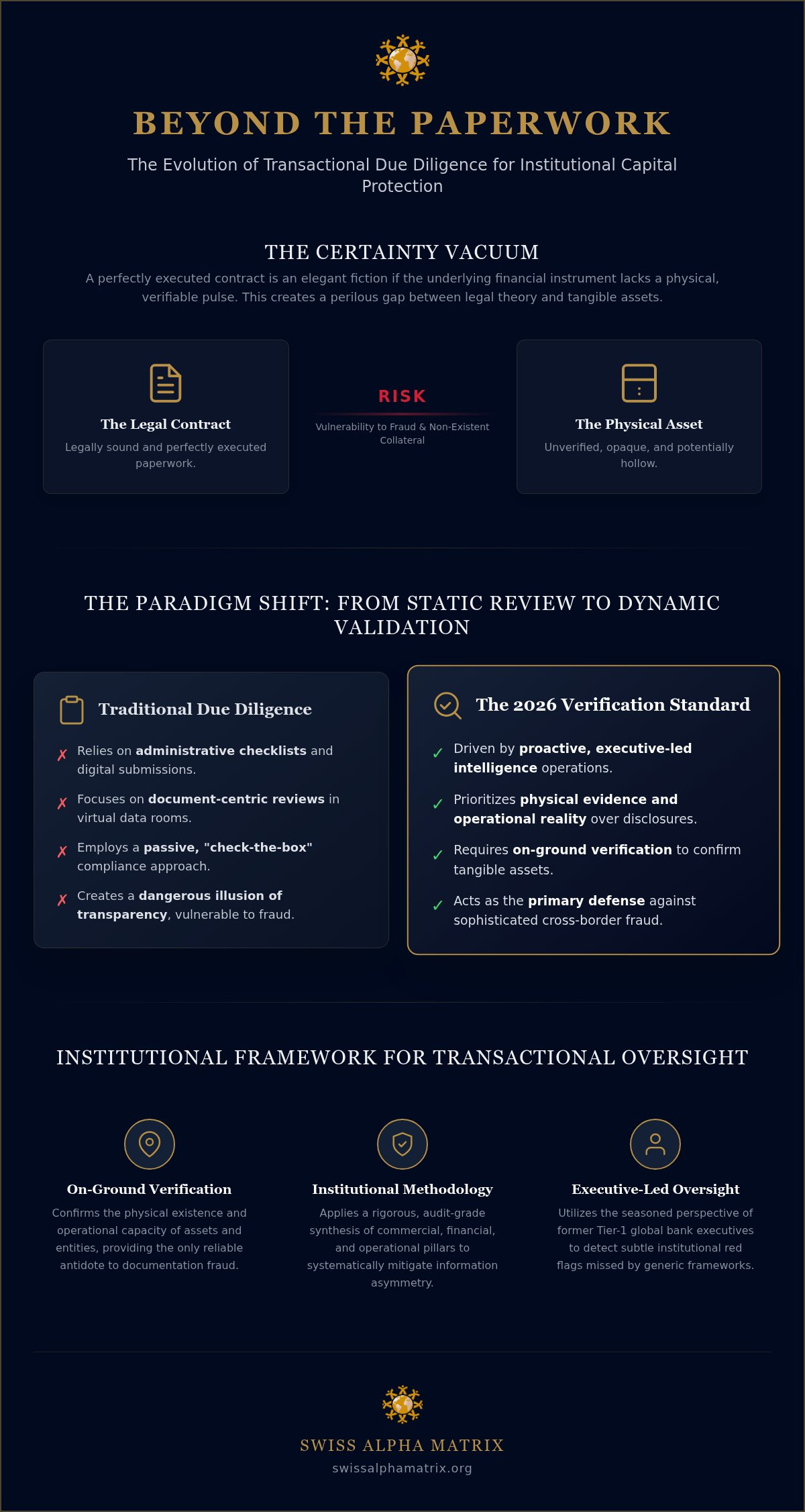
The traditional paradigm of capital protection has shifted from static, document-centric reviews toward a dynamic validation of operational reality. In 2026, transactional due diligence services have evolved into a multi-layered discipline that prioritizes physical evidence over administrative disclosures. While digital data rooms serve as efficient repositories for corporate records, they frequently lack the depth required to expose sophisticated discrepancies in complex financial instruments. This evolution reflects a broader movement from passive, check-the-box compliance toward proactive, executive-led intelligence that seeks to confirm the pulse of an organization rather than its paperwork. Consequently, relying solely on digital submissions is no longer sufficient for institutional-grade capital protection, as the gap between local execution and global standards continues to widen.
The Institutional Definition of Due Diligence
The institutional application of due diligence requires a rigorous synthesis of commercial, financial, and operational pillars to ensure a holistic understanding of risk. For stakeholders operating at the board level, audit-grade reports are the requisite standard, as they provide the technical precision necessary to withstand the scrutiny of internal and external regulators. Due diligence is the systematic mitigation of information asymmetry in capital deployment. The deployment of comprehensive transactional due diligence services ensures that the commercial context of a deal is fully understood before any commitments are finalized. By engaging independent advisors who operate outside the deal’s immediate momentum, organizations can bridge the divide between local execution and global standards of excellence. This independent oversight is particularly critical when navigating emerging markets, where the risk of complex financial instrument fraud often eludes generic consulting frameworks.
Why 2026 Requires a New Verification Standard
The emergence of highly sophisticated synthetic financial frauds in cross-border transactions has rendered traditional verification methods increasingly obsolete. These schemes are often designed to mimic legitimate institutional processes, making the seasoned perspective of former Tier-1 bank executives essential for detecting subtle institutional red flags. Simultaneously, the impact of evolving international financial regulations has expanded the advisory scope, necessitating a standard of verification that goes beyond surface-level legality. It’s no longer enough to confirm that a document exists; one must confirm that the underlying asset is tangible, accessible, and compliant with current global mandates. This proactive stance ensures that capital is not merely deployed, but strategically protected against the volatility of an increasingly complex financial ecosystem.
On-Ground Verification: The Essential Layer of Advisory
Digital interfaces often create a dangerous illusion of transparency. While a virtual data room provides the structural skeleton of a transaction, it rarely reveals the physical substance or the operational pulse of the assets involved. For institutional investors, physical validation remains the only reliable antidote to the rising tide of sophisticated cross-border documentation fraud. Sophisticated actors can easily fabricate digital footprints, yet they struggle to replicate the authentic operational reality of a functioning facility or the legitimate authority of a local signatory. Relying solely on remote reviews ignores the possibility that the paperwork, while legally perfect, may describe a non-existent or hollowed-out entity. In these high-stakes scenarios, an on-ground presence is the fundamental difference between strategic capital preservation and catastrophic loss.
Validating the Physical and the Personal
High-stakes environments demand a level of scrutiny that transcends the review of scanned PDFs. Effective cross-border investment due diligence necessitates on-site operational reviews to confirm that the entities described in the prospectus possess the technical and logistical capacity they claim. This process involves a meticulous verification of the chain of custody for sensitive financial instruments, ensuring that every hand that has touched the document is identified and authorized. Local jurisdictional knowledge is indispensable here. It allows advisors to navigate regional eccentricities and verify actual signatories, moving beyond the limitations of digital signatures that can be easily compromised or misrepresented. This layer of personal validation ensures that the individuals behind the deal possess the institutional authority they profess.
Audit-Grade Instrument Validation
Verifying the legitimacy of Standby Letters of Credit (SBLC) or complex bank instruments requires a deep-dive methodology that traces origins through Tier-1 institutional channels. This level of due diligence in an M&A transaction ensures that instruments are not merely cosmetic additions to a balance sheet but represent valid, enforceable obligations. Our transactional due diligence services focus on this technical rigor, integrating instrument validation into a broader project management framework that survives the entire transaction lifecycle. We trace the lineage of an instrument back to its source, identifying potential red flags that generic consultants often overlook. For those requiring this level of institutional oversight, aligning with specialized verification experts provides the certainty needed to deploy capital with confidence. It’s an uncompromising standard designed for those who prioritize long-term stability over speculative speed.
Advisory vs. Legal Counsel: A Functional Comparison
The distinction between legal counsel and specialized advisory is fundamentally a divide between contractual enforceability and operational reality. While legal professionals focus on the architecture of the agreement, ensuring that representations and warranties are robust, transactional due diligence services serve to validate the substance behind those declarations. It’s a critical synergy; the advisory team provides the commercial intelligence that allows legal strategy to move from generic protection toward targeted risk mitigation. Without this on-ground context, a contract may be perfectly enforceable against an entity that possesses no actual assets or legitimate authority. Institutional-grade transactional due diligence services thus provide the essential commercial context that legal teams often lack.
The Legal Mandate: Enforceability and Compliance
Legal teams prioritize the jurisdictional legality of a transaction, focusing on compliance with international mandates and the structural integrity of deal documents. However, their review is naturally confined to the information presented within the digital data room. When dealing with fraudulent financial instruments or synthetic collateral, the limits of a purely legal review become apparent. Legal professionals are often the primary beneficiaries of high-level advisory intelligence, as it allows them to draft more precise protections based on verified physical realities rather than assumed disclosures. This ensures that the legal framework reflects the actual risk profile of the transaction.
The Advisory Mandate: Integrity and Execution
The advisory mandate focuses on the integrity of execution and the operational viability of the counterparty. Through independent financial project management, advisors provide the oversight necessary to manage complex transaction lifecycles with technical rigor. This role includes the validation of instruments and the facilitation of milestone-based capital releases, ensuring that funds are only deployed when specific, verified criteria are met. It’s a protective layer that prioritizes capital preservation over deal velocity, acting as a master planner for the deployment of institutional funds. This approach provides the technical depth required to identify red flags that might otherwise remain hidden behind sophisticated paperwork.
A clear RACI (Responsible, Accountable, Consulted, Informed) framework is essential for maintaining deal integrity across these disciplines. In this structure, the advisor is responsible for Risk Identification, utilizing technical expertise to uncover operational or financial discrepancies that exist outside the contract. The legal team is responsible for Risk Documentation, translating those identified risks into enforceable contractual language. This collaborative approach ensures that the investor’s vision is both physically verified and legally shielded, creating a comprehensive defense against cross-border fraud and operational failure.
A Framework for Complex Transactional Oversight
A resilient oversight framework must survive the entire transaction lifecycle, evolving from initial screening to final capital deployment. By establishing a centralized Project Management Office (PMO) structure, organizations can effectively manage multi-jurisdictional stakeholders while maintaining a single source of truth. This centralized approach is particularly vital when deploying transactional due diligence services across diverse regulatory environments where local execution often diverges from global expectations. It ensures that every communication, document review, and physical verification is synchronized within a cohesive strategic vision. It’s a standard that ensures deal integrity isn’t compromised by the fragmented nature of cross-border operations.
The efficacy of this oversight is rooted in the utilization of financial advisory methodologies that prioritize capital protection over mere deal velocity. These methodologies provide the technical scaffolding required to validate complex financial instruments, such as Standby Letters of Credit (SBLC), which often present risks that standard M&A frameworks fail to address. To further ensure alignment between the advisor and the investor, the implementation of milestone-based charges serves as a critical mechanism. This structure incentivizes the advisor to deliver exhaustive validation at every stage, ensuring that fees are earned through the successful mitigation of risk rather than the mere passage of time.
Designing the Deliverable Review Matrix
Structuring audit-grade reports for executive and regulatory consumption requires a meticulous deliverable review matrix. Every project milestone must be supported by verified data points that withstand the scrutiny of both internal boards and external auditors. By employing detailed RACI matrices, clear accountability is established for every facet of the cross-border project, ensuring that no technical detail is overlooked during the validation process. This level of precision transforms raw intelligence into a strategic asset that informs high-stakes decision-making. It’s the difference between a generic summary and a robust, defensible audit trail.
Regulatory Compliance and Risk Mitigation
Navigating the intricacies of contemporary AML and KYC requirements demands more than a cursory database check; it requires deep-dive investigations that uncover the ultimate beneficial ownership and the legitimacy of funding sources. In volatile global markets, addressing operational risk and resilience is paramount to protecting long-term interests. Independent oversight acts as a second set of eyes for the C-suite, providing an unemotional filter through which complex transaction dynamics are evaluated. For those seeking to fortify their capital deployment strategies, engaging with specialized risk management experts ensures that every transaction is anchored in verified reality.
The Swiss Alpha Matrix Standard of Advisory
The Swiss Alpha Matrix standard is defined by a refusal to delegate critical oversight to junior analysts, ensuring instead that every engagement is led by former senior executives from Tier-1 global banks who possess the technical depth required to evaluate complex financial instruments. This leadership model provides a level of institutional technical rigor that is tempered by the traditional discretion of Swiss financial discipline, creating an environment where complex transactions are evaluated with unemotional precision. By deliberately limiting our mandates, we maintain a hyper-personalized focus that guarantees executive-level attention for each client, a necessity when navigating the intricate dynamics of high-value capital deployment. This commitment to precision ensures that the path from initial investigation to final capital protection is marked by absolute clarity and strategic depth, distinguishing our transactional due diligence services from the broader, more passive participants in the advisory market.
Audit-Grade Validation as a Competitive Edge
Utilizing bank instrument validation services provides a definitive competitive edge by identifying institutional red flags before they manifest as irrevocable losses. This executive-level intelligence is paramount for board-room decision making, where the stakes of a cross-border transaction demand more than just a cursory review of legal paperwork. Our independence from direct asset management ensures that our advisory remains entirely conflict-free, allowing us to serve as a truly objective oversight partner rather than a participant with competing interests. By focusing exclusively on validation and risk management frameworks, we provide a standard of service that is both broad in its jurisdictional reach and meticulous in its attention to technical detail, ensuring that every deployment of capital is backed by an audit-grade validation of reality.
Engaging Our Specialized Mandates
Engaging our firm involves a transition from traditional, volume-based consulting toward a specialized mandate that prioritizes long-term preservation and regional precision. While many entities offer generic retainers, our project-based advisory is structured around specific, deep-dive investigations into complex financial entities and their underlying instruments. This process begins with a structured alignment of objectives, followed by the deployment of on-ground verification capabilities to confirm operational reality. To secure your capital and ensure your interests are managed by seasoned experts who prioritize strategic growth over short-term speculation, we invite you to explore the precision of Swiss Alpha Matrix advisory services, where every transaction is anchored in a tradition of reliability and intellectual superiority.
Securing the Future of Complex Capital Deployment
The landscape of 2026 requires a fundamental shift from passive, document-centric compliance toward active, operational verification. While legal frameworks provide the necessary contractual architecture, they can’t substitute for the physical validation of underlying assets or the technical scrutiny of financial instruments. Specialized transactional due diligence services serve as the vital bridge, ensuring that the reality of a foreign jurisdiction matches the elegance of the paperwork. This executive-led oversight is the only reliable method to mitigate the risks of synthetic fraud and information asymmetry in high-stakes environments.
Managed by former Tier-1 global bank executives, Swiss Alpha Matrix applies audit-grade instrument validation standards with a signature level of Swiss discretion and precision. It’s a standard of care designed for those who prioritize long-term preservation over short-term speculation. We invite you to Request a Confidential Advisory Consultation to ensure your interests are protected by seasoned experts who understand the intricate nature of global finance. Your capital deployment deserves the certainty that only rigorous, independent validation can provide.
Frequently Asked Questions
What is the difference between a due diligence advisor and a lawyer?
A due diligence advisor focuses on the physical and operational reality of a transaction, whereas a lawyer prioritizes contractual enforceability and jurisdictional compliance. While your legal team ensures that the agreement’s architecture is robust, our advisory services validate the substance behind those declarations. We don’t provide legal representation. Instead, we act as an independent oversight partner, confirming that the underlying assets and instruments actually exist before you commit capital.
How do you verify a standby letter of credit (SBLC) in a cross-border deal?
Verifying a Standby Letter of Credit requires a deep-dive methodology that traces the instrument’s lineage through Tier-1 institutional channels. We don’t rely on digital copies provided by intermediaries. Our process involves direct confirmation of the issuing bank’s authority and the instrument’s authenticity. This level of technical rigor is essential in cross-border deals where documentation fraud is increasingly sophisticated. It’s about ensuring the instrument is a valid, enforceable obligation rather than a cosmetic balance sheet entry.
Why is on-ground verification necessary if I have a digital data room?
Digital data rooms provide a convenient repository for records, yet they remain vulnerable to sophisticated documentation fraud. On-ground verification is the only definitive antidote to synthetic representations of reality. By physically inspecting facilities and verifying the actual authority of signatories, we bridge the gap between digital paperwork and operational truth. It’s often the difference between strategic capital preservation and catastrophic loss in complex jurisdictions where digital footprints are easily fabricated.
What are the common red flags in complex financial instrument validation?
Common red flags include non-standard terminology within the instrument’s text, unusual routing instructions that bypass established SWIFT protocols, or the involvement of secondary institutions lacking recognized credit ratings. We also look for discrepancies in the chain of custody and signatures that don’t match authorized institutional lists. Detecting these subtle institutional anomalies requires the seasoned perspective of former Tier-1 bank executives who understand the technical nuances of legitimate financial instruments.
How much do transactional due diligence services typically cost for institutional deals?
The cost structure for transactional due diligence services is generally organized around the complexity and jurisdictional scope of the mandate. We utilize fixed-fee or milestone-based charges for deep-dive investigations into financial entities and instruments. This approach aligns our incentives with your outcomes, ensuring that every project milestone is backed by verified data. For long-term projects requiring continuous oversight, a retainer-based strategic consulting model provides ongoing access to senior-level risk mitigation expertise.
Can an advisory firm provide regulatory compliance oversight for long-term projects?
An advisory firm can indeed provide continuous regulatory compliance oversight for the entire duration of a long-term project. Our retainer-based strategic consulting fees are designed to support ongoing project management and risk mitigation needs. This ensures that your financial programs remain compliant with evolving international mandates. By acting as a dedicated partner, we help maintain a consistent risk management framework that adapts to the volatile dynamics of global markets.
What is the role of a PMO in complex financial project management?
A Project Management Office (PMO) serves as the centralized source of truth for complex financial project management, ensuring that multi-jurisdictional stakeholders remain synchronized. It provides the technical scaffolding necessary to manage the transaction lifecycle with precision. By establishing a centralized structure, we maintain clear accountability through RACI matrices and ensure that every communication is aligned with the broader strategic vision. This centralized oversight is critical for maintaining deal integrity across diverse regulatory environments.
How does audit-grade validation differ from a standard financial audit?
Audit-grade validation differs from a standard financial audit by focusing on the real-time physical and technical verification of specific assets or instruments rather than a historical review of financial statements. While a standard audit assesses past performance, our validation provides executive-level intelligence regarding the current existence and legitimacy of a transaction’s underlying value. These audit-grade reports are structured to withstand the rigorous scrutiny of board-level stakeholders and external regulators during active capital deployment.