

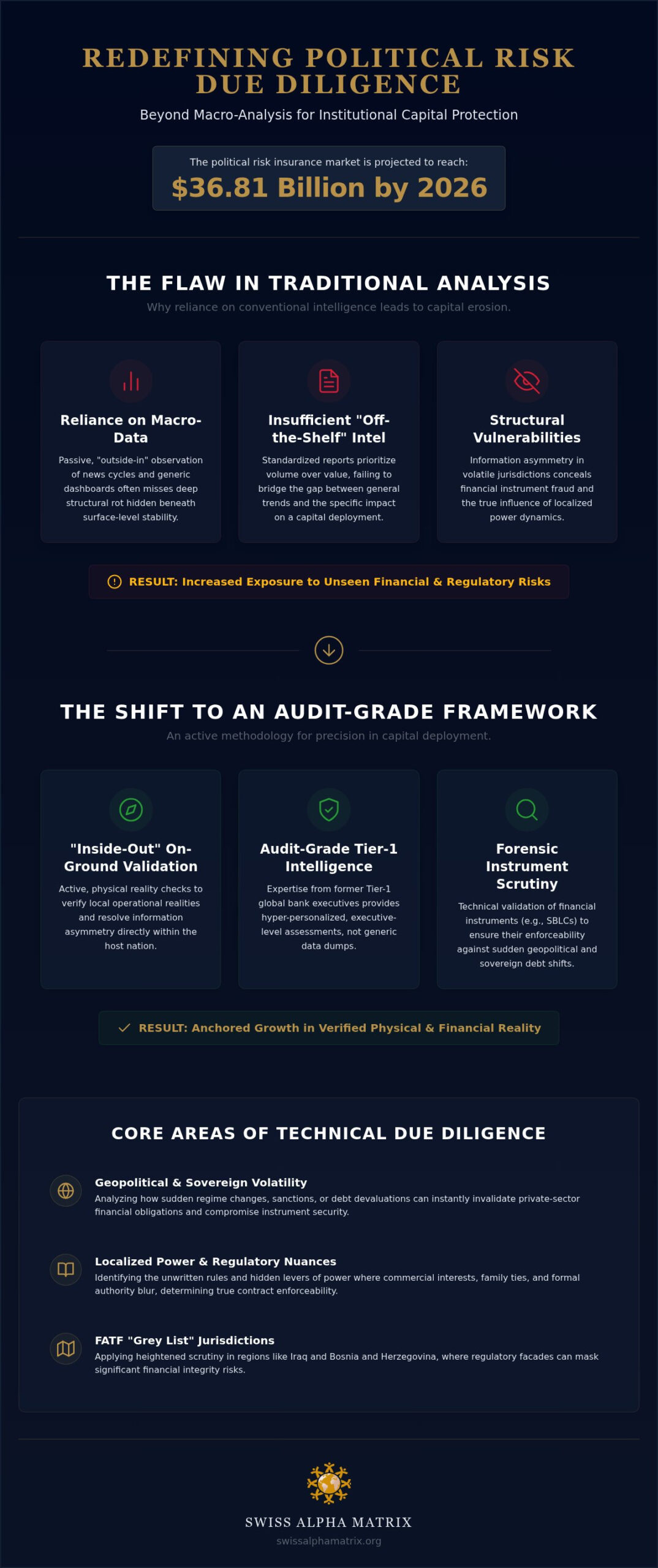
Could the very data points your firm relies on for emerging market stability be the precise instruments of your capital’s erosion? In an era where the political risk insurance market is projected to reach USD 36.81 billion by the close of 2026, the traditional reliance on macro-level dashboards for political risk due diligence has proven insufficient for the preservation of institutional wealth. You likely recognize that information asymmetry in volatile jurisdictions isn’t just a hurdle; it’s a structural vulnerability that often hides financial instrument fraud behind a facade of regulatory compliance, particularly as the FATF continues to expand its “grey list” to include jurisdictions like Iraq and Bosnia and Herzegovina.
This article provides an institutional framework that moves beyond theoretical analysis into the realm of audit-grade validation. We’ll explore how to achieve precision in capital deployment by integrating on-ground verification with rigorous instrument scrutiny. By shifting from passive observation to active, physical reality checks, you’ll gain the clarity required to protect interests against the shifting sands of global governance. This methodology ensures that your strategic growth is anchored in verified physical and financial reality, providing a standard of service that is both broad in reach and meticulous in its attention to detail.
Key Takeaways
- It’s essential to move beyond passive macro-analysis by adopting an “inside-out” validation model that scrutinizes the technical mechanics of emerging market transactions.
- Understand how sovereign debt volatility and sudden political shifts can compromise the validity of financial instruments, including standby letters of credit.
- Implement an institutional framework for political risk due diligence that utilizes on-ground verification to resolve information asymmetry in complex jurisdictions.
- Learn to embed rigorous risk assessment protocols within the lifecycle of complex project management to ensure continuous capital protection and regulatory compliance.
- Access audit-grade intelligence derived from Tier-1 banking expertise, providing the precision necessary for high-stakes capital deployment decisions.
Beyond the Macro: Redefining Political Risk Due Diligence for 2026
While standard definitions of Political risk often focus on broad societal upheavals or regime changes, the requirements for 2026 demand a more rigorous, technical approach. For the institutional investor, political risk due diligence can’t be treated as a descriptive exercise in geopolitical speculation. It must instead be refined into a technical discipline that validates the actual integrity of financial instruments against the shifting regulatory and social structures of a host nation. Capital protection requires technical precision. Moving from an “outside-in” observation of news cycles to an “inside-out” validation of local operational realities is the only way to ensure safety in an increasingly balkanized global economy. Passive participants often find themselves exposed when surface-level stability masks deep structural rot.
The Institutional Scope of Political Risk
In emerging and frontier markets, the distinction between private commercial interests, influential family ties, and formal regulatory authority is frequently blurred. This overlap creates a complex web of unwritten rules that can override formal financial structures without warning. Our team, comprised of former Tier-1 global bank executives, specializes in interpreting these nuanced signals that traditional analysts often overlook. Implementing a robust framework for political risk due diligence requires identifying these hidden levers of power before capital is committed. This level of scrutiny is essential because surface-level intelligence fails to account for the localized power dynamics that determine whether a contract is enforceable or if a regulatory approval is merely a temporary concession. A sophisticated, unemotional expert perspective is required to navigate these intricacies with the necessary discretion.
Why Traditional Reports Are No Longer Sufficient
Standardized, “off-the-shelf” reports typically provide a deluge of political minutiae that lacks the specificity required for high-stakes transactions. These documents often prioritize volume over value, failing to bridge the gap between general risk trends and the precise impact on a specific capital deployment. Generic data isn’t enough. At Swiss Alpha Matrix, we advocate for a transition to executive-level intelligence that informs precision in capital deployment. By applying a rigorous financial discipline to geopolitical uncertainty, we provide more than just data; we deliver an audit-grade assessment of the physical and financial reality on the ground. This shift ensures that risk management is not a passive checklist but a proactive component of independent financial project management. Our methodology treats every jurisdiction as a unique ecosystem, requiring hyper-personalized verification that transcends generic intelligence.
The Intersection of Geopolitics and Financial Instrument Integrity
Sudden shifts in the geopolitical landscape don’t merely change the news cycle; they can fundamentally invalidate the underlying mechanics of a transaction. A Standby Letter of Credit (SBLC), which serves as a cornerstone of security in international trade, can become a dormant asset overnight if the issuing jurisdiction faces a sudden regime change or a suspension of international banking protocols. This is where political risk due diligence must evolve into a forensic examination of instrument enforceability. When sovereign debt volatility triggers a cascade of devaluations, the private-sector financial obligations that seemed robust during the negotiation phase can quickly dissolve into legal and financial ambiguity, leaving the investor with little recourse if the local judiciary is compromised by political influence.
Instrument Validation in Volatile Jurisdictions
The technical process of bank instrument validation services becomes paramount when a nation’s fiscal policy begins to diverge from international norms. Verifying the stability of an issuing bank requires a deep understanding of its capital adequacy in the face of national economic distress. This fiscal divergence often precedes the weaponization of domestic banking systems, where transactions are stalled or diverted under the guise of national security. It’s imperative that institutional investors adopt Emerging Governance Safeguards to mitigate these risks effectively. Our regulatory compliance advisory acts as a shield, ensuring that capital is protected from politically motivated sanctions that might otherwise freeze assets or disrupt the flow of funds in high-stakes environments where the rule of law is flexible.
Protecting Capital from Politically Motivated Fraud
Political instability often acts as a convenient shroud for sophisticated financial instrument fraud, where “ghost” entities are established under the protection of local actors to siphon capital from unsuspecting foreign investors. Without on-ground verification, these entities can appear legitimate on paper while possessing no physical or operational substance. Integrating mastering cross-border investment due diligence with rigorous instrument validation is the only way to confirm that a counterparty possesses the assets they claim, making political risk due diligence a vital component of the fraud prevention strategy. Our on-ground verification services are designed to cut through this opacity, providing a definitive audit of physical assets and operational histories that cannot be replicated through remote analysis. This ensures that the capital deployment remains anchored in truth, even when the surrounding political climate is characterized by deception.
Audit-Grade Validation vs. Surface-Level Intelligence
Institutional investors must distinguish between the mere documentation of uncertainty and the active management of exposure. In many sophisticated circles, political risk due diligence is often mistaken for a compilation of secondary research, yet a true “Audit-Grade” standard requires a standard of evidence that withstands the most rigorous institutional scrutiny. While surface-level intelligence provides a general narrative of a region’s stability, it lacks the technical depth to validate the physical and financial realities that protect capital. By integrating specialized financial advisory methodologies with forensic verification, we ensure that political risk is not an isolated variable but a core pillar of a comprehensive risk management framework. This approach aligns with the Political Risk Management Framework, which advocates for the integration of political oversight into broader enterprise risk management programs to prevent the fragmentation of critical intelligence.
The Hierarchy of Due Diligence Evidence
To achieve precision in capital deployment, one must understand the three distinct levels of investigative depth. Most providers operate at Level 1, offering a “Balcony View” through public records and media monitoring. Level 2 introduces stakeholder outreach and policy analysis, which serves as a baseline for intelligence but remains speculative. The Swiss Alpha Matrix standard resides at Level 3, where we combine audit-grade instrument validation with on-ground verification. At this level, we don’t just report on the news; we verify the existence of the assets and the integrity of the counterparties involved, ensuring that the information asymmetry common in emerging markets is effectively neutralized through direct, physical confirmation.
Operational Due Diligence in High-Risk Zones
In jurisdictions characterized by high volatility, operational resilience is frequently compromised by sudden trade restrictions or politically motivated regulatory shifts. Political risk due diligence must therefore include a rigorous assessment of supply chain integrity and the physical capacity of cross-border partners. It’s not enough to review a balance sheet; one must verify that the operational infrastructure actually exists and possesses the capacity to fulfill its obligations under duress. This requires independent oversight that remains untethered from local interests, providing a standard of technical and regulatory accuracy that desk-based research cannot replicate. We focus on the following pillars to ensure operational security:
- Verification of physical assets and operational histories through on-ground inspections.
- Assessment of supply chain vulnerability to sector-specific tariffs and border scrutiny.
- Validation of local regulatory standing and the authenticity of business licenses.
- Identification of “ghost” entities that use political instability as a cover for fraudulent activity.
This level of scrutiny provides the professional calm necessary for confident decision-making, ensuring that every deployment of capital is supported by a foundation of verified, institutional-grade reality.
A Strategic Framework for Cross-Border Project Oversight
Effective capital protection in 2026 demands that political risk due diligence is not treated as a peripheral advisory service but as an integrated component of independent financial project management. This transition from passive observation to active oversight requires a structured, four-step framework that anchors every phase of the project lifecycle in verified reality. The initial phase involves a pre-deal jurisdictional and instrument feasibility study, where the technical validity of financial commitments is tested against the host nation’s regulatory climate. Following this, on-ground entity and asset verification ensures that counterparties possess the physical and financial substance they claim. The third step mandates continuous regulatory and geopolitical monitoring, providing real-time data to the Project Management Office. Finally, a milestone-based risk reassessment allows for the recalibration of strategy, ensuring that capital deployment remains aligned with the evolving risk profile of the jurisdiction.
PMO Integration of Geopolitical Risk
The Project Management Office must treat geopolitical risk as a technical project constraint, similar to budgetary or temporal limitations. By utilizing a RACI matrix, which identifies who is Responsible, Accountable, Consulted, and Informed, institutions can assign clear accountability for risk mitigation actions, ensuring that no signal of instability is ignored. This level of independent oversight is essential in cross-border program management, as it prevents local operational teams from overlooking subtle regulatory shifts that could jeopardize the entire project. This structured approach distinguishes a professional master planner from a passive participant, providing the intellectual depth required to manage complex project dynamics with steady, unwavering logic.
Counterparty Risk Mitigation Strategies
Developing risk management frameworks that account for counterparty failure due to political action is a hallmark of institutional excellence. These frameworks must establish clear exit triggers, which are predetermined points of withdrawal based on audit-grade political intelligence rather than emotional reactions to market flux. Even in volatile markets, ensuring that international financial regulations are strictly adhered to provides a layer of protection against localized fraud and corruption. By anchoring decisions in technical precision, investors can maintain their strategic growth objectives while prioritizing the long-term preservation of capital. For institutions seeking to secure their cross-border interests, our complex project management services provide the necessary oversight to navigate these technical complexities with absolute precision.
Precision in Capital Deployment: The Swiss Alpha Matrix Methodology
The Swiss Alpha Matrix methodology represents a paradigm shift in how institutional entities approach political risk due diligence. By merging the historical reliability of Swiss financial discipline with the sophisticated technical acumen of former Tier-1 global bank executives, we provide a level of oversight that transcends the descriptive nature of standard industry reports. Our deliverable isn’t merely a collection of data points; it’s a refined form of executive-level intelligence designed to inform the most complex capital deployment decisions. In a landscape where surface-level intelligence often fails to account for the physical reality of assets, our on-ground verification services serve as the definitive anchor for cross-border project management, ensuring that every transaction is validated against the actual operational capacity of the counterparty.
The Elite Advisory Persona
Our approach is rooted in the traditional discretion of high-end private wealth management, positioning us as a dedicated partner rather than a mere service provider. We prioritize the long-term preservation of capital over the volatility of short-term speculation, employing a measured and highly logical communication rhythm that mirrors the stability we aim to provide for our clients’ interests. This persona is one of a protective authority or a master planner, catering to a sophisticated audience that values regional precision and intellectual depth. By focusing on the nuance of each jurisdiction, we distinguish ourselves from passive participants, offering a hyper-personalized standard of service that emphasizes moral character and institutional excellence.
Engaging Swiss Alpha Matrix for Strategic Due Diligence
We structure our engagements through mandate-specific frameworks that prioritize technical accuracy and absolute precision. Whether the requirement is for audit-grade instrument validation or a comprehensive feasibility study in a frontier market, our process remains steadfastly rooted in financial discipline. Every audit-grade report we produce is intended to minimize exposure by uncovering the unwritten rules and hidden power structures that govern emerging markets. This commitment to professional competence ensures that your capital deployment is supported by a foundation of verified truth. By choosing to engage with seasoned, unemotional experts, stakeholders can navigate the intricacies of global governance with the confidence that their interests are protected by a standard of service that is both broad in reach and meticulous in its attention to detail.
Securing Institutional Longevity Through Verified Reality
The protection of institutional capital in volatile jurisdictions requires a fundamental shift from descriptive reporting to forensic validation. By integrating the technical mechanics of instrument integrity with on-ground verification, investors can effectively bridge the information asymmetry that often masks structural decay in emerging markets. This institutional framework ensures that every deployment is anchored in physical and financial reality, rather than speculative dashboards. Establishing a rigorous standard for political risk due diligence is the only sustainable path to mitigating the complex regulatory and geopolitical signals that define the modern investment landscape.
Led by former Tier-1 global bank executives, Swiss Alpha Matrix applies audit-grade instrument validation standards and Swiss discretion to every mandate we undertake. Our methodology prioritizes long-term capital preservation through regional precision and meticulous attention to detail. We invite you to Secure your cross-border investments with Swiss Alpha Matrix and ensure your strategic growth is supported by a standard of service that is both broad in reach and technical in its execution. We look forward to providing the professional calm necessary for your most high-stakes decisions.
Frequently Asked Questions
What is the primary difference between political risk analysis and political risk due diligence?
Political risk analysis typically provides a macro-level overview of geopolitical trends, whereas political risk due diligence is a technical, mandate-specific discipline. It doesn’t merely describe the environment; it focuses on the validation of specific financial instruments and the operational integrity of counterparties. While analysis is often speculative, due diligence provides an audit-grade assessment that withstands institutional scrutiny, ensuring that capital deployment decisions are based on verified physical and financial reality.
How does political risk due diligence impact the validation of bank instruments like SBLCs?
Due diligence provides the forensic layer required to ensure that instruments such as Standby Letters of Credit (SBLCs) remain enforceable despite jurisdictional volatility. It involves verifying the issuing bank’s capital adequacy and its alignment with international banking protocols under the stress of national fiscal distress. Without this technical validation, an instrument may appear legitimate while being functionally dormant due to sudden regime changes or politically motivated suspensions of cross-border financial transmissions.
Why is on-ground verification necessary in cross-border investment due diligence?
It’s the only definitive method to resolve the information asymmetry prevalent in emerging and frontier markets. On-ground verification allows for the direct confirmation of a counterparty’s physical assets and operational history, which cannot be replicated through desk-based research. This physical reality check is essential for uncovering sophisticated fraud, such as “ghost” entities that use political instability as a shroud to siphon capital from unsuspecting foreign institutional investors.
What industries are most susceptible to political risk in 2026?
In 2026, industries such as critical mineral extraction, energy infrastructure, and advanced semiconductor manufacturing are particularly vulnerable. These sectors face increased scrutiny due to the weaponization of supply chains and the rise of sector-specific tariffs. Additionally, the digital asset sector is navigating a fragmenting regulatory landscape, with the EU AI Act becoming operational in August 2026, making political risk due diligence a vital requirement for firms operating across these high-stakes jurisdictions.
How does Swiss Alpha Matrix integrate political risk into complex project management?
We treat geopolitical risk as a technical project constraint within the Project Management Office (PMO) structure. By utilizing a RACI matrix, we assign clear accountability for risk mitigation, ensuring that every regulatory signal is interpreted with financial discipline. Our methodology integrates risk assessment into the project lifecycle through milestone-based reassessments, allowing for the recalibration of strategy when local market flux threatens the long-term preservation of institutional capital.
Can political risk due diligence prevent financial fraud in emerging markets?
Yes, rigorous due diligence is a primary defense against cross-border financial fraud. By combining audit-grade instrument validation with on-ground inspections, we identify discrepancies between a counterparty’s stated financial position and their actual operational capacity. This process uncovers fraudulent schemes that leverage political instability to bypass traditional compliance checks, providing the intellectual depth necessary to protect interests in environments where the rule of law is flexible or compromised.
What role do former Tier-1 bankers play in the due diligence process?
Former Tier-1 bankers provide the sophisticated technical perspective necessary to interpret complex regulatory and transactional signals. Their decades of experience in high-end private wealth management and global risk management allow them to apply a level of financial discipline that exceeds standard advisory services. This expertise ensures that due diligence reports are not merely descriptive but provide the executive-level intelligence required for precision in capital deployment within highly complex, cross-border environments.
How often should political risk due diligence be updated during a long-term project?
Due diligence should be a continuous process, supplemented by formal updates at every major project milestone or when significant geopolitical shifts occur. In volatile jurisdictions, a static report becomes obsolete as soon as the regulatory or social climate changes. We recommend a measured, steady rhythm of monitoring that allows for the immediate identification of “exit triggers,” ensuring that capital protection remains dynamic and responsive to the evolving risk profile of the project.