

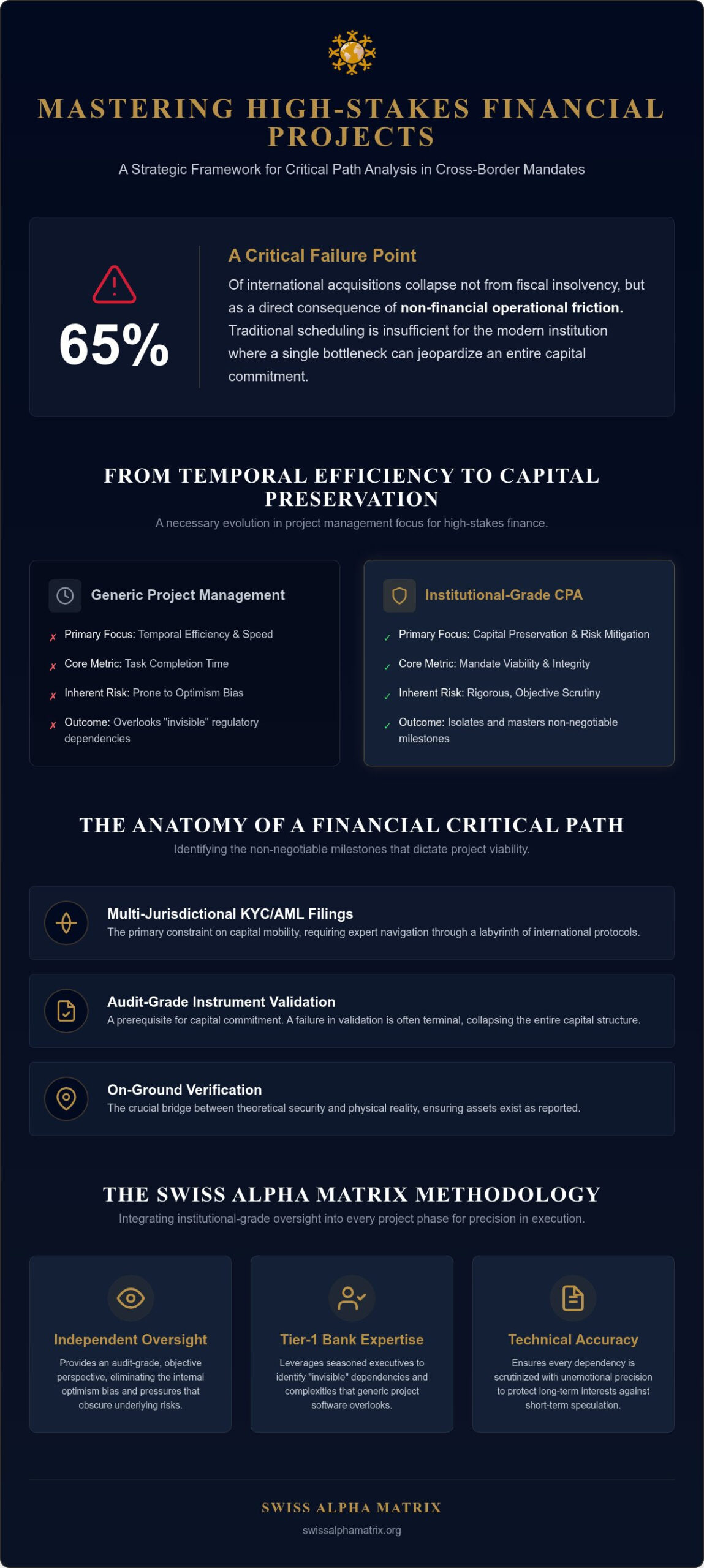
When 65% of international acquisitions collapse not because of fiscal insolvency but as a direct consequence of non-financial operational friction, it becomes evident that traditional scheduling is insufficient for the modern institution. You likely recognize that in high-stakes environments, a single regulatory bottleneck or a failure in multi-jurisdictional instrument validation can jeopardize an entire capital commitment. This is where the sophisticated application of critical path analysis in financial projects transcends mere timeline management, evolving into a rigorous mechanism for capital protection. It’s a reality that seasoned experts accept; the path to success is paved with non-negotiable dependencies that require absolute precision and technical accuracy.
This article provides a strategic framework designed to master these complexities, ensuring the integrity of cross-border mandates through audit-grade clarity. We’ll examine how to identify deal-breaking milestones and reduce transactional risk by aligning project timing with the stringent regulatory demands of 2026. By moving from broad principles to specific strategic pillars, we’ll demonstrate how independent oversight and on-ground verification mitigate the optimism bias that often plagues large-scale deployments. You’ll gain the intellectual depth needed to transform project dependencies into a structured argument for professional calm, ensuring interests remain with experts who prioritize long-term preservation.
Key Takeaways
- Distinguish between traditional schedule-driven metrics and a risk-centric framework that prioritizes capital preservation over simple temporal efficiency.
- Learn to implement critical path analysis in financial projects by isolating non-negotiable regulatory dependencies, such as multi-jurisdictional KYC filings, that dictate the true pace of capital deployment.
- Understand the necessity of audit-grade instrument validation as a prerequisite for capital commitment to eliminate the optimism bias inherent in unverified project timelines.
- Master the deconstruction of cross-border mandates into distinct regulatory, operational, and financial workstreams to pinpoint the “Critical Six” milestones for robust risk mitigation.
- Apply institutional-grade oversight to integrate on-ground verification into every project phase, leveraging the discretion and precision of former Tier-1 bank executives.
The Evolution of Critical Path Analysis in Financial Projects
The history of the Critical Path Method (CPM) is rooted in the industrial efficiency of the mid-20th century, yet its modern adaptation within independent financial project management has evolved into a far more nuanced discipline. Traditional approaches often prioritize temporal efficiency, focusing strictly on how quickly a task can be completed. However, critical path analysis in financial projects must prioritize capital preservation and risk mitigation over simple speed. For the sophisticated investor, the “critical path” isn’t merely a timeline; it’s a sequence of non-negotiable regulatory and validation milestones that determine the viability of a mandate.
Former Tier-1 bank executives bring a unique perspective to this evolution, identifying “invisible” dependencies that generic project management software often overlooks. These seasoned experts understand that in 2026, the complexity of cross-border transactions demands a level of precision where a single missed filing or an unverified instrument can trigger a total collapse of the capital structure. This transition from a time-focused to a risk-focused framework is the hallmark of institutional-grade project oversight.
Defining the Financial Critical Path
In a complex financial environment, the critical path is frequently defined by “bottleneck milestones” such as audit-grade instrument validation. Unlike a construction project where a delay in materials might be recovered through increased labor, a failure in instrument validation is often terminal. During cross-border investment due diligence, dependencies shift from logistical tasks to the verification of jurisdictional integrity. The intersection of temporal logic and regulatory compliance requires a master planner who understands that the longest path is often the one involving the most stringent AML and KYC protocols. It’s a reality where technical accuracy cannot be sacrificed for the sake of a deal’s momentum.
The Strategic Imperative for Independent Oversight
Internal Project Management Offices frequently succumb to optimism bias, where the desire to finalize a deal obscures the underlying risks. This internal pressure can lead to a compromised mapping of dependencies. Independent oversight provides an audit-grade perspective, ensuring that the critical path analysis in financial projects remains objective and uninfluenced by transactional incentives. By utilizing seasoned, unemotional experts, an institution ensures that every dependency is scrutinized with the technical accuracy required to protect long-term interests against short-term speculation. This independent advisory acts as a protective authority, maintaining the sanctity of the project framework even under intense deal-side pressure.
Identifying High-Stakes Dependencies in Financial Mandates
Identifying the specific dependencies that define the “Long Pole” in any sophisticated mandate is the cornerstone of effective critical path analysis in financial projects. While generic project management might focus on software development cycles, the financial architect must analyze the labyrinthine requirements of multi-jurisdictional filings. These often include exhaustive Know Your Customer (KYC) and Anti-Money Laundering (AML) protocols that serve as the primary constraints on capital mobility. According to the Critical Path Method (CPM): The Ultimate Guide, understanding these constraints is vital for accurate forecasting, yet in the institutional sphere, these are not merely tasks but existential risks that require former Tier-1 bank expertise to navigate.
Beyond the paperwork, on-ground verification stands as a non-negotiable critical path item. It’s the bridge between theoretical security and physical reality, ensuring that the assets underpinning a deal actually exist in the reported state. Managing the news cycle and maintaining deal integrity also play a silent but pivotal role in the project timeline. A leak or a shift in market sentiment can alter the regulatory appetite for a transaction, effectively resetting the critical path without warning. For those managing such volatility, engaging in Complex Project Management ensures these external variables are integrated into the strategic framework from the outset.
Regulatory and Compliance Milestones
The introduction of international financial regulations has fundamentally altered how we map project success. Scheduling must now account for institutional reporting requirements like “Form PF” and the increasing scrutiny of digital asset interconnectedness. Regulatory approval is frequently the most volatile element of the path, as it’s subject to the shifting priorities of global supervisors who are currently focused on ESG and AI governance. This volatility requires a master planner who can pivot without compromising the integrity of the mandate.
Validation as a Sequential Prerequisite
Technical precision dictates that bank instrument validation services are completed before final contract execution. Attempting to “parallel process” validation alongside capital deployment is a dangerous practice that invites systemic failure. Instrument validation dependency is the core safeguard of institutional liquidity, acting as the final gatekeeper before capital is irrevocably committed. This sequential discipline ensures that the critical path analysis in financial projects serves its primary purpose: the absolute protection of principal through rigorous, audit-grade verification.
Institutional-Grade CPA vs. Generic Project Management
Generic project management often treats tasks as uniform units of work, prioritized primarily by their chronological sequence. In the sphere of high-stakes capital, this is a dangerous oversimplification that fails to account for the catastrophic cost of failure. While a standard critical path analysis (CPA) might identify the longest sequence of tasks to ensure a project finishes on schedule, critical path analysis in financial projects prioritizes the sequence of risks that could lead to total loss. It’s the fundamental difference between a “Task-Based” approach and a “Risk-Based” one. Applying sophisticated financial advisory methodologies ensures that the mandate’s architecture is built upon a foundation of capital protection rather than just temporal speed.
The construction of an institutional-grade path requires a level of discretion that algorithms simply cannot replicate. Former Tier-1 bank senior executives understand that dependencies in complex deals aren’t always linear. A delay in one jurisdiction’s instrument validation doesn’t just push back a date; it can invalidate the entire legal framework of a cross-border transaction. This measured, logical approach moves away from the frantic energy of generic project management, opting instead for a dignified and formal structure that mirrors the traditional discretion of private wealth management. It’s about creating a sense of inevitable logic that encourages confidence among high-net-worth individuals and institutional entities alike.
The Nuance of Financial Float
In traditional project management, “Float” represents the amount of time a task can be delayed without affecting the final completion date. In high-finance, managing this float requires a master planner’s discretion. While “Total Float” might exist for administrative workstreams, “Zero Float” is the absolute standard for legal or regulatory sign-offs. These are non-negotiable milestones where even a minor delay can trigger a breach of contract or an unexpected regulatory inquiry. Protecting the critical path during periods of market volatility involves building strategic buffers that account for the unpredictable nature of jurisdictional approvals. A tactical delay in a non-essential task can preserve resources for these high-stakes regulatory gates, ensuring that the project’s integrity remains uncompromised.
Expertise Over Algorithms
Software cannot predict the “human element” that often dictates the pace of cross-border negotiations. While a digital tool can map a sequence, it lacks the historical transactional data and regional precision required to set realistic durations for sensitive discussions. Swiss Alpha Matrix leverages the expertise of seasoned professionals who have navigated these complexities at the highest institutional levels. By applying a hyper-personalized approach to global project timelines, we ensure that every milestone is grounded in the reality of on-ground verification. This refusal to oversimplify complex dynamics demonstrates an intellectual depth that caters to a sophisticated audience. It positions the firm not just as a service provider, but as a dedicated partner rooted in historical reliability and technical accuracy.
Implementing CPA in Mastering Cross-Border Investment Due Diligence
To successfully execute a cross-border mandate, one must move beyond the superficiality of generic scheduling. The integration of critical path analysis in financial projects within the strategic framework of mastering institutional due diligence demands a five-step implementation strategy that prioritizes technical accuracy and principal protection. This process begins with the deconstruction of the mandate into three distinct workstreams: regulatory compliance, operational ground-truthing, and financial structuring. This separation allows the master planner to isolate the “Critical Six” milestones, which are the non-negotiable gates for capital protection that must be cleared before any liquidity is deployed.
The third phase involves mapping jurisdictional interdependencies, specifically analyzing the friction between the regulatory expectations of Geneva and the operational speed of Hong Kong. This is followed by a rigorous stress-test of the path against market volatility and counterparty risk, ensuring the framework remains robust even under extreme duress. Finally, establishing independent oversight and reporting protocols ensures that the project remains aligned with the original strategic objectives, effectively removing the optimism bias that often plagues internal deal teams. To secure your next mandate with this level of institutional rigor, explore our Complex Project Management framework.
Mapping the Multi-Jurisdictional Path
Coordinating timelines across London, Geneva, and Hong Kong requires a meticulous understanding of local bank holidays, regulatory hours, and cultural business rhythms. These factors are not mere inconveniences; they are fundamental constraints that dictate the feasibility of a capital deployment. Jurisdictional Lag is a pervasive critical path failure where the misalignment of regional regulatory hours and local administrative customs creates an unrecoverable delay in the capital deployment sequence. A failure to account for these nuances often leads to a breach of contract or the expiration of time-sensitive bank instruments.
Stress-Testing and Scenario Planning
A sophisticated framework must account for the high-impact possibility of a bank instrument failing validation at the 11th hour. Developing “Branching Paths” allows the project lead to pivot toward alternative regulatory structures or backup counterparties without sacrificing the integrity of the deal. Maintaining capital preservation as the primary project objective ensures that no milestone is pursued at the expense of the investor’s principal security. By anticipating regulatory rejection or counterparty delay, the master planner preserves the quiet authority and steady logic required to navigate the most complex global financial environments.
The Swiss Alpha Matrix Methodology: Precision in Execution
The culmination of a robust critical path analysis in financial projects isn’t found in a colorful chart, but in the technical accuracy of its execution. Swiss Alpha Matrix bridges the gap between traditional project management and the specialized requirements of high-end private wealth management by integrating audit-grade validation into every milestone. This methodology reflects the traditional discretion of a boutique entity, where interests are handled by seasoned, former Tier-1 bank executives who prioritize long-term preservation over short-term speculation. By merging Swiss discretion with meticulous project discipline, we provide a protective authority that internal teams often lack. This elite level of oversight ensures that your mandate is governed by historical reliability rather than the frantic energy of the marketplace.
Engaging Swiss Alpha Matrix for Complex Project Management mandates ensures that your capital deployment is shielded from the optimism bias that frequently derails cross-border deals. We don’t merely track tasks; we validate the integrity of every instrument and counterparty involved in the mandate. This steady, logical approach creates a sense of professional calm, allowing institutional entities to proceed with confidence. Our methodology focuses on:
- Removing the optimism bias through independent, third-party oversight led by former bank seniors.
- Securing audit-grade instrument validation before any capital commitment occurs.
- Providing on-ground verification that transcends digital documentation and surface-level due diligence.
- Aligning multi-jurisdictional workstreams with regional precision and technical accuracy.
Audit-Grade Validation as a Project Pillar
We treat validation not as a perfunctory task, but as a project-defining milestone that governs the entire critical path analysis in financial projects. Our on-ground verification process is rigorous, moving beyond digital footprints to confirm the physical and legal existence of assets in both emerging and established markets. This level of scrutiny ensures that executive stakeholders receive intelligence, not just raw data. In a landscape where research from 2024 revealed that nearly 12% of reported industrial assets in certain emerging markets were fabricated, such precision isn’t optional; it’s the foundation of institutional liquidity. We provide the intellectual depth required to identify these discrepancies before they impact the project timeline.
A Partner in Capital Preservation
Adopting a structured, critical-path approach to finance offers long-term benefits that extend far beyond the initial transaction. It moves the investor from a position of passive participation to one of strategic project control. This shift is essential for maintaining the moral character and high-level standards expected by high-net-worth individuals and institutional entities. By identifying deal-breaking milestones early, we reduce exposure to transactional risk and ensure audit-grade clarity on all project dependencies. Contact Swiss Alpha Matrix to secure your next complex mandate and experience a standard of service that is both broad in reach and meticulous in its attention to detail.
Securing the Future of Institutional Capital Deployment
Success in the 2026 financial landscape is no longer a matter of simple scheduling; it’s a byproduct of technical accuracy and the refusal to oversimplify complex multi-jurisdictional dynamics. By shifting from a task-based perspective to a risk-centric framework, you prioritize the integrity of capital over the mere speed of a deal. This strategic shift ensures that non-negotiable milestones, particularly audit-grade instrument validation and regulatory gates, remain the primary focus of the mandate’s architecture. Implementing a rigorous critical path analysis in financial projects allows for the identification of “invisible” dependencies before they compromise a capital commitment.
Partnering with a protective authority ensures that your interests are managed with the discretion and precision that only decades of Tier-1 banking expertise can provide. With global reach and Swiss precision, we offer the intellectual depth required to navigate the most intricate cross-border challenges. It’s time to move beyond passive participation and embrace a standard of service that values historical reliability and meticulous detail. Secure your institutional mandates with Swiss Alpha Matrix project management. Your commitment to excellence starts with a partner who understands that true capital protection requires an unwavering focus on the critical path.
Frequently Asked Questions
What is the primary difference between CPA in finance and other industries?
The primary distinction lies in the transition from a time-centric model to a risk-centric framework that prioritizes capital preservation. While industrial sectors focus on logistical throughput, critical path analysis in financial projects emphasizes regulatory gates and validation milestones. This approach ensures that the longest sequence of tasks isn’t merely about duration; it’s about the technical accuracy of jurisdictional filings and the integrity of the underlying fiscal instruments.
How does critical path analysis improve cross-border due diligence outcomes?
This methodology improves outcomes by deconstructing the mandate into regulatory, operational, and financial workstreams to reveal hidden jurisdictional friction. By mapping these interdependencies, such as the lag between Geneva and Hong Kong, architects can predict bottlenecks before they jeopardize capital. This structured discipline ensures that on-ground verification occurs as a non-negotiable prerequisite, effectively reducing the 74% of international acquisition failures attributed to inadequate operational ground-truthing.
Can CPA be used to mitigate counterparty risk in bank instrument transactions?
It is a foundational tool for mitigation, as it positions audit-grade instrument validation as a sequential prerequisite for final contract execution. By making these validations “Zero Float” tasks, the framework prevents the dangerous practice of parallel processing validation with capital deployment. This ensures that counterparty claims are physically verified through on-ground services before any irrevocable liquidity is released, maintaining the standard of service expected by sophisticated institutional entities.
Why is independent project management necessary for identifying the critical path?
Independent oversight is vital because internal teams often succumb to optimism bias or deal-side pressure that obscures underlying project risks. Seasoned experts from outside the transaction provide an unemotional perspective, ensuring that the critical path analysis in financial projects remains objectively focused on capital protection. This audit-grade clarity allows for the identification of non-negotiable dependencies that might be overlooked by a partner who’s financially incentivized to close the deal quickly.
What are the risks of ignoring task dependencies in high-stakes financial projects?
Ignoring these dependencies leads to catastrophic friction, often resulting in the total collapse of the capital structure or significant regulatory inquiries. When 65% of failed international acquisitions are linked to non-financial operational friction, the cost of overlooking jurisdictional lag or unverified instruments is immense. Without a structured path, institutions risk breaching AML protocols or encountering unexpected bottlenecks that can lead to the fabrication of assets being discovered only after capital is committed.
How often should the critical path be reviewed during a financial mandate?
Review should occur at every significant regulatory shift or market volatility event to ensure the mandate remains viable. In a landscape where supervisors are hardening requirements for ICT and cyber risk, the path must be dynamic. While the broad strategic pillars remain steady, the specific workstreams require constant validation by master planners. This measured pace ensures that the project’s logic stays aligned with the traditional discretion of high-end wealth management.
What role does audit-grade validation play in project scheduling?
It serves as a project-defining milestone that acts as the final gatekeeper for capital mobility. Rather than treating validation as a secondary task, our methodology elevates it to a “Long Pole” dependency that dictates the entire project timeline. This rigor ensures that executive stakeholders receive verified intelligence, not just raw data. It’s a non-negotiable gate that prevents the optimism bias from prematurely moving the project into the capital deployment phase.
Is specialized software required for financial critical path analysis?
While digital tools help map sequences, they cannot replicate the intellectual depth and regional precision provided by former Tier-1 bank executives. Historical transactional data and an understanding of human elements in cross-border negotiations are far more critical than any specific software package. A master planner utilizes these tools as secondary aids; the real value lies in the technical accuracy and moral character of the experts overseeing the mandate’s architecture.