

In the sophisticated corridors of global capital deployment, the difference between a resilient portfolio and one vulnerable to systemic contagion often rests upon the invisible, yet impenetrable, boundaries of a single legal entity. You likely recognize that while the conceptual answer to what is a special purpose vehicle (spv) in finance is technically straightforward, the operational reality of managing these off-balance sheet structures is increasingly fraught with regulatory nuance and counterparty risk. It’s a delicate balance where the pursuit of strategic growth must be anchored by a commitment to long-term preservation and technical precision, ensuring that interests are shielded from the complexities of the broader parent organization.
This guide provides the institutional-grade framework required to transform a standard legal shell into a robust, risk-contained architecture that protects your primary interests from the volatility of underlying assets. You’ll discover how to navigate the 2026 SEC disclosure mandates and the complexities of cross-border capital deployment with the steady hand of a master planner. By the conclusion of this analysis, you’ll possess a clear methodology for implementing audit-grade instrument validation and on-ground verification. This ensures that every asset held within the vehicle meets the highest standards of regional excellence, providing the quiet authority and logical structure necessary for sophisticated wealth management.
Key Takeaways
- Master the fundamental architecture of what is a special purpose vehicle (spv) in finance to effectively isolate parent company contagion from specific strategic assets.
- Identify the optimal 2026 legal structures, from LLCs to Trust arrangements, that align with the rigorous standards of Swiss jurisdictional precision and discretion.
- Implement a robust framework for operational due diligence to differentiate between strategic asset securitisation and the risks of non-transparent debt concealment.
- Establish a dedicated Project Management Office (PMO) to maintain institutional-grade oversight and ensure the long-term integrity of cross-border financial instruments.
- Validate the legitimacy of underlying assets through audit-grade instrument validation and on-ground verification protocols led by seasoned industry experts.
Defining the Special Purpose Vehicle: A Strategic Tool for Risk Isolation
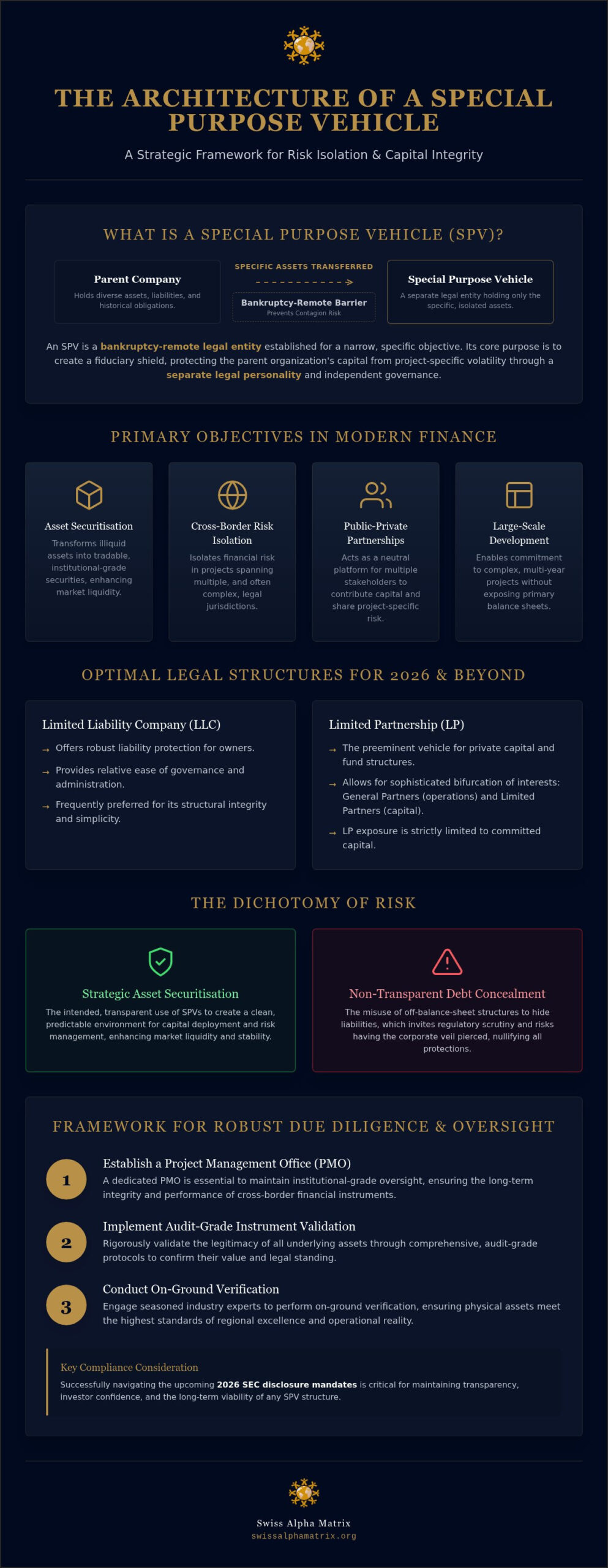
To comprehend what is a special purpose vehicle (spv) in finance, one must look beyond the simple legal shell and view it as a precision-engineered architecture for risk containment. At its core, an SPV is a bankruptcy-remote entity established to fulfill a narrow, specific objective, such as the acquisition or financing of a particular asset. This structural isolation ensures that the vehicle’s financial obligations remain distinct from those of the parent company, creating a fiduciary shield that protects the broader institution’s capital from project-specific volatility. Institutional investors frequently prefer these arrangements for high-value asset securitisation because they provide a clean, predictable environment for capital deployment, free from the historical liabilities of the sponsoring entity.
The Legal and Operational Autonomy of SPVs
The utility of an SPV rests entirely upon its separate legal personality. This autonomy is the primary mechanism that prevents contagion risk, ensuring that the insolvency of one entity doesn’t trigger a cascade of defaults across the corporate group. Maintaining this integrity requires independent governance and a refusal to co-mingle assets, a standard of discipline that mirrors the traditional discretion of elite wealth management. While a Special-purpose entity (SPE) is often used as a broader term, the SPV remains the preferred nomenclature for vehicles dedicated to structured finance. It’s a structural necessity that demands meticulous attention to detail, as any perceived lack of independence can lead regulators to pierce the corporate veil, nullifying the intended risk isolation.
Primary Objectives in Modern Corporate Finance
Modern finance utilizes these vehicles for several high-stakes strategic initiatives that require absolute precision. They’re indispensable for isolating financial risk in cross-border projects where legal jurisdictions can vary significantly. By housing assets within a dedicated vehicle, institutions can facilitate asset-backed securitisation, turning illiquid holdings into tradable, institutional-grade securities that enhance market liquidity. We also see SPVs playing a critical role in Public-Private Partnerships (PPPs) and large-scale infrastructure development. In these scenarios, the SPV acts as a neutral platform where multiple stakeholders can contribute capital and share risk without exposing their primary balance sheets to the project’s long-term operational uncertainties. This logical structure provides the professional calm necessary for stakeholders to commit significant resources to complex, multi-year endeavors.
Structural Architectures and Regulatory Frameworks in 2026
The determination of an SPV’s legal architecture requires a nuanced understanding of how different entities interact with global tax treaties and insolvency laws. When evaluating what is a special purpose vehicle (spv) in finance, one must look past the superficial legal filing to the underlying structural integrity. It’s a foundational decision that dictates the entity’s long-term resilience. The strategic selection of a legal vehicle is not merely a matter of administrative preference but a calculated move to ensure that capital remains ring-fenced from the sponsoring institution’s operational liabilities.
Common Legal Entities: LLCs vs. Limited Partnerships
The choice between a corporation and a partnership often hinges on the specific tax implications for the ultimate beneficial owners, yet the operational risks associated with each must be weighed with equal gravity. LLCs are frequently preferred for their robust liability protection and relative ease of governance. In contrast, the Limited Partnership remains the preeminent vehicle for private capital, allowing for a sophisticated bifurcation of interests. The General Partner (GP) assumes the mantle of operational authority and unlimited liability, while the Limited Partners (LP) enjoy a protected status that limits their exposure to the extent of their committed capital. This structure is particularly effective when navigating the intricacies of what is a special purpose vehicle (spv) in finance, as it provides a logical framework for managing the competing demands of performance and preservation. For those seeking absolute insolvency remoteness, the “Orphan SPV” remains a sophisticated option. In this arrangement, shares are held by a professional trustee under a charitable trust, ensuring that the vehicle isn’t legally tied to the sponsor’s balance sheet should liquidation occur.
Jurisdictional Considerations and Compliance
The selection of a domicile is increasingly influenced by the tightening grip of international financial regulations. While offshore hubs once offered opaque advantages, the 2026 landscape favors jurisdictions like Switzerland, where discretion is balanced with an unwavering commitment to precision and regulatory excellence. The evolution of Global Financial Governance has necessitated a move toward audit-grade reporting and absolute transparency in beneficial ownership. As the 2026 compliance landscape matures, particularly with the SEC’s July 9, 2026, mandate requiring investor disclosure in Schedule 13D filings for activist SPVs, the necessity for regulatory compliance advisory becomes paramount. Furthermore, with the June 3, 2026, deadline for smaller entities to comply with the 2024 amendments to SEC Regulation S-P, the burden of service provider oversight and incident response has become a core operational pillar. Ensuring that an SPV’s assets are validated through institutional-grade frameworks isn’t just a best practice; it’s a requirement for maintaining capital integrity in an era of heightened scrutiny.
The Dichotomy of Risk: Asset Securitisation vs. Hidden Liabilities
The strategic deployment of an SPV represents a sophisticated paradox in modern capital management. While these entities are designed to isolate risk, their very nature as isolated structures can inadvertently facilitate the concealment of liabilities if oversight isn’t absolute. Gaining a comprehensive understanding of what is a special purpose vehicle (spv) in finance requires a deep appreciation for this tension, where the boundary between legitimate risk ring-fencing and non-transparent debt accumulation can become dangerously thin without institutional-grade discipline. It’s a landscape where the master planner must distinguish between the optimization of capital and the mere obfuscation of financial reality.
Asset Securitisation and Structured Finance
For global financial institutions, the SPV serves as the primary engine for asset-backed securitisation. By transferring illiquid receivables, such as long-term mortgages or infrastructure cash flows, into a dedicated vehicle, a parent company can transform these holdings into tradable, institutional-grade securities. This process effectively lowers borrowing costs by decoupling the credit rating of the specific assets from the broader corporate entity. This Guide to Special Purpose Vehicles (SPV) highlights how such structures enhance balance sheet liquidity by allowing for the precise packaging of cash flows. However, the integrity of this transfer relies on a “True Sale” opinion, a legal determination that ensures the assets are truly beyond the reach of the parent company’s creditors. Without this meticulous legal separation, the bankruptcy-remote status of the vehicle remains vulnerable to judicial challenge, potentially exposing the parent to the very contagion it sought to avoid.
Identifying the ‘Enron Trap’ in Modern Transactions
The historical precedent of the Enron collapse serves as a perennial warning against the misuse of off-balance sheet entities for debt concealment. In the 2026 regulatory environment, the “Enron Trap” manifests through complex inter-company loans and a lack of transparency in reporting that can baffle even seasoned analysts. A primary red flag is the reliance on “mark-to-model” accounting within an isolated entity, where valuations are based on internal mathematical projections rather than verifiable market data. This theoretical approach can inflate asset values while masking underlying solvency issues. To mitigate these counterparty risks, sophisticated stakeholders increasingly rely on bank instrument validation services to ensure that the financial instruments held within the SPV are both authentic and liquid. Ultimately, a shell is only as strong as its underlying assets. Physical on-ground verification remains the only definitive antidote to paper-based fraud and the systemic risks of non-transparent financial engineering.
A Framework for Robust SPV Due Diligence and Oversight
Maintaining the integrity of a bankruptcy-remote entity requires more than just legal documentation; it demands a structured, perpetual oversight mechanism. When considering what is a special purpose vehicle (spv) in finance, executives must view the entity as a living project that necessitates a dedicated Project Management Office (PMO) for long-term governance. This office serves as the central nervous system, coordinating between the parent institution and the isolated vehicle to ensure that strategic objectives are met without compromising the fiduciary shield. Implementing a RACI matrix is essential in this context, as it clearly defines who is Responsible, Accountable, Consulted, and Informed, thereby preventing the administrative stagnation that often plagues complex structures. Before any capital is committed, a rigorous phase of cross-border investment due diligence must be executed to map the regulatory and operational landscape of the target jurisdiction.
Operational Due Diligence: Verifying the ‘Shell’
The plumbing of an SPV is only as reliable as the individuals and service providers who manage its daily functions, which is a critical realization when defining what is a special purpose vehicle (spv) in finance for high-stakes operations. A deep-dive investigation into the professional history of directors and signatories is non-negotiable, as is the verification of the third-party administrators who maintain the entity’s records. This process includes a granular assessment of the risk management framework to ensure that internal controls are sufficient to prevent unauthorized asset transfers or reporting discrepancies. In the context of SPVs, operational due diligence functions as an institutional safeguard that validates the structural integrity and administrative competence of the vehicle before and during its lifecycle. Regular testing of these operational channels ensures that the vehicle remains a robust container for high-value assets rather than a hollow shell.
Implementing Independent Project Oversight
Internal bias often obscures emerging risks, making third-party advisory an essential component of professional oversight. The role of independent financial project management is particularly critical in complex deals where milestones and deliverables must be monitored with unemotional precision. By engaging experts who are untethered from the deal’s internal politics, stakeholders gain a transparent view of the SPV’s performance relative to its narrow objective. This disciplined approach ensures that the vehicle fulfills its strategic purpose while maintaining the standards of regional excellence that sophisticated investors demand. To secure your interests through professional oversight, consider the benefits of Audit-Grade Instrument Validation from seasoned experts who prioritize long-term preservation over short-term speculation.
Ensuring Capital Integrity through Audit-Grade Validation
While the legal architecture of what is a special purpose vehicle (spv) in finance provides the necessary framework for risk isolation, the true measure of its success lies in the integrity of the underlying financial instruments. A structure is merely a vessel; without audit-grade validation of the contents, the fiduciary shield remains a purely theoretical construct. Swiss Alpha Matrix applies a level of institutional discipline to SPV oversight that mirrors the traditional discretion of the world’s most prestigious private wealth management firms. By positioning independent verification as the cornerstone of sophisticated SPV usage, stakeholders can ensure that their strategic growth is anchored by verifiable, tangible assets. This measured approach replaces speculative hope with logical certainty, fostering a sense of professional calm in even the most complex transactions.
The Role of Independent Advisory in Complex Transactions
Navigating the technicalities of what is a special purpose vehicle (spv) in finance requires more than just administrative support; it demands the executive-level intelligence of former Tier-1 banking leaders. Our team brings a level of intellectual depth that refuses to oversimplify the intricate dynamics of cross-border capital, opting instead for a thoroughness that high-net-worth individuals and institutional entities value. This expertise is crucial when managing intricate financial programs where jurisdictional nuances can impact capital deployment and long-term preservation. In sensitive environments, the value of Swiss discretion can’t be overstated. It provides a standard of service that is both broad in reach and meticulous in its attention to detail, ensuring that interests are in the hands of seasoned experts who prioritize stability over short-term speculation.
Beyond Paperwork: On-Ground Verification of SPV Assets
Paper-based documentation is a starting point, not a conclusion. Reducing exposure to cross-border fraud necessitates a methodology rooted in on-ground intelligence and physical verification of the assets held within the entity. We don’t rely solely on digital ledgers or the representations of counterparties who may have conflicting interests. Instead, we utilize a rigorous methodology of physical verification to ensure instrument authenticity and liquidity. This synergy between high-level financial advisory and boots-on-the-ground verification creates a standard of service that distinguishes a performance-oriented mindset from passive participation. It’s the only definitive way to transform a legal shell into a genuine engine of strategic growth. To secure the integrity of your capital and ensure your structures meet the highest standards of institutional oversight, contact Swiss Alpha Matrix for bespoke advisory on complex financial programs.
Strategic Resilience in a Transformed Financial Landscape
The strategic utilization of an SPV represents a commitment to long-term preservation and structural precision, ensuring that capital remains isolated from the inherent volatility of parent company operations. As we’ve explored, the transition from a simple legal shell to a robust risk-containment architecture requires more than administrative compliance; it demands the intellectual depth of seasoned experts who prioritize stability over speculation. Deeply understanding what is a special purpose vehicle (spv) in finance serves as the foundation for institutional-grade capital protection, yet the true differentiator remains the implementation of audit-grade instrument validation and on-ground verification protocols.
Led by former senior executives from Tier-1 global banks, our firm provides the independent, project-based advisory necessary to navigate the most complex financial programmes with regional excellence. By tethering modern strategies to concepts of technical accuracy and traditional discretion, we ensure that your interests remain shielded from the complexities of the broader market. The path to capital integrity is found through meticulous oversight and a refusal to oversimplify the intricate nature of global finance. We invite you to Secure Your Cross-Border Interests with Swiss Alpha Matrix Advisory and anchor your strategic growth in a standard of service that is both broad in reach and meticulous in its attention to detail.
Frequently Asked Questions
What is the main purpose of a special purpose vehicle in corporate finance?
The primary objective of a special purpose vehicle is to isolate financial risk by creating a bankruptcy-remote entity dedicated to a narrow, pre-defined mission. In the sophisticated context of what is a special purpose vehicle (spv) in finance, this structure allows institutions to ring-fence specific assets or liabilities from the parent company’s balance sheet. This strategic bifurcation ensures that the failure of a specific project doesn’t jeopardize the core organization’s capital integrity.
How does an SPV isolate risk from its parent company?
An SPV isolates risk through its separate legal personality, which ensures that its obligations remain legally distinct from those of the sponsoring entity. By maintaining strict operational autonomy and preventing the co-mingling of assets, the vehicle functions as a fiduciary shield against parent company contagion. This structural independence is critical for securitization, as it ensures that the underlying financial instruments are protected from the sponsor’s creditors, even in the event of insolvency.
Are SPV assets and liabilities included on the parent company’s balance sheet?
Under current IFRS and GAAP reporting standards, SPV assets and liabilities are generally excluded from the parent company’s balance sheet if the sponsor doesn’t maintain a controlling financial interest. Achieving this off-balance sheet status requires a meticulous “True Sale” of assets and a demonstrated lack of control over the vehicle’s governance. As of 2026, regulatory scrutiny regarding de-consolidation has intensified, making audit-grade instrument validation essential to prove the legitimacy of the entity’s status.
What are the primary differences between an SPV and a traditional investment fund?
While a traditional investment fund typically manages a diversified portfolio with broad mandates, an SPV is engineered for a singular, highly specific transaction or asset. The distinction lies in the scope of the mission; funds are enduring structures for capital growth, whereas SPVs are often tactical architectures designed for risk sharing or securitization. Understanding what is a special purpose vehicle (spv) in finance involves recognizing this shift from broad management to hyper-personalized, asset-specific containment.
What are the common risks associated with using special purpose vehicles?
The primary risks associated with special purpose vehicles include counterparty default, operational opacity, and the potential for regulatory re-characterization. If the entity lacks transparent governance or audit-grade reporting, it can become a vessel for hidden liabilities rather than a tool for risk isolation. The reliance on “mark-to-model” accounting can also inflate asset values, necessitating on-ground verification to ensure that the underlying financial instruments possess the authenticity and liquidity required for preservation.
How do regulatory bodies like the SEC or Swiss FINMA view SPVs in 2026?
In 2026, regulatory bodies like the SEC and Swiss FINMA view SPVs with a heightened emphasis on transparency and beneficial ownership disclosure. Specifically, the SEC’s July 9, 2026, mandate requires detailed investor identification for activist SPVs, signaling a shift toward more rigorous institutional-grade oversight. Swiss authorities continue to prioritize jurisdictional precision and discretion, yet they increasingly demand robust operational due diligence to ensure that these vehicles aren’t utilized for non-transparent debt concealment or arbitrage.
Why is independent project management crucial for SPV-led transactions?
Independent project management is essential to prevent internal bias and ensure that the SPV’s governance remains untethered from the sponsoring institution’s political pressures. By engaging third-party advisory led by former Tier-1 bank executives, stakeholders gain access to unemotional, audit-grade oversight that prioritizes the vehicle’s narrow objective. This disciplined framework facilitates the monitoring of milestones and deliverables, ensuring that the strategic architecture of the deal remains intact and that capital interests are protected through meticulous detail.
What is the role of an ‘orphan’ SPV in structured finance?
An ‘orphan’ SPV is a sophisticated structure where the shares are held by a professional trustee under a charitable trust, effectively removing the vehicle from the sponsor’s corporate group. This arrangement provides the maximum possible level of insolvency remoteness, as the SPV has no legal parent or subsidiary relationship with the originator. It’s a cornerstone of structured finance for high-stakes, cross-border transactions, where absolute legal separation is required to satisfy the most demanding institutional credit requirements.