

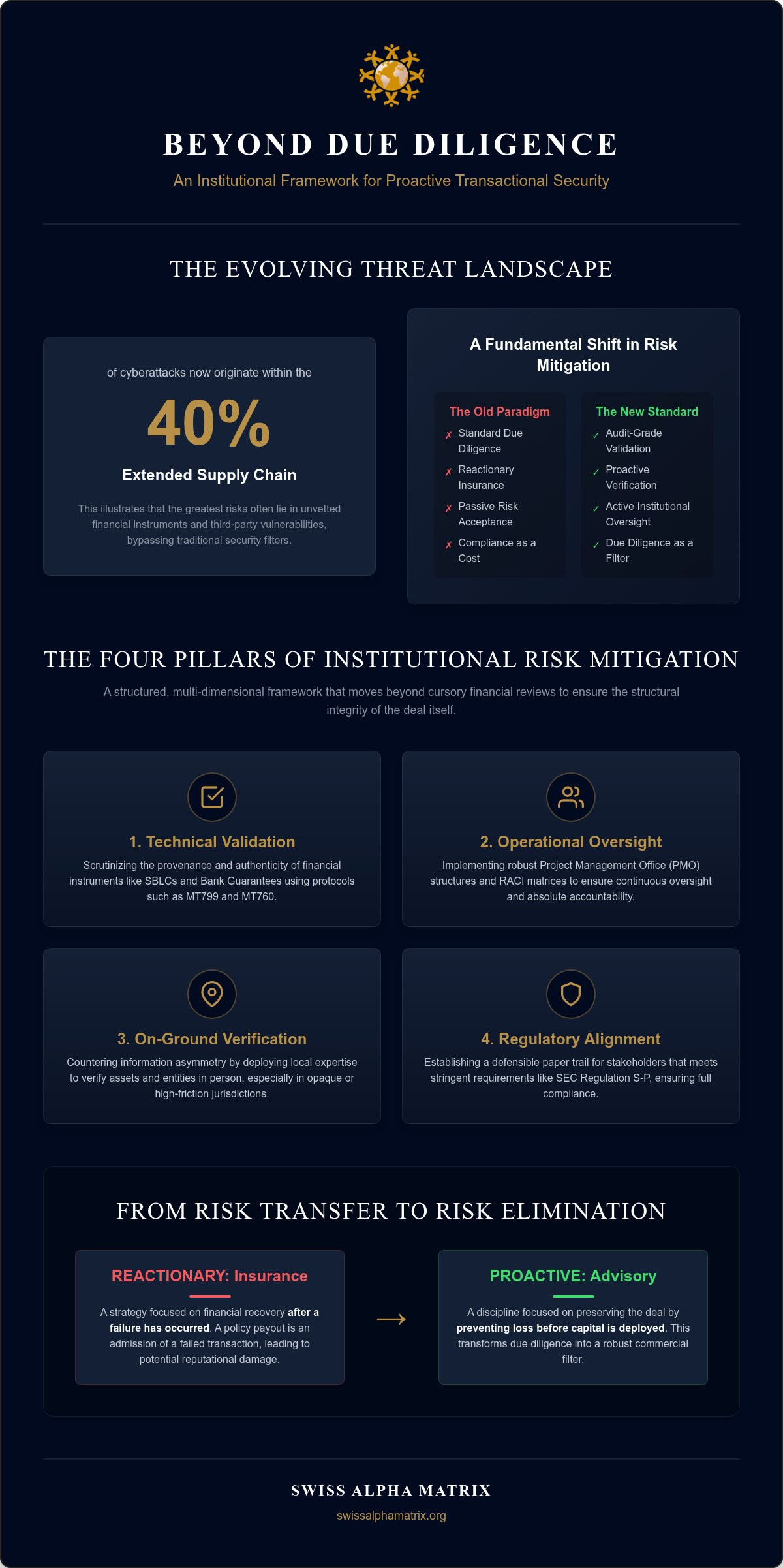
Standard insurance policies often provide a deceptive sense of security in the face of sophisticated financial fraud, acting as a reactionary remedy rather than a proactive shield against structural collapse. You’ve likely recognized that as 40% of cyberattacks now originate within the extended supply chain, a standard vendor due diligence process is no longer a defensible strategy for institutional capital preservation. The persistent challenge of information asymmetry in foreign jurisdictions, combined with the stringent requirements of updated regulations like SEC Regulation S-P, demands a more rigorous approach than traditional indemnity can offer.
We’ll demonstrate how to master the sophisticated architecture of audit-grade risk mitigation to secure your complex cross-border transactions against the inherent risks of non-verifiable bank instruments. By evolving these protocols into a precise commercial filter, you’ll establish a defensible paper trail for stakeholders while eliminating the threat of deal failure. This guide examines the strategic pillars of on-ground verification and instrument validation, providing a logical roadmap to secure capital deployment in even the most opaque global markets.
Key Takeaways
- Master the technical validation of complex financial instruments, including SBLCs and Bank Guarantees, through the precise application of MT799 and MT760 protocols.
- Identify the critical vulnerabilities within a standard vendor due diligence process that frequently allow sophisticated cross-border fraud to bypass traditional institutional filters.
- Implement a robust Project Management Office structure and RACI matrix to ensure continuous operational oversight and absolute accountability throughout the deal lifecycle.
- Transition from reactionary insurance-based strategies to a proactive framework centered on audit-grade instrument validation and on-ground verification in opaque jurisdictions.
- Establish a defensible paper trail for stakeholders by integrating the specialized methodologies and regional precision characteristic of elite Swiss financial advisory.
The Evolution of Transactional Risk Mitigation: Beyond Traditional Due Diligence
The 2026 transactional risk environment has shifted fundamentally, moving beyond the manageable fluctuations of market volatility toward a more insidious focus on structural integrity. High-net-worth individuals and institutional entities now operate in a climate where the primary threat isn’t a percentage drop in asset value, but the total evaporation of capital through sophisticated fraud. While a standard vendor due diligence process might satisfy basic compliance checklists, it frequently lacks the technical depth to identify the intricate layers of deception found in cross-border mandates. This evolution demands a transition from passive risk acceptance, where stakeholders simply hope for the best, to an active institutional oversight methodology that prioritizes the verification of every structural component before capital deployment.
Representations and warranties (R&W) insurance, once the gold standard for risk transfer, reveals its inherent limitations when applied to high-friction jurisdictions. A policy payout, while providing some financial recovery, represents a fundamental failure of the primary objective: the successful execution of the transaction. In opaque markets, relying on insurance is a passive strategy that ignores the potential for irrevocable reputational damage and the loss of strategic opportunity. True capital protection is found in the prevention of the loss, not the collection of an indemnity check after the damage is done.
The Failure of Information Asymmetry
Fragmented global regulations, such as the varied adoption of supply chain mapping requirements, create significant blind spots that bad actors exploit with surgical precision. Relying on unverified documentation or paper-thin certifications in foreign jurisdictions is a recipe for catastrophic structural failure. We’ve seen that 40% of cyberattacks now originate in the extended supply chain, illustrating that the danger often lies in the unvetted financial instruments, such as fraudulent Standby Letters of Credit (SBLCs), that underpin these complex deals. Without on-ground verification, information asymmetry remains a gap that no amount of desk-based research can bridge.
Advisory vs. Insurance: A Strategic Distinction
Independent advisory focuses on the preservation of the deal itself, positioning capital protection as a proactive discipline rather than a reactive claim. Integrating cross-border investment due diligence into the preliminary phase of a transaction allows for the identification of red flags before capital is committed. This methodology moves the needle from “compliance as a cost” to “due diligence as a commercial filter.” By utilizing former Tier-1 banking executives to validate instruments, institutions can achieve a level of precision that traditional insurance providers simply cannot match, ensuring that the vendor due diligence process serves as a robust gateway rather than a mere administrative hurdle.
The Four Pillars of an Institutional Transactional Risk Mitigation Framework
Institutional capital protection in 2026 requires a departure from cursory financial reviews toward a structured, multi-dimensional framework that addresses the structural integrity of the deal itself. While many entities rely on a basic vendor due diligence process to satisfy administrative requirements, true risk mitigation rests upon four institutional pillars: Technical Validation, Operational Oversight, On-Ground Verification, and Regulatory Alignment. This methodology moves beyond mere financial hedging, such as currency risk management, to ensure the very foundations of the transaction are sound. It is a shift from passive acceptance to active, precision-led scrutiny.
Technical Validation and Instrument Provenance
Authentic capital protection begins with the technical scrutiny of the financial vehicles involved in a mandate. We define instrument provenance as the verifiable history of a financial asset’s creation and ownership, a metric that standard digital checks often overlook. Relying solely on SWIFT messages is insufficient in an era characterized by sophisticated digital forgery and unauthorized instrument issuance. Robust validation protocols must extend to verifying the identity and authority of the specific issuing officer at the source bank. This ensures that bank instruments, such as SBLCs or Guarantees, are not only legitimate in appearance but are legally binding and fully funded within the institution’s ledger.
Physical On-Ground Verification
Digital data rooms offer a convenient but fundamentally incomplete picture of transactional reality. To prevent cross-border fraud, physical presence remains the only definitive method to verify the existence of tangible assets and the actual reputation of local counterparties. This pillar bridges the gap between digital intelligence and regional precision, ensuring that what appears on a screen matches the reality on the ground. For those seeking this level of meticulous detail, engaging with specialized risk management frameworks can provide the necessary clarity before capital is irrevocably committed.
Operational oversight ensures that the transaction doesn’t stall or deviate after the initial contracts are signed. It involves the continuous monitoring of milestone execution to prevent “deal drift,” where subtle shifts in terms or timing can signal emerging structural failures. Simultaneously, regulatory alignment navigates the friction between local customs and global standards, ensuring that all parties adhere to evolving requirements like the SEC Regulation S-P amendments. This comprehensive vendor due diligence process ensures that every stakeholder remains compliant while maintaining the momentum required for successful deal closure. By integrating these four pillars, institutions can deploy capital with the confidence that their interests are protected by a defensible, audit-grade strategy.
Audit-Grade Instrument Validation: The Technical Core of Capital Protection
Sophisticated transactions rely on the absolute veracity of the underlying financial vehicle, yet a standard vendor due diligence process often stops at the surface, accepting bank-issued documents at face value without interrogating the legal and operational framework behind them. Audit-grade validation goes much further, scrutinizing Standby Letters of Credit (SBLC) and Bank Guarantees (BG) through a lens of institutional skepticism. This process involves the meticulous deconstruction of MT799 and MT760 protocols, ensuring that the pre-advice and the subsequent guarantee are not only authentic but also legally enforceable under international standards. Without this technical depth, the risk of structural failure remains unacceptably high.
Bank-led confirmations are frequently limited by internal liability constraints, providing only a narrow verification of a document’s existence within their own ledger. In contrast, independent, third-party validation conducted by seasoned experts provides a comprehensive assessment of the instrument’s validity, ensuring that the documentation meets the rigorous standards required for Tier-1 institutional audits. This level of technical scrutiny is the only way to safeguard capital against the structural failures that standard insurance cannot prevent, as it identifies discrepancies before they manifest as financial loss.
Validating Complex Financial Vehicles
The utilization of specialized bank instrument validation services is essential for preventing collateral fraud in high-value debt programs. Professionals must verify the legitimacy of bond programs and high-value debt instruments by identifying red flag indicators, such as non-standard language in the instrument text or inconsistencies in the issuing bank’s credentials. This technical layer ensures that the vendor due diligence process remains a robust defense against sophisticated actors who exploit the complexities of cross-border finance. It’s a necessary step for any mandate involving significant capital deployment in jurisdictions where documentation standards may vary.
Establishing Absolute Certainty in Provenance
Establishing absolute certainty requires a forensic approach to tracking the historical movement and ownership of an instrument. It isn’t enough to confirm that a document exists; one must verify the specific authority of the signing parties within the issuing institution to ensure the commitment is legally binding. This audit-grade validation creates a defensible paper trail for executive stakeholders, providing the unemotional, data-driven evidence needed to justify capital deployment in opaque markets. By documenting every step of the verification, institutions protect themselves against future litigation and internal compliance failures, reinforcing the standard of regional excellence and precision that elite partners expect.
Operationalising Oversight: Integrating RACI and PMO into the Deal Lifecycle
Ensuring the technical veracity of a financial instrument is only the first stage of a robust capital protection strategy. The successful completion of a complex mandate requires an operational framework that translates technical findings into actionable oversight throughout the entire deal lifecycle. While a standard vendor due diligence process often lacks a cohesive management structure, an institutional approach utilizes a Project Management Office (PMO) to act as the central nervous system of the transaction. This entity ensures that every milestone, from preliminary investigation to final settlement, is executed with the same level of precision as the initial validation, preventing the “deal drift” that often leads to structural failure.
The PMO as the Transactional Master Planner
Centralizing communication through a dedicated PMO eliminates the information silos that frequently plague cross-border deals. By implementing independent financial project management, institutions can maintain absolute control over the deal’s schedule and cost parameters. This oversight includes a ‘Red Flag’ rating system, which provides real-time risk monitoring based on pre-defined triggers. If a counterparty fails to provide a verified document or misses a critical milestone, the system initiates an immediate escalation. This proactive stance prevents minor delays from cascading into significant losses, ensuring that capital remains protected during every phase of the engagement.
Strategic Stakeholder Management
Accountability is often the first casualty in complex transactions involving multiple advisory, legal, and executive teams. To mitigate this risk, we employ a RACI matrix to define exactly who is Responsible, Accountable, Consulted, and Informed for every critical task. In this framework, the executive role is clearly delineated, ensuring that the investment committee receives high-level, audit-grade intelligence while the on-ground teams handle the granular verification. This coordination is essential for maintaining deal integrity, as it ensures that the central decision-makers are never insulated from the realities of the market or the performance of their counterparts.
To further institutionalize this oversight, a Deliverable Review Matrix should be established to link capital release to the successful completion of verified milestones. This tool ensures that no funds are deployed until the vendor due diligence process has confirmed the structural soundness of the next phase of the transaction. This methodology provides a defensible paper trail for stakeholders and reinforces the standard of regional excellence that defines institutional capital deployment. For organizations requiring a master planner to secure their next high-stakes mandate, our complex project management services provide the necessary oversight to ensure deal success.
The Swiss Alpha Matrix Methodology: Precision-Led Transactional Security
The methodology pioneered by Swiss Alpha Matrix represents a sophisticated synthesis of traditional Swiss discretion and the rigorous financial discipline required to navigate the complexities of 2026. While a conventional vendor due diligence process might serve as a passive compliance filter, our approach functions as an active commercial filter, led by a partner-level team of former Tier-1 global banking executives. This elite structure ensures that every transaction is viewed through the lens of seasoned experts who prioritize long-term capital preservation over short-term speculative gains. It’s a commitment to hyper-personalization, where the unique requirements of each mandate are met with meticulous attention to detail and a standard of service that is both broad in its global reach and regional in its precision.
The Tier-1 Executive Advantage
Navigating modern regulatory friction, such as the stringent data breach notification requirements of the amended SEC Regulation S-P, requires more than automated software; it demands decades of institutional experience. Our team leverages a deeply entrenched network across London, Geneva, and Hong Kong to provide a level of oversight that transcends standard service engagements. By positioning ourselves as a dedicated partner rather than a mere service provider, we offer high-net-worth individuals and institutional entities the intellectual depth needed to identify structural failures before they manifest. This executive-level intelligence empowers capital deployment decisions in opaque markets, ensuring that your interests are protected by those who have spent their careers at the highest levels of global finance.
Securing the Future of Capital Deployment
The transition from a single service engagement to a long-term strategic mandate is facilitated by our financial advisory methodologies, which are designed to protect and grow capital within a framework of absolute technical certainty. As the vendor due diligence process evolves into a cornerstone of institutional strategy, our framework provides the defensible paper trail and audit-grade validation necessary for executive stakeholders to act with confidence. We don’t just manage risk; we pre-empt structural collapse through the synergy of digital intelligence and on-ground verification. For institutions seeking to secure their most complex cross-border transactions, we invite you to engage our team for a comprehensive risk management framework tailored to your specific strategic objectives.
Securing Transactional Integrity in an Era of Structural Risk
The successful execution of cross-border mandates in 2026 demands a departure from passive risk acceptance toward a framework of absolute technical certainty. You’ve seen that the structural integrity of a transaction isn’t an insurance event to be managed, but a pre-emptive requirement to be validated through a sophisticated vendor due diligence process. By integrating audit-grade instrument validation with meticulous on-ground verification, institutions can bridge the gap created by information asymmetry and navigate the complexities of modern regulatory friction with precision.
Swiss Alpha Matrix serves as your independent master planner, providing a level of oversight that mirrors the traditional discretion of high-end wealth management. Managed by former Tier-1 global bank executives with decades of transactional and regulatory expertise, we deliver the audit-grade reporting and on-ground verification capability required to secure your most significant mandates. We invite you to secure your capital with Swiss Alpha Matrix’s institutional-grade advisory and ensure your long-term strategic growth is built upon a foundation of verified stability. Your interests are in the hands of seasoned experts dedicated to regional excellence.
Frequently Asked Questions
What is a transactional risk mitigation framework?
A transactional risk mitigation framework is a comprehensive, audit-grade methodology designed to secure institutional capital by identifying and pre-empting structural failures before they occur. Unlike a standard vendor due diligence process, this framework integrates technical instrument validation with operational oversight. It moves beyond simple background checks to ensure the fundamental integrity of the deal’s architecture, providing executive stakeholders with a defensible paper trail and a logical roadmap for secure capital deployment in opaque global markets.
How does transactional risk advisory differ from M&A insurance?
Transactional risk advisory serves as a proactive discipline focused on the successful execution of a mandate, whereas M&A insurance is a reactive financial remedy for failure. While insurance provides indemnity after a loss, advisory aims to prevent the loss entirely by validating the technical and operational components of the transaction. This distinction is critical because a policy payout can’t compensate for the reputational damage or lost strategic opportunities that follow a catastrophic structural deal failure.
Why is on-ground verification necessary if the bank has confirmed the instrument?
On-ground verification is essential because bank-led confirmations are often restricted by internal liability limitations, providing only a superficial validation of an instrument’s existence. Physical presence remains the most definitive method to confirm the actual reputation of local counterparties and the existence of tangible assets. This layer of scrutiny bridges the gap between digital data and transactional reality, ensuring that the information provided in a virtual data room accurately reflects the situation on the ground.
What are the common red flags in cross-border financial instrument validation?
Common red flags in financial instrument validation include non-standard terminology within SWIFT MT799 or MT760 messages, which may indicate unauthorized issuance. Discrepancies in the issuing officer’s authority or inconsistencies in the historical provenance of the bank instrument are also significant warnings. Furthermore, a vendor due diligence process that reveals a counterparty’s reluctance to permit on-ground audits often signals underlying structural weaknesses or potential information asymmetry that could lead to capital loss.
How does a RACI matrix improve the security of a financial transaction?
A RACI matrix improves transactional security by clearly defining the roles of all parties involved, ensuring that accountability is never diluted across advisory, legal, and executive teams. By identifying who is Responsible, Accountable, Consulted, and Informed for every critical milestone, the matrix eliminates the information silos that often lead to oversight failures. This structured approach ensures that the investment committee remains fully informed of risks while technical teams handle the granular validation of financial vehicles.
Can a transactional risk framework prevent all forms of cross-border fraud?
While no framework can claim to eliminate every conceivable threat, an institutional risk mitigation strategy significantly reduces the probability of loss by closing the blind spots created by fragmented global regulations. It replaces passive risk acceptance with active technical scrutiny and forensic tracking of instrument provenance. By establishing rigorous validation protocols, institutions can identify sophisticated cross-border fraud attempts early, allowing them to withdraw from high-risk mandates before capital is irrevocably committed to a failing structure.
What role does a PMO play in managing capital risk for international deals?
The Project Management Office (PMO) acts as the master planner for complex transactions, centralizing communication to ensure that all stakeholders operate from a single version of the truth. It monitors real-time risks through a ‘Red Flag’ rating system, allowing for immediate escalation if milestones are missed or documentation fails validation. This level of operational oversight prevents the “deal drift” that often occurs when technical findings aren’t translated into actionable management decisions during the deal lifecycle.
How do Swiss Alpha Matrix methodologies align with international financial regulations?
Our methodologies align with international regulations by integrating evolving compliance standards, such as the SEC Regulation S-P amendments and EU supply chain directives, into our audit-grade reporting. We utilize former Tier-1 banking executives to ensure that our validation protocols meet the highest institutional standards. This commitment to regional precision and technical accuracy ensures that our strategic mandates remain compliant with global expectations while prioritizing the long-term preservation and growth of our partners’ capital.