

The assumption that institutional oversight serves merely as a bureaucratic hurdle is a dangerous fallacy that often precedes significant capital erosion in complex transactions. You likely understand that as we approach the June 2026 deadlines for daily reserve computations and Regulation S-P compliance, the margin for operational ambiguity has effectively vanished. A sophisticated project governance framework is not simply a collection of checklists; it’s a precision instrument designed to eliminate the information asymmetry between execution teams and the C-suite. By mastering these architectural principles, you’ll ensure that every cross-border decision is audit-ready from its inception, protecting interests through seasoned, unemotional expertise.
This guide offers the institutional blueprint required to establish absolute accountability and mitigate the regulatory risks inherent in modern digital infrastructure and energy transition projects. We will explore how to transition from basic paperwork to executive-level intelligence, providing a structured methodology to align every execution phase with your long-term strategic capital goals while maintaining the discretion and precision your firm demands. Through this lens, governance becomes a pillar of stability rather than a source of friction, ensuring your capital remains protected in an increasingly complex global environment.
Key Takeaways
- Establish a clear distinction between administrative project management and institutional-grade oversight to effectively safeguard capital in high-stakes environments.
- Identify the core architectural pillars of a project governance framework that integrate multi-jurisdictional regulatory compliance with rigorous capital protection protocols.
- Implement a definitive separation between execution teams and independent oversight bodies to eliminate decision-making ambiguity and information asymmetry.
- Master the transition from simple paperwork to audit-ready intelligence through structured on-ground verification and bank instrument validation services.
- Align your project’s operational lifecycle with long-term strategic goals by adopting a methodology rooted in Swiss precision and Tier-1 banking expertise.
The Strategic Imperative of a Project Governance Framework in High-Stakes Finance
A project governance framework functions as the definitive institutional architecture, designed to safeguard capital through a structure of quiet authority and technical precision. In the high-stakes environment of global finance, generic project management methodologies frequently collapse; they lack the specialized oversight required for the validation of complex financial instruments. This framework ensures that every strategic decision is anchored in a logical methodology, preventing the drift toward short-term speculation that often characterizes unmonitored execution teams. By tethering modern strategies to concepts of regional excellence, the framework maintains the strategic alignment necessary for large-scale cross-border investment programs, serving as the primary defense against capital erosion and fraudulent activity.
Beyond Execution: The Oversight Mechanism
Distinguishing between project delivery and the governance that validates its integrity is a fundamental requirement for any institutional-grade operation. While management focuses on “doing the work,” the Project Governance structure focuses on “ensuring the work is valid,” creating a protective layer of executive-level intelligence. For high-value mandates, the integration of independent financial project management is non-negotiable. It provides the objective scrutiny needed to prevent groupthink and establishes a single version of truth. This mechanism allows C-suite stakeholders to make decisions based on audit-grade intelligence rather than filtered execution reports, ensuring that interests remain in the hands of seasoned experts.
The Consequences of Governance Deficits
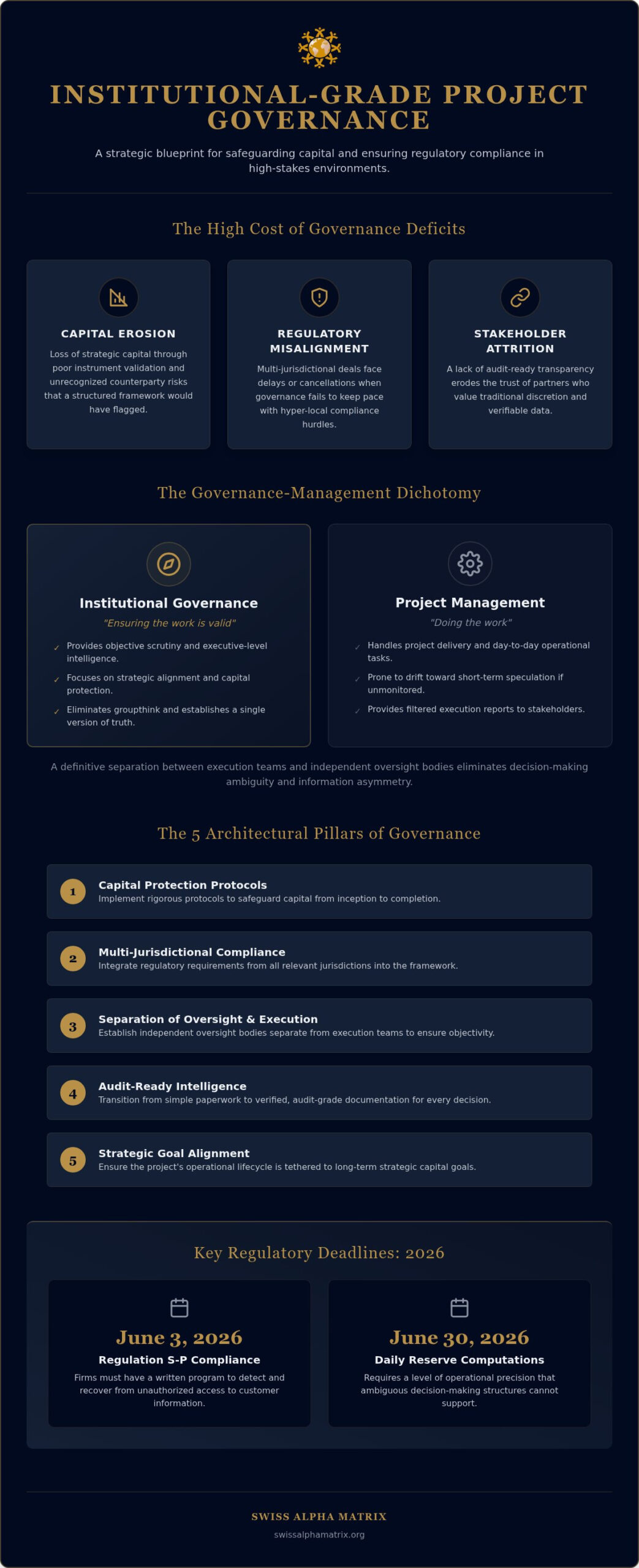
The failure to implement a robust project governance framework typically manifests as a series of expensive, avoidable crises that jeopardize long-term preservation. As we approach the June 3, 2026, deadline for Regulation S-P compliance, firms without a written program to detect and recover from unauthorized access to customer information face significant exposure. Similarly, the move to daily reserve computations by June 30, 2026, requires a level of precision that ambiguous decision-making structures cannot support. These deficits often lead to specific institutional failures:
- Capital Erosion: Strategic capital is lost through poor instrument validation and unrecognized counterparty risks that a structured framework would have flagged.
- Regulatory Misalignment: Multi-jurisdictional deals face delays or cancellations when governance fails to keep pace with the hyper-local compliance hurdles of 2026.
- Stakeholder Attrition: A lack of audit-ready transparency erodes the trust of high-net-worth individuals and institutional partners who value traditional discretion.
Ultimately, poor governance transforms a promising project into a liability. Information asymmetry leaves the executive team blind to operational realities until it’s too late to intervene, whereas a structured oversight model ensures that every decision is audit-ready and aligned with broader capital goals.
The Architectural Pillars of Institutional-Grade Governance
An institutional-grade project governance framework is built upon the dual foundations of capital protection and unwavering regulatory compliance. It moves beyond the administrative simplicity often found in a government project governance framework, which serves public sector needs, to address the hyper-specific risks of Tier-1 financial environments. This architecture demands audit-grade documentation at every level, ensuring that every movement of capital is backed by a verifiable trail. This level of meticulous record-keeping is essential to meet the stringent daily reserve computation requirements that become effective June 30, 2026.
The core of this structure involves the seamless integration of institutional-grade financial advisory methodologies into the governance core. These methodologies provide the analytical depth required to validate cross-border instruments and counterparty claims before they enter the execution phase. Authority is maintained through a strictly defined hierarchy. A Steering Committee provides strategic direction and capital allocation, while the Project Board handles operational oversight. This separation prevents the concentration of power and ensures independent checks and balances are not just conceptual, but functional.
Roles, Responsibilities, and the RACI Matrix
Crafting a RACI matrix for high-stakes mandates requires more than just assigning tasks; it defines senior executive accountability with surgical precision. The Project Sponsor isn’t a figurehead but the ultimate arbiter of capital preservation, responsible for ensuring that project goals remain tethered to the organization’s long-term stability. Clear boundaries between advisory, legal, and execution roles are established to prevent the conflicts of interest that frequently lead to project failure. This clarity ensures that every stakeholder understands their specific contribution to the mandate’s integrity and the preservation of institutional trust.
Risk Mitigation and Issue Management
Risk management in this context transcends digital spreadsheets and theoretical models. It incorporates on-ground verification to confirm the physical and legal existence of assets, providing a layer of security that remote due diligence cannot match. When discrepancies in financial instruments arise, escalation protocols must mirror Tier-1 banking standards, ensuring that issues reach the C-suite with the speed and clarity required for decisive action. Maintaining a risk register to these standards is a prerequisite for audit readiness. If your current structure lacks this depth, engaging an independent oversight body can provide the necessary layer of protection.
Decision-Making vs. Execution: The Governance-Management Dichotomy
The distinction between execution and oversight is often blurred in the haste of transaction cycles, yet this boundary is where institutional stability is either forged or lost. While project management focuses on the tactical momentum of “doing the work,” a project governance framework serves the superior function of “ensuring the work is valid.” This dichotomy is essential for the C-suite. They must recognize that momentum without independent validation is merely a path to accelerated risk. By introducing a structured layer of oversight, an organization creates the necessary friction to prevent impulsive capital deployment, ensuring that the allure of a rapid closing does not bypass the rigorous scrutiny required for long-term preservation.
Research into an academic framework for project governance suggests that formalizing these boundaries reduces the likelihood of “groupthink,” a psychological phenomenon that often plagues internal execution teams during high-pressure transactions. Independent oversight acts as a corrective lens; it challenges assumptions and verifies instrument legitimacy before capital is committed. Balancing speed with absolute precision isn’t a compromise but a deliberate strategic choice. It’s the difference between a project that merely finishes and one that truly succeeds under the scrutiny of an audit.
The Governance Repository: Ensuring Audit Readiness
Establishing a centralized repository for governance intelligence is critical for maintaining audit readiness. This goes beyond simple status updates. It requires the systematic documentation of on-ground verification and instrument validation results within the project governance framework. Managing the information flow between project teams and executive oversight ensures that those with fiduciary responsibility are never operating under information asymmetry. Audit-grade reporting must be the standard, providing a clear, immutable record of how risks were identified and mitigated at each stage of the transaction. This transparency is what separates seasoned experts from passive participants.
Performance Metrics for Capital Protection
Standard KPIs like “on time” or “on budget” are insufficient for institutional-grade projects. Instead, success must be measured through risk-adjusted metrics that prioritize deal integrity and regulatory compliance. Milestones should be designed not just as progress markers, but as triggers for independent validation phases. This ensures that the governance structure remains active throughout the lifecycle, confirming that each step forward is taken on a foundation of verified facts rather than unexamined projections. By focusing on these high-level standards, the organization reinforces its commitment to moral character and professional competence.
Implementing a Governance Framework for Cross-Border Transactions
Implementing a project governance framework within the context of cross-border transactions necessitates a shift from standard administrative procedures toward a model of executive-level intelligence. The process begins with the surgical alignment of the framework to multi-jurisdictional regulatory requirements, ensuring that the oversight mechanism is as robust in London as it is in Geneva or Hong Kong. Following this alignment, the establishment of independent validation protocols for all financial instruments serves as a critical filter. These protocols ensure that every instrument is vetted against Tier-1 banking standards before it’s integrated into the transaction’s financial structure.
The third phase involves defining rigorous on-ground verification requirements for cross-border assets, providing a physical layer of security that digital due diligence cannot replicate. This is reinforced by a communication protocol designed to uphold Swiss-grade discretion, ensuring that sensitive information is managed with the traditional privacy expected by high-end private wealth management. To conclude the implementation, a pre-deal audit of the governance structure is conducted. This final check identifies potential blind spots, ensuring the project governance framework is prepared to protect capital from the moment of deployment.
Navigating Cross-Border Regulatory Nuance
Harmonizing governance across divergent jurisdictions like London and Hong Kong requires a deep understanding of hyper-local compliance hurdles. It’s imperative that cross-border investment due diligence functions as a central governance requirement rather than a peripheral task. This integration ensures that AML protocols and Form PF compliance are managed natively within the project lifecycle, mitigating the risk of regulatory sanctions that could compromise institutional standing. By embedding these requirements into the core oversight mechanism, firms avoid the friction that often derails complex international mandates.
Stakeholder Management in Complex Deals
Identifying “hidden” stakeholders, such as secondary creditors or regional regulatory bodies, is vital for maintaining the stability of international financial programs. The governance structure must balance the competing interests of institutional investors, Tier-1 banks, and local authorities without losing sight of the primary strategic objective. Independent advisors provide the necessary distance to mediate stakeholder conflicts, ensuring that decision-making remains logical and unemotional. If your firm requires this level of dedicated partnership, you should consider securing Swiss Alpha Matrix for complex project management to ensure every transaction is audit-ready and strategically aligned.
The Swiss Alpha Matrix Approach: Precision in Project Oversight
The Swiss Alpha Matrix approach represents a synthesis of rigorous financial discipline and the quiet authority inherent in Swiss discretion. By deploying a bespoke project governance framework, we ensure that oversight is never a passive administrative exercise but a proactive shield for institutional capital. Our methodology is led by former senior executives from Tier-1 global banks; these are individuals who possess the technical depth to provide audit-grade intelligence that standard project management offices cannot replicate. We recognize that in the volatile landscape of 2026, the primary objective of governance must remain capital protection rather than the mere completion of tasks. Precision remains our cornerstone.
Central to our oversight model is the seamless integration of bank instrument validation services into every mandate we manage. This ensures that every letter of credit, bank guarantee, or sovereign bond involved in a transaction is subjected to exhaustive scrutiny before it’s permitted to influence the project’s financial trajectory. This commitment to technical accuracy distinguishes our approach from more conventional models. We prioritize the absolute legitimacy of every asset over the speed of execution, ensuring that interests are in the hands of seasoned, unemotional experts who prioritize long-term preservation.
Bespoke Frameworks for Complex Mandates
We reject the “one-size-fits-all” governance models favored by larger, more commoditized firms, opting instead for mandate-specific oversight architectures. Each project governance framework we design is the result of a deep-dive investigation into the specific jurisdictional, counterparty, and regulatory risks of the deal. This process allows us to generate executive-level intelligence, providing C-suite stakeholders with the clarity required for precise capital deployment in environments where information asymmetry is the norm. Our frameworks are built to handle the multi-layered nature of the industry, ensuring that technical accuracy is never sacrificed for the sake of simplicity.
A Commitment to Exclusivity and Precision
The role of Swiss discretion in high-stakes project management cannot be overstated. It’s the anchor of trust for high-net-worth individuals and institutional entities alike. This commitment to privacy and moral character ensures that your interests are managed by a partner that values traditional reliability and regional precision. Institutional investors trust our independent oversight because it’s rooted in a performance-oriented mindset, offering a standard of service that is both broad in reach and meticulous in its attention to detail. To secure the integrity of your next cross-border deal, we invite you to consult with our senior executives at Swiss Alpha Matrix and experience the definitive standard in financial oversight.
Strategic Fortification through Institutional Oversight
Implementing a robust project governance framework is the definitive step toward securing institutional interests in an era defined by heightened regulatory scrutiny and increasing financial complexity. By establishing a clear dichotomy between tactical execution and independent oversight, organizations effectively eliminate the information asymmetry that so often leads to avoidable capital erosion. This architectural approach ensures that every financial instrument is validated to an audit-grade standard, maintaining the strategic alignment necessary for multi-jurisdictional success while ensuring all decisions are permanently audit-ready.
The transition from administrative paperwork to executive-level intelligence remains the hallmark of elite project management. With leadership provided by former Tier-1 bank executives, our methodology offers the Swiss discretion and technical precision required to navigate the most intricate global mandates through rigorous on-ground verification. You’re invited to Ensure Capital Protection with Swiss-Grade Project Governance and establish a standard of excellence that preserves both wealth and institutional reputation. Trust in a partner that prioritizes stability, technical accuracy, and the traditional values of high-end private wealth management to guide your next complex transaction with unwavering calm.
Frequently Asked Questions
What is the difference between project governance and project management?
Project management focuses on the tactical execution and delivery of specific outputs, whereas a project governance framework provides the overarching oversight architecture that validates those outputs. While management is concerned with meeting deadlines and budgets, governance ensures that all actions align with the organization’s strategic capital goals and fiduciary responsibilities. It acts as a protective layer, ensuring that the execution team’s momentum doesn’t bypass critical risk mitigation protocols or compromise deal integrity.
How does a project governance framework protect against cross-border fraud?
A robust framework mitigates cross-border fraud by mandating independent validation protocols and on-ground verification of physical assets. It eliminates the information asymmetry that often exists in international transactions, where execution teams might overlook jurisdictional risks. By requiring audit-grade documentation and secondary verification of all financial instruments, the framework ensures that counterfeit or misrepresented assets are identified before capital is deployed, thereby protecting the institution’s long-term preservation and strategic growth.
Why is a RACI matrix essential for institutional-grade governance?
The RACI matrix is indispensable for institutional-grade governance because it defines senior executive accountability with surgical precision, preventing the ambiguity that leads to decision-making failures. In complex financial mandates, it’s vital to distinguish between who is responsible for execution and who is ultimately accountable for the mandate’s integrity. This clarity ensures that stakeholders understand their specific roles, facilitating a structured escalation process that mirrors the traditional discretion and reliability of Tier-1 banking standards.
How do you align project governance with international financial regulations?
Alignment is achieved by embedding hyper-local compliance requirements, such as the 2026 Regulation S-P amendments, directly into the governance architecture. This involves harmonizing oversight across diverse jurisdictions, including London, Geneva, and Hong Kong, to ensure that every transaction phase meets specific legal hurdles. A robust framework treats regulatory compliance not as an external check but as a core operational pillar, ensuring that all project activities remain audit-ready and strategically secure.
What role does independent instrument validation play in a governance framework?
Independent instrument validation serves as a critical filter within the governance structure, confirming the legal and financial legitimacy of all trade instruments before transaction finality. It moves beyond simple paperwork checks, utilizing executive-level intelligence to identify sophisticated discrepancies that standard due diligence might miss. This validation is essential for maintaining capital protection, as it ensures that letters of credit or sovereign bonds are backed by verifiable assets and issued by legitimate counterparties.
Can a governance framework be tailored for small-scale institutional projects?
A project governance framework should always be mandate-specific, scaling its complexity to match the project’s risk profile while maintaining core oversight principles. Even in smaller institutional mandates, the need for clear accountability and risk mitigation remains paramount. Tailoring the framework involves focusing on the most critical strategic pillars, such as instrument validation or regulatory alignment, ensuring that the oversight mechanism remains efficient without sacrificing the technical accuracy required for capital protection.
How often should a project governance framework be audited during a transaction?
Audits should occur at every major milestone or whenever a significant shift in the project’s risk profile is identified. This steady, measured rhythm of oversight ensures that the governance structure remains active and logical throughout the transaction lifecycle. Frequent validation phases prevent the accumulation of unmanaged risks, providing executive stakeholders with a constant stream of audit-ready intelligence that confirms the project’s ongoing alignment with long-term strategic capital goals.
What are the key components of a Swiss-grade project governance repository?
A Swiss-grade repository includes audit-grade reporting, immutable records of on-ground verification, and comprehensive documentation of all instrument validation results. It functions as a single version of truth, characterized by meticulous attention to detail and a commitment to privacy. This repository ensures that all information flow between execution teams and the C-suite is transparent yet secure, reflecting the traditional discretion and regional precision that high-net-worth individuals and institutional entities demand.