

Relying solely on digital verification for cross-border capital deployment isn’t merely a tactical oversight; it’s an abdication of fiduciary responsibility in an era where sophisticated financial instruments are increasingly decoupled from their underlying physical reality. You likely recognize that the traditional, checklist-oriented approach to risk management no longer suffices when multi-jurisdictional complexities and nuanced regulatory shifts demand a forensic level of scrutiny. This guide provides the architectural blueprint for a robust operational due diligence framework, designed specifically to validate complex instruments and secure capital against the inherent opacity of international markets.
By moving beyond the limitations of desktop-only analysis, you’ll master a methodology that prioritizes on-ground verification and meticulous execution oversight. We’ll explore the strategic pillars of risk mitigation that transform due diligence from a passive administrative exercise into a proactive, defensible strategy for capital preservation. This exploration ensures your deployment decisions are supported by an audit-grade methodology that satisfies the most stringent regulatory expectations for 2026, offering the precision required for sophisticated institutional mandates.
Key Takeaways
- Identify the critical distinctions between standard financial audits and the forensic operational intelligence required to secure complex cross-border instruments in a shifting 2026 regulatory landscape.
- Establish a multi-layered operational due diligence framework that integrates governance evaluation with the rigorous, audit-grade validation of high-value financial assets.
- Recognize why on-ground verification and physical stakeholder vetting are essential to mitigating the risks that frequently compromise traditional, desktop-only due diligence processes.
- Execute a structured, phased approach to investigation that aligns deep-dive forensic analysis with the specific strategic objectives of your capital deployment mandate.
- Access the refined methodology of former Tier-1 bank executives who prioritize Swiss discretion and regional excellence to safeguard your institutional interests.
The Strategic Imperative of an Institutional Operational Due Diligence Framework
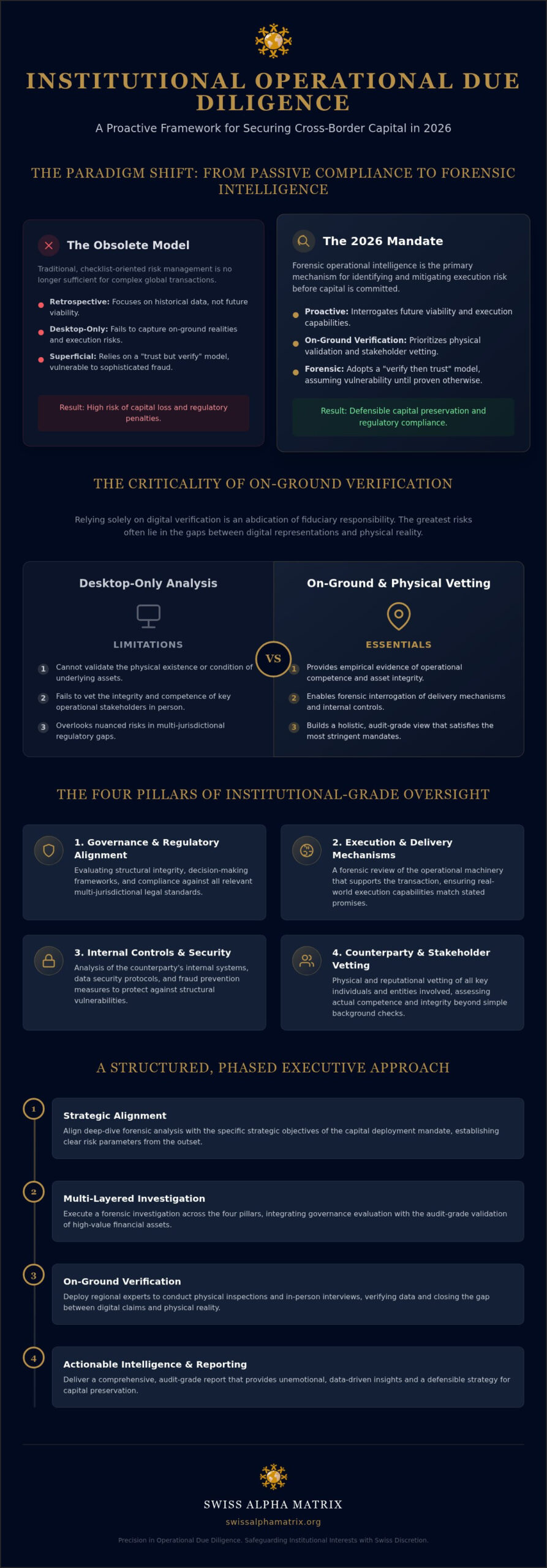
The institutional landscape of 2026 demands a paradigm shift from passive compliance to a model of forensic operational intelligence. While traditional financial audits remain a staple of the investment process, they are inherently retrospective, focusing on historical performance rather than the future viability of the execution environment. For complex cross-border transactions involving sophisticated instruments, a historical balance sheet offers little protection against the structural vulnerabilities of a counterparty’s delivery mechanisms. Establishing a rigorous operational due diligence framework is no longer an optional layer of security; it is the primary mechanism for identifying “execution risk” before capital is committed to high-stakes mandates.
Precision in capital deployment requires an unemotional interrogation of the operational machinery that supports an investment. When dealing with multi-jurisdictional deals, the risk often lies in the gaps between regulatory regimes and the internal controls of the entities involved. An institutional-grade framework serves as a master plan for risk mitigation, ensuring that every strategic pillar of a transaction is validated against real-world execution capabilities. This level of forensic depth is essential for long-term capital preservation, as it transforms the due diligence process from a bureaucratic hurdle into a strategic tool for safeguarding institutional interests against the unseen opacities of global markets.
The Evolution of Risk in Global Transactions
The proliferation of digital fraud and the increasing sophistication of synthetic financial instruments have fundamentally altered the risk profile of international capital deployment. In this environment, the traditional “trust but verify” model has become obsolete, replaced by a “verify then trust” mandate that assumes structural vulnerability until proven otherwise. Operational due diligence is the forensic interrogation of a counterparty’s execution capabilities and the structural integrity of their delivery mechanisms. This shift ensures that professionals don’t just rely on the prestige of a counterparty’s name but instead demand empirical evidence of their operational competence and regulatory alignment in an era of heightened global scrutiny.
ODD as a Component of Capital Protection
Effective risk management requires integrating these operational insights with cross-border investment due diligence to create a holistic view of the transaction’s health. The cost of an operational failure, which can lead to the total loss of capital or severe regulatory penalties, far outweighs the investment in sophisticated, institutional-grade advisory services. Executives often face internal objections suggesting that in-house teams can manage these reviews; however, internal departments frequently lack the specific forensic depth and on-ground presence required to vet complex instruments in foreign jurisdictions. Relying on generalist internal teams for specialized validation often results in an inadequate, desktop-only analysis that fails to capture the intricate nuances of cross-border execution risk.
The Four Pillars of Institutional-Grade Operational Oversight
Constructing a resilient operational due diligence framework requires a departure from superficial assessments, moving instead toward a multi-dimensional interrogation of four foundational pillars. Each pillar represents a critical failure point that, if left unexamined, could compromise the entirety of a cross-border mandate. For the sophisticated investor, these pillars provide a structured methodology to validate the internal machinery of a counterparty, ensuring that the operational reality aligns with the presented financial narrative. This structured approach moves beyond the limits of standard accounting to examine the actual execution environment where capital is at risk.
- Pillar 1: Governance and Regulatory Alignment. This involves evaluating the structural integrity of the counterparty, focusing on decision-making hierarchies and the transparency of their corporate architecture.
- Pillar 2: Financial Instrument Integrity. We prioritize the audit-grade validation of SBLCs, LCs, and other complex assets to ensure they are legally binding and sufficiently collateralized.
- Pillar 3: Infrastructure and Cybersecurity. This assessment ensures the technical environment is resilient to external shocks and that data integrity is maintained across all execution platforms.
- Pillar 4: Human Capital and Management Track Record. We vet the individuals behind the execution, moving beyond resumes to verify historical reliability and professional standing.
Validation of Financial Instruments and Entities
Within the modern operational due diligence framework, the integrity of the underlying assets is paramount. Many institutions fall into the trap of “paper-based verification,” which accepts documents at face value without interrogating their source or the authority of the signer. Our approach utilizes specialized bank instrument validation services to confirm the authenticity of high-value instruments through direct communication with issuing institutions. Identifying red flags, such as inconsistent SWIFT messaging formats or unverifiable issuing officers, is a core component of this forensic process. If you require a higher standard of certainty, you might consider how professional risk management frameworks can bridge these transparency gaps.
Structural and Regulatory Compliance Assessment
Navigating the labyrinth of international financial regulations requires more than a cursory check of a counterparty’s licenses. It involves mapping the entity against global standards to ensure that AML and KYC protocols aren’t just present on paper, but are actively enforced within their daily operations. It’s vital to verify regulatory standing in multiple jurisdictions simultaneously to uncover any discrepancies that might indicate jurisdictional arbitrage or hidden sanctions. This level of scrutiny ensures that your capital deployment remains compliant with both local mandates and global institutional standards, protecting your firm from secondary liability and reputational damage.
Physical vs. Digital Oversight: The Criticality of On-Ground Verification
The pervasive reliance on digital data rooms and remote compliance filters has created a dangerous sense of security that often crumbles when confronted with the realities of cross-border execution. While digital tools offer efficiency, they lack the sensory depth required to identify sophisticated fraud or the subtle operational misalignments that precede a total investment failure. Within any institutional operational due diligence framework, the transition from digital oversight to physical presence isn’t just a best practice; it’s a defensive necessity. The “desktop due diligence” model, while cost-effective in the short term, frequently overlooks the environmental and cultural cues that only a seasoned expert can detect during a face-to-face interrogation of the counterparty’s operational hub.
Independent oversight provides the unemotional perspective required to evaluate a transaction without the inherent bias of the deal-making team. By utilizing third-party validation, institutional investors ensure that the verification process remains objective, rigorous, and detached from the pressure of closing the mandate. This approach bridges the gap between the precision of Swiss-led planning and the often-chaotic reality of global execution, providing a layer of protection that digital-only systems simply cannot replicate. It’s this commitment to physical verification that distinguishes a master planner from a passive participant in the global capital markets.
The Limitations of Remote Due Diligence
Digital documentation, no matter how securely encrypted, remains susceptible to manipulation or the intentional omission of critical operational context. Remote filters might confirm that a document exists, but they can’t verify the physical existence of the assets it describes or the professional character of the individuals managing those assets. In mandates involving London, Geneva, or Hong Kong, the necessity of physical presence becomes even more acute. These financial hubs operate within intricate social and professional networks that require on-ground vetting to navigate effectively. Identifying cultural nuances and the actual “vibe” of an operation provides a level of intelligence that a data room’s spreadsheet will never capture.
Implementing On-Ground Verification Protocols
Establishing standard operating procedures for physical site visits is essential to maintaining the integrity of the investigative process. These protocols include face-to-face stakeholder vetting, physical asset inspections, and a thorough review of local internal controls that aren’t visible through a remote portal. Integrating these on-ground findings into the final financial advisory methodologies report ensures that executive stakeholders receive a comprehensive, audit-grade assessment of the risk environment. This methodology prioritizes empirical evidence over administrative assertions, creating a defensible record of diligence that satisfies both internal fiduciaries and external regulatory bodies.
Implementing the Framework: A Phased Executive Approach
Implementing a sophisticated operational due diligence framework requires a disciplined, four-phase methodology that moves methodically from abstract mandate objectives to concrete execution oversight. This structured approach ensures that no operational vulnerability is left unexamined, providing the master planner with a logical path toward risk mitigation in complex international markets. By adopting a phased execution, institutional entities can maintain a sense of professional calm, knowing that each strategic pillar is being validated by seasoned experts who prioritize long-term preservation over short-term speculation.
- Phase 1: Pre-Diligence and Scope Definition. This phase involves aligning the operational due diligence framework with the specific objectives of the mandate, ensuring the investigation is tailored to the unique jurisdictional and instrument-based risks of the deal.
- Phase 2: Deep-Dive Investigation. This is the execution of the four pillars across all relevant jurisdictions, utilizing on-ground verification to interrogate the counterparty’s structural integrity and financial instrument validity.
- Phase 3: Synthesis and Risk Grading. Here, the raw data is transformed into executive-level intelligence, providing a clear, defensible grading of the operational risks identified during the discovery process.
- Phase 4: Ongoing Monitoring and Milestone Validation. Recognizing that risk is dynamic, this phase leverages independent financial project management to ensure that the operational health of the project is maintained throughout its lifecycle.
From Data Collection to Strategic Intelligence
The transition from raw data discovery to executive-level decision support is characterized by a shift from quantitative collection to qualitative synthesis, providing the nuanced perspective required for high-stakes capital preservation. To maintain absolute precision during this transition, we utilize a RACI matrix to ensure that every stakeholder, from the forensic investigator to the senior fiduciary, has a clearly defined role and accountability within the validation process. This structured accountability prevents the dilution of critical findings and ensures that the final report serves as a robust, audit-grade document for strategic planning. If your organization requires this level of forensic depth, you can engage our senior-led risk management services to secure your next cross-border mandate.
Post-Transaction Monitoring and Oversight
The closing of a complex transaction represents not an end, but a transition into a phase of ongoing operational health monitoring, where retainer-based strategic consulting provides the necessary continuity of oversight. Establishing specific KPIs for operational performance allows for the early detection of deviations from the agreed-upon execution plan, protecting the investment from the gradual erosion of internal controls. Leveraging independent oversight ensures that long-term regulatory compliance is not just a goal, but a consistently validated reality, maintaining the high-level standards of service and regional excellence that sophisticated institutional entities demand.
Swiss Alpha Matrix: Precision in Operational Due Diligence
Swiss Alpha Matrix operates as a boutique entity characterized by a sense of quiet authority, where the traditionally discreet values of Swiss private wealth management are applied to the forensic demands of global capital protection. Our operational due diligence framework is not merely a standardized process; it’s a bespoke interrogation led by former senior executives from Tier-1 global banks who possess the seasoned intuition required to identify structural vulnerabilities that automated systems inevitably miss. This senior-led approach ensures that every mandate is treated with the intellectual depth and technical accuracy that sophisticated institutional entities expect when deploying capital in multi-jurisdictional environments. By prioritizing a master planner’s perspective, we transform the investigative process into a strategic asset that safeguards interests in the world’s most complex financial environments.
Our commitment to regional excellence and Swiss discretion serves as a recurring thematic anchor, distinguishing our performance-oriented mindset from the passive participants of the broader market. We recognize that in high-stakes transactions, the standard of service must be both broad in its global reach and meticulous in its attention to the smallest operational detail. This dedication to excellence ensures that capital is not only deployed with precision but is also protected by an audit-grade methodology that satisfies the most stringent fiduciary requirements. Partnering with us provides the reassurance that your interests are in the hands of unemotional experts who value historical reliability over short-term speculation.
The Value of Tier-1 Institutional Expertise
The value of having former senior executives at the helm of an investigation can’t be overstated, particularly when navigating the opaque layers of complex cross-border instruments. These professionals have spent decades within the very institutions that define global finance, allowing them to recognize institutional-level red flags that would appear benign to less experienced observers. Our approach to hyper-personalization ensures that the financial discipline of a Tier-1 bank is integrated with a performance-oriented mindset that views every transaction through the lens of long-term preservation. This level of expertise allows us to move beyond simple data collection, providing the nuanced executive-level decision support that is essential for complex financial project management.
Securing Your Next Global Mandate
Engaging with Swiss Alpha Matrix provides access to a standard of service that is both broad in reach and meticulous in its attention to detail, spanning the critical financial hubs of Geneva, London, and Hong Kong. Whether through project-based advisory for a specific transaction or a retainer-based consulting arrangement for ongoing oversight, our partners provide the master planning required to navigate today’s intricate regulatory landscape. We invite you to consult with our senior partners on your ODD framework to ensure your next global mandate is supported by the regional excellence and audit-grade validation that your capital deserves.
Securing the Future of Institutional Capital Deployment
As the complexities of the 2026 financial landscape continue to evolve, the distinction between passive compliance and forensic operational intelligence will define the success of institutional mandates. You’ve seen that a robust investigative architecture must move beyond the limitations of desktop-only analysis, prioritizing instead the physical verification of assets and the rigorous vetting of counterparties in their native jurisdictions. This structured approach ensures that execution risk isn’t merely acknowledged but is systematically mitigated through meticulous oversight and technical precision.
Led by former senior executives from Tier-1 global banks, our firm specializes in the high-stakes intricacies of cross-border project management and instrument validation. We provide the audit-grade reporting necessary to transform raw discovery into defensible, executive-level intelligence. We invite you to secure your capital with our institutional-grade operational due diligence framework, ensuring that every deployment decision is supported by elite expertise and a commitment to long-term preservation. Your pursuit of regional excellence and strategic growth deserves a partner who prioritizes the same standards of technical accuracy and Swiss discretion.
Frequently Asked Questions
What is the primary objective of an operational due diligence framework in 2026?
The primary objective of an operational due diligence framework in 2026 is the forensic interrogation of a counterparty’s execution environment to ensure that capital deployment is supported by robust, verifiable delivery mechanisms. This process moves beyond historical financial performance to identify structural vulnerabilities and execution risks that could compromise a mandate. By establishing this framework, institutional investors gain a defensible, audit-grade assessment that prioritizes long-term capital preservation over superficial administrative compliance.
How does operational due diligence differ from standard financial due diligence?
Operational due diligence focuses on the prospective viability of a counterparty’s internal machinery, whereas standard financial due diligence is primarily retrospective, examining historical balance sheets and profit and loss statements. While a financial audit confirms what has happened, the ODD process interrogates how a firm operates, evaluating governance, technical infrastructure, and human capital. This distinction is critical for identifying potential points of failure that historical data cannot predict in complex cross-border transactions.
Why is on-ground verification essential for cross-border investment due diligence?
On-ground verification is essential because digital data rooms often mask the physical reality of assets and the professional character of stakeholders in foreign jurisdictions. Physical presence allows for the identification of cultural nuances and operational inconsistencies that remote filters inevitably miss, providing a layer of security against sophisticated document manipulation. In hubs like London, Geneva, and Hong Kong, direct interaction is the only reliable method for validating the structural integrity of a counterparty.
What are the key red flags in financial instrument validation?
Key red flags in financial instrument validation include inconsistent SWIFT messaging formats, the presence of unverifiable issuing officers, and documentation originating from jurisdictions known for opaque regulatory standards. Instruments that lack direct, bank-to-bank verification protocols or exhibit unusual collateralization structures often indicate underlying structural weakness. Identifying these anomalies requires a forensic depth that standard compliance checks lack, ensuring that high-value assets like SBLCs are legally binding and sufficiently backed.
Can operational due diligence be conducted remotely for international deals?
While certain administrative elements can be reviewed through digital portals, a comprehensive operational due diligence framework cannot be executed purely through remote means without introducing significant execution risk. Remote analysis fails to capture the environmental and behavioral cues that are only apparent during physical site visits and face-to-face stakeholder vetting. Relying exclusively on desktop due diligence leaves an institution vulnerable to sophisticated fraud that digital compliance filters are not designed to detect.
How long does a comprehensive institutional-grade ODD process typically take?
The duration of a comprehensive institutional-grade ODD process typically varies based on the complexity of the mandate and the jurisdictions involved, often spanning several weeks to months. This measured pace is necessary to conduct deep-dive investigations into governance, infrastructure, and instrument validity while ensuring all on-ground findings are meticulously validated. Rushing this forensic interrogation compromises the technical accuracy required for audit-grade reporting, undermining the very stability the framework is designed to provide.
What role does regulatory compliance play in the ODD framework?
Regulatory compliance serves as a foundational pillar within the ODD framework, requiring the mapping of a counterparty’s operations against both local mandates and international standards. This process involves a forensic evaluation of AML and KYC protocols to ensure they are actively enforced rather than merely existing on paper. Verifying regulatory standing across multiple jurisdictions simultaneously is vital for uncovering jurisdictional arbitrage and ensuring that capital deployment remains compliant with shifting 2026 global requirements.
How does Swiss Alpha Matrix ensure discretion during high-stakes investigations?
Swiss Alpha Matrix ensures discretion by adhering to the traditional standards of high-end private wealth management, where privacy and exclusivity are prioritized above all else. Our investigations are led by former senior executives from Tier-1 global banks who handle all communications directly, avoiding the use of junior staff or broad-scale administrative teams. This boutique approach allows for meticulous attention to detail while maintaining the quiet authority and professional calm necessary for sensitive, multi-jurisdictional mandates.