

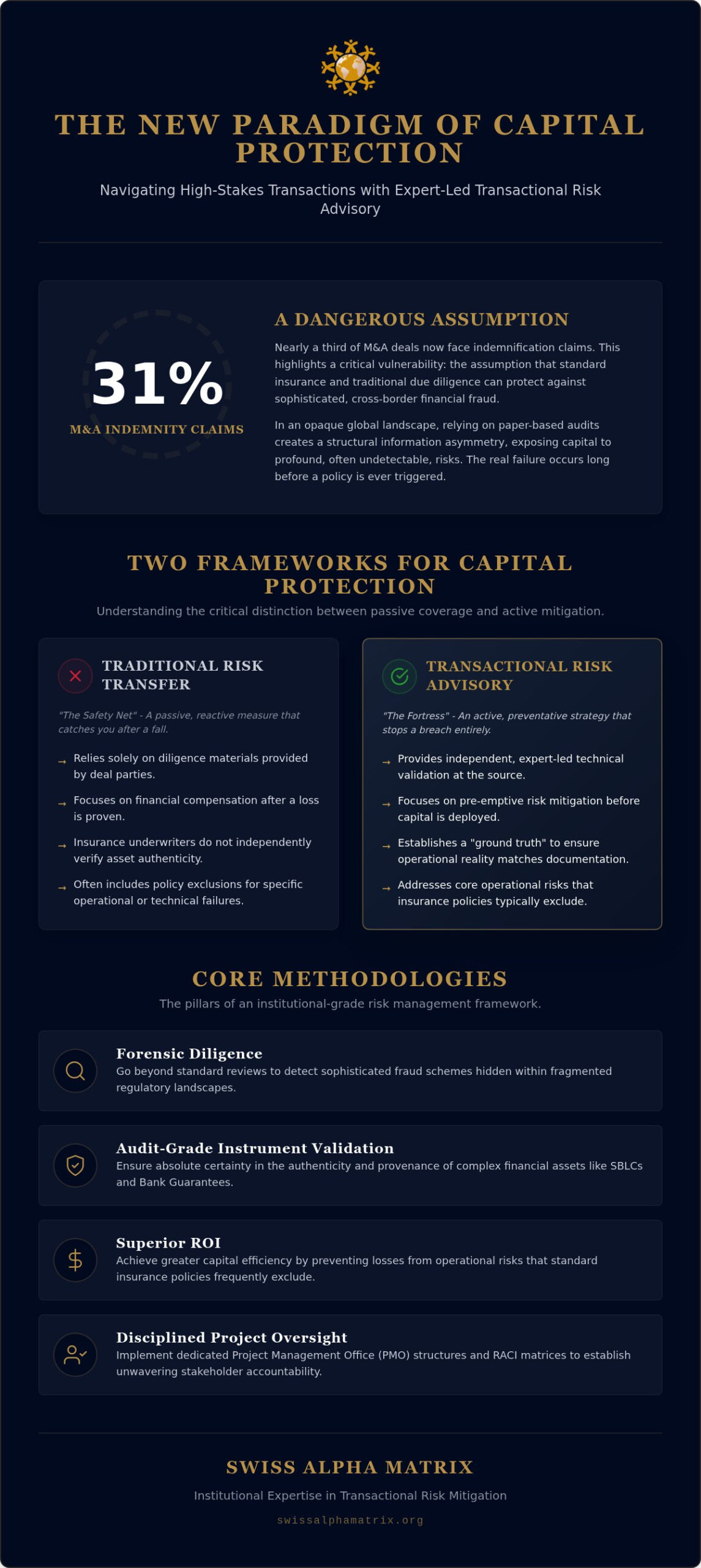
While approximately 31% of M&A transactions now face an indemnification claim, the most profound failures of capital protection often occur long before a policy is triggered. In the increasingly opaque corridors of international finance, the assumption that a standard insurance wrapper compensates for structural information asymmetry is a dangerous fallacy. You recognize that the security of a complex cross-border deal depends entirely on the verifiable authenticity of the financial instruments involved. When operating within jurisdictions characterized by significant regulatory friction, the difference between a successful closing and a total loss often resides in the depth of your transactional risk advisory.
We agree that relying solely on traditional due diligence is no longer sufficient when confronting sophisticated fraud or non-verifiable bank instruments. This framework empowers you to master the institutional-grade strategies required to validate complex assets and mitigate cross-border exposure through rigorous, expert-led oversight. We shall explore the transition from bank-led validation to independent, on-ground verification; this provides a clear roadmap for project execution that ensures your capital remains protected by audit-grade documentation and a standard of regional precision that distinguishes performance-oriented leaders from passive participants.
Key Takeaways
- Understand why traditional legal and accounting reviews often fail to detect sophisticated cross-border fraud within a fragmented global regulatory landscape.
- Learn the critical necessity of audit-grade instrument validation to ensure absolute certainty in the authenticity and provenance of complex financial assets.
- Discover how specialized transactional risk advisory provides a superior ROI compared to standard insurance policies by addressing operational risks that policy exclusions frequently target.
- Master the implementation of a dedicated Project Management Office (PMO) and RACI matrices to establish clear stakeholder accountability throughout high-value transactions.
- Leverage the methodologies of former Tier-1 bank executives to merge institutional financial discipline with the discretion required for elite capital protection.
Defining Transactional Risk Advisory: Beyond Representations and Warranties
The traditional paradigms of capital protection are undergoing a profound transformation as the global regulatory environment becomes increasingly fragmented. In this context, transactional risk advisory has emerged as a critical discipline that transcends the mere acquisition of insurance policies. While standard legal and accounting due diligence remains a foundational requirement, it often lacks the forensic depth necessary to detect sophisticated instrument fraud that bypasses conventional paper-based audits. The modern landscape demands a shift from passive risk transfer toward active, technical risk mitigation. This ensures that every financial instrument is validated at its source before capital is deployed, reflecting a commitment to long-term preservation over short-term speculation.
The independent advisor remains a steady, unemotional presence amidst the frantic energy of high-stakes negotiations. Their role isn’t merely to facilitate a closing but to serve as a protective authority that prioritizes the structural integrity of the transaction. By providing a layer of oversight that is both technically precise and strategically broad, they bridge the gap between institutional financial discipline and the specific nuances of cross-border execution. It’s a standard of service that values historical reliability, ensuring that stakeholders aren’t just participants in a deal, but masters of their own capital exposure.
The Scope of Modern Transactional Risk
Identifying hidden risks in cross-border investment requires an appreciation for the nuances of local jurisdictions and the varying standards of institutional conduct. Geopolitical volatility in 2026 has introduced layers of complexity that standard risk models fail to capture, making it difficult to ascertain the true provenance of assets. Institutional investors are increasingly moving toward independent project oversight to navigate these uncertainties. This transition reflects a desire for hyper-personalized intelligence that goes beyond the surface level. It’s about establishing a ground truth through on-ground verification, ensuring that the operational reality of a project matches the documentation presented in the data room.
Advisory vs. Insurance: A Strategic Distinction
Representations and Warranties Insurance (RWI) serves a specific purpose in the deal architecture, yet its limitations become starkly evident when operational or technical failures occur. Underwriters often rely on the quality of the diligence materials provided; they don’t necessarily verify the underlying authenticity of the instruments themselves. Advisory services provide the technical validation that informs a robust financial risk management strategy. By integrating these insights into the broader international financial regulations framework, stakeholders gain a level of certainty that insurance alone cannot provide. It’s the difference between a safety net that catches you after a fall and a fortress that prevents the breach entirely.
The Architecture of Technical Due Diligence: Validating Financial Instruments
The architecture of capital protection rests upon the rigorous validation of the underlying assets, a process that extends far beyond the cursory review of digital documentation. While many firms prioritize algorithmic risk assessments, the true essence of transactional risk advisory lies in the technical verification of financial instruments at their source. This is particularly vital when dealing with high-value vehicles such as Standby Letters of Credit (SBLC) or bank guarantees, where the complexity of the instrument often masks structural weaknesses or outright forgeries. By employing bank instrument validation services, stakeholders ensure that the provenance of their collateral is beyond reproach, bridging the information gap that frequently plagues transactions in emerging markets.
Effective Managing Transactional Risk In M&A Deals requires an admission that paperwork, regardless of its apparent authenticity, is merely a representation of value rather than the value itself. Audit-grade validation moves past this surface level, seeking institutional confirmation that the issuing entity possesses both the capacity and the intent to honor the obligation. This level of scrutiny is indispensable for those who prioritize long-term stability over the transient allure of high-velocity deal-making. For executives seeking this level of certainty, engaging with specialized risk consultants provides the necessary institutional depth and peace of mind.
Audit-Grade Instrument Validation Protocols
The methodology employed by former Tier-1 bank executives involves a direct institutional inquiry that bypasses traditional intermediaries. This approach is designed to detect sophisticated forgeries that often elude standard digital verification tools, focusing instead on the specific protocols and security features unique to global financial institutions. A historical reliance on paperwork has frequently led to catastrophic failures in complex project management; therefore, our protocols demand a secondary layer of verification that confirms the instrument’s status on the bank’s ledger. It’s a meticulous process that reflects a refusal to oversimplify the intricate dynamics of modern finance.
On-Ground Verification: The Ultimate Risk Shield
Physical verification of entities and assets serves as the final, most robust layer of a comprehensive risk management framework. In an era where digital signatures can be manipulated, the presence of an expert on the ground provides a level of assurance that no remote audit can replicate. This practice, anchored in Swiss discretion and a global reach, allows for the sensitive inquiry of stakeholders and the direct inspection of physical assets. By establishing a clear chain of trust, investors can navigate cross-border investment programmes with the confidence that their interests are protected by seasoned experts who value regional precision and absolute technical accuracy.
Strategic Risk Transfer vs. Operational Oversight: A Comparison
The decision to deploy capital in complex, cross-border environments often necessitates a strategic choice between the broad protection of insurance and the precise intervention of a dedicated advisor. While many entities prioritize the acquisition of transactional risk insurance to facilitate clean exits and manage post-closing liabilities, this approach primarily serves as a post-event recovery tool. It doesn’t prevent the structural failures that lead to claims. In contrast, transactional risk advisory focuses on pre-event prevention, identifying the operational and technical fissures that insurance underwriters frequently exclude from their coverage. By prioritizing high-level oversight, sophisticated investors can achieve a superior ROI, as the cost of independent validation is often offset by reduced premiums and the avoidance of catastrophic deal failure.
The Master Planner role in these transactions requires a level of Tier-1 expertise that merges financial discipline with a refusal to oversimplify complex dynamics. This proactive stance significantly enhances underwriting appetite; insurers are more likely to offer favorable terms when they’re presented with a dossier of audit-grade diligence. Financial advisory methodologies stabilize volatile transactions by replacing speculative assumptions with verifiable institutional data. This synergy between project management and deal integrity ensures that interests remain in the hands of seasoned, unemotional experts who value long-term preservation over short-term speculation.
Comparing Risk Mitigation Strategies
Insurance functions as a financial safety net, yet it remains fundamentally reactive. It addresses the financial impact of a breach but leaves the operational disruption untouched. Advisory services, conversely, act as a protective authority, scrutinizing the “ground truth” of a transaction before capital is committed. This distinction is critical in 2026, where approximately 20% of R&W policies generate notifications, yet only 4% lead to a successful payment. Relying on a recovery tool that fails to pay out in the vast majority of cases isn’t a strategy; it’s a gamble. A dedicated advisor ensures that the technical integrity of the deal is established from the outset, minimizing the likelihood that a claim will ever need to be filed.
Exposing the Gaps in Standard Diligence
Standard M&A checklists are often designed for domestic transactions and fail to account for the jurisdictional friction inherent in cross-border programs. They frequently overlook the operational reality of counterparties, focusing instead on legal validity that may not reflect actual capacity. Institutional-grade intelligence identifies these gaps by examining:
- Counterparty Operational Risk: Determining if the entity has the physical infrastructure and personnel to fulfill its obligations.
- Instrument Authenticity: Moving beyond digital copies to verify the existence of assets on the issuing bank’s ledger.
- Regulatory Alignment: Ensuring the transaction structure complies with local mandates that standard legal reviews might miss.
By leveraging this level of detail, executive-level decision makers gain the absolute certainty required to navigate the intricate nature of modern finance with confidence and poise.
Implementing a Robust Transactional Risk Management Framework
The successful execution of high-value, cross-border programs necessitates a transition from passive due diligence to an active, structured framework of oversight. Establishing a dedicated Project Management Office (PMO) ensures that the intricate nature of the transaction is managed with the precision of a master planner, rather than left to the fragmented efforts of disparate teams. Within this framework, the utilization of a RACI matrix-defining who is Responsible, Accountable, Consulted, and Informed-provides the clarity of stakeholder accountability required to mitigate information asymmetry. It’s a structured approach that moves beyond the surface level, creating an environment where transactional risk advisory serves as the central nervous system of the deal architecture.
Central to this methodology is the phase-gate approach to capital deployment, a strategy that mandates absolute validation before any execution occurs. By defining clear milestones for risk-adjusted capital release, stakeholders maintain control over their exposure throughout the lifecycle of the project. This prevents the premature commitment of funds to instruments or entities that haven’t yet met the rigorous standards of institutional-grade verification. For those seeking to secure their interests against operational failures, consulting with seasoned risk management experts ensures that every phase of the transaction is anchored in technical accuracy and regional precision.
Structuring the Risk Oversight Team
The strategic architecture of independent financial project management remains essential for maintaining deal neutrality, particularly when navigating the mandates of international jurisdictions. An effective oversight team integrates technical advisors, often former Tier-1 bank executives, directly with legal and financial counsel. This integration ensures that the operational reality discussed in previous sections is reflected in the legal drafting and financial modeling. By establishing these multi-disciplinary silos under a single PMO, the firm provides a standard of service that’s both broad in reach and meticulous in its attention to detail.
The Validation Lifecycle
A robust lifecycle begins with initial counterparty vetting and regulatory compliance advisory, identifying potential friction points in anti-money laundering (AML) or Know Your Customer (KYC) protocols. This is followed by a deep-dive technical validation of all financial instruments involved, moving past digital copies to confirm institutional provenance on the issuing bank’s ledger. The lifecycle concludes with the delivery of an audit-grade executive intelligence report, providing the board-level approval required for significant capital deployment. This transition from transactional oversight to continuous, retainer-based monitoring ensures that risk mitigation remains a constant priority, shielding the project from the inherent volatility of the global market.
Swiss Alpha Matrix: Institutional Expertise in Transactional Risk Mitigation
Swiss Alpha Matrix operates at the intersection of institutional financial discipline and the refined discretion typically reserved for high-end private wealth management. As an entity led by former senior executives from Tier-1 global banks, our pedigree ensures that every engagement is underpinned by a profound understanding of the internal mechanics that govern high-value capital movements. This background allows us to provide a level of transactional risk advisory that is both forensic in its technical depth and strategic in its breadth of vision. We don’t merely participate in the market; we serve as dedicated partners to institutional entities and high-net-worth individuals who value the preservation of capital above speculative gain.
Our commitment to audit-grade precision is reflected in the meticulous nature of our reporting, providing executive stakeholders with the absolute certainty required to authorize complex capital deployment. By merging the historical reliability of traditional financial oversight with modern, on-ground verification strategies, we bridge the gap between the digital representation of assets and their operational reality. This approach distinguishes a performance-oriented mindset from passive participation, ensuring that interests remain protected by seasoned experts who prioritize regional precision and long-term strategic growth. It’s this quiet authority that positions us as the master planner for your most complex cross-border arrangements.
The Tier-1 Advantage
The efficacy of our validation protocols is rooted in a network of global institutional contacts that allows for rapid, direct verification of complex financial instruments. Former senior bank executives possess a unique perspective, having spent decades inside the very institutions that issue the instruments we validate. This insider’s understanding is what enables us to provide executive-level intelligence that standard advisory firms simply cannot replicate. It’s a standard of service that recognizes the intricate nature of the industry and refuses to oversimplify the dynamics at play in high-stakes negotiations. Our on-ground presence provides a unique advantage, allowing us to verify the “ground truth” where others rely on digital data rooms.
Engaging Swiss Alpha Matrix
We offer project-based mandates for deep-dive due diligence, providing a structured argument for the methodology that leads to professional calm and confidence in the decision-making process. For ongoing project oversight, our strategic retainer-based consulting provides a continuous layer of protection, transitioning from initial validation to sustained operational monitoring. We invite you to contact our senior partners for a confidential consultation on your next transaction. Here, you can experience a standard of service that’s broad in reach yet meticulous in its attention to detail, ensuring your interests are in the hands of seasoned, unemotional experts.
Securing the Future of Global Capital Deployment
The evolution of global finance in 2026 demands a departure from reactive risk transfer toward a proactive, technically rigorous methodology. We’ve explored how technical due diligence and the implementation of a structured PMO bridge the information gaps that frequently undermine cross-border transactions. It’s clear that the structural integrity of your capital depends on moving beyond simple paper reviews toward institutional-grade verification. By establishing a robust transactional risk advisory framework, you ensure that every financial instrument is validated at its source, bridging the gap between digital representations and operational reality.
Our firm, managed by former senior executives from Tier-1 global banks, specializes in audit-grade financial instrument validation with a global reach that mirrors the traditional excellence of Swiss oversight. We invite you to secure your capital with institutional-grade transactional risk advisory from Swiss Alpha Matrix. You can move forward with the confidence that your strategic growth is anchored in historical reliability and meticulous attention to detail.
Frequently Asked Questions
What is the primary difference between transactional risk advisory and legal due diligence?
Transactional risk advisory focuses on the technical and operational validation of assets, whereas legal due diligence primarily addresses contractual obligations and regulatory standing. While a lawyer ensures the agreement is enforceable, our advisory services confirm that the underlying financial instrument actually exists and possesses the value claimed. This distinction is critical in avoiding sophisticated fraud that legal frameworks alone aren’t designed to detect or mitigate.
How do you verify the authenticity of a Standby Letter of Credit (SBLC)?
Authenticity is verified through a direct institutional inquiry that bypasses intermediaries to confirm the instrument’s presence on the issuing bank’s ledger. We scrutinize the specific security features and communication protocols unique to Tier-1 global institutions. This audit-grade validation ensures that the Standby Letter of Credit isn’t merely a digital forgery but a legitimate obligation backed by the true capacity of the issuing entity.
When should a firm engage an independent transactional risk advisor in the M&A process?
A firm should engage an independent advisor during the initial vetting phase, ideally before the Letter of Intent is finalized. Early intervention allows for the establishment of a risk management framework that informs the entire negotiation process. By identifying structural weaknesses before capital is committed, stakeholders maintain a position of intellectual superiority and can walk away from flawed arrangements before incurring significant costs or reputational damage.
Can transactional risk advisory reduce the cost of R&W insurance?
Yes, comprehensive transactional risk advisory can significantly reduce R&W insurance premiums by providing underwriters with a superior dossier of technical diligence. When insurers see that instruments have been validated by former Tier-1 bank executives, their perceived risk decreases. This often leads to more favorable terms, higher limits, and a reduction in policy exclusions that typically target unverified operational areas or complex jurisdictional risks.
What are the common red flags in cross-border financial instruments in 2026?
Common red flags include inconsistent SWIFT communication protocols and the use of offshore entities with non-verifiable balance sheets. In 2026, sophisticated digital anomalies in documentation often signal forgeries that standard scans miss. We also monitor for jurisdictional friction, where local mandates conflict with international standards, suggesting an underlying attempt to obscure the true provenance of the capital or the instrument’s legitimacy on the global stage.
How does Swiss Alpha Matrix conduct on-ground verification in restricted jurisdictions?
We utilize a global network of seasoned experts to conduct physical inspections and sensitive inquiries with local stakeholders while maintaining Swiss discretion. This on-ground presence allows us to verify the existence of physical assets and the operational capacity of entities in regions where digital data is unreliable. It’s a standard of service that values regional precision, ensuring that the ground truth matches the documentation presented.
What is the role of a PMO in complex financial project management?
The Project Management Office (PMO) serves as the central nervous system of the deal, providing structured oversight through RACI matrices and phase-gate deployment. It ensures that every stakeholder remains accountable and that no capital is released until specific validation milestones are met. This disciplined approach prevents the fragmented communication that often leads to operational failure in high-value, cross-border financial programs involving multiple international jurisdictions.
How does independent oversight protect capital in high-stakes investment programs?
Independent oversight protects capital by providing an unemotional, expert assessment of the transaction’s structural integrity. By removing the bias often present in deal-driven teams, our advisors identify potential failures before they manifest as financial losses. This protective authority ensures that the long-term preservation of capital remains the primary objective, shielding the investment from the inherent volatility of speculative market movements and sophisticated international fraud.