

Why do multi-billion dollar cross-border acquisitions, despite exhaustive legal oversight, frequently succumb to the silent erosion caused by undisclosed liabilities or sophisticated instrument fraud? It’s an unsettling reality that many institutional leaders face when traditional checklists fail to penetrate the opaque layers of foreign jurisdictions. You’re likely aware that the conventional m&a due diligence process has become increasingly performative, often favoring administrative speed over the forensic rigor necessary for genuine capital protection.
This guide establishes a sophisticated framework for the m&a due diligence process tailored for 2026, offering the Tier-1 institutional expertise required to transition from passive document review to active, on-ground verification. We’ll examine the architecture of audit-grade validation and independent oversight, ensuring your strategic growth is anchored in technical accuracy rather than optimistic speculation. By adopting these master-planner methodologies, you can eliminate information asymmetry and ensure that every financial instrument within the target entity is validated with the clinical precision that high-level mandates demand.
Key Takeaways
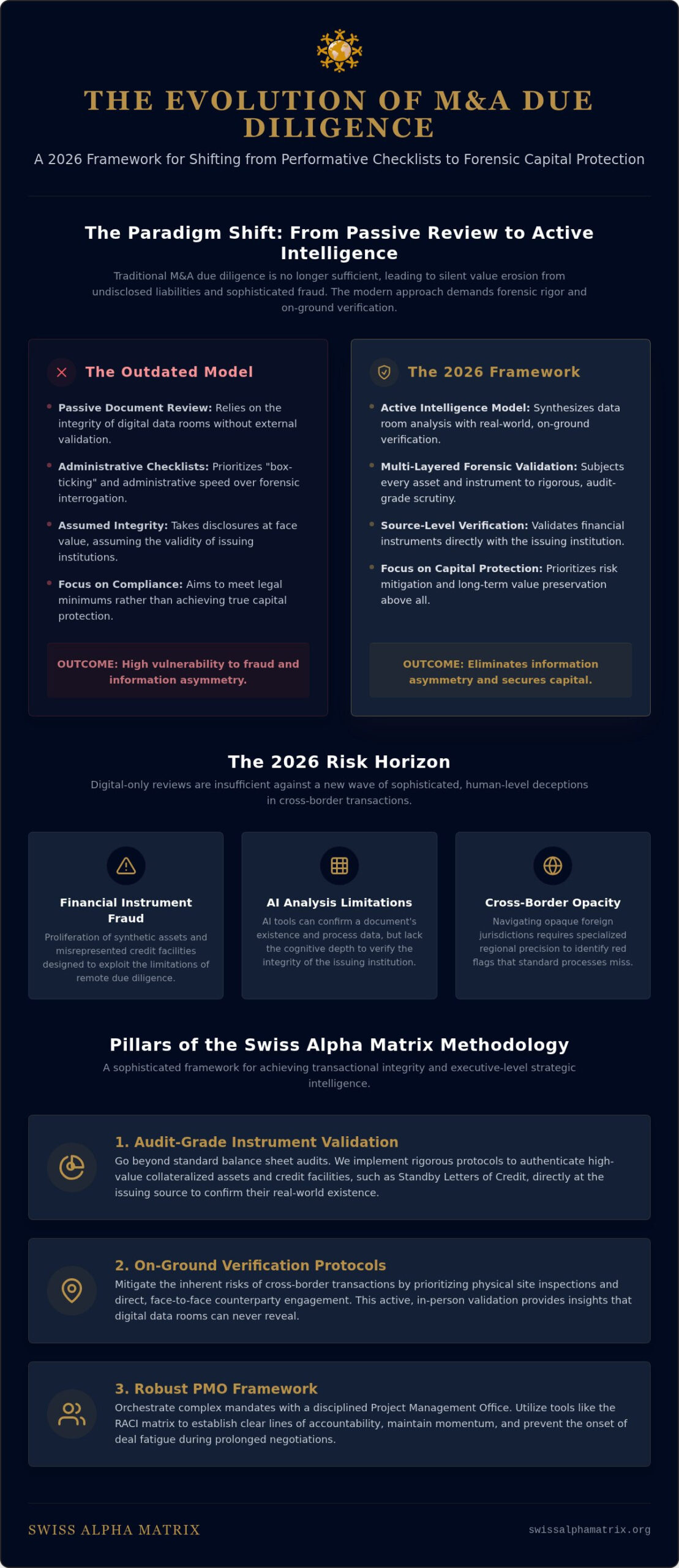
- Transition from passive document review to an active intelligence model, ensuring that every asset is subjected to multi-layered forensic validation rather than simple administrative checklists.
- Enhance your m&a due diligence process by integrating audit-grade validation of complex financial instruments, such as Standby Letters of Credit, directly at the issuing source.
- Address the inherent risks of cross-border transactions through on-ground verification protocols, which prioritize physical site inspections and direct counterparty engagement over digital data rooms.
- Implement a robust Project Management Office framework, utilizing the RACI matrix to maintain clear lines of accountability and prevent the onset of deal fatigue during complex negotiations.
- Adopt a methodology rooted in Swiss precision to secure executive-level intelligence, facilitating a level of capital protection and independent oversight that standard reporting cannot achieve.
Beyond the Virtual Data Room: The Evolution of M&A Due Diligence in 2026
The m&a due diligence process has fundamentally transformed, moving far beyond its origins as a standard administrative check to become a high-stakes forensic exercise. In the current market environment, institutional experts define this process as a multi-layered validation of both tangible assets and the increasingly volatile intangible variables that constitute modern enterprise value. This transition is a direct response to the inadequacy of traditional virtual data rooms, which, while useful for organizing disclosures, often fail to penetrate the sophisticated veils of institutional-grade risks. To comprehend What is Due Diligence? in this new era, one must accept that capital protection, rather than mere compliance, has become the primary objective of every serious mandate.
The Shift from Compliance to Strategic Intelligence
The distinction between a “box-ticking” exercise and a strategic risk assessment is the difference between surviving a deal and thriving after its completion. While traditional checklists focus on historical data and legal minimums, strategic intelligence interrogates the forward-looking stability of the target entity. In 2026, heightened global market volatility necessitates a more aggressive posture toward counterparty risk mitigation. Traditional checklists often fail because:
- They prioritize administrative completion over forensic interrogation of source documents.
- They assume the integrity of the issuing institution without independent validation.
- They lack the regional precision required to identify jurisdictional red flags.
Active intelligence is defined as the synthesis of data room analysis and real-world verification. This approach ensures that the m&a due diligence process remains an exercise in precision, where every disclosure is weighed against its physical reality to prevent the erosion of stakeholder value.
Identifying the 2026 Risk Horizon
International markets are currently grappling with a surge in sophisticated financial instrument fraud, where synthetic assets and misrepresented credit facilities are designed to exploit the limitations of digital-only review. AI-driven document analysis, while efficient for processing vast quantities of data, often lacks the cognitive depth to identify nuanced, human-level deceptions that are increasingly common in cross-border environments. These digital tools can confirm that a document exists, but they can’t confirm the integrity of the institution that issued it. For a more comprehensive exploration of these tactical challenges, our guide on Mastering Cross-Border Investment Due Diligence outlines the institutional frameworks required to navigate such opaque jurisdictions. Capital protection in 2026 relies on the ability to look past the screen and verify the source with clinical accuracy.
The Architecture of Forensic Validation: Financial and Operational Layers
A standard balance sheet audit, while necessary, is insufficient for identifying the sophisticated risks inherent in 2026 cross-border transactions. The m&a due diligence process must incorporate a forensic layer that scrutinizes the authenticity of financial instruments and the operational integrity of the target. Standard audit practices often overlook the “paper-only” nature of complex assets. In contrast, a Tier-1 institutional approach prioritizes verification at the issuance source to ensure that what appears on paper exists in reality.
Audit-Grade Instrument Validation
High-value acquisitions frequently involve collateralized assets or credit facilities that require independent authentication. Relying on digital scans or third-party summaries is a vulnerability that sophisticated actors exploit. We implement a rigorous protocol for Bank Instrument Validation Services, ensuring that Standby Letters of Credit (SBLCs) and other monetization instruments are verified directly through issuing bank officers. This level of forensic validation is essential because it moves beyond the balance sheet to confirm the liquidity and legal standing of the assets. Capital protection depends on this ability to spot technical anomalies that standard auditors, focused on historical cash flows, might naturally overlook.
Operational Due Diligence (ODD) Framework
Operational Due Diligence serves as the bridge between theoretical value and on-ground reality. It isn’t merely a review of management’s self-reported KPIs; it’s an interrogation of their internal controls and institutional discipline. ODD uncovers hidden liabilities, such as legacy cultural friction or inefficient resource allocation, that don’t appear in financial statements but can derail post-merger integration. This framework validates the intersection of regulatory compliance and operational efficiency, ensuring the target can sustain its projected performance under new ownership. For those seeking to safeguard their interests, integrating independent risk management frameworks into the m&a due diligence process ensures that every operational layer is validated with clinical precision and Swiss-led discretion.
Mitigating Cross-Border Exposure: The Imperative of On-Ground Verification
Digital due diligence, while efficient for initial screening, often creates a false sense of security, particularly in high-value cross-border transactions where the geographic and cultural distance between the investor and the target asset increases the propensity for sophisticated deception. Relying solely on virtual data rooms is a tactical vulnerability that can lead to catastrophic capital erosion. A robust m&a due diligence process must therefore move beyond the screen to incorporate physical site visits and face-to-face counterparty interviews, as these are the only methods capable of validating the human and physical elements of a deal with absolute certainty. By prioritizing on-ground verification, institutional investors can bridge the gap between administrative disclosure and the unvarnished reality of the target’s operations.
The Physicality of Trust
Trust in international dealings isn’t a commodity to be granted based on the quality of a PDF; it’s a conclusion that must be reached through a rigorous interrogation of physical reality. For capital-intensive projects, physical asset inspection is a non-negotiable requirement, ensuring that facilities, equipment, and inventory actually exist in the condition and quantity described in the disclosure documents. Our methodology utilizes former Tier-1 bank executives to conduct high-level counterparty interviews, as their seasoned intuition, developed over decades of institutional oversight, allows them to identify subtle inconsistencies in a narrative that junior analysts or automated systems might overlook. This transition from “paper-based” trust to “verified” trust is the cornerstone of effective risk management in complex environments.
Navigating Opaque Jurisdictions
In many emerging markets, official documentation is frequently unreliable, subject to local influence, or intentionally obscured, making it difficult to ascertain the true standing of a target entity through traditional channels. Navigating these environments requires a sophisticated methodology that cross-references local filings with independent institutional data, identifying discrepancies that suggest hidden liabilities or regulatory non-compliance. Swiss Alpha Matrix bridges the gap between the rigorous standards of global financial hubs like London or Geneva and the often opaque realities of local jurisdictions, providing a layer of protection that digital reviews cannot offer. This process demands a high degree of discretion, ensuring that sensitive investigations are conducted with the quiet authority necessary to protect the client’s interests without alerting competitors or destabilizing the target’s internal operations. Within the broader m&a due diligence process, this regional precision ensures that capital remains protected even in the most challenging regulatory landscapes.
Orchestrating the Mandate: PMO Frameworks for Transactional Integrity
The m&a due diligence process is frequently misunderstood as a static series of administrative checks, yet for high-stakes institutional transactions, it requires the structural rigor of a dedicated Project Management Office (PMO). Treating a cross-border acquisition as a complex project rather than a simple checklist ensures that the mandate progresses through a disciplined lifecycle of initiation, execution, forensic validation, and executive reporting. This institutional framework is essential for maintaining transactional integrity, as it provides the independent oversight necessary to neutralize “deal fever,” a psychological bias where the momentum of a transaction begins to override clinical risk assessment. By positioning the diligence mandate within a PMO structure, capital protection remains the central, unwavering objective throughout the deal’s evolution.
The PMO Structure in M&A
A centralized PMO serves as the nervous system of the transaction, coordinating communication across legal, financial, and operational workstreams to prevent the information silos that often obscure critical liabilities. This structure transforms the m&a due diligence process into a series of transparent milestones, where each deliverable is subjected to rigorous internal review before proceeding to the next phase. Such a methodology ensures that progress isn’t measured by the volume of documents processed, but by the quality of intelligence gathered. For those seeking to implement these standards, our framework for Independent Financial Project Management details the technical architecture required to manage complex international mandates with precision and discretion.
The RACI Matrix for Executive Stakeholders
Clarity regarding decision-making authority is established through the RACI matrix, which defines who is Responsible, Accountable, Consulted, and Informed for every critical finding. In an institutional-grade diligence team, this matrix ensures that former Tier-1 bank executives remain “Accountable” for the final validation of risk, preventing the dilution of oversight that occurs when complex tasks are delegated without senior-level interrogation. We utilize a Deliverable Review Matrix to ensure that every validated instrument and on-ground report meets our “audit-grade” standard before being presented to the board. To secure this level of professional oversight for your next transaction, consider the advantages of complex project management led by seasoned institutional experts who prioritize long-term stability over short-term deal closure.
Strategic Intelligence for Capital Protection: The Swiss Alpha Matrix Methodology
The m&a due diligence process finds its most potent expression when the discipline of Tier-1 institutional frameworks is synthesized with the discretion of a boutique consultancy. Swiss Alpha Matrix provides a methodology that avoids the superficiality of generic reporting, opting instead for executive-level intelligence that interrogates the core of a transaction. It’s this commitment to audit-grade validation that distinguishes our approach, ensuring that capital protection isn’t merely a byproduct of the deal but its primary structural anchor. By merging regional precision with a global perspective, we provide the forensic depth necessary to navigate the most intricate cross-border mandates without succumbing to the inefficiencies of traditional administrative models.
The Value of Tier-1 Institutional Experience
Former senior executives from Tier-1 global financial institutions possess a refined perception of risk that’s often absent in standard advisory teams. This institutional pedigree allows for an unemotional, highly logical assessment of a target’s viability, particularly during the intense pressure of a transaction cycle. It’s this quiet authority that enables us to identify technical red flags that might be obscured by the momentum of a deal. We don’t view ourselves as passive participants; we’re dedicated partners focused on the long-term preservation and strategic growth of your interests, mirroring the traditional values of high-end private wealth management. This intellectual depth ensures that every facet of the m&a due diligence process is conducted with a refusal to oversimplify complex dynamics.
Engaging Independent Oversight
Engaging independent oversight requires a structured transition from broad strategic principles to specific, mandate-driven pillars. Our project-based advisory services are bespoke, tailored to the specific jurisdictional complexities and financial instruments involved in your acquisition. We move beyond the paperwork to deliver the on-ground verification and operational due diligence necessary for a forensic-level understanding of the target entity. This methodical approach ensures that every decision is backed by audit-grade validation and a sense of inevitable logic that encourages confidence in the final outcome. To secure this standard of service for your next acquisition, you may request a confidential consultation for your cross-border mandate. Our process is designed to lead you through a structured argument for the methodology, creating a sense of professional calm that is both broad in reach and meticulous in its attention to detail.
Securing Transactional Excellence through Institutional Rigor
The complexity of the 2026 deal landscape requires a departure from administrative shortcuts in favor of a forensic m&a due diligence process. We’ve explored how the integration of a dedicated PMO structure, coupled with on-ground verification and audit-grade instrument validation, serves as the definitive barrier against capital erosion. By moving beyond the virtual data room and interrogating the source of every financial claim, institutional investors can replace information asymmetry with absolute technical certainty. This methodical approach ensures that every strategic pillar is validated with the clinical precision that high-level mandates demand.
Our methodology is led by former Tier-1 global bank executives who specialize in cross-border instrument validation, ensuring that your interests are protected with Swiss-standard precision and discretion. This unemotional, master-planner approach provides the independent oversight necessary to navigate opaque jurisdictions with clinical accuracy. As you evaluate your next strategic acquisition, ensure your framework is anchored in historical reliability and regional precision. You can secure your capital with institutional-grade due diligence advisory to ensure your growth remains both stable and protected.
Frequently Asked Questions
What is the primary difference between standard and institutional-grade M&A due diligence?
Institutional-grade diligence prioritizes forensic validation and capital protection over the simple administrative completion of a checklist. While a standard m&a due diligence process often relies on the target’s self-reported disclosures, an institutional framework interrogates the source of every claim. This approach utilizes former Tier-1 bank executives to identify deep-seated risks that standard legal or accounting reviews might overlook, ensuring that the transaction is anchored in verified reality.
How long does a comprehensive cross-border due diligence process typically take in 2026?
The timeline for a comprehensive cross-border mandate in 2026 typically extends between eight and twelve weeks, depending on jurisdictional complexity and the availability of on-ground intelligence. This duration reflects the time required to move beyond digital data rooms to conduct physical site visits and face-to-face counterparty interviews. Rushing this process often leads to deal fatigue; therefore, a measured pace is essential for maintaining transactional integrity and capital preservation.
Why is on-ground verification necessary if all documents are in the Virtual Data Room?
On-ground verification is necessary because digital documentation within a Virtual Data Room can be meticulously curated or, in extreme cases, sophisticatedly fabricated. Physical inspections and direct interviews allow our experts to validate that tangible assets exist in the condition described and that management’s operational discipline matches their written disclosures. This forensic layer of the m&a due diligence process provides a level of certainty that digital-only reviews cannot replicate.
What role does a RACI matrix play in managing an M&A due diligence team?
A RACI matrix serves as the structural foundation for team accountability, clearly defining who is Responsible, Accountable, Consulted, and Informed for each risk workstream. In complex mandates, it ensures that senior institutional experts remain Accountable for the final validation of technical findings. This prevents information silos and ensures that every red flag is escalated to the appropriate stakeholder, maintaining a steady, logical flow of intelligence throughout the transaction lifecycle.
How does Swiss Alpha Matrix validate complex financial instruments like SBLCs?
We validate complex financial instruments like Standby Letters of Credit (SBLCs) by conducting direct, audit-grade inquiries at the issuing institution’s source. This process involves verifying the credit facility’s legitimacy with bank officers rather than relying on third-party representations or digital scans. By applying Tier-1 institutional standards, we ensure that every instrument is monetizable and legally standing, providing an essential layer of capital protection that standard audits often fail to address.
Can operational due diligence be conducted remotely in international deals?
While certain administrative aspects of operational due diligence can be managed remotely, a forensic-level review requires physical presence to assess the target’s true internal controls. Remote reviews often miss the subtle cultural frictions and management inefficiencies that only become apparent during on-site observations. To achieve the Swiss standard of precision, our experts prioritize on-ground verification, ensuring that the operational reality of the international entity aligns perfectly with its strategic projections.
What are the common red flags in financial instrument validation for M&A?
Common red flags include a lack of transparency regarding the issuing bank’s jurisdiction, non-standard SWIFT formatting, or collateral histories that appear inconsistent with market realities. Technical anomalies in the documentation of bank instruments often signal underlying institutional-grade fraud that standard auditors might miss. Identifying these discrepancies early requires a specialized forensic mindset that prioritizes the interrogation of the asset’s origin over the mere acceptance of its current face value.
How do you manage stakeholder communication during a sensitive, cross-border DD process?
Stakeholder communication is managed through a centralized PMO structure that prioritizes discretion and logic-driven reporting over frantic updates. This framework ensures that all parties remain informed of critical milestones without the onset of “deal fever” or unnecessary urgency. By providing steady, measured intelligence, we maintain a professional calm that encourages confidence in the decision-making process, ensuring that all communications reflect the dignified nature of high-end private wealth management.