

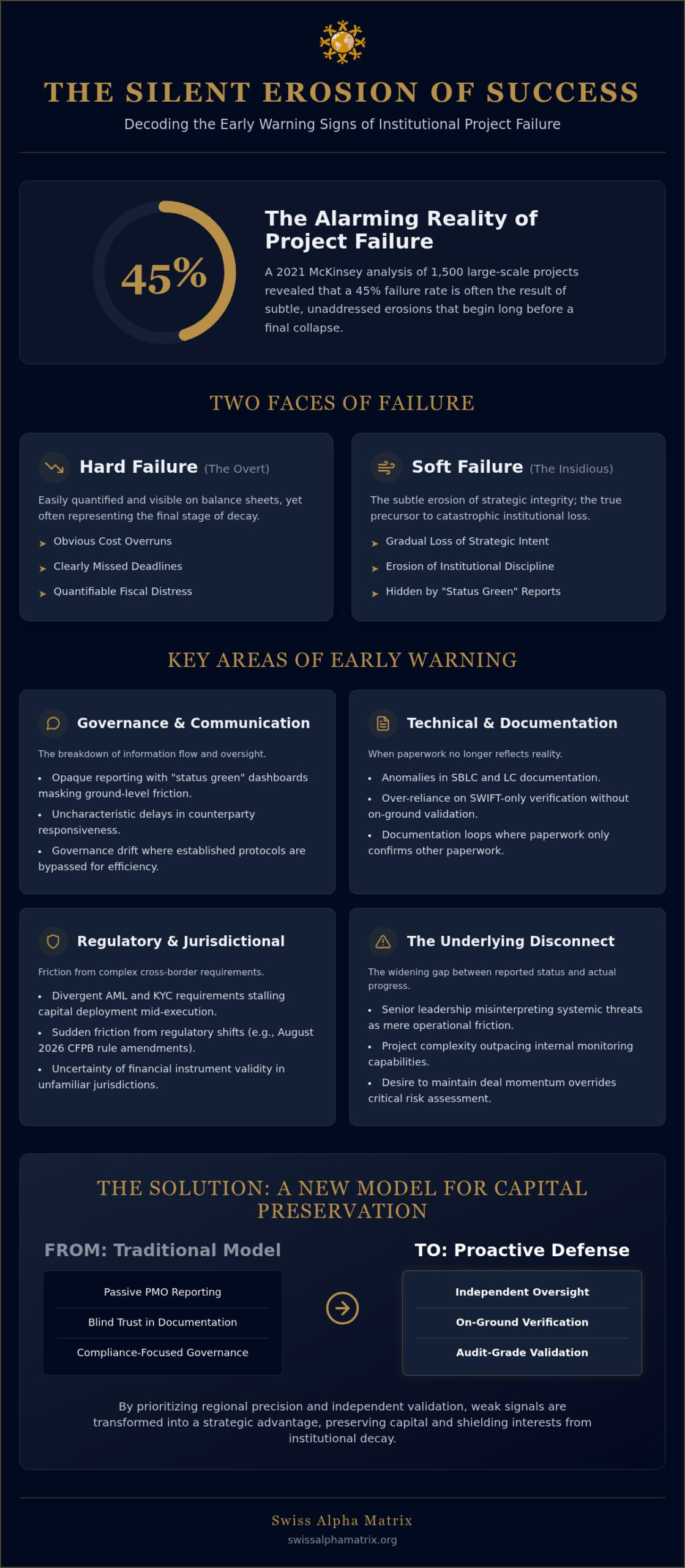
While institutions often wait for a balance sheet collapse to signal distress, a 2021 McKinsey analysis of 1,500 large-scale projects revealed that a 45 percent failure rate is often the result of subtle, unaddressed erosions that begin months before a final cancellation. Recognizing the early warning signs of project failure is essential when you face the quiet unease that accompanies opaque reporting from local teams or the sudden friction of regulatory shifts, such as the upcoming August 2026 amendments to the CFPB Civil Penalty Fund rule. It’s a common experience for sophisticated stakeholders to feel a growing uncertainty regarding the validity of financial instruments when operating in unfamiliar jurisdictions.
This discussion provides a rigorous framework designed to detect failure early, offering methods for on-ground validation of counterparty claims and ensuring capital protection through independent verification. We will examine the gradual erosion of institutional discipline and the specific methods required to maintain oversight in an increasingly complex global environment. By prioritizing regional precision and audit-grade validation, you can transform these weak signals into a strategic advantage that preserves long-term growth and shields interests from the consequences of institutional decay.
Key Takeaways
- Distinguish between overt fiscal overruns and the more insidious “soft” erosion of strategic intent that serves as a precursor to catastrophic institutional loss.
- Identify technical anomalies in SBLC and LC documentation, acknowledging the inherent limitations of standard SWIFT-only verification in the evolving 2026 regulatory landscape.
- Navigate the complexities of cross-border mandates by understanding how divergent AML and KYC requirements can unexpectedly stall capital deployment mid-execution.
- Establish a proactive defense by recognizing the early warning signs of project failure within “status green” dashboards that may mask ground-level operational friction.
- Transition toward a model of independent oversight that utilizes on-ground verification to validate counterparty claims and ensure absolute capital protection.
Decoding the ‘Weak Signals’ of Failure in Institutional Mandates
In high-stakes financial mandates, failure rarely manifests as a sudden, cataclysmic event; instead, it’s the culmination of subtle institutional erosions that sophisticated observers categorize as ‘soft’ failure. While ‘hard’ failure is easily quantified through cost overruns and missed deadlines, soft erosion involves the gradual loss of strategic integrity, where the project’s execution no longer aligns with the original fiduciary intent. Traditional Project Management Office (PMO) reporting often masks the early warning signs of project failure by prioritizing administrative throughput over qualitative risk assessment. By focusing on administrative milestones rather than the qualitative integrity of the underlying assets, these systems inadvertently hide the very risks they were designed to mitigate.
The psychological barrier remains a formidable obstacle, as the desire to maintain deal momentum frequently leads senior leadership to interpret technical red flags as mere operational friction rather than systemic threats. A retrospective analysis of the list of notable project failures demonstrates that most catastrophic losses were preceded by a series of ignored soft signals. Establishing an Institutional Failure Threshold allows a firm to determine the precise moment when the risk of continued participation outweighs the potential for strategic recovery, ensuring that capital protection remains the primary objective.
The Divergence Between Paperwork and Reality
Digital documentation, while efficient for routine operations, provides a fragile basis for high-value instrument validation in jurisdictions where regulatory standards are fluid. Relying on standard due diligence in emerging markets often results in a documentation loop, where paperwork confirms other paperwork without ever touching the physical reality of the asset. Weak signals represent the first, often non-linear deviations from an established operational baseline that, while seemingly inconsequential in isolation, indicate a fundamental breakdown in the underlying risk management framework. Without on-ground verification, the gap between reported status and actual progress will inevitably widen until the mandate is no longer salvageable.
The Role of Governance in Early Detection
Rigid governance structures, designed for stability, can paradoxically obscure project risks by encouraging a culture of compliance over one of critical inquiry. True oversight requires an audit-grade approach, moving beyond administrative tracking to verify the actual existence and standing of financial counterparties. When project complexity outpaces internal monitoring capabilities, the early warning signs of project failure become background noise, lost in the sheer volume of data. It’s at this juncture that independent oversight becomes a necessity, providing the unemotional expertise required to validate claims and protect long-term growth from the consequences of institutional decay.
The Anatomy of Institutional Erosion: Communication and Governance
Reporting opacity serves as a primary catalyst for capital erosion, particularly when “status green” dashboards present a sanitized, administrative version of progress that fundamentally contradicts ground-level operational reality. In multi-jurisdictional financial programs, the breakdown of stakeholder alignment often begins with subtle communication lapses, which, if left unaddressed, evolve into systemic failures that threaten the strategic integrity of the mandate. These gaps are frequently the early warning signs of project failure, indicating that the rigorous standards of the original agreement are being sacrificed for a misguided pursuit of transactional efficiency. Governance drift inevitably occurs when established protocols are bypassed, a practice that inadvertently creates impenetrable information silos and systematically prevents the thorough due diligence required for high-stakes cross-border investment protection.
Identifying Stakeholder Disengagement
Subtle shifts in counterparty responsiveness, such as uncharacteristic delays in addressing technical queries or a sudden lack of transparency regarding early indicators of financial distress, serve as critical precursors to potential default. Executive turnover within a local project team can further destabilize long-term objectives, as new leadership may lack the historical context or the fiduciary commitment required to sustain the original mandate. To mitigate these risks, sophisticated entities utilize a deliverable review matrix to spot alignment gaps before they compromise the integrity of the transaction. This methodology ensures that every milestone is validated against rigorous, audit-grade standards rather than mere administrative checklists, providing a clear view of the project’s true trajectory.
Governance as a Risk Mitigation Tool
Re-establishing the strategic architecture of project management is essential for maintaining institutional discipline, especially when operating in volatile or unfamiliar markets. The introduction of independent oversight serves as a necessary strategic buffer, ensuring that project protocols, which are designed to safeguard institutional interests, remain intact despite the pervasive and often distracting pressures of deal momentum. Implementing “Zero-Trust” reporting protocols requires that all data, particularly concerning the validity of financial instruments, be independently verified through on-ground verification services rather than accepted at face value. By prioritizing this level of meticulous detail, partners can ensure that their capital remains protected against both overt fraud and the gradual erosion of governance standards, which are the most persistent early warning signs of project failure in complex mandates.
Technical Red Flags in Financial Instrument Validation
In high-stakes financial mandates, the digital veneer of legitimacy often conceals fundamental insolvency. While many institutions rely on SWIFT messages as the ultimate proof of authenticity, the 2026 regulatory landscape, defined by the rise of agentic AI and the tokenization of real-world assets, has rendered SWIFT-only verification insufficient. These digital signals can be issued by entities practicing sophisticated regulatory arbitrage, where the appearance of liquidity masks a hollow balance sheet. Recognizing these technical discrepancies provides the most objective early warning signs of project failure, allowing for a decisive pivot before capital is irrevocably committed. Without on-ground verification, a project remains vulnerable to digital forgery that no remote audit can reliably detect.
Inconsistencies in operational due diligence often surface when counterparty balance sheets are subjected to rigorous, independent scrutiny. It’s common to find ‘window dressing’ in financial entity reporting, where assets are temporarily inflated to meet minimum requirements for a specific transaction. These anomalies aren’t merely administrative errors; they’re the primary early warning signs of project failure that signal a counterparty’s inability to fulfill their fiduciary obligations. Independent validation acts as the only effective antidote to these deceptive practices, ensuring that the instruments underpinning the mandate are both valid and enforceable.
Detecting Instrument Forgery and Misuse
The sophistication of modern financial forgery requires a move toward audit-grade bank instrument validation services that look beyond the surface of a document. Fraudulent standby letters of credit often exhibit non-standard verbiage that deviates from ICC UCP 600 standards, inconsistent bank stamps from non-existent regional branches, and expiry dates that logically precede the project’s anticipated funding cycle. When these technical red flags appear, they indicate a fundamental breakdown in the transaction’s integrity. Relying on ‘standard’ due diligence in such cases isn’t just risky; it’s a dereliction of duty that invites catastrophic capital loss.
Counterparty Integrity and Transactional Risk
Evaluating the ‘moral character’ of a counterparty involves more than a simple credit check; it requires deep institutional intelligence and a thorough assessment of their regulatory standing across multiple jurisdictions. Signs of regulatory arbitrage, such as routing transactions through regions with lax oversight, should be viewed as a deliberate attempt to bypass the transparency required in institutional mandates. Independent validation provides the necessary strategic distance to assess these risks unemotionally. By verifying the physical existence of assets and the actual standing of the issuing officers, you can protect the mandate from the consequences of counterparty default and ensure that project protocols remain uncompromised by external pressures.
Regulatory Divergence as a Failure Catalyst in 2026
The landscape of global finance in August 2026 is defined by a rapid acceleration of oversight, where shifting AML and KYC requirements frequently stall high-value projects mid-execution. Such friction points are often the primary early warning signs of project failure, signaling that a mandate’s original compliance framework is no longer sufficient to meet the evolving standards of Tier-1 jurisdictions. The implementation of payment safeguarding regulations in May 2026, followed by the anticipated non-financial misconduct rule extension in September 2026, illustrates the volatility that can destabilize even the most meticulously planned capital deployments. Understanding the impact of international financial regulations is essential for maintaining institutional integrity throughout the lifecycle of a cross-border transaction, as the cost of reactive adjustment often exceeds the project’s remaining contingency reserves.
Compliance fatigue represents a significant risk factor, as project teams burdened by repetitive, high-stakes verification tasks may begin to overlook subtle anomalies in favor of operational speed. This psychological erosion leads to regulatory drift, a phenomenon where the project’s adherence to legal standards gradually diverges from its initial fiduciary obligations over the course of multi-year infrastructure or investment programs. When teams prioritize “transactional efficiency” over the rigorous validation of new counterparty requirements, the project enters a state of latent failure that may only become visible during a final audit or capital call.
Navigating Cross-Border Compliance Friction
Jurisdictions like Geneva, London, and Hong Kong present unique challenges, particularly as Hong Kong and Geneva reconcile their divergent regulatory trends for the 2026 fiscal year. Mastering the nuances of cross-border investment due diligence requires more than just administrative awareness; it demands a strategic foresight that integrates regulatory shifts directly into the project scheduling process. By anticipating friction before it manifests as a hard stop, institutions can preserve deal momentum while ensuring absolute compliance. This proactive approach prevents the early warning signs of project failure from escalating into a total loss of jurisdictional standing, which is often impossible to recover once a project is flagged by regional authorities.
The Cost of Compliance Failure
Quantifying the impact of regulatory fines on project ROI is only the first step in assessing risk, as the reputation of an institution faces irreparable harm when associated with a failed mandate due to oversight lapses. A proactive risk management framework for 2026 must account for the August 2026 CFPB Civil Penalty Fund rule amendments and other late-year shifts that could impact capital deployment strategies. To secure your mandate against these systemic pressures, engaging a dedicated regulatory compliance advisory ensures that your project remains resilient in the face of jurisdictional divergence. This level of independent oversight provides the intellectual depth required to navigate complex mandates without sacrificing the speed or precision that high-net-worth entities expect.
Implementing Independent Oversight for Capital Preservation
The transition from internal monitoring to independent project oversight represents a critical evolution in the lifecycle of a high-stakes mandate, especially when the inherent complexity of the transaction begins to exceed the internal capacity for truly objective critique. Internal project teams, while technically proficient, are frequently susceptible to institutional biases and corporate politics that can obscure the early warning signs of project failure until the point of no return. Swiss Alpha Matrix, led by former Tier-1 global bank executives, provides a layer of protective authority that prioritizes the long-term preservation of capital over the temporary satisfaction of meeting administrative milestones. Our methodology integrates audit-grade reporting with physical, ground-level intelligence, ensuring that every claim made by a counterparty is validated against the physical reality of the asset rather than just the digital documentation provided.
Establishing a “Fail-Safe” protocol for capital recovery serves as the final pillar of this methodology, ensuring that even in the most challenging environments, your interests are shielded by a master plan rooted in historical reliability and intellectual superiority. This protocol defines the precise thresholds at which a project must be restructured or exited to prevent catastrophic loss. By maintaining this level of strategic distance, we ensure that the early warning signs of project failure are addressed with unemotional precision, allowing for the implementation of recovery strategies that preserve the strategic integrity of the original mandate.
The Value of Independent Advisory
True independence requires a detachment from the internal pressures of a firm, allowing for an unbiased assessment of risk that is often impossible for those embedded within the project’s daily operations. Swiss-led project management is characterized by a standard of precision and regional excellence that distinguishes a performance-oriented mindset from passive participation in the market. Integrating external experts shouldn’t disrupt existing teams; rather, it should empower them by providing the specialized oversight necessary to navigate regulatory friction and technical anomalies. This partnership ensures that fiduciary interests remain protected through a standard of service that is both broad in reach and meticulous in its attention to detail.
The Path to Execution Excellence
Deploying a rigorous RACI matrix establishes absolute accountability, ensuring that every stakeholder’s responsibility is clearly defined within the multi-jurisdictional framework. This clarity is essential for identifying misalignments before they compromise the strategic architecture of the deal. Retainer-based strategic consulting offers the long-term stability required for complex mandates, providing consistent access to seasoned experts who can pivot strategies in response to shifting global dynamics. To secure your capital and ensure the successful execution of your high-stakes mandates, you should engage Swiss Alpha Matrix for specialized project oversight, leveraging our Tier-1 expertise to maintain the highest standards of institutional discipline.
Securing the Strategic Integrity of Your Institutional Mandate
The transition from administrative tracking to audit-grade validation is no longer a mere option; it’s a fundamental fiduciary necessity for the modern institution. By acknowledging the subtle institutional erosions and technical anomalies discussed, you can move beyond the surface-level reporting that often masks underlying distress. Recognizing these early warning signs of project failure allows for the implementation of a proactive defense, ensuring that capital protection remains the absolute priority throughout the entire transaction lifecycle. It’s this level of meticulous detail that separates passive participants from those who achieve long-term strategic growth and institutional stability.
Swiss Alpha Matrix, managed by former Tier-1 global bank executives, offers a unique synthesis of Swiss precision and global reach to verify the physical reality of your assets through audit-grade instrument validation. Our methodology ensures that your mandates are protected from both overt fraud and the gradual decay of governance standards. Secure your mandate with independent financial project management to ensure your interests are in the hands of seasoned experts who prioritize stability and trust. We’re here to provide the intellectual depth and master planning required to navigate the complexities of 2026 and beyond with quiet authority.
Frequently Asked Questions
What are the first signs of communication breakdown in a cross-border project?
The first indicators often involve subtle delays in addressing technical queries and a shift toward generic, administrative reporting rather than qualitative updates. These are frequently the early warning signs of project failure in multi-jurisdictional mandates. When local teams prioritize “status green” dashboards over detailed operational disclosures, it indicates a breakdown in stakeholder alignment that requires immediate, independent verification to prevent the further erosion of strategic integrity.
How can I tell if a bank instrument is valid without relying on SWIFT?
Audit-grade instrument validation requires verifying the physical existence of the asset and the actual standing of the issuing officers through on-ground verification capabilities. While SWIFT messages remain an industry standard, they’re increasingly susceptible to digital forgery in the 2026 regulatory landscape. Independent oversight ensures that the underlying financial entity possesses the requisite liquidity and moral character, moving beyond the digital veneer to confirm the document’s enforceability.
Is a RACI matrix enough to prevent project failure in 2026?
A RACI matrix serves as a foundational tool for establishing accountability, yet it’s insufficient to manage the intricate regulatory shifts and technical anomalies of modern cross-border deals. It must be paired with proactive risk management frameworks and independent project oversight to address the volatility of the 2026 fiscal year. Without these additional layers of institutional discipline, a project remains vulnerable to compliance fatigue and the gradual loss of strategic integrity.
Can independent oversight save a project that is already over budget?
Independent oversight can facilitate capital recovery by identifying the precise technical red flags that led to the initial fiscal overrun. By establishing a fail-safe protocol, seasoned advisors can determine if the mandate is salvageable through rigorous restructuring or if an exit strategy is required to preserve remaining assets. This unemotional assessment provides the strategic distance needed to address early warning signs of project failure that internal teams might otherwise ignore.
What is the difference between a project audit and independent project oversight?
A project audit is a retrospective examination of historical data, whereas independent project oversight involves continuous, proactive monitoring of the mandate’s execution. Oversight prioritizes the prevention of failure by validating counterparty claims in real-time and ensuring strict adherence to established protocols. This ongoing involvement offers a standard of service that is both broad in reach and meticulous in its attention to detail, unlike the periodic nature of an audit.
Why do Tier-1 bank executives make better project advisors for complex deals?
Former Tier-1 global bank executives possess the deep institutional intelligence and historical reliability required to navigate the technical complexities of high-stakes mandates. Their experience allows them to recognize subtle anomalies in financial entity reporting that less seasoned observers might overlook. This caliber of expertise ensures that interests are in the hands of experts who prioritize long-term preservation and strategic growth over the risks associated with short-term speculation.
How does regulatory divergence in Hong Kong affect my investment in Switzerland?
Divergent regulatory trends, such as shifting AML requirements in Hong Kong, can create friction for capital deployment strategies managed through Swiss financial hubs. This divergence requires a sophisticated approach to cross-border investment due diligence to ensure that jurisdictional shifts don’t stall execution. Maintaining institutional integrity across these regions demands a proactive risk management framework that anticipates regulatory drift before it impacts the project’s overall ROI or jurisdictional standing.
What happens if on-ground verification contradicts the digital paperwork?
When on-ground verification contradicts digital documentation, it signals a fundamental breakdown in the mandate’s integrity that often indicates fraudulent activity or insolvency. In such instances, the physical reality must always supersede the digital signal to ensure absolute capital protection. This discrepancy is a definitive indicator of risk, necessitating the immediate activation of recovery protocols to shield the institution from catastrophic loss and the associated reputational harm.