

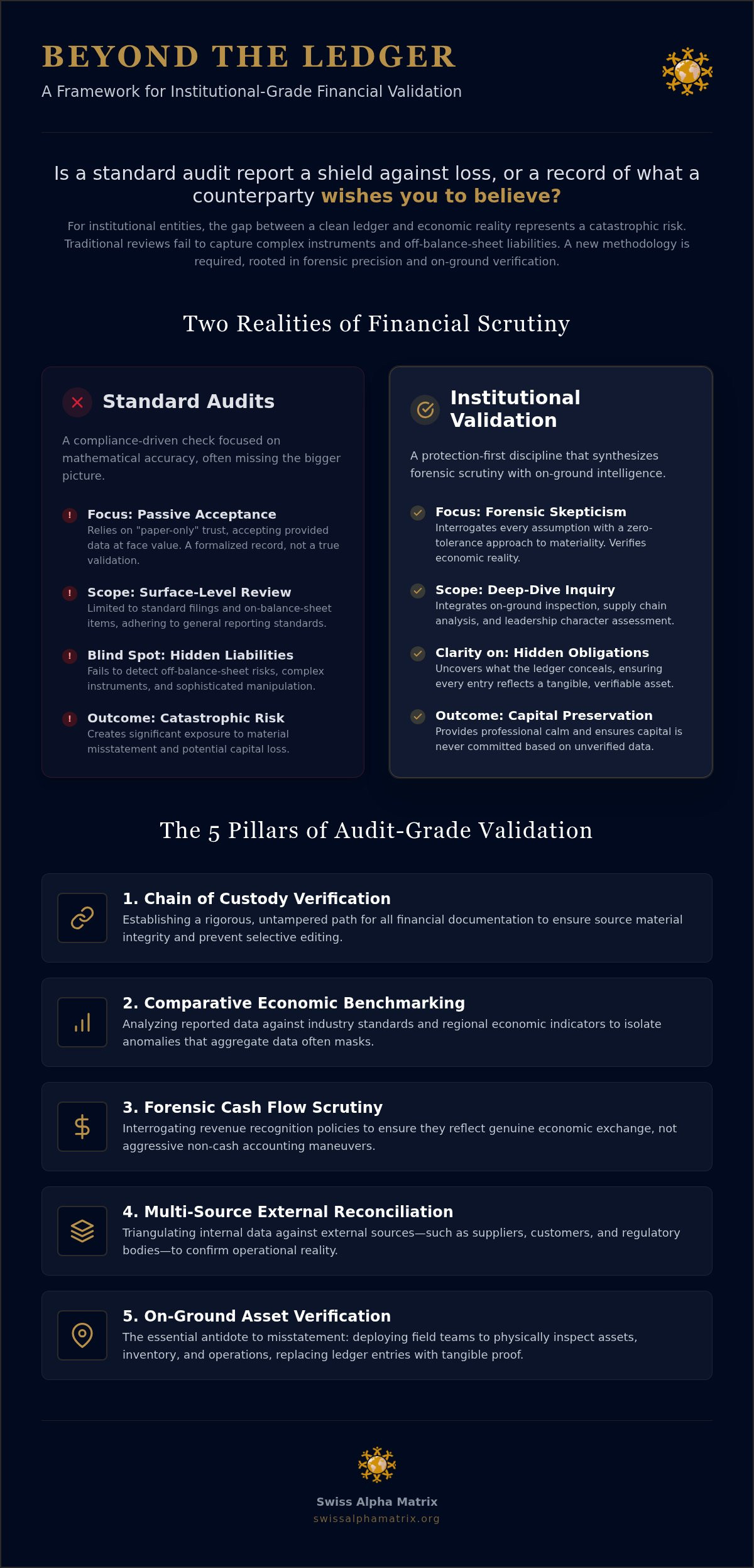
Is a standard audit report truly a shield against loss, or merely a formalised record of what a counterparty wishes you to believe? For institutional entities operating within high-risk jurisdictions, the gap between a clean ledger and economic reality often represents a catastrophic risk to capital preservation. You’re likely aware that routine statutory filings frequently fail to capture the nuances of complex instruments or the true extent of off-balance-sheet liabilities. Validating a company’s financial statements in 2026 requires a shift from passive acceptance to a methodology rooted in on-ground verification and forensic precision, particularly when dealing with instruments that reside outside the scope of traditional oversight.
This guide provides a definitive framework for moving beyond surface-level reviews to achieve audit-grade validation, ensuring that every entry reflects a tangible asset. We’ll examine the integration of global intelligence with technical analysis to secure your capital deployment against material misstatement. By the conclusion, you’ll possess the strategic pillars necessary to verify physical assets and expose hidden obligations with the quiet authority that sophisticated mandates demand.
Key Takeaways
- Understand why traditional accounting reviews are insufficient for cross-border capital protection and how to identify the hidden risks of “paper-only” trust.
- Learn the rigorous, multi-step architecture for validating a company’s financial statements, focusing on document chain of custody and regional economic benchmarking.
- Distinguish between compliance-driven standard audits and mandate-specific forensic inquiries that utilise zero-tolerance materiality thresholds.
- Discover why on-ground verification serves as the essential antidote to material misstatement and the presence of off-balance-sheet liabilities.
- Master the selection criteria for tier-1 advisory partners who can integrate instrument validation into a broader framework of complex project management.
Beyond the Ledger: Why Institutional Validation is a Strategic Imperative
The methodology of validating a company’s financial statements has transitioned from a routine administrative requirement into a critical defensive maneuver for the institutional investor. While traditional accounting reviews focus on the mathematical accuracy of a ledger, they often fail to address the qualitative integrity of the data provided, particularly in jurisdictions where regulatory oversight remains inconsistent. Relying on “paper-only” trust when deploying capital across borders invites significant exposure to material misstatements that a standard audit might overlook. Effective financial statement analysis techniques must therefore be augmented by a forensic lens that prioritizes the verification of economic reality over mere compliance with reporting standards.
This rigorous approach serves as the essential foundation for mastering cross-border investment due diligence, where the complexity of international mandates demands a level of scrutiny that generalist consultancies rarely provide. By employing former Tier-1 bank executives, it’s possible to identify subtle narrative inconsistencies that suggest a disconnect between the reported performance and the operational truth. Such expertise is vital for validating a company’s financial statements when the stakes involve substantial capital deployment and long-term preservation.
The Evolution of Financial Misstatement in 2026
As we move into 2026, the nature of financial deception has evolved from simple clerical errors to sophisticated algorithmic manipulation designed to bypass automated detection systems. Standard audit reports, while technically correct in their adherence to frameworks, frequently fail to capture off-balance-sheet risks that are prevalent in emerging markets or high-risk jurisdictions. These risks often reside in complex instruments that require specialized validation to untangle. Audit-Grade Validation is a multi-layered investigative discipline that synthesizes forensic financial scrutiny with on-ground intelligence to authenticate the existence and valuation of reported assets.
Capital Protection as the Primary Objective
Adopting a protection-first mindset requires a shift away from the compliance-driven checklists that define the broader consulting industry. Sophisticated investors understand that forensic skepticism isn’t an obstacle to growth, but rather a prerequisite for it. By applying the same Tier-1 banking discipline used by global financial institutions to private mandates, Swiss Alpha Matrix ensures that capital is never committed based on unverified assumptions. This process involves:
- Interrogating the methodology behind revenue recognition to ensure alignment with cash flow reality.
- Verifying the existence of physical assets through on-ground inspection rather than ledger entries alone.
- Analyzing the moral character and historical reliability of the entity’s leadership.
The goal is to provide a sense of professional calm, knowing that every strategic pillar of the investment has been tested against a zero-tolerance forensic inquiry.
The Architecture of Audit-Grade Financial Statement Analysis
To move beyond the limitations of standard accounting reviews, the process of validating a company’s financial statements must follow a structured, institutional architecture that prioritizes the provenance of data. This architecture is defined by five critical pillars of inquiry that ensure every figure on the ledger is tethered to economic reality:
- Chain of Custody: Establishing a rigorous path for all financial documentation to ensure the source material remains untampered and hasn’t been selectively edited.
- Comparative Benchmarking: Analyzing reported data against industry standards and regional economic indicators to isolate anomalies that aggregate data often masks.
- Cash Flow Scrutiny: Investigating revenue recognition policies to ensure they reflect genuine economic exchange rather than aggressive, non-cash accounting maneuvers.
- External Reconciliation: Triangulating internal management accounts with external tax filings and bank statements to verify that reported liquidity actually exists.
- Balance Sheet Stress-Testing: Evaluating resilience against volatile market scenarios and sudden regional shifts to determine the true strength of the entity’s position.
Utilizing established strategies for accurate financial statements ensures that the validation remains grounded in institutional best practices, providing the master planner with a reliable foundation for capital deployment.
Revenue Integrity and Cash Flow Persistence
A central component of our methodology involves distinguishing between one-time gains and sustainable operational cash flow, as the former often masks underlying structural weaknesses. We employ specific forensic techniques to identify “round-tripping”, a practice where artificial revenue is generated through circular transactions with affiliated parties that lack genuine economic substance. Verifying the persistence of earnings requires a granular look at the quality of the ledger, ensuring that reported growth isn’t merely a byproduct of algorithmic manipulation or aggressive booking. For those managing high-value transactions, integrating Audit-Grade Instrument Validation into the project lifecycle ensures that liquidity claims are backed by verifiable bank assets.
Liability Exposure and Contingent Risks
Our comprehensive approach to validating a company’s financial statements extends to uncovering hidden debt that often resides within the complex prose of financial footnotes, requiring a seasoned eye to identify potential encumbrances. Our framework utilizes specialized bank instrument validation services to confirm the existence and technical terms of standby letters of credit, which are frequently omitted from primary balance sheet views in high-risk jurisdictions. By evaluating the impact of cross-border regulatory shifts on these long-term liabilities, we provide a definitive risk assessment that safeguards against unforeseen claims on capital, ensuring that your interests are protected by experts who prioritize long-term preservation over short-term speculation.
Standard Audits vs. Institutional Validation: A Framework for Comparison
Distinguishing between a routine audit and institutional-grade validation is essential for those managing significant cross-border interests. While a standard audit serves as a baseline for regulatory compliance, it’s rarely sufficient for the strategic demands of high-net-worth capital deployment. The fundamental difference lies in the intent. A routine audit seeks to provide “reasonable assurance” that figures aren’t materially misstated according to accounting standards. Validating a company’s financial statements through an institutional lens, however, is a mandate-specific investigation designed to uncover the operational truth behind the numbers.
- Scope: Routine audits follow a generalized checklist to satisfy statutory requirements. Validation is surgical, focusing on specific instruments and project-level risks that directly impact the investor.
- Depth: Audits rely on materiality thresholds that intentionally ignore smaller discrepancies. Validation adopts a zero-tolerance forensic inquiry, viewing minor anomalies as potential indicators of systemic fraud or broken internal controls.
- Perspective: Audits are historical, documenting what has already occurred within a set timeframe. Validation is forward-looking, identifying risks and liabilities that could compromise future capital preservation.
- Outcome: An auditor provides a standardized opinion, often qualified by numerous disclaimers. Institutional validation delivers a bespoke intelligence report that informs C-suite decision-making with clarity and precision.
The Limitations of Materiality in High-Stakes Deals
In the context of validating a company’s financial statements, the concept of materiality often creates a dangerous blind spot. In jurisdictions with weak regulatory oversight, “immaterial” discrepancies are frequently used as test cases for larger-scale deception or to hide the true nature of off-balance-sheet obligations. Relying on third-party auditors who may be subject to local pressures or limited by a narrow scope can lead to catastrophic miscalculations. We bridge this gap by providing independent oversight, ensuring that no detail is dismissed simply because it falls below a traditional accounting threshold. This level of scrutiny is a core component of our risk management frameworks, designed to protect capital from the very beginning.
Navigating the ‘Discretion Gap’ in Swiss and Global Finance
Managing cross-border mandates requires a delicate balance between deep transparency and the preservation of professional discretion. Institutional-grade methodologies allow for the verification of sensitive data without compromising the integrity of the deal or the privacy of the parties involved. Former Tier-1 banking executives bring a level of regional precision and technical accuracy that generalist consultants cannot replicate. This elite perspective is essential for navigating the complex regulatory environments of 2026, where modern AML and compliance shifts demand a more nuanced approach to risk management. By merging financial forensics with on-ground intelligence, we ensure that your interests are handled by seasoned experts who value long-term stability over short-term speculation.
The Critical Role of On-Ground Verification in Financial Validation
While the digital forensics discussed in previous sections provide a necessary layer of scrutiny, they remain insufficient if they aren’t tethered to the physical reality of the assets in question. The methodology of validating a company’s financial statements must include a robust phase of physical verification to serve as the ultimate antidote to “paper-wealth” fraud. In high-stakes mandates, a ledger may report a fully operational production facility, yet an independent inspection might reveal a dormant site or, in extreme cases, an empty lot. These discrepancies, which often elude traditional auditors, represent a catastrophic risk to capital that only a dedicated on-ground presence can mitigate.
By synthesizing physical findings with digital financial models, we establish a 360-degree view that reconciles the abstract nature of the ledger with the tangible reality of the asset base. This process involves meticulous site visits, inventory audits, and local interviews conducted with the quiet authority of seasoned experts. This integration ensures that the valuation isn’t merely an accounting exercise but a definitive confirmation of existence and operational health. To secure your interests against such material misstatements, our On-Ground Verification Services provide the independent oversight required for institutional-grade certainty.
Verifying Operational Reality
A primary objective of on-ground verification is to match internal payroll records to actual headcount through direct, unobtrusive observation. This investigative layer exposes “ghost employees” and artificial payroll inflation that can be used to mask the unauthorized siphoning of cash. We also assess the physical condition and actual existence of capital equipment listed on the balance sheet, ensuring that depreciation schedules align with the true state of the machinery. This synergy between financial advisory and operational due diligence allows for the identification of subtle red flags that suggest a disconnect between reported productivity and the physical capacity of the enterprise.
Jurisdictional Specifics: London, Geneva, and Hong Kong
The process of validating a company’s financial statements must be tailored to the specific corporate laws and reporting standards of the jurisdiction in question. In London, the focus might lean toward complex regulatory compliance, whereas in Geneva or Hong Kong, the emphasis shifts toward uncovering local market-specific anomalies that suggest jurisdictional opacity. In the sophisticated corridors of Geneva or the high-velocity markets of Hong Kong, an on-ground presence is non-negotiable for cross-border deals as it provides the only definitive safeguard against jurisdictional opacity and sophisticated document forgery. By leveraging regional precision, we ensure that every mandate reflects the unique standards of excellence required by elite institutional entities.
Implementing an Institutional Validation Program: Next Steps for the C-Suite
The transition from theoretical risk assessment to the practical application of an institutional validation program requires a deliberate shift in executive focus. Selecting an advisory partner isn’t merely a procurement decision; it’s a strategic choice between the standardized checklists of generalist consulting and the nuanced, Tier-1 banking experience necessary for high-stakes mandates. For the master planner, the process of validating a company’s financial statements serves as the final filter through which all capital deployment must pass. This program must be defined by a clear scope that extends from specific instrument authentication to complex project management, ensuring that every financial pillar is anchored in verifiable fact.
To maintain rigorous project oversight, we recommend establishing a Deliverable Review Matrix. This framework allows the C-suite to track the progress of forensic inquiries against predefined risk benchmarks in real time. Integrating these findings into the final capital deployment decision transforms raw data into executive-level intelligence. It’s this disciplined approach that distinguishes a performance-oriented mindset from passive participation in the market, providing the professional calm necessary for strategic growth.
The Swiss Alpha Matrix Approach
Our methodology merges traditional Swiss discretion with the technical precision of former global Tier-1 bank executives who understand the intricate nature of cross-border transactions. We’re committed to producing audit-grade documentation that meets the exacting standards of institutional stakeholders and regulatory bodies alike. Engaging our team for a mandate-specific project begins with a confidential consultation to define the unique parameters of your interests. This ensures that the resulting validation is as hyper-personalized as the assets it’s designed to protect, providing a standard of service that is both broad in reach and meticulous in its attention to detail.
Ensuring Long-Term Capital Preservation
Capital preservation isn’t a static achievement but a continuous process of vigilant oversight. The role of ongoing monitoring, particularly in the context of evolving international financial regulations, is vital for managing risk in a volatile global economy. Transitioning from transactional validation to a long-term strategic partnership allows for the early identification of structural shifts that could threaten portfolio stability. By validating a company’s financial statements on a recurring basis, institutional entities can maintain the quiet authority that comes from knowing their interests are in the hands of seasoned experts. Contact Swiss Alpha Matrix to secure the future of your next cross-border investment with the regional precision your capital deserves.
Securing the Integrity of Global Capital Deployment
The sophisticated landscape of 2026 requires a definitive departure from passive reliance on statutory filings. By prioritizing a methodology that synthesizes forensic digital analysis with rigorous on-ground verification, institutional investors can effectively mitigate the risks of material misstatement and jurisdictional opacity. Validating a company’s financial statements has become a strategic pillar for long-term capital preservation, ensuring that the provenance of every asset on the ledger is independently authenticated before capital is committed.
Led by former Tier-1 banking executives, Swiss Alpha Matrix provides the intellectual depth and regional precision required for the most complex cross-border mandates. We deliver audit-grade reports that empower C-suite decision makers with the technical accuracy needed to navigate high-risk environments with a sense of professional calm. This master-planning approach ensures that your interests are protected by seasoned experts who prioritize stability and moral character over short-term speculation.
Secure your capital with Swiss Alpha Matrix’s institutional-grade validation services. It’s the definitive path to achieving the standard of service and high-level access your global portfolio demands.
Frequently Asked Questions
What is the primary difference between a financial audit and institutional validation?
The primary distinction lies in the objective. A standard audit provides reasonable assurance of compliance with accounting standards, whereas institutional validation is a surgical, forensic inquiry tailored to the specific needs of a capital deployment mandate. While auditors rely on materiality thresholds that may overlook systemic risks, validation prioritizes the absolute verification of economic reality. This process ensures that the ledger isn’t merely mathematically correct but reflects a tangible operational truth.
How long does a comprehensive validation of a company’s financial statements typically take?
A comprehensive validation typically spans four to eight weeks, depending on the complexity of the entity’s cross-border holdings and the accessibility of primary documentation. This timeline accounts for the rigorous chain-of-custody checks and on-ground verification phases required to achieve audit-grade certainty. While passive reviews are faster, the meticulous nature of institutional-grade validation ensures that no hidden liabilities or off-balance-sheet encumbrances compromise the final risk assessment for executive stakeholders.
Can you validate financial statements in jurisdictions with limited public disclosure?
Validating a company’s financial statements in jurisdictions with limited public disclosure is possible through the integration of on-ground intelligence and technical triangulation. When public records are sparse, our methodology shifts toward verifying physical assets and conducting local interviews to authenticate reported figures. By reconciling internal management accounts with bank instrument validation, we bypass the limitations of local transparency. This approach provides a definitive safeguard against the jurisdictional opacity often encountered in emerging markets.
What are the most common red flags found during the validation of cross-border financial statements?
Frequent red flags include “round-tripping” revenue through affiliated entities and inconsistencies between reported cash flow and tax filings in different jurisdictions. We often encounter artificial revenue inflation through aggressive accounting maneuvers that lack genuine economic substance. Other indicators include unexplained fluctuations in depreciation schedules or the sudden appearance of complex, off-balance-sheet instruments. Identifying these subtle narrative inconsistencies requires the seasoned eye of experts who understand the nuances of international reporting standards.
How does physical on-ground verification impact the final risk assessment?
Physical on-ground verification serves as the final, non-negotiable reality check within a risk assessment framework. It bridges the gap between digital representations and tangible operational health by confirming that assets listed on the balance sheet actually exist in the reported condition. This phase often exposes discrepancies that “paper-only” audits miss, such as dormant facilities or ghost inventory. Without this layer, the risk of committing capital to a facade remains unacceptably high for sophisticated institutional entities.
Is it possible to validate complex financial instruments like SBLCs through this process?
Validating complex financial instruments such as Standby Letters of Credit (SBLCs) is a core component of our specialized validation services. This process involves direct authentication with issuing banks and a technical review of the instrument’s terms to ensure they align with the reported liabilities. We move beyond surface-level documentation to verify the underlying liquidity and the legitimacy of the collateral. This level of scrutiny is essential for protecting capital in transactions involving high-value, non-standard instruments.
How do modern AML requirements in 2026 change the validation process?
Modern AML requirements in 2026 have shifted the validation process toward a more granular analysis of beneficial ownership and the provenance of funds. The focus has moved from simple identity verification to the continuous monitoring of transactional flows and the detection of sophisticated algorithmic manipulation. This necessitates a more technical approach to validating a company’s financial statements, where financial forensics must be paired with real-time regulatory compliance advisory. These shifts demand a higher standard of service and technical accuracy.
What role does a RACI matrix play in managing a financial validation project?
A RACI matrix is instrumental in managing the complex workflows of a financial validation project by clearly defining who is Responsible, Accountable, Consulted, and Informed. In institutional-grade mandates, this structure prevents the fragmentation of oversight and ensures that every technical pillar of the inquiry has a dedicated owner. This clarity is vital for maintaining the professional calm and logical pace required when navigating the intricate dynamics of cross-border due diligence and capital preservation.