

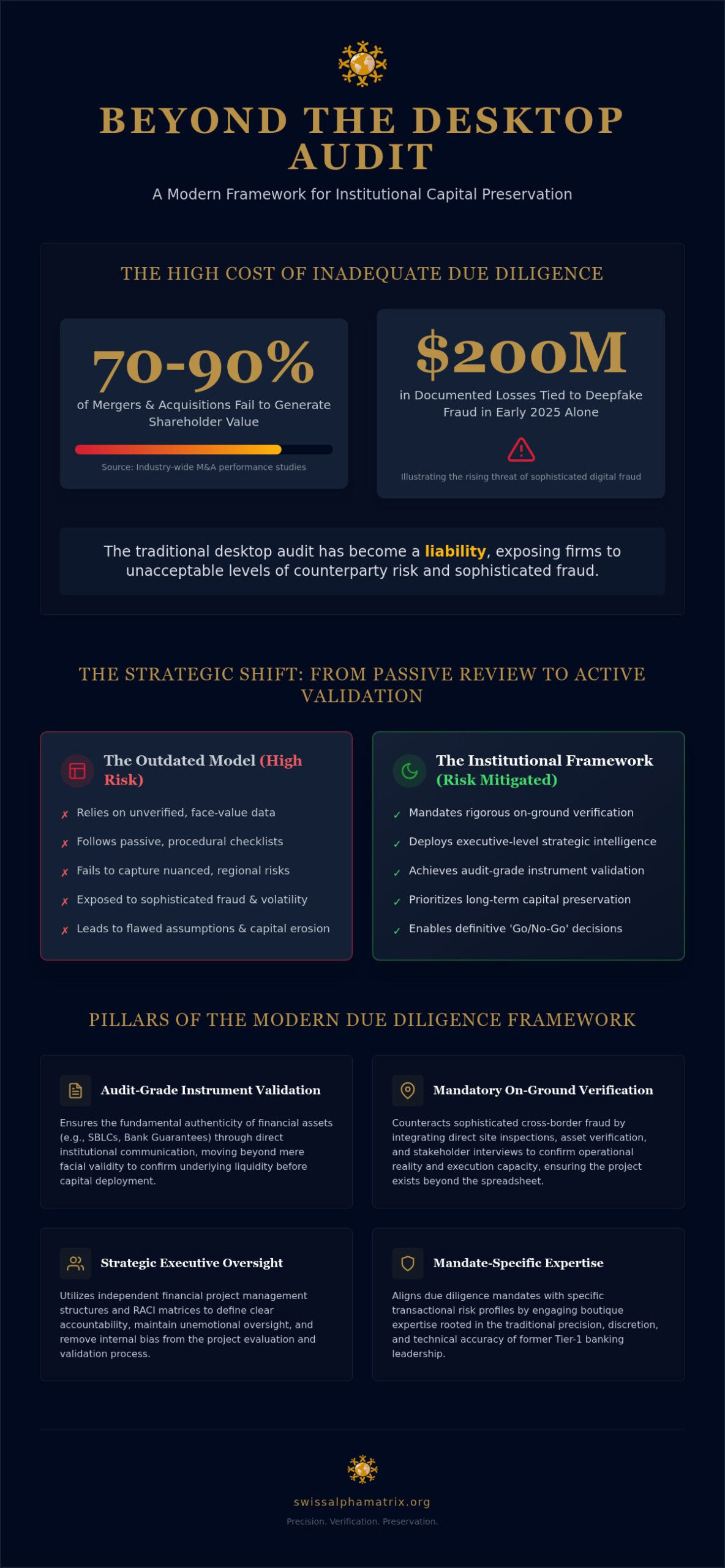
If 70% to 90% of mergers and acquisitions fail to generate shareholder value, one must consider whether the traditional desktop audit has become a liability rather than a safeguard for institutional capital. In an environment where documented losses tied to deepfake fraud reached $200 million in early 2025 alone, the necessity for robust business case due diligence has transitioned from a standard procedural requirement to a critical pillar of institutional survival. You likely recognize that relying on unverified data or sovereign bank instruments without on-ground validation exposes your firm to unacceptable levels of counterparty risk. This vulnerability is exacerbated by a shifting regulatory climate, including the postponement of FinCEN AML requirements to 2028, which demands a more proactive stance toward capital preservation.
We’ll provide the sophisticated methodologies required to validate complex cross-border business cases and protect institutional capital through audit-grade verification. By moving beyond passive research, you’ll master the frameworks necessary to achieve a definitive ‘Go/No-Go’ decision based on technical precision and regional intelligence. This discussion outlines the transition from speculative desktop reviews to a rigorous institutional framework; focusing on the validation of Tier-1 bank instruments and the mitigation of regulatory exposure in an increasingly volatile global market.
Key Takeaways
- Transition from standard procedural checklists to a strategic framework of executive-level intelligence designed to preserve institutional capital in high-stakes environments.
- Execute rigorous business case due diligence through audit-grade instrument validation, ensuring the fundamental authenticity of financial assets before capital deployment.
- Counteract sophisticated cross-border fraud by integrating mandatory on-ground verification, encompassing direct site inspections and stakeholder interviews to confirm operational reality.
- Utilize independent financial project management structures and RACI matrices to define clear accountability and maintain oversight throughout the validation process.
- Align due diligence mandates with specific transactional risk profiles by engaging boutique expertise rooted in the traditional precision of former Tier-1 banking leadership.
The Architecture of Business Case Due Diligence in High-Stakes Transactions
High-stakes transactions demand a level of scrutiny that transcends the perfunctory. While many view due diligence as a defensive obligation, it’s more accurately described as a strategic pillar of capital preservation. The traditional reliance on standardized checklists often fails to capture the nuanced risks inherent in complex, cross-border environments. Instead, a shift toward sophisticated executive-level intelligence is required. This methodology prioritizes deep technical validation over superficial compliance, moving the focus from passive participation to a performance-oriented mindset that prioritizes the long-term preservation of assets. Desktop analysis, while convenient, remains fundamentally insufficient for verifying the integrity of sovereign or Tier-1 bank instruments. Without on-ground verification, institutional capital remains exposed to sophisticated fraud and regional volatility. Independent advisory services play a critical role here, as they provide an unemotional perspective that removes internal bias from the project evaluation process.
The Institutional Mandate for Precision
Stakeholders carry a profound fiduciary responsibility that necessitates absolute technical accuracy. Precision in the initial business case due diligence prevents the gradual capital erosion that occurs when underlying assumptions are flawed. It’s vital to distinguish between a legal review, which confirms contractual validity, and operational due diligence, which assesses the actual capacity to execute. A contract might be legally sound while the operational infrastructure remains non-existent or inadequate for the project’s scale. The failure to recognize this distinction often leads to the commitment of resources to projects that are structurally incapable of yielding the projected returns. Institutional entities must demand audit-grade verification that goes beyond facial validity to ensure stability and strategic growth.
Identifying Strategic Vulnerabilities
Identifying strategic vulnerabilities requires evaluating the granular alignment between stated project milestones and financial projections. In volatile markets, a business model’s credibility depends on more than just historical data; it requires an assessment of real-time market dynamics and counterparty reliability. A rigorous business case due diligence mandate ensures that risk identification isn’t a generic exercise but a hyper-personalized investigation into the specific variables of the deal. By assessing the credibility of the underlying business model against current geopolitical shifts, experts can identify potential points of failure before capital is deployed. This process is not a static audit but a dynamic exercise in validation that mirrors the traditional discretion of high-end private wealth management, providing the clarity needed for a definitive ‘Go/No-Go’ decision.
Validating the Financial Core: Audit-Grade Instrument Integrity
The integrity of a transaction’s financial core often rests upon the validity of sophisticated bank instruments. Many executives mistakenly assume that a provided document, appearing legitimate on its face, represents an ironclad commitment of capital. However, rigorous business case due diligence must penetrate this veneer of facial validity to confirm the actual issuance and underlying liquidity of assets. Relying on “grey market” or unverified instruments doesn’t just jeopardize the individual deal; it threatens the institutional reputation and long-term stability of the acquiring party. Providing audit-grade reports ensures that C-suite stakeholders possess the verified, technical documentation required to authorize significant capital deployment with absolute confidence.
Validation of Complex Bank Instruments
The verification of Standby Letters of Credit (SBLCs) and Bank Guarantees requires a nuanced approach that involves direct communication with issuing institutions. It’s insufficient to merely review a digital copy; seasoned experts must confirm that the instrument is active, unencumbered, and that its specific terms align precisely with the proposed transaction milestones. Utilizing professional bank instrument validation services allows firms to bypass the ambiguity often introduced by intermediaries or brokers. This meticulous process mitigates counterparty risk by ensuring that the financial collateral is both authentic and enforceable under international banking standards. For those seeking broader strategic context, reviewing due diligence tips for business owners can highlight the universal necessity of verifying asset claims before committing to any definitive legal agreement.
Capital Protection Through Forensic Analysis
Institutional-grade metrics are employed to stress-test the financial assumptions embedded within the core business model. Discrepancies in capital structures or hidden funding commitments often remain obscured until a forensic lens is applied to the balance sheet and instrument history. This level of business case due diligence identifies exactly where financial projections diverge from current market realities or regulatory constraints. Maintaining a standard of Swiss discretion while handling such sensitive financial data ensures that proprietary information remains secure throughout the inquiry. This structured approach to forensic analysis distinguishes a robust risk management framework from a passive, checklist-based audit. To ensure your interests are protected by seasoned experts, it’s prudent to consult with an independent authority capable of delivering audit-grade instrument verification.
Beyond the Spreadsheet: Operational and On-Ground Verification
Digital validation, while essential for securing the financial instrument, remains a partial exercise if it’s not supported by a physical presence on the ground. This on-site engagement serves as the only definitive counter to sophisticated cross-border fraud, which often utilizes high-quality digital documentation to mask operational deficiencies. A spreadsheet can be meticulously crafted to reflect a financial reality that simply doesn’t exist; therefore, bridging the gap between “paper assets” and operational reality requires a boots-on-the-ground approach. By integrating cross-border investment due diligence into the broader risk framework, institutions move beyond the theoretical. This level of business case due diligence ensures that the assets described in a memorandum are not only authentic but also functional and unencumbered by local logistical failures or undisclosed liabilities.
The Necessity of Local Intelligence
Navigating the intricate regulatory environments of global financial hubs like London, Geneva, and Hong Kong requires more than just a passing familiarity with local laws. It demands the deep, established networks of former Tier-1 bank executives who understand the subtle market dynamics that numerical models often overlook. These networks provide access to informal intelligence and regional precision that are inaccessible to those performing research from a distance. Local intelligence allows for the identification of geographic risks, such as those highlighted by the upcoming 2027 EU Forced Labour Regulation, which requires enhanced due diligence to identify forced labor in supply chains. This regional expertise ensures that business case due diligence remains compliant with evolving international standards and protects the firm from unforeseen regulatory sanctions.
Operational Due Diligence (ODD) Frameworks
A robust ODD framework evaluates management competence and organizational integrity through direct, in-person engagement rather than relying on curated biographies. This process involves several critical components:
- Detailed site visits to verify the existence and condition of physical infrastructure.
- Personnel interviews designed to gauge the depth of the leadership team’s technical expertise and moral character.
- Direct asset inspection to ensure that equipment and inventory match the balance sheet valuations.
- Mapping operational workflows to identify hidden bottlenecks that could derail projected milestones.
Verifying the physical infrastructure prevents the catastrophic failure of capital deployment into substandard or non-existent facilities. This meticulous inspection of the operational core provides a level of certainty that no digital audit can replicate, reinforcing the institutional mandate for capital preservation and strategic growth. It’s this commitment to technical accuracy and unemotional expertise that distinguishes a boutique, high-level service from a passive participant in the global market.
Strategic Frameworks for Executive Decision-Making and Oversight
Effective governance transforms raw data into actionable intelligence, ensuring that the insights gained from technical audits are translated into strategic clarity. This process requires implementing a structured independent financial project management framework that prioritizes capital preservation over deal momentum. Unlike generalized corporate oversight, this specialized structure focuses on the validation of high-stakes financial commitments and the removal of internal bias. It ensures that the findings of your business case due diligence aren’t lost in institutional bureaucracy but are instead used to inform precise, unemotional decisions. Establishing clear project milestones versus final deliverables creates a transparent reporting environment, allowing the C-suite to monitor progress without becoming entangled in tactical minutiae.
The RACI Model in Complex Transactions
Accountability often becomes blurred in multi-stakeholder deals, leading to decision-making paralysis or the oversight of critical risks. The RACI model provides a remedy by explicitly defining who is Responsible, Accountable, Consulted, and Informed for every phase of the validation process. In the context of business case due diligence, this clarity is paramount when verifying high-value deliverables such as sovereign bank guarantees or cross-border asset valuations. It ensures that every technical finding is reviewed by the appropriate expert and that the final decision rests with a clearly identified stakeholder. This structured approach prevents the diffusion of responsibility that often precedes significant capital loss.
PMO Integration for Transactional Success
A dedicated Project Management Office (PMO) serves as the engine room of the due diligence phase, maintaining deal momentum while ensuring no step in the critical path is bypassed. This independent oversight is vital for capital protection, as it provides an objective buffer against the “deal fever” that often clouds internal evaluations. By monitoring every stage of the inquiry, the PMO generates the structured audit trails required to satisfy increasingly stringent regulatory compliance standards. This methodical approach mirrors the traditional discretion of high-end private wealth management, prioritizing meticulous detail over short-term speed. To implement these sophisticated frameworks within your organization, you may request an institutional consultation with our project management experts.
Mandate-Specific Advisory: The Swiss Alpha Matrix Methodology
The efficacy of an institutional validation framework depends heavily on the caliber of the practitioners executing the mandate, as the depth of inquiry required for high-stakes deals demands more than a cursory review of financial statements. Swiss Alpha Matrix distinguishes itself as a boutique entity led by former Tier-1 banking executives, offering a level of technical depth and regional precision that larger, more generalized firms often struggle to replicate. By customizing each business case due diligence mandate to the specific risk profile of the deal, we ensure that no variable, whether it’s a complex bank instrument or a nuanced regulatory hurdle, remains unexamined. This approach utilizes financial advisory methodologies rooted in the traditional discretion of high-end private wealth management. The conclusion of our review provides more than just a summary; it delivers actionable, executive-grade intelligence that serves as a definitive foundation for capital protection and strategic growth.
A Partnership Rooted in Discretion and Precision
Sophisticated investors and institutional entities often seek independent, unemotional experts who prioritize long-term preservation over the momentum of a single transaction. As a master planner for complex programs, Swiss Alpha Matrix maintains deal integrity through every phase of the validation lifecycle, acting as a protective authority for your interests. This partnership is defined by a refusal to oversimplify complex dynamics, catering instead to an audience that values technical accuracy and moral character. Our methodology moves beyond the identification of risks to the active planning of their mitigation, ensuring that every strategic pillar is supported by verifiable data and audit-grade intelligence. This elite level of service feels more like a dedicated partnership than a standard provider relationship, rooted in historical reliability and regional precision that distinguishes a performance-oriented mindset from passive participants.
Next Steps in Capital Deployment
Once the initial validation is complete, the focus shifts toward the transition from business case due diligence to active project management. Protecting capital requires ongoing regulatory and operational oversight that extends well beyond the signing of a contract, especially when navigating the intricacies of cross-border transactional risk. By engaging with Swiss Alpha Matrix for bespoke advisory mandates, firms ensure that the precision established during the initial validation phase is maintained throughout the entire deployment cycle. This standard of service is both broad in reach and meticulous in its attention to detail, offering high-level access to networks that safeguard institutional interests in volatile markets. We invite you to experience a partnership rooted in historical reliability and regional excellence, where every decision is backed by seasoned expertise and a commitment to absolute technical accuracy.
Securing Institutional Longevity through Rigorous Validation
The preservation of institutional capital requires a transition from passive observation to a state of active, technical verification. By implementing a sophisticated framework for business case due diligence, firms ensure that every financial instrument and operational claim undergoes a rigorous, audit-grade review before any commitment is finalized. It’s a methodology that prioritizes on-ground intelligence and the validation of complex bank instruments over superficial desktop research, serving as the definitive safeguard against the escalating risks of cross-border fraud and regulatory volatility.
Maintaining this standard of excellence demands a partner who understands the traditional discretion of high-end wealth management while possessing the technical depth to navigate modern global markets. Swiss Alpha Matrix, led by former Tier-1 bank executives, provides the specialized expertise required to manage complex cross-border projects with regional precision through audit-grade instrument validation. We invite you to secure your next transaction with Swiss Alpha Matrix advisory, ensuring your strategic growth is built upon a foundation of absolute technical accuracy and institutional-grade oversight. Your commitment to precision today defines the stability of your portfolio tomorrow.
Frequently Asked Questions
What is the primary objective of business case due diligence?
The primary objective of business case due diligence is to provide executive stakeholders with a definitive validation of a transaction’s underlying assumptions and financial integrity. It moves beyond superficial checklists to deliver audit-grade intelligence that ensures long-term capital preservation. By identifying strategic vulnerabilities early, this process allows for a precise ‘Go/No-Go’ decision, effectively mitigating counterparty and regulatory risks before any capital is deployed.
How does operational due diligence differ from financial due diligence?
Financial due diligence focuses on the fiscal health and historical performance of an entity, whereas operational due diligence (ODD) evaluates the organization’s actual capacity to execute its stated business model. ODD examines management competence, organizational integrity, and the physical condition of infrastructure. This distinction is critical because a project may appear financially sound on paper while remaining operationally incapable of meeting its projected milestones.
Why is on-ground verification critical for cross-border investments?
On-ground verification is essential for cross-border investments because it provides the only definitive counter to sophisticated digital fraud. Spreadsheets and digital certificates can be manipulated to mask operational failures or non-existent assets. By conducting site visits and personnel interviews in jurisdictions such as Geneva or Hong Kong, experts can confirm that the operational reality matches the documentation provided by the counterparty.
What are the common red flags in financial instrument validation?
Common red flags include discrepancies in SWIFT codes, unverified histories of “grey market” instruments, and any reluctance to allow direct communication with the issuing Tier-1 bank. These indicators often suggest that the collateral is either non-existent or heavily encumbered. Rigorous business case due diligence identifies these anomalies through forensic analysis, preventing the commitment of capital to fraudulent or structurally flawed financial instruments.
How does a RACI matrix improve the due diligence process?
A RACI matrix improves the process by explicitly defining who is Responsible, Accountable, Consulted, and Informed for every technical deliverable. This structure prevents the diffusion of responsibility and decision-making paralysis that often occurs in multi-stakeholder deals. It ensures that high-value risks are reviewed by the correct experts, maintaining absolute clarity on the validation of high-stakes financial commitments throughout the lifecycle of the deal.
What is the role of independent project management in deal execution?
Independent project management provides an objective buffer against internal bias and the “deal fever” that can cloud executive judgment. By establishing an independent PMO, firms can maintain deal momentum without bypassing critical validation steps. This oversight ensures that the due diligence process remains a logical, steady exercise in risk mitigation, producing the structured audit trails required for modern regulatory compliance.
How long does a comprehensive business case due diligence mandate typically take?
The timeline for a comprehensive mandate varies based on the complexity of the bank instruments and the geographic scope of the required on-ground verification. While some preliminary reviews can be completed quickly, a full institutional-grade audit typically requires several weeks of intensive technical inquiry. This duration ensures that the final report meets the standards of technical accuracy and thoroughness expected by sophisticated executive stakeholders.
Why should I choose a boutique advisory over a Big 4 firm for due diligence?
Boutique advisories offer a level of hyper-personalization and direct access to former Tier-1 banking executives that larger firms often cannot match. This model prioritizes regional precision and Swiss discretion over high-volume throughput, ensuring that your specific risk profile receives meticulous attention. Choosing a boutique partner means your interests are handled by seasoned experts who value long-term preservation and strategic growth over short-term transaction counts.