

The preservation of institutional capital during periods of heightened volatility is not merely a function of rapid communication, but rather the result of an unwavering commitment to evidentiary precision. You likely understand that when cross-border deal delays occur or market volatility questions the validity of financial instruments, the resulting information asymmetry can quickly dissolve years of carefully cultivated trust. Successfully managing stakeholder expectations in a crisis requires more than traditional public relations; it demands a rigorous framework of objective verification that replaces panic with institutional certainty.
This article provides the sophisticated methodologies necessary to maintain stakeholder confidence and shield capital from the erosion of credibility. We will explore a structured framework for executive communication that aligns with the 2026 regulatory landscape, including the heightened capital standards of the Basel III Endgame and the stringent reporting requirements of the updated Corporate Transparency Act. You’ll discover how to deploy audit-grade instrument validation and on-ground verification to provide the objective proof of project viability that today’s sophisticated investors demand. Through disciplined oversight and technical depth, you can transform a period of uncertainty into a demonstration of unwavering professional competence.
Key Takeaways
- Identify the mechanisms of information asymmetry that compromise cross-border deals and learn to replace ambiguity with technical precision.
- Transition from reactive public relations to a disciplined, mandate-specific reporting cadence that prioritizes institutional stability over emotional reassurance.
- Deploy audit-grade instrument validation to provide the objective proof required by high-net-worth individuals and institutional entities during market volatility.
- Master the sophisticated methodologies for managing stakeholder expectations in a crisis by leveraging independent project oversight and Tier-1 banking expertise.
- Establish a rigorous framework for on-ground verification to preserve capital and restore deal integrity during complex financial disruptions.
The Anatomy of Transactional Crises in Complex Financial Programmes
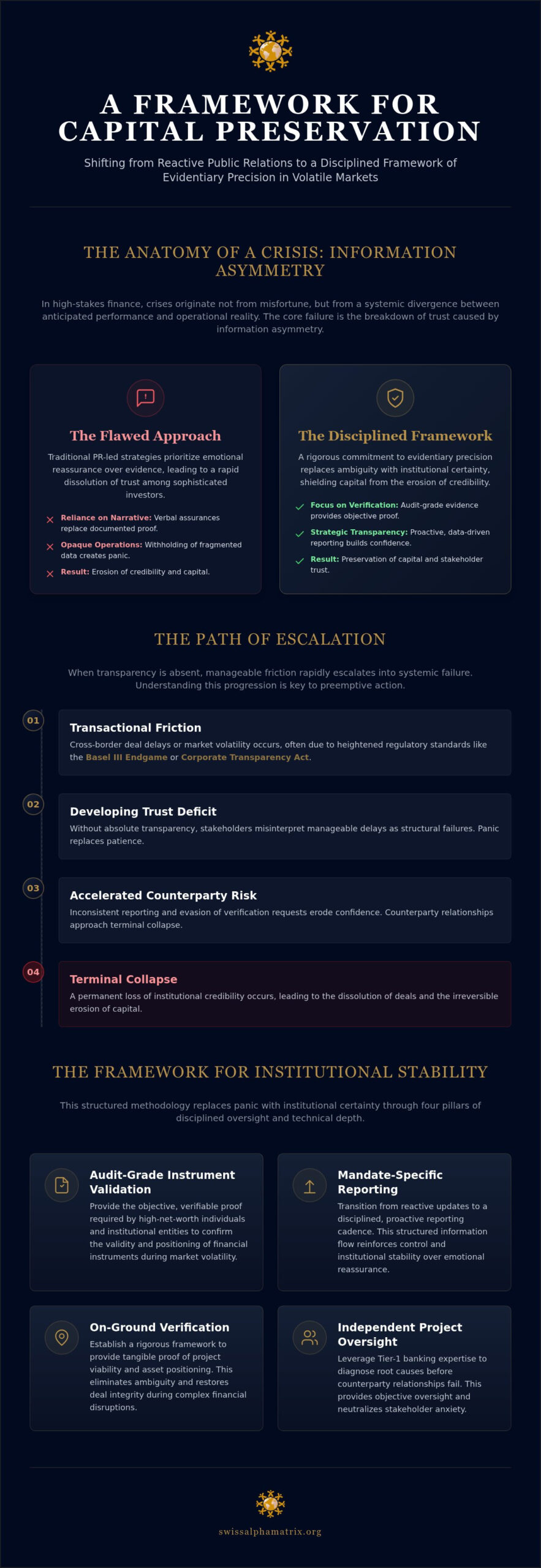
In the context of complex financial mandates, a crisis is rarely a singular event of public relations misfortune. It is, more accurately, a systemic divergence between anticipated performance and operational reality. While generic business literature might suggest a broad crisis management framework, these models often lack the technical granularity required for high-stakes finance. For institutional entities, the true crisis originates in information asymmetry, where one party possesses critical data that the other lacks, leading to a rapid dissolution of trust. Successfully managing stakeholder expectations in a crisis requires an immediate pivot from narrative control to technical verification.
Traditional PR-led strategies fail in sophisticated institutional environments because they prioritise emotional reassurance over audit-grade evidence. High-net-worth individuals and fund managers don’t require platitudes; they require a precise accounting of capital positioning and regulatory standing. When information is withheld or presented in a fragmented manner, stakeholders naturally assume the worst case scenario. This assumption creates a tipping point where a project delay is no longer viewed as a manageable hurdle but as a structural threat to capital preservation.
Structural vs. Perceived Transactional Friction
Distinguishing between temporary friction and terminal instrument invalidity is a foundational skill for the modern executive. In 2026, the implementation of the Basel III Endgame has fundamentally altered capital standards, often causing administrative delays that stakeholders may misinterpret as structural failures. Missing a milestone in a cross-border deal isn’t always a sign of incompetence; it’s frequently a byproduct of shifting reporting requirements under the updated Corporate Transparency Act. However, when these delays aren’t met with absolute transparency, a trust deficit develops. This deficit can transform a manageable liquidity bottleneck into a permanent loss of institutional credibility if the technical causes aren’t clearly articulated.
The Escalation of Counterparty Risk
Counterparty risk accelerates when transparency remains stagnant. It’s a quiet erosion. One day, the deal is viable; the next, trust has evaporated. Early warning signs of systemic failure include inconsistent reporting, the evasion of on-ground verification requests, and a reliance on verbal assurances over documented proof. Managing stakeholder expectations in a crisis becomes an exercise in futility if the underlying project management is opaque. The necessity of independent financial project management becomes clear here, as it provides a mechanism to diagnose root causes before counterparty relationships reach a state of terminal collapse. By placing oversight in the hands of those with Tier-1 banking experience, organisations can identify whether a crisis is a result of external market forces or internal operational negligence.
Establishing a Framework of Strategic Transparency and Institutional Discipline
Moving beyond the frantic urgency that characterizes common corporate responses, the Swiss Alpha approach prioritizes technical accuracy over the hollow comfort of emotional reassurance. This methodology recognizes that in high-stakes finance, the primary objective is the preservation of capital through the elimination of ambiguity. By utilizing sophisticated financial advisory methodologies, executives can construct a reporting cadence that functions as a stabilizing force rather than a reactive shield. Successfully managing stakeholder expectations in a crisis involves a deliberate shift toward a proactive, mandate-specific communication schedule that reinforces the perception of control through the delivery of verifiable data.
The process of managing stakeholder expectations during a period of capital risk requires a clearly defined hierarchy of information. Not every participant in a complex project requires the same level of granularity; indeed, over-sharing technical minutiae with non-essential parties can often exacerbate anxiety. Instead, information must be tiered, ensuring that C-suite executives and institutional partners receive the high-level intelligence required for strategic decision-making, while operational teams focus on the execution of tactical milestones. For those overseeing multi-jurisdictional portfolios, engaging with a partner focused on operational due diligence ensures that this transparency is backed by on-ground reality.
The Executive Communication Protocol
Central to this framework is the drafting of a formal “Statement of Facts,” a document designed to neutralize speculation by providing a definitive, chronological account of the disruption. This protocol balances the absolute requirement for transparency with the necessity of Swiss-style discretion, ensuring that sensitive deal structures remain protected while stakeholders are kept informed. To maintain this balance, a structured feedback loop must be implemented, allowing for the real-time capture of concerns without compromising the steady, measured pace of institutional updates. This approach ensures that managing stakeholder expectations in a crisis remains an exercise in logical progression rather than emotional management.
Institutional Discipline in Reporting
Discipline in reporting is maintained through the standardization of data delivery, which ensures that all stakeholders, regardless of their location or time zone, operate from a single source of truth. The Project Management Office (PMO) plays a critical role here, maintaining a rigorous audit trail that documents every action taken during the crisis execution phase. This level of oversight is essential for meeting the 2026 regulatory expectations regarding communication archives and governance. The Deliverable Review Matrix serves as the definitive tool for crisis accountability by mapping technical milestones directly to specific reporting obligations, ensuring that no aspect of the recovery process remains unverified or undocumented.
Leveraging Audit-Grade Validation to Neutralise Stakeholder Anxiety
In the current climate of 2026, where regulatory frameworks like the Basel III Endgame have significantly heightened the scrutiny on capital adequacy, verbal assurances have lost their historical currency. For high-net-worth individuals and institutional entities, the standard for managing stakeholder expectations in a crisis has shifted from narrative-driven updates to the provision of irrefutable, technical evidence. Fiduciary responsibility now mandates a move beyond optimistic projections, requiring instead the deployment of intelligence-grade documentation that can withstand the most rigorous internal audits. When capital is at risk, stakeholders don’t seek a partner who merely communicates; they seek a partner who validates.
Central to this evidentiary turn is the utilisation of bank instrument validation services, which serve as an objective counterweight to market rumours and speculative anxiety. By providing third-party verification of the underlying financial assets, executives can replace the fragile concept of “hope” with the concrete reality of verified liquidity. This level of precision is essential for maintaining the quiet authority required to lead a project through complex financial disruptions without succumbing to the pressure of short-term speculation.
Validation as a Strategic Anchor
Audit-grade reports provide the necessary technical air cover for executive decision-making, allowing leaders to stand firm on a foundation of facts rather than defensive posturing. This is where the psychology of the “unemotional expert” becomes a critical asset. When an external partner, unburdened by the internal pressures of the deal, provides a cold, technical assessment, it naturally restores a sense of professional calm. This process involves a meticulous comparison of perceived risk versus verified reality, often facilitated through cross-border investment due diligence that accounts for regional nuances and jurisdictional specifics. By tethering modern strategies to these concepts of regional excellence, firms can distinguish a performance-oriented mindset from passive participation in a failing mandate.
The Role of Physical On-Ground Verification
While digital archives and electronic records are essential, they are often insufficient during a high-stakes financial crisis where the very existence or status of an asset is in question. Physical on-ground verification provides the final layer of certainty, confirming that operational realities match the data presented on a balance sheet. When communicating with stakeholders, the inclusion of on-ground findings, such as site inspections or face-to-face counterparty interviews, serves to dismantle the information asymmetry discussed earlier. Integrating these findings into the broader stakeholder management strategy ensures that every update is anchored in a reality that has been seen, touched, and technically validated. It’s this standard of service, both broad in reach and meticulous in detail, that preserves the long-term trust of elite institutional partners.
Tactical Execution: Managing the Information Flow in Cross-Border Engagements
The tactical execution of a communication strategy within a multi-jurisdictional environment requires a profound understanding of how international financial regulations dictate the timing and substance of disclosures, particularly when dealing with the heightened reporting standards established in 2026. Effectively managing stakeholder expectations in a crisis across multiple borders demands a rejection of the high-velocity M&A news cycle in favor of a measured, legally vetted cadence of information release. This approach ensures that deal integrity is preserved while maintaining the confidentiality necessary for complex capital protections. When navigating these intricate global mandates, the objective isn’t merely to speak, but to ensure that every word aligns with the specific compliance frameworks of each involved jurisdiction.
Managing expectations across different time zones and cultural business norms requires more than logistical coordination; it demands a hyper-personalized awareness of how various institutional partners perceive risk and value. While a European private bank might prioritize long-term stability and discretion, an Asian sovereign wealth fund might focus on the immediate technical verification of asset liquidity. For executives seeking to fortify their global operations against such complexities, our risk management frameworks provide the institutional discipline necessary to navigate these intricate landscapes with precision and authority.
Multi-Jurisdictional Stakeholder Coordination
Aligning diverse stakeholder groups, including investors, regulators, and local partners, necessitates a centralized narrative managed by a lead advisor with global experience. This centralization is the primary defense against information leakage, which can be devastating in high-profile international deals where market speculation often outpaces factual reality. By funneling all intelligence through a single, sophisticated point of contact, organizations can ensure that the narrative remains consistent across all global offices. This prevents the fragmentation of trust that occurs when different stakeholders receive varying levels of technical detail, thereby reinforcing the image of a master planner in control of the situation.
Preserving Long-Term Deal Integrity
Admitting to setbacks in a complex financial programme is a delicate art that, when executed correctly, can actually strengthen stakeholder trust. The key lies in structuring milestone-based recoveries that demonstrate tangible, verified progress toward the ultimate project objective, rather than offering vague promises of future resolution. This logic moves from broad principles down to specific strategic pillars, creating a sense of professional calm that encourages confidence in the recovery process. By clearly delineating the Responsible, Accountable, Consulted, and Informed parties for every crisis-related task, the RACI matrix prevents accountability gaps during crisis execution and ensures that managing stakeholder expectations in a crisis remains a structured, logical endeavor.
Restoring Deal Integrity through Independent Project Oversight
The resolution of a complex financial disruption requires more than technical skill; it necessitates an objective distance that internal teams, by virtue of their emotional and professional proximity to the project, often cannot maintain. When a mandate faces significant headwinds, internal stakeholders frequently succumb to cognitive biases that can cloud judgment and lead to defensive reporting. In such high-stakes environments, managing stakeholder expectations in a crisis becomes exponentially more difficult as the lines between operational reality and corporate preservation begin to blur. Leveraging an independent advisor, particularly one with a background as a former Tier-1 bank executive, provides the necessary “unemotional expert” perspective required to restore institutional trust through technical precision rather than narrative optimism.
Transitioning from a state of emergency back to a trajectory of strategic growth demands a disciplined hand. The value proposition of an independent partner lies in their ability to provide the “Audit-Grade” bridge necessary to reach project completion. This oversight ensures that every step taken toward recovery is documented, verified, and aligned with the overarching fiduciary duties of the organization. By removing the internal pressure to “save” a deal, the independent advisor can focus exclusively on the technical accuracy of the recovery path, which is the only currency that carries weight with sophisticated institutional partners in 2026.
The Neutral Arbiter Advantage
Utilizing independent oversight allows an organization to present recovery plans that carry the weight of external validation. Skeptical stakeholders, who may have grown weary of internal assurances during the height of a disruption, often find the presence of a neutral arbiter to be the most significant indicator of a genuine commitment to project viability. This strategic delegation also serves to reduce executive fatigue, allowing the C-suite to refocus on broad strategic objectives while the specialist manages the granular complexities of crisis resolution. Once the immediate disruption is neutralized, the long-term benefits of a “Crisis Post-Mortem” based on objective data cannot be overstated. These evaluations provide the technical insights necessary to fortify future mandates against similar vulnerabilities, ensuring that the organization emerges with improved structural resilience.
Conclusion: Precision as the Ultimate Reassurance
The transition from a defensive posture back to performance-oriented growth must be handled with the same level of precision that defined the initial response framework. Managing stakeholder expectations in a crisis is ultimately a process of replacing the volatile energy of uncertainty with the steady, measured pace of institutional discipline. By adhering to the methodologies outlined in this framework, from audit-grade instrument validation to on-ground verification, firms can protect their capital and their reputation simultaneously. This commitment to technical depth over simplicity is what distinguishes elite entities from passive market participants. Swiss Alpha Matrix serves as the definitive partner for these complex requirements, offering a standard of service that is both broad in reach and meticulous in its attention to detail. To explore how our former Tier-1 executives can restore integrity to your mandates, Contact Swiss Alpha Matrix for a confidential consultation.
Advancing Institutional Resilience in an Evolving Financial Landscape
The evolution of global financial mandates in 2026 requires a departure from traditional crisis management toward a model of rigorous, evidentiary precision. As we have examined, the transition from transactional friction to structural stability is achieved through the systematic elimination of information asymmetry. By prioritizing technical accuracy over emotional reassurance, organizations can maintain the quiet authority necessary to navigate multi-jurisdictional complexities with absolute discretion. Successfully managing stakeholder expectations in a crisis is not a matter of narrative control; it’s a commitment to the objective verification of every asset and operational milestone.
The path toward long-term capital preservation is built upon a foundation of institutional discipline and independent oversight. Swiss Alpha Matrix, led by former Tier-1 global bank executives, provides the specialized expertise required for complex cross-border project oversight and audit-grade instrument validation. By utilizing on-ground verification and refusing to oversimplify complex dynamics, we ensure that your interests remain in the hands of seasoned experts who prioritize strategic growth. You can confidently restore deal integrity by aligning your recovery frameworks with a standard of service that is both broad in reach and meticulous in its attention to detail. Secure your programme’s integrity with Swiss Alpha Matrix and move forward with the certainty of institutional excellence.
Frequently Asked Questions
What is the most common mistake when managing stakeholder expectations in a crisis?
The most frequent error is substituting narrative-driven reassurance for evidentiary precision. Executives often feel compelled to provide immediate, optimistic projections to calm markets, yet this frequently backfires when subsequent data contradicts those early claims. In sophisticated finance, stakeholders value the admission of technical friction far more than a hollow promise of rapid resolution that lacks an audit-grade foundation.
How much transparency is too much when dealing with HNWIs during a deal delay?
Transparency reaches a point of diminishing returns when it transitions from strategic disclosure to the release of raw, unvetted operational data that could compromise deal integrity. For high-net-worth individuals, the requirement is for intelligence-grade clarity regarding capital positioning, not an exhaustive log of every administrative hurdle. Maintaining Swiss-style discretion ensures that while stakeholders are informed of structural risks, the sensitive architecture of the mandate remains protected from unnecessary exposure.
Can independent project management really restore trust after a significant setback?
Independent project oversight is often the only mechanism capable of restoring trust because it eliminates the perceived conflict of interest inherent in internal reporting. When a third party with Tier-1 banking experience validates a recovery strategy, it provides the unemotional expert perspective that skeptical institutional partners require. This oversight replaces defensive posturing with an objective audit trail, effectively bridging the credibility gap that typically follows a significant transactional setback.
How do on-ground verification services differ from standard due diligence?
On-ground verification services extend beyond the desk-based analysis of standard due diligence by providing physical confirmation of asset existence and operational status. While traditional diligence relies heavily on digital archives and representations made by counterparties, on-ground verification involves site inspections and face-to-face interviews. This layer of regional precision is essential during a crisis to dismantle information asymmetry and provide stakeholders with absolute certainty regarding the physical reality of their interests.
What role does the RACI matrix play in crisis stakeholder management?
The RACI matrix serves as a critical governance tool that prevents accountability gaps by clearly defining who is Responsible, Accountable, Consulted, and Informed for every crisis recovery task. In the frantic energy of a disruption, roles often become blurred, leading to fragmented communication. By formalizing these relationships, an organization ensures that managing stakeholder expectations in a crisis remains a logical, structured process where every technical milestone is tethered to a specific reporting obligation.
How should an executive handle conflicting expectations between different stakeholder groups?
Executives should resolve conflicting stakeholder expectations by establishing a tiered information protocol that prioritizes disclosures based on the specific fiduciary mandates of each group. Rather than attempting to satisfy all parties with a single narrative, the master planner delivers tailored technical intelligence that addresses the unique risk profiles of regulators, investors, and partners. This measured approach ensures that the most critical institutional entities receive the granularity they require without overwhelming less essential participants with technical minutiae.
What is audit-grade validation and why is it necessary for financial instruments?
Audit-grade validation is a high-precision process that verifies the authenticity, liquidity, and regulatory standing of financial instruments using standards that meet the requirements of global financial institutions. It’s necessary because, in the 2026 landscape of Basel III Endgame regulations, verbal or standard bank confirmations are often insufficient to satisfy institutional due diligence. This rigorous verification provides the objective proof required to protect capital and maintain stakeholder confidence during periods of complex financial disruption.
How do cross-border regulations impact crisis communication strategies in 2026?
Cross-border regulations in 2026, such as the updated Corporate Transparency Act and international tax reforms, mandate a shift from high-volume data collection to high-precision verification in all stakeholder communications. These frameworks require firms to maintain a unified archive of both digital and voice records, with regulators increasingly asking for complete communication trails on demand. Consequently, crisis strategies must now align with these stringent governance expectations to avoid the secondary risk of regulatory non-compliance during an operational recovery.