

With the global cost of financial crime surging to an unprecedented $4.4 trillion in 2026, can your institution truly afford to rely on the mere veneer of standard bank-to-bank verifications? You likely recognize that in a climate defined by sophisticated institutional fraud, traditional documentary compliance often fails to reveal the nuanced risks inherent in high-volatility jurisdictions or ensure the practical enforceability of cross-border collateral. While recent regulatory shifts, such as the 2026 Treasury guidance on beneficial ownership, attempt to streamline administrative burdens, they simultaneously demand a more rigorous, risk-based approach to verify the true institutional standing of every counterparty.
By mastering the forensic methodologies outlined in this framework, you’ll move beyond automated checks to achieve absolute certainty regarding instrument legitimacy. We’ll explore how robust operational due diligence for financial services provides the intellectual depth required to minimize capital exposure and produce a definitive, audit-grade report for your stakeholders. From the integration of on-ground verification to the adoption of the latest 2026 Wolfsberg Group principles, this guide ensures your interests remain protected by the highest standards of regional excellence and technical precision.
Key Takeaways
- Recognize the critical shift from standard process reviews to forensic assessments capable of detecting “institutional hollowing” within counterparty entities.
- Execute a rigorous framework for operational due diligence for financial services that ensures all operative clauses are legally binding and aligned with your mandate’s risk schedule.
- Uncover the limitations of SWIFT MT760 verifications, which often confirm the identity of a sender while failing to validate the actual value or liquidity of the underlying asset.
- Adopt a multi-stage forensic protocol that integrates documentary analysis under UCP 600 standards with exhaustive reviews of an issuer’s institutional standing.
- Gain the strategic advantage of Swiss-grade precision to achieve absolute certainty in cross-border transactions and effectively minimize capital exposure in volatile jurisdictions.
The Evolution of Operational Risk in Cross-Border Financial Services
The discipline of operational due diligence for financial services has undergone a fundamental transformation, evolving from a perfunctory review of administrative processes into a rigorous, forensic assessment of an entity’s structural capacity to honor its long-term financial obligations. This shift is particularly acute in 2026, where the detection of institutional hollowing, a phenomenon where ostensibly stable entities maintain the facade of solvency while their internal capital structures are compromised, has become the primary objective of sophisticated investors. As the global M&A landscape continues to benchmark against a USD 2.8 trillion volume, the reliance on standard documentary compliance is no longer sufficient to protect interests in high-volatility jurisdictions. In the context of Operational Due Diligence in Alternative Investments, professionals must now scrutinize the practical enforceability of collateral rather than merely accepting the presence of a legitimate-looking balance sheet.
The Illusion of Technical Compliance
Technical compliance with International Chamber of Commerce standards, such as UCP 600 or ISP98, frequently provides a false sense of security for stakeholders involved in complex instrument validation. It’s a sobering reality that “ghost” institutions can maintain active SWIFT access and issue technically perfect messages while lacking the underlying liquidity to satisfy a draw-down request. The authentication gap represents the critical discrepancy between the technical validity of a financial transmission and the actual legal enforceability of the asset it purports to represent. Without on-ground verification, a transaction remains vulnerable to jurisdictional nuances that standard bank-to-bank protocols are simply not designed to capture.
Strategic Impact on Capital Preservation
Failures in the due diligence process don’t merely lead to administrative delays; they often result in irrevocable capital loss and profound reputational damage that can take decades to repair. Utilizing executive-level intelligence is essential for stabilizing stakeholder confidence, especially when deploying capital into unfamiliar regional markets where institutional standards may diverge from Western expectations. Deploying a dedicated framework for operational due diligence for financial services allows partners to distinguish between superficial compliance and genuine institutional resilience. By integrating a performance-oriented mindset, firms can move beyond passive participation and ensure their strategic growth is anchored in verifiable reality. For a deeper analysis of these methodologies, you may find our framework on Mastering Cross-Border Investment Due Diligence particularly instructive for your next mandate.
Defining the Four Pillars of Audit-Grade Operational Due Diligence
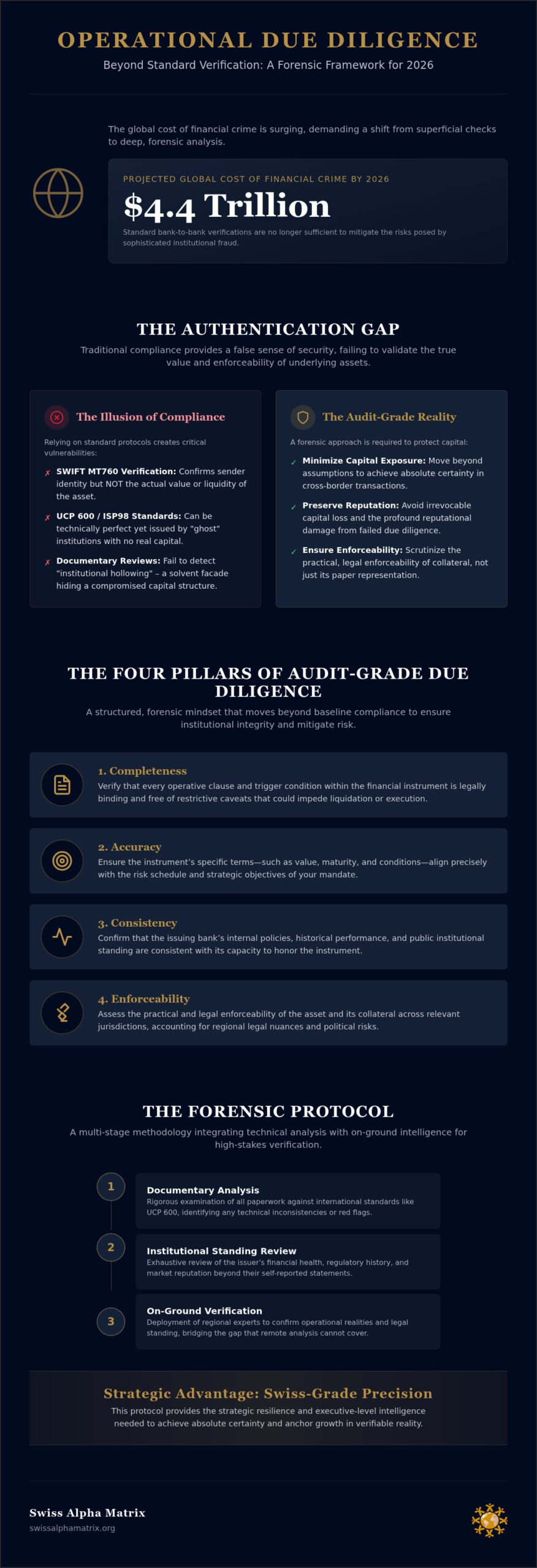
To move beyond the standard baseline of documentary compliance, one must adopt a forensic mindset that treats every financial instrument as a complex legal architecture. Audit-grade operational due diligence for financial services relies on four immutable pillars, ensuring that capital is never deployed based on assumptions of institutional integrity. These pillars provide the structured argument required to satisfy the most discerning stakeholders and provide a definitive roadmap for risk mitigation.
- Completeness: Verifying that every operative clause and trigger condition within the instrument is legally binding and free of restrictive caveats that could impede liquidation.
- Accuracy: Ensuring the instrument’s specific terms align precisely with the risk schedule and strategic objectives of the mandate.
- Consistency: Confirming that the issuing bank’s underlying internal policies and historical performance reflect its public institutional standing.
- Traceability: Establishing an immutable, deterministic chain of custody from the point of issuance to the ultimate beneficiary.
Completeness and Operative Veracity
A common pitfall in cross-border transactions is the presence of “non-operative” clauses within SWIFT MT760 messages. These clauses often negate the instrument’s value until a secondary, often obscure, condition is fulfilled, effectively rendering the collateral useless in a default scenario. A sophisticated review involves scrutinizing the jurisdictional alignment of the document. For instance, an instrument governed by Swiss law may have vastly different enforcement mechanisms than one governed by English law, even if the technical language appears identical. Verifying the application of specific ICC rules in bespoke transactions isn’t a mere formality; it’s a prerequisite for establishing legal recourse. Partners seeking this level of precision often rely on expert Audit-Grade Instrument Validation to ensure no clause remains unexamined.
The Requirement for Traceability
In high-value transactions, establishing a deterministic chain of custody is paramount for risk mitigation. This process ensures that the instrument hasn’t been compromised or encumbered at any stage of its transmission. Independent validation serves a dual purpose: it protects the principal’s capital and provides the definitive report required to satisfy external auditors and regulatory bodies. Without this forensic trail, the risk of “hollow” institutional representation increases, potentially leading to catastrophic capital loss. Our approach to Institutional-Grade Financial Advisory Methodologies emphasizes this need for transparency, ensuring every strategic pillar is anchored in verifiable data rather than trust in automated bank-to-bank verifications.
Beyond SWIFT MT760: Why Correspondent Banking Fails the Audit-Grade Standard
Many institutional investors mistakenly equate a SWIFT MT760 message with a definitive guarantee of asset liquidity, yet this reliance is fundamentally flawed. SWIFT is a secure messaging protocol designed to verify the identity of the sender, but it remains entirely agnostic to the underlying value or legal veracity of the asset being transmitted. In the current 2026 financial climate, we’re seeing an increasing number of “hollow” institutions that maintain active SWIFT connectivity and valid BIC codes despite underlying insolvency or a lack of tangible capital reserves. Relying on a standard bank-to-bank verification often misses these nuances because correspondent banks typically lack the mandate, the specialized expertise, or the regional presence to perform deep-dive, on-ground operational due diligence for financial services.
The Limitations of Automated Authentication
Automated KYC and AML systems are programmed to flag sanctioned entities or suspicious transaction patterns, but they’re notoriously poor at detecting bespoke “cut-and-paste” fraud within instrument templates. A technically perfect document can be issued by an institution that lacks a stable Tier-1 correspondent relationship, which significantly complicates the eventual liquidation of the instrument. It’s a dangerous assumption that a computer-generated confirmation equals institutional stability. Expert-led, manual forensic review remains the only credible path to establishing absolute certainty in complex cross-border transactions.
Independent Advisory vs. Conventional Banking
There are inherent conflicts of interest when you rely solely on bank-led verification processes. A bank’s primary objective is to facilitate the transaction and manage its own internal risk, which doesn’t always align with the principal’s need for exhaustive structural validation. Independent oversight provides an objective, unemotional risk assessment that’s essential for C-suite stakeholders who require a definitive audit-grade report before authorizing capital deployment. Utilizing specialized Bank Instrument Validation Services ensures the focus remains entirely on the preservation of your capital rather than the mere completion of a banking protocol. This distinction separates a passive participant from a performance-oriented master planner in the modern financial services sector.
The Forensic Protocol: A Multi-Stage Methodology for High-Stakes Verification
Achieving absolute certainty in cross-border transactions requires a departure from passive administrative reviews toward a structured, four-stage forensic protocol. This architecture ensures that every facet of a financial instrument, from its technical phrasing to the physical existence of its issuer, is scrutinized with a level of detail that standard compliance departments simply aren’t equipped to provide. By adopting this rigorous methodology, partners can ensure that operational due diligence for financial services functions as a genuine shield for capital preservation rather than a mere box-ticking exercise.
- Stage 1: Granular documentary analysis to ensure regulatory alignment with UCP 600 or ISP98 standards.
- Stage 2: Exhaustive institutional standing review, evaluating the creditworthiness and historical reputation of the issuing entity.
- Stage 3: On-ground verification of physical presence and the actual signatory authority of institutional officers in the host jurisdiction.
- Stage 4: Synthesis of all forensic data into a final audit-grade report, providing the clarity required for capital deployment decisions.
Institutional Standing and Regulatory Clarity
The 2026 landscape of international finance is characterized by shifting beneficial ownership requirements and enhanced Bank Secrecy Act regulations, both of which demand a higher standard of transparency. Verifying an issuing institution’s actual standing requires looking beyond the surface-level balance sheet to understand its place within the broader correspondent banking network and its adherence to the latest Wolfsberg Group principles. Our International Financial Regulations Guide details how these evolving standards impact the validity of bespoke financial instruments. It’s through this lens of regulatory precision that we evaluate whether an issuer possesses the moral character and institutional depth to satisfy their long-term obligations under complex market conditions.
The Imperative of On-Ground Verification
Site visits are the only definitive way to expose “ghost” banks that operate from offshore jurisdictions with little more than a digital facade and a rented suite. This stage of operational due diligence for financial services involves physically verifying the office location, the presence of operational staff, and the actual signatory authority of institutional officers in the host jurisdiction. We don’t simply rely on digital signatures or automated bank-to-bank confirmations; we assess the institutional environment to ensure it aligns with the prestige and scale of the transaction. This on-ground intelligence, which includes a nuanced reputation analysis of key personnel and their historical reliability, informs the final forensic risk rating presented to the C-suite. For those navigating high-volatility jurisdictions where legal enforceability is often opaque, our On-Ground Verification Services provide the necessary certainty to move forward with strategic confidence.
Strategic Resilience through Swiss Alpha Matrix Advisory Mandates
The transition from identifying systemic vulnerabilities to establishing a resilient investment framework requires more than just a methodology; it requires the presence of seasoned, unemotional experts who prioritize strategic growth over short-term speculation. At Swiss Alpha Matrix, our mandates are steered by former senior executives from Tier-1 global financial institutions, ensuring that every engagement is informed by decades of direct transactional experience at the highest levels of sovereign and institutional finance. By integrating the traditional discretion of a Swiss boutique with the uncompromising financial discipline required for rigorous operational due diligence for financial services, we provide a level of forensic oversight that automated bank-to-bank systems simply cannot replicate. This specialized expertise is meticulously designed to move beyond the mere identification of risk, focusing instead on the long-term preservation of capital through exhaustive instrument validation and complex project management.
Independent Project Oversight and Capital Protection
For organizations involved in complex, multi-year financial programs, recurring strategic consulting provides a necessary, persistent layer of protection against evolving jurisdictional risks and the subtle hollowing of institutional counterparties. These audit-grade reports are not merely internal documents, but are rather structured to satisfy the most stringent requirements of external regulators and institutional stakeholders who demand absolute transparency in their capital deployments. Our methodology ensures that every stage of a transaction, from initial issuance to final liquidation, is anchored in verifiable data, effectively bridging the gap between technical compliance and practical legal enforceability. For a deeper understanding of this framework, explore The Strategic Architecture of Independent Financial Project Management to see how we stabilize high-stakes deployments through regional precision.
Engaging with Swiss Alpha Matrix
Initiating a high-value mandate for operational due diligence for financial services begins with a comprehensive, confidential assessment of your specific risk schedule and institutional objectives. We operate with a profound commitment to absolute privacy and exclusivity, positioning ourselves as a dedicated partner rather than a commoditized service provider, which mirrors the traditional values of private wealth management. Every advisory engagement is hyper-personalized to the unique requirements of the mandate, reflecting our firm belief that regional excellence and technical precision are the only credible ways to achieve absolute deal integrity in the 2026 landscape. To secure your capital and establish an immutable forensic foundation for your next cross-border transaction, we invite you to contact our senior advisory team in Geneva or Hong Kong for a confidential consultation regarding our bespoke risk management frameworks.
Securing Transactional Integrity in a Volatile Global Landscape
Navigating the complexities of cross-border finance in 2026 requires a shift from passive compliance to proactive forensic scrutiny. The limitations of automated bank-to-bank verifications, as highlighted throughout this framework, necessitate a discipline that prioritizes institutional depth and legal enforceability over technical appearances. By adopting a multi-stage protocol that integrates on-ground intelligence with rigorous documentary analysis, partners can achieve the absolute certainty required to protect capital in high-volatility jurisdictions. This standard of operational due diligence for financial services ensures that every operative clause is verified and every counterparty’s institutional standing is beyond reproach.
Swiss Alpha Matrix stands as the definitive partner for those who value regional excellence and technical precision. Led by former Tier-1 global bank executives, our firm provides the intellectual depth and specialized on-ground verification network across key financial hubs necessary to expose nuanced risks. Our audit-grade reports are accepted by global regulators and external auditors, providing a definitive foundation for complex project management. Secure your capital deployment with audit-grade operational due diligence from Swiss Alpha Matrix. We invite you to experience a standard of service where your interests are managed with the utmost discretion and professional calm.
Frequently Asked Questions
What defines an operational due diligence report as “audit-grade”?
An audit-grade report is defined by its forensic depth and its capacity to satisfy the most stringent requirements of external regulators and institutional auditors. Unlike standard compliance checks, it integrates on-ground verification with exhaustive documentary analysis to establish an immutable chain of custody. This level of reporting provides stakeholders with the absolute certainty required for high-stakes capital deployment in complex jurisdictions where traditional transparency is often lacking.
How does UCP 600 differ from ISP98 in the instrument validation process?
UCP 600 primarily governs commercial letters of credit and focuses on the presentation of documents for payment, whereas ISP98 is specifically designed for standby letters of credit. In the validation process, the choice of rule set dictates the legal framework for enforcement and the specific trigger conditions for liquidation. Identifying which set of rules applies is a critical component of ensuring jurisdictional alignment and operative veracity in bespoke transactions.
Why is on-ground verification necessary if the bank has already sent a SWIFT MT760?
A SWIFT MT760 merely confirms the identity of the sender and the technical validity of the message, but it remains agnostic to the underlying institutional solvency or the actual value of the asset. On-ground verification is essential to expose “ghost” institutions and ensure that the signatories possess the actual authority to bind the bank. This forensic step bridges the authentication gap that automated bank-to-bank protocols aren’t designed to capture.
Can Swiss Alpha Matrix perform operational due diligence in offshore or non-Western jurisdictions?
Our firm maintains a specialized on-ground verification network that spans key financial hubs and offshore jurisdictions where legal transparency is often opaque. Our team of former Tier-1 executives applies a performance-oriented mindset to evaluate institutional standing in regions where standard bank-to-bank verifications may fail. This global reach ensures that operational due diligence for financial services remains consistent and precise, regardless of the host jurisdiction’s volatility or regional nuances.
What are the most common red flags identified during an audit-grade review?
Frequent red flags include the presence of “non-operative” clauses in SWIFT templates and the absence of established Tier-1 correspondent banking relationships. We also frequently identify jurisdictional misalignments where the governing law of the instrument contradicts the underlying contract. These nuances, often missed by automated KYC systems, indicate a lack of structural resilience and a potential for irrevocable capital loss upon attempted liquidation or draw-down requests.
How long does a comprehensive operational due diligence mandate typically take?
The duration of a mandate typically ranges from ten to twenty-one business days, depending on the complexity of the instrument and the accessibility of the host jurisdiction. This timeframe allows for a multi-stage forensic protocol that includes documentary analysis, institutional standing reviews, and on-ground verification. Maintaining this measured, steady pace is necessary to ensure the technical accuracy and intellectual depth required for a definitive audit-grade report.
How does audit-grade validation assist with Form PF filings for investment managers?
Audit-grade validation provides the deterministic data required to satisfy the operational risk disclosure requirements of Form PF filings for alternative investment managers. By establishing a forensic trail of instrument legitimacy and counterparty standing, managers can accurately report on the structural capacity of their portfolios. This level of operational due diligence for financial services ensures that regulatory compliance is anchored in verifiable institutional reality rather than superficial administrative claims.
Is independent validation required if the issuing bank is a Tier-1 global institution?
Independent validation remains a prerequisite for managing the risks inherent in bespoke financial instruments, even when dealing with Tier-1 global institutions. Large entities aren’t immune to internal hollowing or the issuance of non-standard documents that may carry unfavorable operative caveats. Independent oversight provides an objective, unemotional risk assessment that prioritizes the principal’s capital preservation over the issuing bank’s internal transactional goals or administrative convenience.