

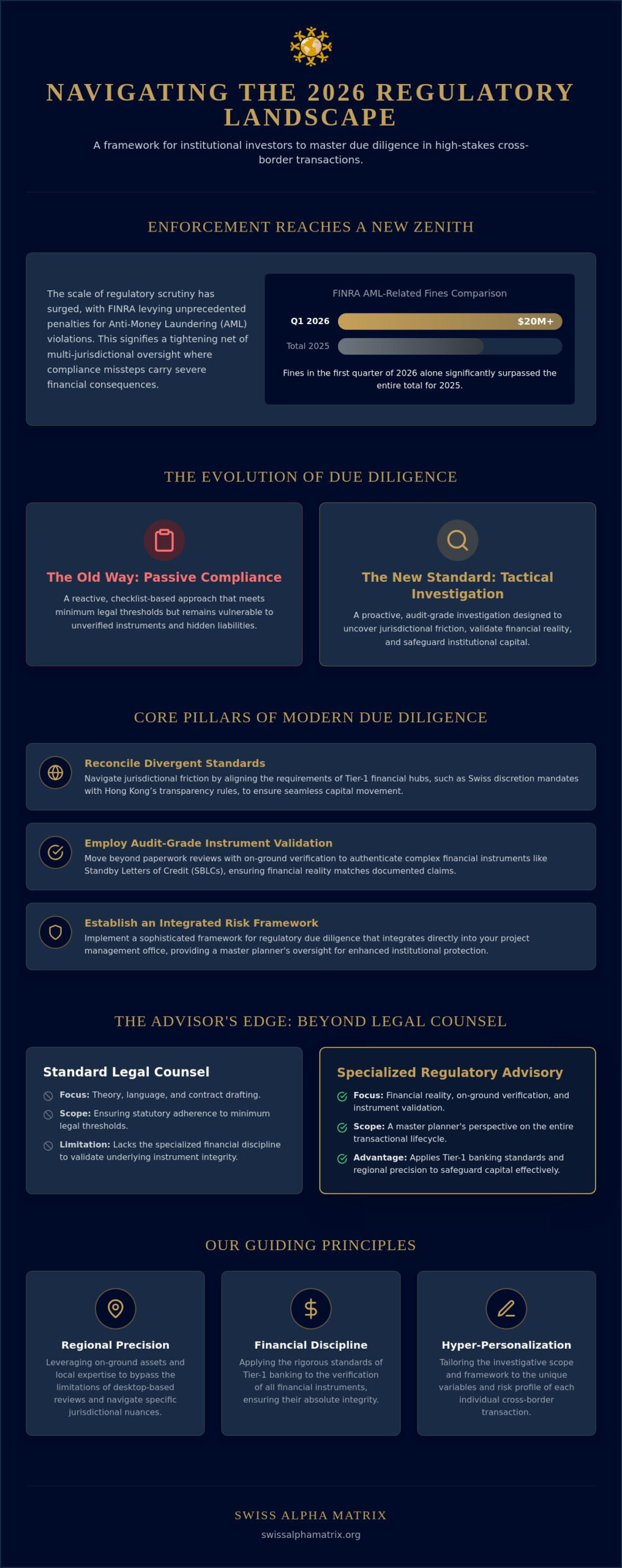
The scale of regulatory enforcement has reached an unprecedented zenith in 2026, evidenced by FINRA levying over $20 million in AML-related fines within the first quarter alone, a figure that significantly surpasses the total penalties recorded for the entirety of 2025. For the institutional investor, these numbers represent more than mere statistics; they signify a tightening net of multi-jurisdictional scrutiny where a single misalignment between FINMA, the FCA, or the SEC can jeopardize the integrity of an entire acquisition. You likely recognize that the traditional checklist approach is no longer sufficient to uncover the hidden liabilities or unverified financial instruments that often lurk within complex global programs. This article provides a sophisticated framework for regulatory due diligence for cross-border transactions, designed to transition your oversight from passive compliance to a proactive, audit-grade investigation of jurisdictional friction.
We’ll examine the strategic implications of the 2026 EU Foreign Direct Investment Screening Regulation alongside Switzerland’s revised Anti-Money Laundering Act, ensuring your capital remains shielded through a methodology rooted in regional precision. By mastering the validation of financial instruments to an elite standard, you can navigate the intricacies of the global landscape with the calm, unwavering pace that characterizes seasoned institutional expertise. It’s time to move beyond the constraints of standard legal counsel to adopt a master planner’s approach to cross-border oversight.
Key Takeaways
- Transition from passive compliance to a tactical, investigative approach that identifies hidden liabilities and ensures the long-term preservation of institutional capital.
- Reconcile the divergent regulatory standards of Tier-1 financial hubs, such as Swiss discretion and Hong Kong’s transparency mandates, to ensure seamless capital movement.
- Employ audit-grade instrument validation and on-ground verification to authenticate financial instruments like SBLCs, moving beyond the limitations of standard paperwork reviews.
- Establish a sophisticated framework for regulatory due diligence for cross-border transactions that integrates directly into your project management office for enhanced institutional protection.
- Utilize a structured RACI matrix to define absolute precision in accountability between advisory, legal, and executive teams during high-stakes M&A.
Defining Regulatory Due Diligence in the 2026 Cross-Border Landscape
In the sophisticated environment of institutional finance, the traditional concept of compliance has undergone a fundamental metamorphosis. No longer can a passive, checklist-based approach suffice when capital is deployed across borders, particularly as the global regulatory architecture becomes increasingly fragmented. We define regulatory due diligence for cross-border transactions not as a mere administrative hurdle, but as a proactive, tactical investigation of jurisdictional friction and target integrity. This investigative process focuses on identifying latent transactional risks that standard audits often overlook, such as the subtle misalignment between the U.S. Executive Order 14406 on financial integrity and the newly implemented EU Foreign Direct Investment Screening Regulation. While standard compliance ensures a firm meets the minimum legal threshold to operate, tactical regulatory due diligence provides the intellectual depth required to safeguard capital in high-stakes M&A environments where the cost of oversight can reach millions of dollars.
The Evolution of Regulatory Oversight
The transition toward a transparency-by-default standard has fundamentally altered the requirements for global deal-making. As of late 2026, the implementation of Switzerland’s Federal Act on the Transparency of Legal Entities and the revised FINMA Anti-Money Laundering Ordinance necessitates a more granular understanding of beneficial ownership than was previously required. This shift demands a rigorous application of due diligence that incorporates operational verification alongside traditional document review. Regulatory due diligence is the surgical validation of a target’s legal and financial standing across divergent jurisdictions. The rise of digital asset frameworks, such as the U.S. GENIUS Act and Hong Kong’s stablecoin licensing regime, adds further layers of complexity that require a performance-oriented mindset to navigate effectively.
Why Legal Counsel is Not Enough
While legal representation is indispensable for drafting contracts and ensuring statutory adherence, it often lacks the specialized financial discipline required to validate the underlying integrity of complex instruments. Independent regulatory advisory fills this critical gap by providing a master planner’s perspective on the entire transactional lifecycle. Legal teams typically focus on theory and language, yet the validation of a Standby Letter of Credit or a complex project funding structure requires a different caliber of expertise. Swiss Alpha Matrix provides this necessary bridge through On-Ground Verification Services and Audit-Grade Instrument Validation, ensuring that the financial reality of a target entity matches its documented claims. Our approach prioritizes:
- Hyper-personalization: Tailoring the investigative scope to the specific jurisdictional nuances of the deal.
- Financial Discipline: Applying Tier-1 banking standards to the verification of all financial instruments.
- Regional Precision: Leveraging on-ground assets to bypass the limitations of desktop-based reviews.
By integrating these pillars into a broader Risk Management Framework, institutional entities can move beyond the constraints of traditional counsel, ensuring that their regulatory due diligence for cross-border transactions is both broad in reach and meticulous in its attention to detail.
Navigating Jurisdictional Friction: London, Geneva, and Hong Kong
The movement of institutional capital between Tier-1 hubs is often characterized by a profound degree of jurisdictional friction, a strategic variable that necessitates a master planner’s approach to risk mitigation. Achieving a seamless transition of assets between London, Geneva, and Hong Kong requires a meticulous understanding of how divergent regulatory philosophies, often rooted in historical regional precedents, interact under modern pressure. In 2026, the complexity of regulatory due diligence for cross-border transactions has intensified, particularly as the UK’s Financial Conduct Authority (FCA) and Switzerland’s FINMA adopt increasingly nuanced definitions of transactional complexity. The UK Money Laundering and Terrorist Financing Regulations, which came into effect on June 30, 2026, exemplify this shift by mandating enhanced due diligence (EDD) only for transactions involving FATF “Call for Action” countries, a refined scope that requires precise financial calibration to avoid unnecessary deal delays.
Institutional stakeholders who prioritize long-term preservation must evaluate the Five Key Due Diligence Areas before initiating any significant transfer of capital, as the interplay between distinct regulatory bodies can create unforeseen bottlenecks that threaten deal integrity. Effectively mastering cross-border investment due diligence requires more than a standard compliance review; it demands an appreciation for how the “Swiss standard” of discretion, which remains a cornerstone of Geneva’s financial architecture, must now be reconciled with the heightened transparency mandates of the Hong Kong Securities and Futures Commission (SFC). These divergent standards often result in extended timelines that, without an expert’s intervention, can lead to significant capital exposure.
The Swiss Matrix: Precision in Geneva and Zurich
Switzerland’s regulatory landscape is currently defined by the anticipated implementation of the Federal Act on the Transparency of Legal Entities (LETA) and the revised Anti-Money Laundering Act (AMLA), both expected to enter into force during the latter half of 2026. These legislative updates introduce a federal beneficial ownership register, a development that requires financial intermediaries to reconcile their internal KYC data with a centralized state database. FINMA’s reinforced requirements for understanding complex client structures, launched through consultations in early 2026, mean that the validation of financial instruments must be conducted with absolute precision. Navigating the specific requirements of the Swiss Federal Act on Financial Services (FIDLEG) demands a partner capable of maintaining deal integrity within this new era of transparency.
The Asian Gateway: Regulatory Dynamics in Hong Kong
In contrast, Hong Kong’s regulatory framework emphasizes a transparency-by-default approach, underscored by the SFC’s rigorous oversight of cross-border investment programs and the maturation of the stablecoin licensing regime in early 2026. Managing the friction between Western capital and Asian regulatory frameworks involves a sophisticated reconciliation of the SFC’s focus on personal accountability with the Western preference for institutional governance structures. Integrating international financial regulations into a unified global strategy is not merely a compliance task, but a strategic necessity. Our Regulatory Compliance Advisory serves as the independent master planner, providing the regional precision required to ensure that your Asian gateway remains secure and compliant.
Audit-Grade Instrument Validation: Beyond Desktop Reviews
In the high-stakes environment of 2026, the reliance on digital documentation alone presents a systemic vulnerability that sophisticated actors frequently exploit to the detriment of institutional capital. Audit-Grade Instrument Validation represents the absolute pinnacle of verification, moving decisively beyond the superficiality of desktop-based paperwork reviews to establish the undeniable authenticity of Standby Letters of Credit (SBLCs) and other complex bank instruments. While standard regulatory due diligence for cross-border transactions may accept a SWIFT message or a notarized document at face value, audit-grade protocols mandate a comprehensive tracing of the provenance of capital and the rigorous verification of bank communications through independent, multi-factor channels. This methodology ensures that the financial instruments underpinning a deal are not merely plausible, but are structurally sound and legally enforceable across all relevant jurisdictions.
The Mechanics of On-Ground Verification
Physical presence at the issuing institution remains a non-negotiable requirement for high-value transactions, particularly as digital signatures and encrypted PDFs can be meticulously forged in the current technological climate. Our team, which is exclusively comprised of former Tier-1 bank executives, possesses the institutional memory and technical insight necessary to identify the subtle anomalies that signal institutional-grade fraud. These experts understand the internal protocols of global banks, allowing them to verify not just the document itself, but the specific authority of the signatory and the actual existence of the underlying collateral. Utilizing specialized bank instrument validation services serves as a critical safeguard, often acting as the singular factor that prevents nine-figure losses in complex global programs where the appearance of legitimacy is carefully manufactured.
Standard vs. Audit-Grade: A Comparison
The distinction between standard compliance reviews and audit-grade validation is fundamental to the long-term preservation of capital and the fulfillment of institutional mandates. While many firms offer a cursory glance at financial standing, the depth of an audit-grade investigation provides a level of risk mitigation that automated systems cannot replicate. Consider the following distinctions in verification depth:
- Verification Depth: Standard reviews focus on facial validity and database checks; Audit-grade involves on-ground, source-level authentication at the bank of origin.
- Stakeholder Trust: Standard reviews provide “reasonable assurance” for internal records; Audit-grade delivers definitive, audit-ready evidence for executive stakeholders.
- Risk Mitigation: Standard processes address known variables; Audit-grade uncovers hidden regulatory liabilities and structural flaws in the instrument’s issuance.
For executive stakeholders, the concept of “reasonable assurance” is increasingly viewed as insufficient for the demands of complex project management. Audit-grade validation provides the precision required for fiduciary duty compliance, ensuring that every facet of the transaction is anchored in verified reality. Red flags, such as unusual bank communication routing or inconsistencies in collateral documentation, are frequently missed by standard software but are immediately apparent under the scrutiny of seasoned experts conducting regulatory due diligence for cross-border transactions.
Implementing a Risk Management Framework for Complex Execution
The successful execution of high-value deals requires the seamless integration of regulatory due diligence for cross-border transactions into the core functions of the broader Project Management Office (PMO). Rather than treating compliance as a tangential administrative task, sophisticated institutions recognize it as a central strategic pillar that dictates the pace and security of capital deployment. This integration begins with a structured RACI matrix, which serves to meticulously define accountability between the independent advisory, the internal legal counsel, and the executive leadership team. By assigning the accountable designation to a master planner, organizations ensure that technical accuracy is maintained across every jurisdiction, effectively bridging the gap between legal theory and the practicalities of financial reality. Utilizing independent financial project management ensures that every milestone is validated against localized regulatory standards before the next phase of capital commitment occurs.
Stakeholder Management and Deal Integrity
Managing the expectations of executive stakeholders during prolonged regulatory reviews requires a delicate balance of transparency and professional discretion. When regulatory surprises emerge, such as a localized shift in AML interpretation or a sudden requirement for deeper beneficial ownership disclosure, the existence of a centralized financial advisory methodology allows for a calm, logical pivot that preserves the transaction’s viability. This methodology provides the C-suite with audit-grade reports that offer a sense of stability, ensuring that interests are protected by seasoned experts who prioritize long-term preservation over short-term deal velocity. For institutions seeking to institutionalize these standards, our Complex Project Management services provide the necessary oversight to navigate multi-jurisdictional friction with absolute precision.
Continuous Oversight and Milestone Validation
The transition from pre-deal due diligence to ongoing regulatory oversight is a defining characteristic of a performance-oriented mindset. In the 2026 landscape, the risk profile of a project can shift significantly after the initial contracts are signed, necessitating a framework for continuous milestone validation. This ensures that capital deployment remains compliant throughout the entire project lifecycle, particularly when dealing with evolving digital asset regulations or shifting ESG mandates. Retainer-based consulting serves as a critical tool for long-term risk mitigation, providing high-level access to expertise that can anticipate and neutralize regulatory friction before it manifests as a liability. By maintaining this steady, logical pace of oversight, institutions can ensure that their regulatory due diligence for cross-border transactions remains as broad in reach as it is meticulous in detail.
The Swiss Alpha Matrix Advantage: Precision, Discretion, and Authority
The complexities inherent in the 2026 financial landscape demand a level of sophistication that transcends the capabilities of standard advisory firms, particularly as the divergence between global regulatory regimes continues to widen. Navigating the multifaceted layers of international friction requires the technical insight that only former Tier-1 bank executives can provide, as their understanding of institutional protocols is rooted in years of high-level operational experience within the world’s most significant financial hubs. Swiss Alpha Matrix distinguishes itself as the premier partner for complex financial instrument validation, specifically for entities that require absolute certainty before committing substantial institutional capital. By merging the traditional virtues of Swiss precision and discretion with a robust, global on-ground reach, we provide a standard of oversight that is both broad in its geographical scope and meticulous in its technical execution.
Executive-Level Intelligence for Fiduciary Protection
In an environment where personal accountability for directors and officers is increasingly scrutinized by global regulators, our audit-grade reports serve as a critical shield against potential regulatory liability. The value of an independent, unemotional expert perspective cannot be overstated in high-pressure deal environments, where the proximity to a transaction can sometimes cloud the assessment of latent risks or structural flaws in a target’s financial standing. Our regulatory due diligence for cross-border transactions is designed to provide executive stakeholders with the clarity required to fulfill their fiduciary duties with confidence, ensuring that every decision is backed by verified, institutional-grade intelligence. We invite institutional leaders to discuss specific cross-border mandates under the strictest confidentiality, ensuring that strategic objectives are aligned with the highest standards of financial discipline and moral character.
Securing the Future of Global Capital
The adoption of an institutional-grade due diligence framework offers benefits that extend far beyond the immediate security of a single transaction, fostering a culture of long-term capital preservation and strategic growth. As the global cross-border payments market continues its projected expansion toward USD 193.5 billion in 2026, the necessity for rigorous, on-ground verification becomes the primary differentiator between successful execution and costly oversight. In the final analysis of any high-stakes acquisition, precision remains the only currency that truly matters, as it is the only force capable of neutralizing the unpredictability of global markets. To ensure your interests are managed with the technical depth and regional precision they deserve, Engage Swiss Alpha Matrix for your next cross-border mandate. Our standard of service remains broad in reach and meticulous in its attention to detail, positioning your institution for stability in an increasingly complex world.
Securing Institutional Capital in an Evolving Global Landscape
The transition toward a more rigorous, multi-jurisdictional regulatory environment in 2026 demands that institutional leaders move beyond the superficiality of standard compliance. Successfully managing regulatory due diligence for cross-border transactions requires a synthesis of regional precision and technical depth that addresses the inherent friction between financial hubs like Geneva and Hong Kong. By prioritizing audit-grade financial instrument validation and physical, on-ground verification, your organization can neutralize hidden liabilities before they manifest as systemic failures. This strategic architecture doesn’t just protect a single deal; it establishes a standard of excellence that fulfills your fiduciary duties with absolute precision.
Swiss Alpha Matrix, led by former senior executives from Tier-1 global banks, provides the unemotional expertise and global on-ground verification capabilities necessary to navigate these complexities with confidence. Our commitment to audit-grade reports ensures your interests are handled with the traditional discretion and master-planning vision required for long-term preservation. It’s time to anchor your global strategy in the stability of seasoned expertise. Secure your cross-border transaction with Swiss Alpha Matrix executive advisory and ensure your capital remains protected in an increasingly intricate world.
Frequently Asked Questions
What is the primary difference between legal due diligence and regulatory due diligence in cross-border deals?
The primary distinction lies in scope; legal due diligence ensures statutory adherence and contractual validity, whereas regulatory due diligence for cross-border transactions investigates the dynamic friction between disparate jurisdictions. It focuses on the proactive identification of latent risks that standard legal reviews might overlook, such as the subtle misalignment of AML standards in 2026. This investigative process ensures that the transaction remains viable under the scrutiny of multiple global bodies.
How does audit-grade instrument validation protect institutional investors from fraud?
Audit-grade instrument validation protects capital by establishing the undeniable authenticity of bank instruments through source-level authentication at the issuing institution. Unlike standard reviews, this protocol involves a meticulous tracing of the provenance of capital and the verification of bank communications through independent channels. It ensures that instruments like SBLCs are not merely plausible but are structurally sound and legally enforceable across all relevant jurisdictions.
Why is on-ground verification necessary if a bank instrument has been transmitted via SWIFT?
Physical, on-ground verification is essential because digital transmissions, including those via SWIFT, can be meticulously forged or lack sufficient context regarding the underlying collateral. Our experts, who are former Tier-1 bank executives, visit the issuing bank to verify the specific authority of the signatory and the actual existence of the assets. This level of scrutiny bypasses the limitations of desktop-based reviews, providing the precision required for fiduciary duty compliance.
What are the most common regulatory friction points between Swiss and Asian financial jurisdictions?
Friction typically arises from the reconciliation of the “Swiss standard” of discretion with the “Hong Kong transparency” requirements enforced by the SFC. As of late 2026, Switzerland’s new federal beneficial ownership register creates a transparency mandate that must be aligned with Asian regulatory frameworks. Navigating these divergent philosophies requires a sophisticated understanding of how regional precedents interact under modern pressure, ensuring that deal timelines aren’t compromised.
How does a RACI matrix improve the efficiency of regulatory due diligence in complex M&A?
A RACI matrix improves efficiency by meticulously defining accountability between the independent advisory, legal counsel, and executive leadership. This structured framework ensures that every milestone of the regulatory due diligence for cross-border transactions is validated against localized standards before capital is committed. By assigning clear responsibility for jurisdictional oversight, organizations eliminate the gaps that often lead to unforeseen liabilities in high-stakes M&A.
Can regulatory due diligence help in mitigating counterparty risk in volatile markets?
Yes, this investigative framework is a critical tool for neutralizing counterparty risk in volatile markets by validating the target entity’s actual standing. By uncovering hidden regulatory liabilities and verifying the legitimacy of financial instruments, investors can avoid entities that lack structural integrity. This proactive oversight provides a sense of stability, ensuring that interests are protected by seasoned experts who prioritize long-term preservation over speculation.
What role does an independent advisory firm play compared to a Tier-1 bank’s internal compliance team?
Independent advisory firms serve as master planners who prioritize the specific transaction’s success and the investor’s capital protection. While a Tier-1 bank’s internal compliance team focuses on the bank’s own liability and general GRC adherence, an independent advisor provides hyper-personalized oversight. This distinction is critical for complex global programs where independent, unemotional expert perspectives are required to bridge the gap between legal theory and financial execution.
How should executives prepare for the evolving AML requirements of 2026?
Executives should prepare by adopting a transparency-by-default mindset and ensuring their internal KYC protocols are reconciled with new federal registers in jurisdictions like Switzerland. The evolving landscape of 2026 requires a more granular understanding of client structures and the implementation of audit-grade verification for all financial instruments. Engaging in mandate-specific advisory relationships allows for a calm, logical approach to these shifting standards, securing the future of global capital.