

What if the most profound threat to your cross-border capital deployment isn’t a shifting market, but the unexamined professional history of the individual at the helm? You likely recognize that at the highest levels of institutional leadership, standard HR screening, while functional for mid-level roles, often fails to capture the intricate nuances of C-suite integrity. It’s a common concern among seasoned partners that a single undisclosed instance of professional misconduct could jeopardize a multi-million dollar deal or trigger severe regulatory fines. Because of these stakes, background checks for key executives must function as sophisticated instruments of operational due diligence that mirror the traditional discretion and precision of high-end private wealth management.
This article demonstrates how an institutional framework for executive vetting can safeguard your capital through exhaustive verification of professional history. We’ll outline a methodology that aligns with the highest standards of regional excellence, ensuring that your interests remain in the hands of experts who prioritize long-term preservation over short-term gains. By the end, you’ll understand how to implement a risk management framework that provides absolute clarity, derived from on-ground verification and meticulous attention to detail, before any capital is committed. This approach ensures that your leadership choices are grounded in technical accuracy and a standard of service that is both broad in reach and profoundly protective.
Key Takeaways
- Transition from standard HR screening to a robust institutional risk management framework to navigate the complexities of the 2026 regulatory environment.
- Leverage former senior banking expertise and Swiss-level discretion to decode the intricate professional and financial histories of C-suite candidates.
- Distinguish between routine administrative checks and exhaustive operational due diligence to effectively mitigate counterparty risk in high-stakes transactions.
- Establish a rigorous investigative scope for background checks for key executives that accounts for jurisdictional nuances and transaction complexity.
- Protect cross-border capital deployment by engaging independent advisors who prioritize long-term preservation through audit-grade verification.
The Strategic Imperative of Background Checks for Key Executives
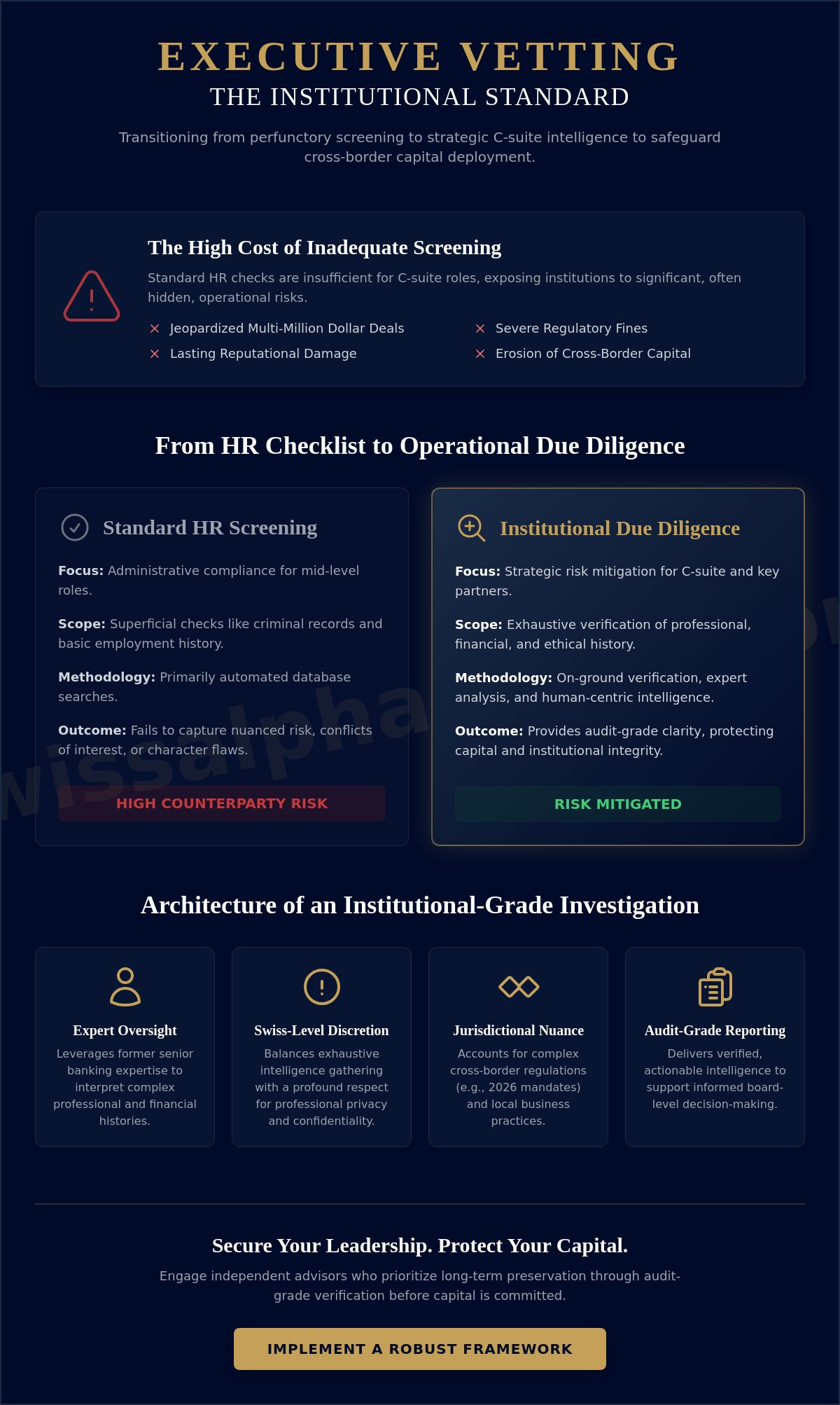
In the sophisticated environment of high-stakes capital deployment, the traditional parameters of human resources often prove insufficient for the rigorous demands of institutional protection. Background checks for key executives, when executed at an audit-grade standard, represent an exhaustive investigation into the professional, financial, and ethical history of senior leadership, transcending the superficiality of standard candidate vetting. As we move through the 2026 regulatory landscape, which is increasingly defined by heightened scrutiny and complex cross-border mandates, the transition from administrative screening to a comprehensive risk management framework has become a strategic necessity. Tier-1 financial standards now dictate a level of scrutiny that considers an individual’s past performance not merely as a record of employment, but as a predictor of institutional stability and a critical safeguard for investor confidence. Maintaining the integrity of the C-suite is paramount for securing project milestones and ensuring the long-term preservation of capital in an era of unprecedented transparency.
Beyond Criminal Records: The Institutional Standard
A comprehensive background check must extend far beyond the automated retrieval of criminal records or credit scores, especially given the inherent limitations of digital database searches in mitigating nuanced counterparty risk. High-level vetting requires a sophisticated understanding of international financial regulations, ensuring that every senior appointment aligns with the stringent compliance requirements of multiple jurisdictions. This institutional standard involves a meticulous verification of technical competence, confirming that an executive’s claimed expertise is supported by verifiable outcomes in complex project environments. It’s not enough to confirm that a candidate is legally eligible to work. One must ensure their moral character is congruent with the traditional values of precision and discretion that define elite financial partnerships.
Protecting Capital through Human-Centric Due Diligence
Human-centric due diligence focuses on identifying “soft” red flags that automated systems frequently overlook, such as subtle discrepancies in professional influence or undisclosed conflicts of interest that might emerge only through seasoned on-ground verification. The cost of failure at this level is immense, as an integrity breach within the C-suite doesn’t just result in a vacancy. It can derail project milestones, erode cross-border capital, and inflict lasting damage on an institution’s reputation. Establishing a baseline of intellectual and professional excellence for all deal participants is essential for long-term growth. By quantifying the potential impact of misconduct, partners can prioritize background checks for key executives as a primary pillar of their operational due diligence, ensuring that every leader is a steward of the institution’s legacy.
The Architecture of an Institutional-Grade Executive Investigation
The architecture of an institutional-grade investigation is not merely an extension of human resources, but rather a fusion of rigorous financial discipline and the traditional discretion found within the upper echelons of Swiss wealth management. When conducting background checks for key executives, the process must be overseen by individuals with former senior banking expertise who possess the unique ability to interpret complex professional histories. These experts understand that high-level screening requires more than a cursory review of public filings. It demands audit-grade documentation that provides boards and investment committees with the intellectual depth necessary for informed decision-making. By balancing the need for exhaustive intelligence with a profound respect for professional privacy, this framework ensures that the investigation remains a dignified exercise in capital preservation rather than an intrusive administrative hurdle.
On-Ground Verification and Global Intelligence
While digital databases offer a foundational layer of data, they are often insufficient for identifying the sophisticated nuances of modern fraud or undisclosed reputational liabilities. Physical verification in local jurisdictions remains the only reliable method for confirming the authenticity of an executive’s historical influence and their standing within specific professional circles. This methodology aligns with established governmental frameworks for mitigating counterparty risk, ensuring that the vetting process is as robust as the financial instruments it seeks to protect. Navigating the complexities of cross-border data privacy laws requires a partner who can maintain a rigorous investigative standard while adhering to jurisdictional legalities. Utilizing local networks allows for the uncovering of off-book signals that never reach a digital ledger, providing a hyper-personalized view of a candidate’s true moral character.
Verifying Financial Instrument Authority
In the context of complex project management, it is critical to verify that senior leaders possess the specific technical experience required to manage sophisticated liquidity tools. This involves a meticulous review of their historical performance in handling Standby Letters of Credit (SBLCs) and other documentary credits, often requiring integration with bank instrument validation services to ensure the legitimacy of past mandates. Mandate verification is the rigorous process of confirming that an individual possesses the verified legal and institutional authority to commit assets or execute financial instruments on behalf of a specific entity. Without this confirmation, the risk of entering into a transaction with an unauthorized counterparty remains unacceptably high. Engaging with specialists in operational due diligence allows for these technical verifications to be conducted with the precision and quiet authority that institutional capital deployment demands.
Mitigating Counterparty Risk: HR Screening vs. Operational Due Diligence
The fundamental distinction between administrative compliance and strategic risk mitigation lies in the primary objective of the inquiry. While standard HR screening typically seeks to confirm an individual’s eligibility for a role, operational due diligence aims to quantify the probability of transactional failure and institutional harm. Legal counsel, while indispensable for structuring agreements and ensuring contractual validity, often lacks the specialized investigative tools and financial perspective required to uncover deep-seated operational anomalies. Background checks for key executives must be integrated into a robust risk management framework that prioritizes the identification of risks that standard criminal and civil databases inevitably miss. This level of vetting provides the intellectual depth needed to distinguish between a technically qualified candidate and one whose professional history is truly congruent with the institutional integrity of the project.
The Limitations of Commodity Screening
Commodity screening providers prioritize volume and speed, often relying on automated algorithms that are ill-equipped to navigate the nuances of Tier-1 financial transactions. These systems frequently produce false negatives by failing to correlate disparate data points across multiple jurisdictions, a flaw that can lead to catastrophic oversights in cross-border capital deployment. Human-led analysis remains essential for interpreting complex regulatory filings and identifying subtle patterns of professional misconduct that automated scrapers overlook. In the high-stakes environment of international finance, a missed signal isn’t just an HR error; it’s a potential catalyst for significant capital loss and regulatory censure. Relying on high-volume providers for C-suite vetting creates a dangerous illusion of security that fails to address the unique pressures of the 2026 regulatory landscape, where transparency and moral character are non-negotiable.
Operational Due Diligence as a Competitive Advantage
Sophisticated vetting serves as a powerful instrument for negotiation, allowing partners to enter discussions with a comprehensive understanding of their counterparty’s operational history and potential liabilities. This intelligence ensures deal integrity by validating the moral character of the lead entities involved, which is a fundamental requirement for maintaining long-term investor confidence and securing project milestones. By integrating background checks for key executives into the independent financial project management lifecycle, institutions can maintain a continuous oversight mechanism that transcends the initial hiring phase. This proactive approach transforms due diligence from a defensive hurdle into a strategic advantage that fosters long-term trust and stability. It ensures that every leader involved in a project is not only technically capable but also ethically aligned with the institution’s historical standards of regional excellence and precision.
Implementing a Framework for Executive Integrity in Cross-Border Deals
Implementing a framework for executive integrity requires a methodical transition from conceptual risk assessment to rigorous operational execution. To ensure the absolute protection of capital, partners must establish an investigative scope that is directly proportional to the transaction’s complexity and the specific jurisdictional risks involved. This process is most effective when overseen by independent advisors who bring Tier-1 global banking experience to the verification process, as they possess the seasoned perspective necessary to evaluate subtle professional histories that might otherwise be misinterpreted by standard administrative entities. Background checks for key executives, when conducted under this institutional umbrella, involve the physical, on-ground verification of professional and financial milestones, moving beyond the limitations of digital records. The resulting intelligence is synthesized into an audit-grade report, providing stakeholders with a clear, unemotional evaluation of a candidate’s suitability for high-stakes mandates. Finally, a protocol for ongoing monitoring must be established to maintain oversight throughout the duration of the project, ensuring that the initial standard of integrity is preserved as the deal evolves.
Defining the Scope of Scrutiny
The depth of investigation must be meticulously tailored to the executive’s level of financial authority, with particular emphasis on identifying jurisdictions that require specialized local knowledge. Determining the materiality of any found discrepancies is a critical step; it involves assessing whether a specific historical event truly impacts the candidate’s fitness for the current deal. This nuanced approach avoids the pitfalls of oversimplification, ensuring that every finding is contextualized within the broader strategic objectives of the partnership. It’s a necessary step for capital preservation. By focusing on jurisdictional precision, the framework identifies potential conflicts of interest that automated systems frequently overlook, providing a layer of security that is both broad in reach and meticulous in detail.
Stakeholder Management and Reporting
Delivering sensitive findings requires the highest level of Swiss discretion, ensuring that information is shared only with authorized decision-makers in a dignified and formal manner. These risk assessments are designed to provide clear, actionable intelligence that directly informs capital deployment strategies, adhering strictly to global compliance and regulatory standards. By maintaining this level of professional competence, the vetting process serves as a dedicated partner in the decision-making process rather than a mere service provider. The final report must be structured logically, moving from broad principles to specific strategic pillars with a calm, unwavering pace. To ensure your leadership vetting meets these rigorous standards, you can establish a robust Risk Management Framework designed for high-stakes environments.
The Swiss Alpha Matrix Approach to Executive Intelligence
The Swiss Alpha Matrix approach is defined by a leadership team comprised of former senior executives from Tier-1 global banks, a pedigree that provides an unparalleled professional perspective on the risks inherent in high-level appointments. Our methodology is rooted in a commitment to regional excellence and the traditional values of Swiss discretion, ensuring that every inquiry is conducted with the utmost technical accuracy. By delivering executive-level intelligence, we ensure that capital deployment decisions are made with the same precision that characterizes elite wealth management. Within our broader suite of complex project management services, background checks for key executives are positioned as a critical defensive pillar, protecting institutional integrity from the earliest stages of a mandate. This specialized focus allows us to provide a level of oversight that transcends the capabilities of traditional screening firms, offering a standard of service that is both broad in reach and meticulous in its attention to detail.
Precision in Cross-Border Oversight
The efficacy of our investigative process is derived from our team’s deep transactional history, which informs every aspect of our inquiry into an executive’s professional background. This experience allows us to identify subtle anomalies in financial records or professional influence that individuals without a banking pedigree would likely overlook. There is a profound synergy between our vetting process and cross-border investment due diligence, as both disciplines require a sophisticated understanding of international regulatory environments and jurisdictional nuances. Swiss Alpha Matrix bridges the gap between financial discipline and investigative depth by applying the same analytical rigor used in multi-billion dollar capital allocations to the verification of individual professional integrity. This alignment ensures that the human element of a deal is as thoroughly validated as the financial instruments involved, providing a holistic view of the project’s risk profile.
Securing Your Mandate
Independent project oversight is a non-negotiable requirement for protecting long-term capital in an increasingly transparent and litigious global market. By partnering with a boutique firm that values privacy and exclusivity above all else, you ensure that your most sensitive due diligence requirements are handled with the quiet authority they deserve. We don’t operate as a high-volume commodity provider; we function as a dedicated partner, committed to the preservation of your institution’s legacy and the success of your strategic growth. Our background checks for key executives are designed to provide the intellectual superiority and traditional values necessary to navigate complex dynamics with confidence. To ensure your interests are managed by seasoned experts who prioritize long-term stability, we invite you to contact our senior advisors to discuss your specific due diligence requirements and establish a robust framework for your next cross-border deployment.
Securing Institutional Integrity through Strategic Oversight
The long-term preservation of institutional capital requires a deliberate shift from routine administrative compliance to a sophisticated framework of operational due diligence. Precision is paramount. By moving beyond the inherent limitations of digital database searches, partners ensure that their leadership choices are grounded in technical accuracy and verified moral character. This methodology provides the intellectual depth necessary to navigate the intricacies of cross-border mandates. Background checks for key executives function as an essential instrument of capital protection. It’s a commitment to excellence.
Our advisory team, led by former Tier-1 banking executives, utilizes global on-ground verification and audit-grade reporting to provide the clarity required for high-stakes decision-making. We invite you to Request a Consultation with our Senior Advisory Team to discuss the implementation of a risk management framework tailored to your specific transactional requirements. Securing your institution’s legacy begins with professional precision and unwavering discretion.
Frequently Asked Questions
What is the primary difference between a standard background check and an executive background check?
Executive investigations are exhaustive, audit-grade inquiries focused on quantifying transactional risk and safeguarding institutional integrity rather than merely confirming employment eligibility. While standard screening validates basic data points, background checks for key executives involve a deep-dive into intricate professional, financial, and ethical histories. This process often requires the specialized perspective of former senior banking experts to interpret complex mandates and historical performance in high-stakes project environments.
How do background checks for key executives impact regulatory compliance in 2026?
Regulatory compliance in 2026 demands a rigorous standard of counterparty vetting to mitigate the rising risk of litigation and severe financial penalties. Strict adherence to evolving mandates, such as the Fair Credit Reporting Act (FCRA) and various regional “Clean Slate” enactments, is non-negotiable for institutional entities. Advanced screening ensures that leadership appointments don’t inadvertently trigger regulatory breaches that could derail cross-border capital deployment or inflict lasting damage on an institution’s reputation.
Why is on-ground verification necessary for international executive vetting?
On-ground verification is essential because digital databases frequently fail to capture the subtle reputational signals and localized professional standing critical for sophisticated mandates. Physical verification in local jurisdictions allows for the authentic confirmation of professional milestones and the identification of undisclosed conflicts of interest. This meticulous approach ensures that the intelligence gathered is technically accurate, particularly in regions where digital records are incomplete or susceptible to manipulation.
Can executive background checks be conducted without compromising professional discretion?
Executive investigations are conducted with the highest level of Swiss discretion, ensuring that the process remains a dignified exercise in risk management rather than an intrusive administrative hurdle. Sensitive information is shared exclusively with authorized stakeholders using formal, audit-grade reporting structures that prioritize privacy. This methodology respects the moral character of senior leadership while providing the board with the comprehensive intelligence necessary to safeguard institutional interests and ensure deal integrity.
What are the common red flags discovered during an institutional-grade executive investigation?
Institutional-grade investigations frequently uncover “soft” red flags such as undisclosed conflicts of interest, discrepancies in professional influence, or misrepresentations of historical financial authority. Other concerns include patterns of professional misconduct that haven’t reached formal litigation but suggest a lack of ethical alignment with institutional standards. Identifying these signals early allows partners to evaluate the materiality of the risk before committing significant capital to a cross-border transaction.
How long does a comprehensive executive background check typically take for a cross-border mandate?
A comprehensive investigation for a cross-border mandate typically requires several weeks to ensure the necessary depth of on-ground verification and jurisdictional analysis. While automated database searches provide immediate results, the meticulous process of authenticating professional histories across multiple legal environments cannot be rushed without compromising technical accuracy. This steady, logical pace reflects a commitment to precision and the thoroughness expected by sophisticated institutional entities and high-net-worth individuals.
Is it necessary to conduct ongoing monitoring of executives after the initial deal is closed?
Ongoing monitoring is critical for maintaining the initial standard of integrity throughout the duration of a long-term project mandate. The risk profile of an individual can shift due to new financial interests or external professional pressures that emerge after the initial deal closes. Establishing a protocol for continuous oversight ensures that the institution remains protected from evolving human-centric risks that could jeopardize capital preservation or the achievement of strategic project milestones.
How should a board of directors interpret discrepancies found in an executive’s professional history?
Boards should interpret discrepancies by assessing their materiality within the specific context of the transaction and the executive’s level of financial authority. Not every inconsistency indicates a breach of integrity, but each requires a logical, unemotional evaluation by independent advisors with senior banking experience. Background checks for key executives provide the data-driven metrics needed to distinguish between minor administrative errors and systemic patterns of professional misconduct that warrant institutional disqualification.