

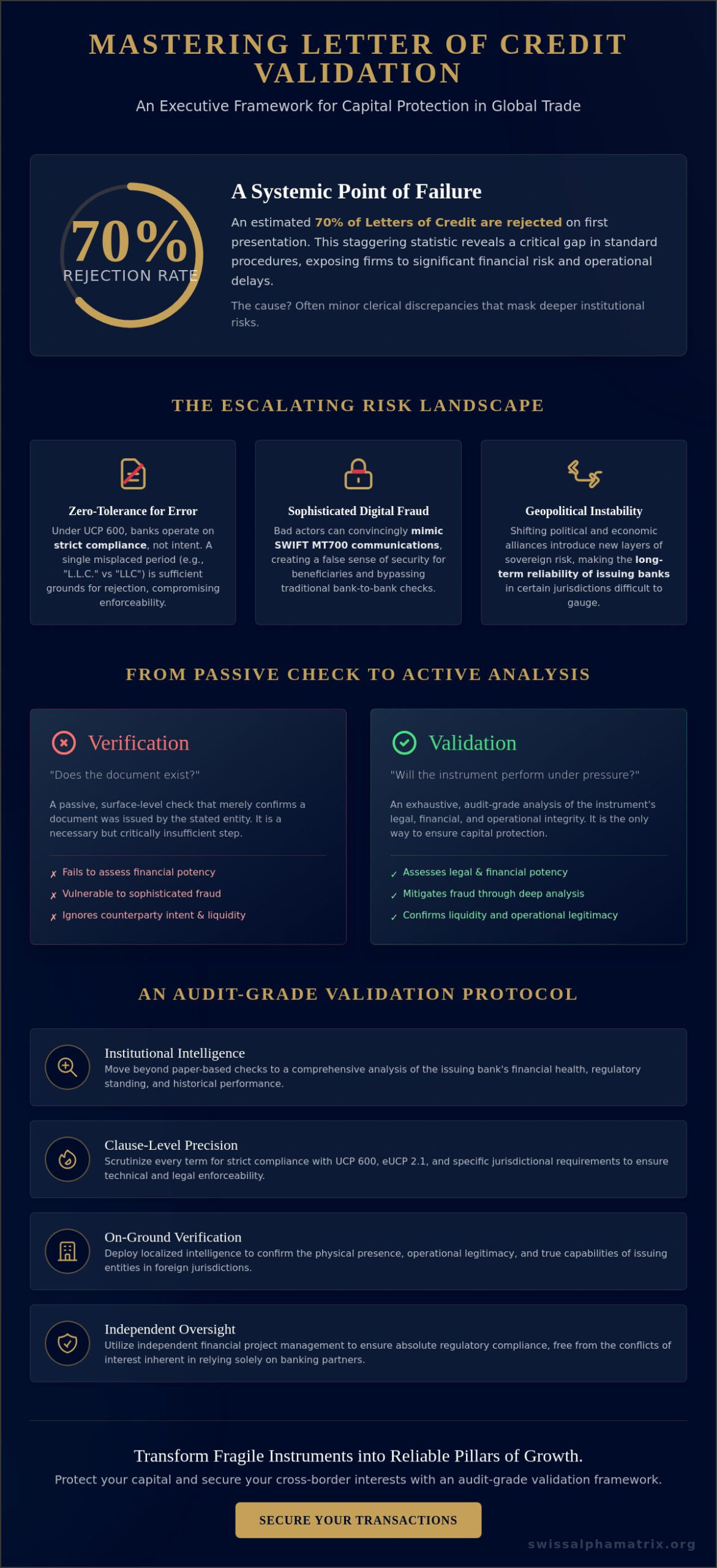
Seventy percent of letters of credit are rejected upon first presentation because of minor clerical discrepancies that frequently obscure more profound institutional risks. You likely recognize that in high-stakes international trade, a document’s surface-level adherence to standards is rarely a sufficient guarantee of a counterparty’s actual liquidity or intent. For the executive tasked with capital preservation, understanding how to validate a letter of credit requires a shift from passive acceptance to a methodology of active, audit-grade verification.
This article provides a sophisticated framework for securing your interests through the lens of modern regulatory requirements and on-ground operational intelligence. We’ll explore the critical intersection of UCP 600 technicalities, the implications of the latest eUCP 2.1 standards, and the rigorous due diligence necessary to mitigate sovereign and counterparty risk in 2026. By applying this measured approach, you can transform a fragile instrument into a reliable pillar of your global strategic growth, ensuring that every transaction is anchored by technical precision and institutional transparency.
Key Takeaways
- Understand the zero-tolerance standard for documentary precision where even minute punctuation errors can compromise the enforceability of your instrument.
- Learn how to validate a letter of credit by moving beyond paper-based checks toward a comprehensive methodology of active institutional intelligence.
- Establish a rigorous on-ground verification protocol to confirm the physical presence and operational legitimacy of issuing entities in foreign jurisdictions.
- Adopt an audit-grade framework that utilizes independent financial project management to ensure absolute regulatory compliance and capital protection.
The Strategic Imperative of Letter of Credit Validation
The process of securing a Letter of credit has evolved from a routine administrative task into a critical exercise in strategic risk management. While many institutional participants view the document as a standardized guarantee, seasoned executives understand that validation is a multi-layered discipline. It requires confirming not just the authenticity of the instrument, but its operational enforceability and absolute regulatory compliance. Learning how to validate a letter of credit is no longer optional; it’s a fundamental requirement for any entity engaged in high-value cross-border trade where capital protection is the primary objective.
Statistics from the International Chamber of Commerce suggest that approximately 70% of document presentations are initially rejected by banks due to discrepancies. This high failure rate underscores a systemic lack of precision that can lead to catastrophic delays or the complete loss of capital. Such rigorous scrutiny is precisely why sophisticated market participants rely on comprehensive bank instrument validation services to ensure that every clause aligns with both UCP 600 standards and the specific jurisdictional requirements of the transaction. Simple clerical checking, which often focuses on surface-level typos, is insufficient. True validation involves a deep-dive analysis into the financial potency of the issuing bank and the legal integrity of the credit itself.
The Escalating Risk Landscape in 2026
The current financial environment presents challenges that traditional bank-to-bank verification struggles to address. Sophisticated digital fraud has advanced to the point where bad actors can convincingly mimic SWIFT MT700 communications, creating a false sense of security for the unwary beneficiary. Simultaneously, shifting geopolitical alliances have introduced new layers of instability, making the reliability of regional issuing banks more difficult to gauge. Relying solely on standard interbank communication is no longer a sufficient safeguard for complex projects where the stakes involve significant capital deployment and long-term institutional commitments.
Validation vs. Verification: A Nuanced Distinction
A critical component of understanding how to validate a letter of credit lies in distinguishing between verification and validation. Verification is merely the confirmation that a document exists and was issued by the stated entity. Validation, conversely, is an exhaustive analysis of the instrument’s legal and financial potency. It asks whether the instrument will actually perform under pressure. This level of scrutiny necessitates independent oversight, as internal bank departments may lack the incentive or the localized intelligence to fully vet a counterparty’s long-term liquidity or intent in a volatile cross-border context.
The Technical Framework: UCP 600 and Clause-Level Precision
The Uniform Customs and Practice for Documentary Credits (UCP 600) serves as the indispensable legal architecture for international trade finance, yet its rules are often applied with a rigidity that catches even seasoned operators off guard. When considering how to validate a letter of credit, one must accept that the banking environment operates on a principle of strict compliance rather than intent. A single character discrepancy, such as the omission of periods in a corporate designation like “L.L.C.” when the underlying contract specifies “LLC,” is enough to trigger an immediate rejection. This zero-tolerance approach ensures that instruments are enforceable, but it also places a significant burden of technical precision on the parties involved.
To navigate these complexities, executives should align their internal review processes with sophisticated financial advisory methodologies that prioritize clause-level integrity. As highlighted in Trade Finance Global’s 2026 LC Guide, the interplay between UCP rules and local bank interpretations requires a high level of technical mastery. It’s not just about reading the document; it’s about validating that every term is executable within the specific parameters of the transaction. For those seeking to fortify their transaction security, consulting with specialists in operational due diligence can provide the necessary layer of protection.
Critical Clauses: The Foundation of Instrument Integrity
Precision begins with Clauses 50 and 59, which identify the applicant and beneficiary. Any deviation from the registered legal name of either entity can render the instrument useless at the point of presentation. Beyond nomenclature, amount clauses must be validated for currency precision and tolerance levels, ensuring that fluctuations in shipment value don’t lead to non-payment. Perhaps the most common pitfall is the “Close Enough” trap regarding expiry dates and presentation locations. If a credit expires in a city where the beneficiary doesn’t have a physical presence for document delivery, the instrument’s protection becomes illusory.
SWIFT MT700 Protocol Validation
The MT700 protocol is the institutional backbone of secure trade finance, providing a standardized format for the electronic transmission of letters of credit between financial institutions. Validation at this level involves deconstructing the SWIFT header to ensure the message originated from a legitimate, authorized terminal. Fraudulent headers often contain subtle anomalies in the bank identifier codes (BIC) or the sequence of fields that an automated system might overlook. Identifying these discrepancies requires an expert eye capable of distinguishing between a standard interbank communication and a sophisticated forgery designed to mimic institutional legitimacy.
Beyond the Paperwork: The Multi-Layered Validation Methodology
While technical precision is the baseline for any transaction, true security resides in the layers of institutional intelligence that exist outside the document’s margins. When determining how to validate a letter of credit, an executive must transcend the clerical exercise of character matching to adopt an audit-grade validation methodology. This approach treats the instrument not as an isolated legal text, but as the final output of a complex counterparty ecosystem. It requires a profound assessment of the issuing bank’s actual liquidity and its historical reliability in cross-border settlements, particularly in jurisdictions where regulatory oversight may be opaque or inconsistent.
The implementation of such a framework often necessitates the integration of independent financial project management to provide an objective layer of oversight. This level of scrutiny ensures that the instrument’s issuance isn’t merely a procedural formality but a reflection of a sound underlying commercial transaction with clear economic logic. Without this broader perspective, a perfectly formatted document may still fail if the issuing entity lacks the institutional solvency to honor its obligations when the presentation is made. True validation confirms that the promise to pay is backed by both the intent and the capacity to perform.
Counterparty Risk Mitigation
A primary objective of this methodology is the identification and neutralization of counterparty risk before capital is committed. This involves conducting deep-dive investigations into the creditworthiness of the issuing entity, specifically looking for indicators of ‘shell’ banks or non-standard financial institutions that lack the capital reserves required for high-value mandates. In 2026, the rise of shadow banking makes it imperative to assess the jurisdictional risk of the bank’s home country. Local legal frameworks can significantly impact your ability to enforce payment, regardless of the document’s adherence to international standards.
The Executive Review Matrix
To maintain control over these intricate variables, we recommend the development of a deliverable review matrix. This tool tracks validation milestones from initial issuance through to final settlement, ensuring that all stakeholders are informed via audit-grade reporting. By utilizing institutional terminology and precise risk metrics, this matrix transforms a subjective process into a structured, logical sequence of verified truths. It’s through this steady, measured pace of verification that an organization achieves the professional calm necessary to deploy capital with confidence, knowing that every strategic pillar has been tested for resilience.
Mitigating Transactional Risk through On-Ground Verification
Standard interbank protocols, while essential for the secure movement of financial data, often fail to account for the physical and operational realities of the issuing institution. In the context of high-value mandates, relying solely on digital channels creates a vulnerability that sophisticated actors are increasingly adept at exploiting. Determining how to validate a letter of credit requires more than just a review of electronic records; it demands a physical confirmation of the bank’s operational reality. This level of scrutiny is a vital component of mastering cross-border investment due diligence, where the primary objective is to eliminate the information asymmetry that often precedes capital loss in emerging or opaque markets.
By deploying seasoned practitioners to the point of issuance, we move beyond the limitations of electronic communication to observe the institutional environment directly, a practice that identifies red flags that automated systems are structurally incapable of detecting. This methodology provides a definitive answer for executives asking how to validate a letter of credit when digital confirmation alone feels insufficient for the scale of the transaction. For those seeking to secure significant interests in complex jurisdictions, engaging professional On-Ground Verification Services provides the final layer of institutional certainty required for informed capital deployment.
The Physical Verification Process
The execution of a physical verification mandate follows a rigorous, five-step protocol designed to leave no room for institutional ambiguity. It begins with direct engagement with the issuing bank’s compliance department to ensure the instrument is recognized within their regulatory reporting systems and anti-money laundering frameworks. This is followed by a formal, on-site inspection of the bank’s physical headquarters or the specific regional branch responsible for the credit to confirm its operational existence. Our practitioners then verify the signing officer’s credentials and legal authority to bind the institution, cross-referencing the specific instrument data with the bank’s internal ledger to ensure the transaction is fully authorized. The process concludes with the issuance of an audit-grade authentication report, providing a definitive record of the instrument’s validity and the bank’s capacity to perform.
Detecting Fraudulent Signatures and Seals
Digital signatures, despite their rapid adoption and the convenience they offer, are not immune to the sophisticated forgery techniques employed in modern financial deception. Forensic-level validation of physical ‘wet ink’ signatures and embossed seals remains a critical safeguard, as these physical artifacts are significantly more difficult to replicate with precision in a controlled, on-site environment. By observing the signing process or examining the original documents in person, our experts can detect anomalies in ink consistency, paper quality, or seal impressions that are invisible to high-resolution scanners. On-ground verification acts as the ultimate filter for sophisticated financial deception.
Securing Cross-Border Interests with Swiss Alpha Matrix
The complexity of modern trade finance demands a partner who understands that a document is only as strong as the institutional framework supporting it. At Swiss Alpha Matrix, we merge the traditional discretion of high-end private wealth management with the rigorous institutional discipline required for complex global transactions. Our approach to how to validate a letter of credit isn’t merely a checklist of technical requirements; it’s a comprehensive exercise in capital preservation. By positioning ourselves as a dedicated partner, we ensure that your interests are protected by experts who, through their deep understanding of institutional protocols, prioritize long-term stability over the expediency of a single deal.
Our methodology is executed by a team of former senior Tier-1 bank executives who bring decades of operational experience to every mandate. This background allows us to deliver audit-grade certainty that, by transcending the limitations of automated systems, goes beyond standard interbank verification. We provide a definitive answer for those seeking to understand how to validate a letter of credit within a high-stakes environment by providing a proactive layer of oversight. This transforms the validation process into a strategic asset, ensuring that every instrument is not only technically sound but also aligned with the broader economic logic of your project.
Institutional-Grade Advisory for the C-Suite
Global stakeholders trust our independent validation frameworks because we provide a level of transparency that internal bank departments, often constrained by their own internal protocols, cannot replicate. We integrate regulatory compliance advisory with transactional risk management to create a seamless protective shield around your cross-border deployments. Our commitment to delivering executive-level intelligence ensures that you receive the nuanced information required to make informed decisions. By utilizing institutional terminology and precise metrics, we provide the C-suite with the clarity needed to navigate the most intricate financial landscapes with absolute confidence.
Initiating a Validation Mandate
The most effective risk mitigation strategies begin long before an instrument is issued. We emphasize the importance of early engagement during the deal-structuring phase, allowing our team to influence the terms of the credit to favor enforceability and minimize potential discrepancies. Throughout the instrument’s lifecycle, we provide continuous oversight, monitoring for regulatory shifts or counterparty changes that could impact the validity of your security. To ensure your interests remain protected in the face of evolving global risks, we invite you to contact Swiss Alpha Matrix to secure your next cross-border transaction and experience a standard of service that is both broad in reach and meticulous in detail.
Fortifying Global Mandates through Institutional Precision
The transition from document-based verification to comprehensive instrument validation represents a fundamental shift in how global entities must approach capital protection. While technical adherence to UCP 600 remains a non-negotiable prerequisite, the true measure of security in 2026 lies in the synthesis of clause-level precision and on-ground institutional intelligence. By adopting this multi-layered methodology, you ensure that your cross-border transactions are anchored by more than just clerical accuracy; they are supported by a thorough understanding of counterparty liquidity and jurisdictional risk.
Mastering how to validate a letter of credit is ultimately an exercise in sophisticated risk management that requires the oversight of seasoned experts. Our team, led by former senior executives from Tier-1 global banks, specializes in complex, cross-border project oversight to deliver audit-grade reports for executive stakeholders. We invite you to secure your capital with our audit-grade instrument validation services. Your strategic growth deserves the stability of a partner dedicated to the meticulous preservation of your interests across every global mandate.
Frequently Asked Questions
What is the primary reason for Letter of Credit rejection in 2026?
Rejections are predominantly driven by minute clerical discrepancies that violate the principle of strict compliance. Even a misplaced comma or an inconsistent corporate suffix can lead a bank to refuse payment during the examination process. These technical failures often mask deeper issues, such as a lack of institutional alignment between the applicant and the beneficiary, making character-level precision a non-negotiable requirement.
How does UCP 600 influence the validation process for international trade?
UCP 600 serves as the authoritative regulatory pillar that governs the interpretation and execution of documentary credits across 175 countries. It ensures that all parties operate under a unified set of rules, which minimizes jurisdictional ambiguity during a transaction. When considering how to validate a letter of credit, one must interpret every clause through the specific articles of UCP 600 to ensure the instrument is legally enforceable.
Can a Letter of Credit be validated without the involvement of the issuing bank?
Authentic validation cannot occur in isolation and necessitates direct engagement with the issuing institution’s compliance department. While third-party analysis provides technical insights, the final confirmation must cross-reference the instrument against the bank’s internal ledger. This interaction ensures the credit isn’t a convincing forgery but a recorded liability that the bank is prepared to honor upon a compliant presentation of documents.
What are the common red flags in a fraudulent Letter of Credit?
Fraudulent instruments often exhibit non-standard SWIFT headers or utilize “shell” banks that lack a verifiable physical presence in their stated jurisdiction. Other red flags include inconsistent bank identifier codes or clauses that attempt to override fundamental UCP 600 protections. Identifying these anomalies requires a sophisticated understanding of institutional communication protocols and a refusal to accept digital documents at face value without further on-ground investigation.
Is digital validation through AI sufficient for high-value financial instruments?
Digital validation tools are useful for preliminary screenings but remain insufficient for high-value mandates where capital protection is the primary objective. AI is structurally incapable of conducting on-ground verification or assessing the subjective intent of a counterparty in a complex cross-border transaction. Professional validation requires human expertise to interpret the nuance of risk and to confirm the physical operational reality of the issuing entity.
What is the difference between an SBLC and a Commercial LC in terms of validation?
The validation of a Standby Letter of Credit focuses on the trigger events of default, whereas a Commercial Letter of Credit centers on the fulfillment of trade obligations. While both instruments are governed by international standards, the due diligence for an SBLC requires a more intensive look at the applicant’s long-term creditworthiness. Each requires a distinct validation framework to ensure the instrument’s specific protective purpose is maintained.
How long does a professional audit-grade validation process typically take?
The duration of an audit-grade validation depends heavily on the complexity of the jurisdiction and the responsiveness of the issuing bank’s compliance team. A thorough process usually spans several business days to allow for physical inspection and ledger cross-referencing. This measured pace is necessary to ensure that every strategic pillar is verified with the precision required to protect significant institutional capital deployments.
Why is on-ground verification considered the ‘gold standard’ for fraud prevention?
On-ground verification is the gold standard because it provides an immutable link between digital records and physical reality. It’s the only method that can definitively expose “ghost” branches or unauthorized signing officers that digital systems might overlook. By placing an expert at the point of issuance, you eliminate the information asymmetry that bad actors rely on to execute sophisticated and high-stakes financial deceptions.