

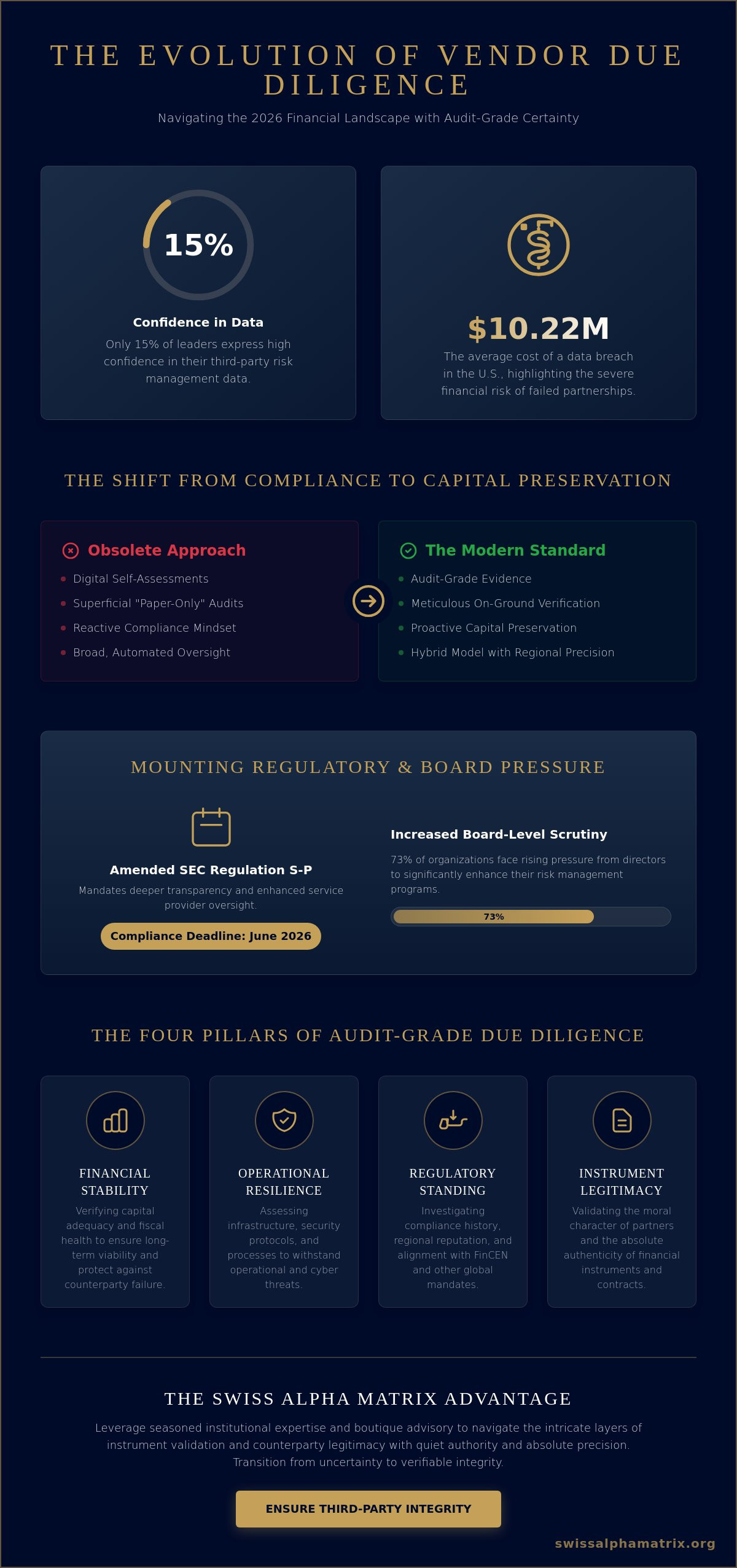
With only 15% of leaders expressing high confidence in the data underpinning their third-party risk management programs, the traditional reliance on digital self-assessments has reached a point of institutional obsolescence. In an era where the average cost of a data breach in the United States has climbed to $10.22 million, the execution of vendor due diligence for financial services must evolve beyond the superficiality of paper-only audit trails. You’ve likely observed that as regulatory scrutiny intensifies, particularly with the June 2026 compliance deadline for amended SEC Regulation S-P, the margin for error in counterparty selection has effectively vanished. It’s no longer sufficient to merely collect certificates; one must possess the intellectual depth to verify the moral character and operational stability of every global partner. This framework provides the sophisticated methodologies required to validate third-party integrity with absolute certainty, ensuring your capital remains protected within even the most fragmented cross-border jurisdictions. We’ll examine the strategic pillars of audit-grade instrument validation, the implications of the latest FinCEN Customer Due Diligence orders, and the transition toward a hybrid operating model that prioritizes regional precision over broad, automated oversight.
Key Takeaways
- Transition from a standard compliance mindset toward a strategy of proactive capital preservation to address the inherent volatility of the 2026 global financial landscape.
- Establish a rigorous framework for vendor due diligence for financial services that prioritizes audit-grade evidence to satisfy the stringent expectations of both internal boards and international regulators.
- Identify the critical limitations of digital-only verification and the necessity of on-ground operational due diligence when engaging with counterparties in fragmented or emerging jurisdictions.
- Implement a structured RACI matrix for third-party risk management to ensure absolute accountability and precision throughout the lifecycle of complex financial engagements.
- Leverage seasoned institutional expertise and boutique advisory to navigate the intricate layers of instrument validation and counterparty legitimacy with a sense of quiet authority.
The Strategic Imperative of Vendor Due Diligence in Financial Services
The traditional paradigm of third-party oversight has undergone a fundamental transformation, shifting from a perfunctory compliance exercise to a critical pillar of strategic capital protection. In a global market defined by heightened volatility and intricate cross-border dependencies, the mere collection of standardized questionnaires is no longer a defensible practice for institutional entities. Modern due diligence serves as the primary mechanism for validating the integrity of counterparties, ensuring that every engagement is underpinned by a deep understanding of operational reality rather than curated digital representations. For the sophisticated practitioner, this process isn’t merely about satisfying a checklist; it’s about the preservation of institutional legacy and the mitigation of risks that could otherwise lead to catastrophic capital erosion.
The 2026 fiscal environment demands a level of scrutiny that transcends historical norms. As financial engagements become more complex, the reliance on vendor due diligence for financial services has become the bedrock of institutional trust. Without a rigorous, on-ground intelligence operation, firms remain exposed to sophisticated misrepresentations that digital audits simply cannot detect. This shift reflects a broader recognition that true security isn’t found in the volume of documentation gathered, but in the precision of the validation performed by seasoned experts who prioritize long-term stability over short-term expediency.
Regulatory Evolution and Institutional Pressure
The regulatory horizon for 2026 is marked by an unprecedented focus on operational resilience, exemplified by the June 3, 2026, compliance deadline for amended SEC Regulation S-P. This mandate, which requires smaller entities to implement written incident response programs and enhance service provider oversight, underscores a global trend toward deeper transparency. While technical certifications like SOC2 provide a necessary baseline, they’re increasingly viewed as insufficient on their own. Fiduciary duty now mandates a more granular analysis of international partners, moving beyond technical checkboxes to evaluate the moral character and regional standing of a vendor. It’s a standard that requires a proactive, rather than reactive, posture toward regulatory compliance advisory.
The Cost of Failure in High-Stakes Engagements
The consequences of inadequate validation are both severe and quantifiable. With the average cost of a data breach in the United States reaching $10.22 million in 2025, the financial implications of a failed partnership are staggering. Beyond the immediate capital loss, the reputational damage resulting from cross-border fraud or regulatory non-compliance can be irreparable. ‘Paper-only’ audits frequently fail to uncover the layers of institutional misrepresentation that exist in fragmented jurisdictions. To counter these risks, we employ a ‘Swiss standard’ of precision, merging traditional financial discipline with meticulous on-ground verification. This boutique approach ensures that every counterparty is vetted with the same level of intellectual depth and technical accuracy that one would apply to their own internal operations, providing the absolute certainty required for board-level approval.
The Anatomy of Audit-Grade Vendor Due Diligence
To achieve an audit-grade standard, the evidence gathered must surpass the perfunctory requirements of a standard compliance checklist. It requires a threshold of proof that provides absolute clarity to both internal boards and external regulators, leaving no room for ambiguity regarding a counterparty’s integrity. In the context of vendor due diligence for financial services, this level of scrutiny is essential to address the 73% of organizations currently facing increased pressure from directors to enhance their risk management programs. A truly robust framework rests upon four primary pillars: financial stability, operational resilience, regulatory standing, and instrument legitimacy. Each pillar must be independently verified through a process that prioritizes primary source data over third-party summaries.
The necessity for independent oversight cannot be overstated. Internal teams, often constrained by a lack of specialized expertise or the pressure of deal timelines, may overlook subtle red flags that a seasoned advisor would identify immediately. Integrating audit-grade instrument validation into the review process ensures that the financial vehicles underpinning a transaction are as legitimate as the entities presenting them. For institutions seeking to maintain this level of precision, utilizing bespoke risk management frameworks provides the executive-level intelligence required to protect capital in high-stakes environments.
Operational Due Diligence (ODD) Frameworks
Effective ODD moves beyond technical infrastructure to assess the “human element” of a vendor’s operation. This involves a granular evaluation of management experience, corporate governance structures, and the viability of succession planning. It’s critical to distinguish between a vendor’s “stated capacity,” often found in marketing collateral, and their “actual operational bandwidth.” We analyze internal controls and the robustness of risk management protocols to ensure they can withstand the pressures of a complex, cross-border engagement without compromising service delivery or security standards.
Validating the Validity of Financial Instruments
In 2026, the sophisticated misrepresentation of SBLCs, LCs, and other complex bank instruments remains a significant threat. Our methodology prioritizes physical bank communication and direct source verification over the acceptance of digital document copies, which are increasingly susceptible to high-level forgery. By establishing a clear, documented chain of custody for all financial documentation, we ensure that every instrument is authentic and legally enforceable. This meticulous attention to detail prevents the catastrophic capital exposure that often results from relying on unverified digital trails in fragmented jurisdictions.
Cross-Border Complexity and the Necessity of On-Ground Verification
Software-based Third-Party Risk Management (TPRM) often creates a false sense of security through the accumulation of digital data points that may lack a tether to physical reality. While algorithms are proficient at flagging fluctuating credit scores or aggregated negative news, they remain fundamentally incapable of confirming whether a corporate headquarters in a fragmented jurisdiction is a legitimate operation or merely a sophisticated shell. In the rigorous execution of vendor due diligence for financial services, the reliance on purely digital trails represents a systemic vulnerability that can’t be ignored. The Swiss Alpha Matrix approach addresses this by merging traditional financial discipline with physical on-ground verification, ensuring that the entities you engage with possess the operational substance and moral character they claim in their documentation.
Navigating the distinct regulatory environments and cultural nuances of financial hubs like London, Geneva, and Hong Kong requires more than just theoretical legal knowledge; it demands a physical presence to interpret regional specifics that are often lost in translation. Physical verification uncovers red flags, such as ghost offices, misrepresented personnel counts, or dubious local reputations, that digital audits systematically miss. This level of scrutiny is the only path to achieving absolute certainty in counterparty legitimacy, transforming vendor due diligence for financial services from a passive administrative task into an active intelligence operation that prioritizes the long-term preservation of capital.
The Antidote to Cross-Border Fraud
Effective on-ground verification involves the direct inspection of physical assets, the confirmation of registered office locations, and face-to-face interviews with key personnel to gauge institutional depth. This process isn’t solely about data collection. It’s about the psychological impact of presence. When a counterparty recognizes that a seasoned expert is physically validating their claims, the level of transparency naturally increases. These on-ground findings are then seamlessly integrated into the broader cross-border investment due diligence strategy, providing a holistic view of risk that automated tools simply cannot replicate. It’s a meticulous standard of service that distinguishes performance-oriented institutions from passive participants.
Managing Discretion in Sensitive Investigations
Conducting deep-dive investigations requires a delicate balance between rigorous intrusiveness and professional courtesy. Rooted in the Swiss tradition of confidentiality and quiet authority, our methodology ensures that sensitive inquiries don’t damage strategic relationships or alert competitors to your interests. We prioritize executive-level privacy while maintaining the absolute transparency required for board-level approval and regulatory compliance. This boutique approach allows for the validation of complex engagements without causing unnecessary friction, positioning the due diligence process as a collaborative step toward mutual stability rather than an adversarial interrogation.
Implementing a Robust Third-Party Risk Management (TPRM) Framework
The transition from on-ground verification to long-term operational stability requires a structured architecture that transcends the limitations of basic monitoring software. While automated tools provide a stream of data points, they lack the strategic depth required to manage the 12 data breaches or security incidents that organizations experience on average each year due to third-party vulnerabilities. A robust TPRM framework is not merely an administrative necessity but a strategic safeguard against the gradual erosion of standards, often referred to as compliance drift. Establishing a clear RACI matrix ensures that every facet of vendor due diligence for financial services is governed by precise lines of authority, particularly in complex cross-border environments where jurisdictional nuances can obscure accountability.
By integrating independent financial project management into the core of the deal execution process, institutions can maintain an unbiased perspective that software-driven tools are incapable of providing. This approach allows for the creation of milestone-based validation schedules, ensuring that vendor performance is measured against audit-grade evidence rather than self-reported progress. To ensure your oversight protocols meet these institutional standards, we invite you to explore our bespoke risk management frameworks, designed for those who prioritize long-term preservation over speculative growth.
The RACI Model in Vendor Oversight
The effectiveness of any due diligence lifecycle depends on the clear demarcation of roles. Within our framework, we define exactly who is Accountable for the final risk determination versus who is Responsible for the technical execution of the verification process. This structure ensures that the C-suite remains Informed of critical risk profiles without being overwhelmed by technical minutiae that could distract from high-level strategic planning. Using a RACI matrix eliminates the ambiguity that often plagues cross-border project management, providing a steady and logical flow of information that encourages confidence in the decision-making process.
Milestones vs. Deliverables: Ensuring Accountability
Precision in contract structure is paramount. We advocate for vendor agreements built around verifiable, audit-grade milestones that trigger specific review phases. There is a critical distinction between the receipt of a report and the actual validation of the data contained within it. Our Deliverable Review Matrix serves as the final arbiter of quality, ensuring that every vendor output aligns with the meticulous standards expected by the board. By implementing clear stop-work or clawback triggers based on due diligence findings, institutions can minimize capital exposure and maintain total control over the partnership lifecycle, even in the most volatile global markets.
The Swiss Alpha Matrix Advantage: Precision in Advisory
The execution of vendor due diligence for financial services requires more than just a broad understanding of the market; it demands a level of transactional grit and regional precision that only seasoned practitioners can provide. While large-scale consulting firms often rely on standardized templates and junior analysts to process high volumes of data, our approach is rooted in the traditional discretion of high-end private wealth management. We believe that Tier-1 banking experience isn’t merely an asset but a prerequisite for navigating the intricate layers of cross-border engagements. By maintaining a boutique structure, we ensure that our clients have direct access to senior advisors who possess the intellectual depth to identify subtle anomalies that automated systems and less experienced teams routinely overlook.
Our methodology combines a profound understanding of international financial regulations with a commitment to on-ground verification that ensures absolute certainty in counterparty legitimacy. This fusion of technical expertise and physical presence allows us to serve as a master planner for your most sensitive transactions. We don’t view ourselves as a mere service provider but as a dedicated partner focused on the long-term preservation of your capital. In a landscape where 73% of organizations report feeling pressure from boards to improve their risk management, we provide the steady, logical oversight necessary to move forward with confidence.
Bespoke Intelligence vs. Commoditized Reports
We purposefully reject the industry trend toward commoditized, one-size-fits-all reporting. Swiss Alpha Matrix produces executive-level intelligence that addresses the nuanced reality of complex financial instruments and fragmented jurisdictions. Our refusal to oversimplify these dynamics reflects our respect for the sophistication of our audience. Whether we’re validating the moral character of a key stakeholder or confirming the operational bandwidth of a foreign entity, the resulting intelligence is designed for precise decision-making. This hyper-personalization ensures that every risk factor is analyzed through the lens of your specific institutional standards and long-term strategic goals.
Engaging the Experts
The transition from identifying a potential risk to managing a successful project requires a seamless onboarding process tailored to your mandate. When a detected risk arises, we don’t just flag it; we transform it into a managed project with clear milestones and audit-grade deliverables. Our investigative process is characterized by a sense of quiet authority, ensuring that deep-dive due diligence is conducted without disrupting the strategic relationship or compromising executive-level privacy. We invite you to contact Swiss Alpha Matrix to arrange a confidential consultation. Together, we’ll ensure your next cross-border deal is underpinned by the precision, discretion, and rigorous validation that your capital deserves.
The Future of Institutional Capital Protection
The strategic pivot toward a more rigorous, on-ground verification model represents a necessary evolution in how sophisticated entities manage third-party risk. By prioritizing audit-grade evidence over perfunctory digital trails, institutions can navigate the complexities of cross-border engagements with the unwavering certainty required for long-term preservation. This framework has underscored the necessity of a structured RACI matrix and the integration of independent project management to ensure that every engagement remains tethered to operational reality, even in the most fragmented jurisdictions. Effective vendor due diligence for financial services in 2026 isn’t merely a regulatory requirement; it’s a core governance capability that distinguishes the master planner from the passive participant.
Swiss Alpha Matrix, managed by former Tier-1 global bank executives, offers decades of cross-border transactional and regulatory expertise to those who value precision above all else. Our boutique focus on on-ground verification ensures that your interests are protected by seasoned experts who understand the weight of fiduciary responsibility. Secure your next cross-border deal with Swiss Alpha Matrix precision. We look forward to serving as your dedicated partner in navigating the intricate landscapes of international finance with stability and trust.
Frequently Asked Questions
What is the primary difference between standard and audit-grade vendor due diligence?
Audit-grade due diligence requires a significantly higher threshold of evidence that satisfies both internal boards and international regulators through direct source verification. While standard processes often rely on self-reported data or automated risk scores, audit-grade methodologies involve rigorous validation of operational substance and the moral character of counterparties. This ensures that every finding is defensible under the most stringent regulatory examinations and preserves institutional integrity.
How long does a comprehensive cross-border vendor due diligence process typically take?
The timeline for a comprehensive cross-border investigation typically ranges from three to six weeks, depending on the complexity of the target’s jurisdiction and the accessibility of local records. Fragmented jurisdictions or emerging markets may require additional time to conduct on-ground verification and physical asset inspections. We prioritize meticulous accuracy over hurried timelines to ensure that no operational or financial anomaly remains unaddressed during the validation phase.
Why is on-ground verification necessary if a vendor provides certified digital documents?
On-ground verification is essential because digital documents are increasingly susceptible to sophisticated institutional misrepresentation and high-level forgery. Physical presence allows seasoned experts to confirm the existence of office locations, verify the identity of key personnel, and assess the actual operational bandwidth of a vendor. It bridges the critical gap between what is stated in digital certificates and the physical reality of the counterparty’s enterprise.
What are the most common red flags in financial service provider due diligence?
Frequent red flags in vendor due diligence for financial services include opaque ownership structures, discrepancies between stated personnel counts and physical office capacity, and unverified claims regarding financial instrument legitimacy. Additionally, a lack of clear succession planning or the absence of robust internal risk management frameworks often indicates a higher probability of future operational failure. Identifying these early allows for strategic project adjustments or immediate deal termination.
How do Swiss Alpha Matrix services differ from traditional legal counsel in due diligence?
Our services differ from traditional legal representation by providing operational due diligence and transactional grit rather than purely legal advice. While legal counsel focuses on contractual protections, we execute audit-grade instrument validation and on-ground verification to confirm the underlying facts of the engagement. This provides a holistic view of counterparty risk that legal reviews alone cannot capture, ensuring that the deal’s operational foundation is as sound as its legal structure.
Can vendor due diligence be integrated into existing risk management frameworks?
Vendor due diligence for financial services is designed to be seamlessly integrated into existing Enterprise Risk Management and Third-Party Risk Management frameworks. We utilize structured RACI matrices and milestone-based validation schedules to align with your institution’s specific oversight protocols. This integration ensures that our bespoke intelligence informs your broader decision-making process without causing friction within your current operational workflows or established compliance cycles.
What role does instrument validation play in mergers and acquisitions?
In mergers and acquisitions, instrument validation serves as a critical safeguard against the acquisition of liabilities disguised as assets. Verifying the legitimacy of SBLCs, LCs, and other complex financial vehicles at the source prevents catastrophic capital exposure post-acquisition. This process ensures that the target entity’s balance sheet is underpinned by authentic financial instruments, providing the absolute certainty required for board approval and long-term capital preservation during complex deal execution.
How does Swiss Alpha Matrix ensure discretion during high-stakes investigations?
We ensure discretion by adhering to the Swiss tradition of confidentiality and maintaining a boutique engagement model that limits the number of personnel involved in sensitive investigations. Our senior advisors conduct mandate-specific inquiries with a sense of quiet authority, avoiding the broad, intrusive footprints typical of larger consulting firms. This approach allows for deep-dive due diligence while protecting the strategic relationship and the privacy of all involved parties throughout the investigation.