

In an era where the US dollar’s traditional role as a safe haven is increasingly challenged by unpredictable trade policies and the implementation of the GENIUS Act, currency risk has evolved from a secondary market variable into a profound structural vulnerability. For the discerning executive, the standard financial instrument due diligence process must now transcend basic market analysis to incorporate a rigorous validation of the underlying regulatory and counterparty frameworks. With the FDIC proposing new prudential requirements for stablecoins and modernizing risk-based capital standards as of March 2026, the margin for error in international capital deployment has narrowed significantly.
You’re likely aware that the erosion of project ROI often stems not from a lack of vision, but from the subtle failure of unhedged volatility and the technical roadblocks inherent in capital repatriation. This discussion presents a sophisticated, institutional framework intended to provide the quiet authority and technical precision required to mitigate such risks. By adopting a methodology rooted in independent verification and audit-grade oversight, you’ll gain the clarity necessary to secure your global interests against the complexities of diverging central bank policies and shifting institutional ratings. We’ll examine the strategic pillars of instrument validation and the logical steps required to ensure your cross-border projects maintain their intended trajectory.
Key Takeaways
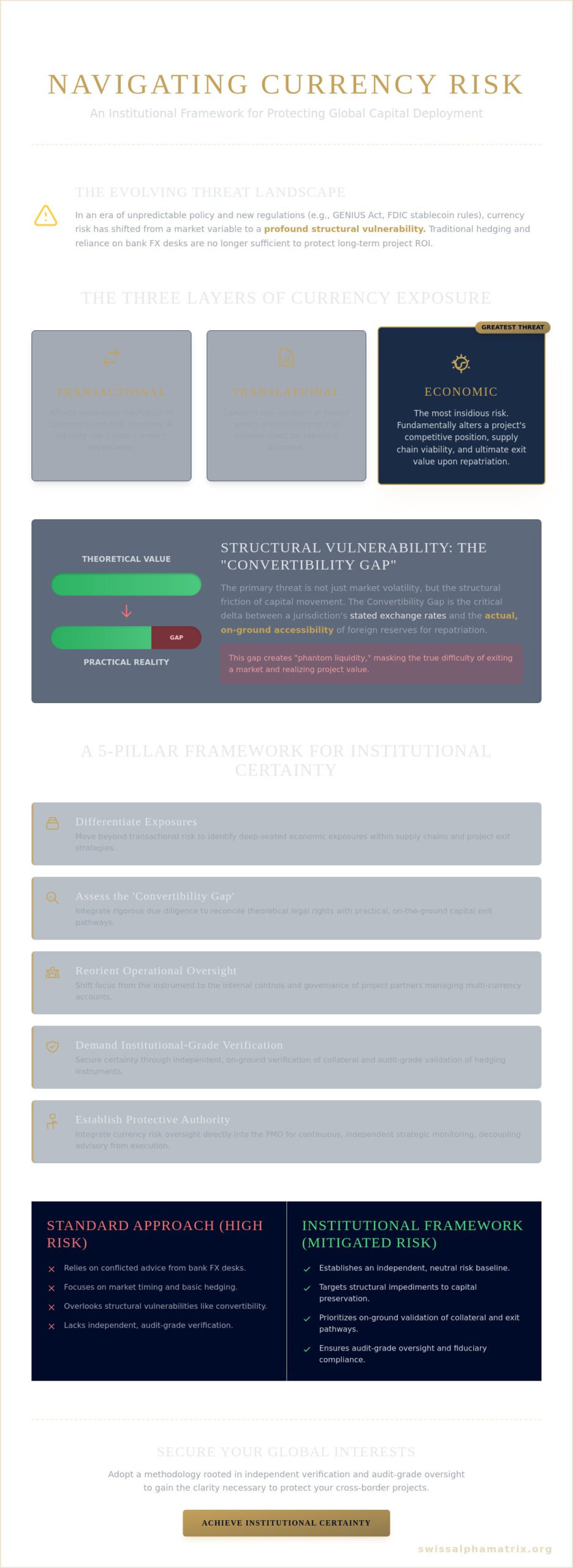
- Differentiate the nuances of transactional, translational, and economic exposures to identify structural impediments to capital preservation in long-term international mandates.
- Integrate a rigorous assessment of the “Convertibility Gap” into your financial instrument due diligence process to reconcile theoretical legal rights with practical capital exit pathways.
- Reorient operational oversight from the financial instrument itself toward the internal controls and governance of the project partners managing multi-currency accounts.
- Secure institutional-grade certainty through on-ground verification of physical collateral and audit-grade validation of hedging instruments to ensure structural reliability.
- Establish a protective authority by integrating currency risk oversight directly into a complex project management framework for continuous, independent strategic monitoring.
The Architecture of Currency Risk in International Capital Deployment
Currency risk is frequently mischaracterized as a mere fluctuation in market pricing; however, for the institutional investor, it represents a profound structural impediment to capital preservation. In cross-border mandates, the volatility of a local currency doesn’t just impact a balance sheet. It can fundamentally alter the viability of a project’s long-term deployment. Market timing isn’t the solution. Traditional market hedging often proves insufficient for complex, milestone-based international programmes because these instruments are typically designed for static timelines rather than the fluid nature of multi-year capital works.
To manage these dynamics effectively, one must distinguish between the various layers of foreign exchange risk that exist within a single project. Transactional exposure addresses the immediate mechanics of payment and debt service, while translational exposure concerns the valuation of assets held in foreign denominations. It’s economic exposure, however, that poses the greatest threat to a project’s terminal value. This risk reflects how currency shifts impact the competitive position of the enterprise itself, often manifesting through hidden links within multi-jurisdictional supply chain contracts.
Transactional vs. Economic Exposure
Short-term liquidity depends on the precise timing of currency conversions to meet debt obligations. If a local currency depreciates against the funding currency, the cost of servicing that debt can spiral, creating an immediate liquidity crunch that threatens project milestones. Economic risk is more insidious. It affects the project’s exit strategy and final valuation, as the purchasing power of the realized capital may be significantly diminished upon repatriation. Identifying these vulnerabilities requires a deep dive into the operational layers where currency fluctuations intersect with procurement and revenue realization.
The Institutional Necessity for Independent Validation
Relying solely on the FX desks of lead banks often creates an inherent conflict of interest, as these entities are frequently the counterparties to the very hedges they recommend. For C-suite executives, establishing an independent risk baseline is essential for fulfilling fiduciary duties. Establishing a robust financial instrument due diligence process allows the board to verify the efficacy of a strategy without the bias of an interested counterparty. This oversight should include specialized bank instrument validation services to verify that the collateral backing a hedge is both authentic and enforceable within the specific jurisdiction of the project.
A neutral risk baseline provides the executive team with a clear view of the structural vulnerabilities that market-driven data might obscure. It’s a requirement for audit-grade reporting that supports high-level decision-making and ensures that the interests of the project remain the primary focus of the risk management strategy. By decoupling the advisory role from the execution of the hedge, an organization secures a protective authority that prioritizes long-term stability over short-term speculative gains.
Structural Vulnerabilities: Convertibility and Repatriation Risks
While traditional risk assessments focus on market volatility, the seasoned executive recognizes that the primary threat to international project viability often lies in the structural friction of capital movement. During a rigorous financial instrument due diligence process, it’s vital to assess the Convertibility Gap, which represents the delta between a jurisdiction’s stated exchange rates and the actual, on-ground accessibility of foreign reserves. This is particularly critical in emerging markets where phantom liquidity can create a deceptive sense of security, allowing for local currency accumulation while masking the impossibility of high-volume hard currency conversion. It’s a structural trap that market data alone cannot reveal.
Repatriation risk isn’t merely a legal concern; it’s an operational reality that determines whether a project’s success ever translates into realized value. The distance between theoretical legal rights and the practical ability to exit a position can be vast, often influenced by shifting sovereign credit profiles that compromise local currency stability. When a sovereign entity’s creditworthiness falters, the first casualty is often the availability of hard currency for private capital exit. This makes the independent validation of sovereign guarantees a non-negotiable component of institutional oversight.
Repatriation Frameworks and Regulatory Barriers
Evaluating central bank protocols requires more than a cursory review of standing regulations. It demands a granular understanding of how capital outflow is prioritized during periods of fiscal stress. Our framework focuses on three critical pillars to ensure capital mobility:
- Bilateral Investment Treaties: Assessing the practical enforceability of transferability and expropriation protections within the specific geopolitical context.
- Repatriation Prioritization: Verifying the project’s standing within the central bank’s queue for hard currency and identifying any informal capital controls.
- Conversion Tax Exposure: Quantifying the fiscal impact of final project exit to ensure that the net realized value isn’t eroded by unforeseen conversion levies.
Sovereign Risk and Currency Pegs
The fragility of pegged currencies is a recurring theme in global finance, where sudden devaluations can instantly compromise a project’s internal rate of return (IRR). As central bank policies diverge throughout 2026, the pressure on these artificial benchmarks intensifies, making it essential to analyze the likelihood of a peg’s collapse. Understanding the nuances of Currency Risk in Project Finance allows for a more realistic appraisal of whether a sovereign entity can actually fulfill its promise of hard currency availability when local markets tighten. For those managing multi-jurisdictional mandates, engaging with a partner for operational due diligence provides the necessary distance to evaluate these sovereign risks without the optimism bias often found in local project teams. Identifying these vulnerabilities early prevents the catastrophic impact of a sudden devaluation on long-term capital deployments.
The Operational Due Diligence Framework for Currency Mitigation
The efficacy of a currency mitigation strategy is fundamentally dependent on the operational integrity of those tasked with its execution. While previous sections addressed the structural market risks inherent in capital deployment, a robust financial instrument due diligence process must pivot toward the human and procedural elements that govern these complex deployments. It is a frequent institutional oversight to validate the instrument while neglecting the operator; yet, the technical competence of a local treasury function in a cross-border deal is often the primary determinant of whether a hedge performs as intended during periods of extreme volatility. A failure in operational execution can render even the most sophisticated financial instrument entirely ineffective.
Central to this operational inquiry is the Conflict of Interest audit. Executives must ensure that the currency strategies employed by project partners or lead banks are designed to protect the project’s principal capital rather than generate ancillary profit for the counterparty through spread manipulation or excessive transaction fees. This requires a forensic level of transparency into how multi-currency accounts are managed and how risk limits are established at the local level. Without independent oversight, the interests of the project can easily be secondary to the profit motives of the financial institution executing the trades.
Counterparty Risk Validation
A sophisticated approach to risk management requires an institutional-grade review of the fiscal health and creditworthiness of all hedging counterparties. It’s not enough to rely on headline credit ratings, which can lag behind market realities; instead, one must verify the legal enforceability of ISDA agreements within secondary or offshore jurisdictions where local laws may supersede standard international protocols. Applying a rigorous cross-border investment due diligence framework ensures that every financial institution involved in the capital flow is scrutinized for both its regulatory standing and its historical reliability. This layer of protection is essential for maintaining the stability of the project’s financial architecture over multi-year cycles.
Internal Governance and Oversight
Rigorous internal governance serves as the final barrier against operational failure. This involves a comprehensive review of the project’s FX policy, specifically looking at authority levels, reporting lines, and the underlying risk limits that prevent unauthorized speculation. A clear RACI matrix should be established for all currency-related decision-making to eliminate ambiguity and ensure that accountability is clearly defined. Effective budgeting and risk planning, as highlighted in Columbia University’s Framework for International Project Budgets, emphasize the need for a logical, steady flow of information between local project entities and global stakeholders. Validating the transparency of these reporting lines is a critical component of the financial instrument due diligence process, ensuring that executive stakeholders are never insulated from the ground-level realities of currency exposure.
Institutional-Grade Verification of Hedging Instruments
The transition from operational oversight to technical validation represents the most critical phase of the financial instrument due diligence process. While governance frameworks ensure that the right people are in place, they cannot account for the structural integrity of the instruments themselves. In complex international projects, a “paper hedge” often creates a dangerous illusion of security. This occurs when a derivative contract or currency backstop appears valid on a digital ledger but lacks the legal or liquidity depth to perform during a localized market freeze. True protection requires a shift toward audit-grade verification that reconciles HQ-level reporting with the ground-level reality of local banking relationships.
Confirming the validity of a hedging instrument demands a methodology that bypasses intermediaries. Relying on digital confirmations or third-party attestations is insufficient for C-suite stakeholders who carry the ultimate fiduciary responsibility for capital preservation. Instead, our approach emphasizes direct, independent inquiry with both issuing and confirming banks to ensure that instruments, such as Standby Letters of Credit (SBLCs) used as currency backstops, are correctly structured, free of hidden encumbrances, and fully aligned with the project’s specific jurisdictional requirements.
Physical On-Ground Verification
Digital records are notoriously insufficient for verifying local banking liquidity in emerging markets. Discrepancies often emerge between the polished reports provided by corporate headquarters and the actual presence of assets within a regional treasury operation. To mitigate this, we conduct physical audits of local project accounts. This process involves verifying the existence of physical collateral and the actual standing of the project entity with local regulators. By identifying these gaps early, executives can avoid the catastrophic realization that their primary hedge is unenforceable due to local regulatory shifts or banking insolvency that was never reported up the chain.
Instrument Integrity and Validation
Technical validation of derivative contracts requires a forensic eye. We apply sophisticated financial advisory methodologies to scrutinize the fine print of every currency instrument. This ensures that the triggers for a hedge are not only market-based but also project-based, allowing for flexibility during milestone delays. The Swiss Alpha Matrix methodology for independent financial instrument review provides a neutral, protective layer between the project and the counterparty. We verify that each instrument is structured to withstand the specific sovereign risks identified in previous sections, ensuring that the cash-flow reality matches the theoretical protection. For those requiring absolute certainty, our Audit-Grade Instrument Validation services provide the definitive verification necessary to secure large-scale capital deployments against structural failure.
Strategic Oversight: Integrating Currency Risk into the PMO
Currency risk management shouldn’t be relegated to a pre-closing checklist; instead, it requires deep integration into the very heart of a project’s operational architecture. By positioning these risks within a Complex Project Management framework, stakeholders ensure that currency fluctuations are treated as dynamic variables rather than static assumptions. This transition from reactive monitoring to proactive structural mitigation allows for the preservation of capital through periods of extreme market instability. An independent advisory firm acts as a protective authority, providing the necessary distance to evaluate risk without the internal pressures that often lead to over-optimism in project timelines or the miscalculation of regional volatility.
The finalization of the financial instrument due diligence process serves as the foundational baseline for this ongoing oversight. It’s not merely about the initial validation of a contract; it’s about establishing a technical standard that can be measured against real-world performance throughout the project lifecycle. When independent oversight is absent, capital erosion often occurs through subtle, unhedged slippages that accumulate over multi-currency mandates. Institutional history shows that projects utilizing on-ground verification and continuous technical auditing are far better equipped to avoid the principal losses typically seen during sudden emerging market devaluations, where local liquidity can evaporate in hours.
The Independent PMO Approach
Integrating currency risk metrics into the monthly project oversight dashboard provides stakeholders with a clear, unemotional view of their global exposure. This level of technical intelligence is essential for the Board to fulfill its fiduciary duties, ensuring that every transaction remains in strict regulatory compliance across all jurisdictions. By decoupling the monitoring function from the project’s execution team, the PMO maintains a standard of service that is both broad in reach and meticulous in its attention to detail. This independence ensures that reporting remains objective, even when market conditions challenge the project’s original financial assumptions.
Establishing a Resilient Risk Framework
Developing a resilient risk framework involves designing trigger-based mitigation strategies that activate automatically during sudden currency shifts or the imposition of capital controls. These frameworks are built to survive extreme market shocks, utilizing the data gathered during the initial financial instrument due diligence process to anticipate structural vulnerabilities before they manifest as losses. The concluding due diligence report provides executive stakeholders with a comprehensive technical view, offering the certainty required to proceed with complex capital deployments. This meticulous approach lead to a sense of inevitable logic, creating the professional calm necessary for confident, long-term decision-making in an increasingly volatile global economy.
Securing Capital Integrity in an Era of Global Volatility
Navigating the complexities of international capital deployment requires a transition from passive market observation to rigorous structural validation. By acknowledging that currency risk is a fundamental impediment to capital preservation, executive stakeholders can implement a framework that prioritizes transparency and technical accuracy. Integrating a robust financial instrument due diligence process ensures that every hedge and backstop is verified not merely on paper, but through the ground-level reality of local banking liquidity and regulatory compliance. This institutional approach transforms currency management from a reactive necessity into a proactive pillar of project stability.
Our methodology, led by former Tier-1 global bank senior executives, provides the independent, conflict-free strategic consulting necessary to shield your interests from the erosion of unhedged volatility and counterparty failure. We offer audit-grade instrument validation and on-ground verification services that move beyond digital records to confirm the actual standing of your capital in foreign jurisdictions. To ensure your cross-border projects maintain their intended trajectory and terminal value, it’s essential to partner with experts who value meticulous precision over short-term speculation.
Secure your international capital deployment with our expert advisory services.
Your commitment to institutional-grade oversight today will define the stability and success of your global mandates for years to come.
Frequently Asked Questions
What is the primary objective of the financial instrument due diligence process regarding currency risk?
The primary objective is the structural validation of a project’s hedging architecture to ensure it reliably protects principal capital against unhedged volatility. It moves beyond simple market analysis to verify the legal and operational depth of each instrument involved. By applying a rigorous financial instrument due diligence process, stakeholders gain the certainty that their mitigation strategy will perform as intended during localized market freezes or liquidity crunches.
How does operational due diligence differ from traditional financial hedging strategies?
Traditional strategies often prioritize market timing and price fluctuations within standard exchange environments. Operational due diligence, conversely, scrutinizes the human and procedural elements governing the execution of those strategies. It assesses the technical competence of treasury functions and the integrity of internal controls. This ensures that the operator is as resilient as the financial instrument itself, preventing failure through human error or institutional conflict.
Why is on-ground verification critical for managing currency repatriation risk in 2026?
On-ground verification is essential because digital ledger entries frequently fail to reflect the practical roadblocks inherent in capital repatriation. In 2026, shifting sovereign credit profiles and new regulatory frameworks have created a landscape where theoretical legal rights don’t always equal capital exit. Physical audits verify the actual presence of assets and the project’s standing within local central bank queues, providing a level of certainty that remote reporting cannot match.
What are the common red flags in international financial instruments used for currency hedging?
Common red flags include instruments with hidden encumbrances or triggers that are purely market-based without accounting for project milestone delays. Another significant concern is the presence of phantom liquidity, where a bank instrument appears valid but lacks the depth of hard currency reserves to support a large-scale conversion. Identifying these discrepancies requires a forensic review of the instrument’s fine print and an independent assessment of the issuing bank’s current regulatory standing.
How can an independent advisory firm assist in validating cross-border currency strategies?
An independent advisory firm provides a neutral risk baseline that is free from the profit motives of lead bank FX desks. They act as a protective authority, utilizing a technical financial instrument due diligence process to audit the efficacy of a strategy without the bias of an interested counterparty. This ensures that the hedging architecture is designed solely for capital preservation, providing the Board with unemotional intelligence regarding their multi-jurisdictional exposure.
What role does sovereign risk play in the due diligence of project-based currency exposure?
Sovereign risk is a primary determinant of whether a local currency peg remains viable or if a sudden devaluation will compromise the project’s internal rate of return. It directly influences the availability of hard currency for private capital exit, particularly during periods of fiscal stress. Due diligence must therefore include an independent validation of sovereign guarantees to ensure they are backed by more than just theoretical legislative promises.
Can a project be fully protected against currency volatility in emerging markets?
While absolute protection against market volatility is rarely achievable, structural mitigation can significantly minimize the impact of currency shocks on principal capital. A resilient framework utilizes trigger-based strategies and audit-grade validation to ensure that hedges are enforceable and liquidity is accessible. By focusing on capital preservation rather than speculative gains, an organization can navigate emerging market devaluations without the catastrophic erosion of project ROI.
How should C-suite executives interpret audit-grade validation reports for currency risk?
Audit-grade validation reports should be interpreted as a definitive technical baseline for fulfilling fiduciary duties and making strategic capital deployment decisions. These reports provide a logical, steady flow of intelligence that reconciles HQ reports with ground-level realities. They offer the professional calm necessary for executive teams to proceed with complex mandates, knowing that their structural vulnerabilities have been independently identified and mitigated through a rigorous oversight framework.