

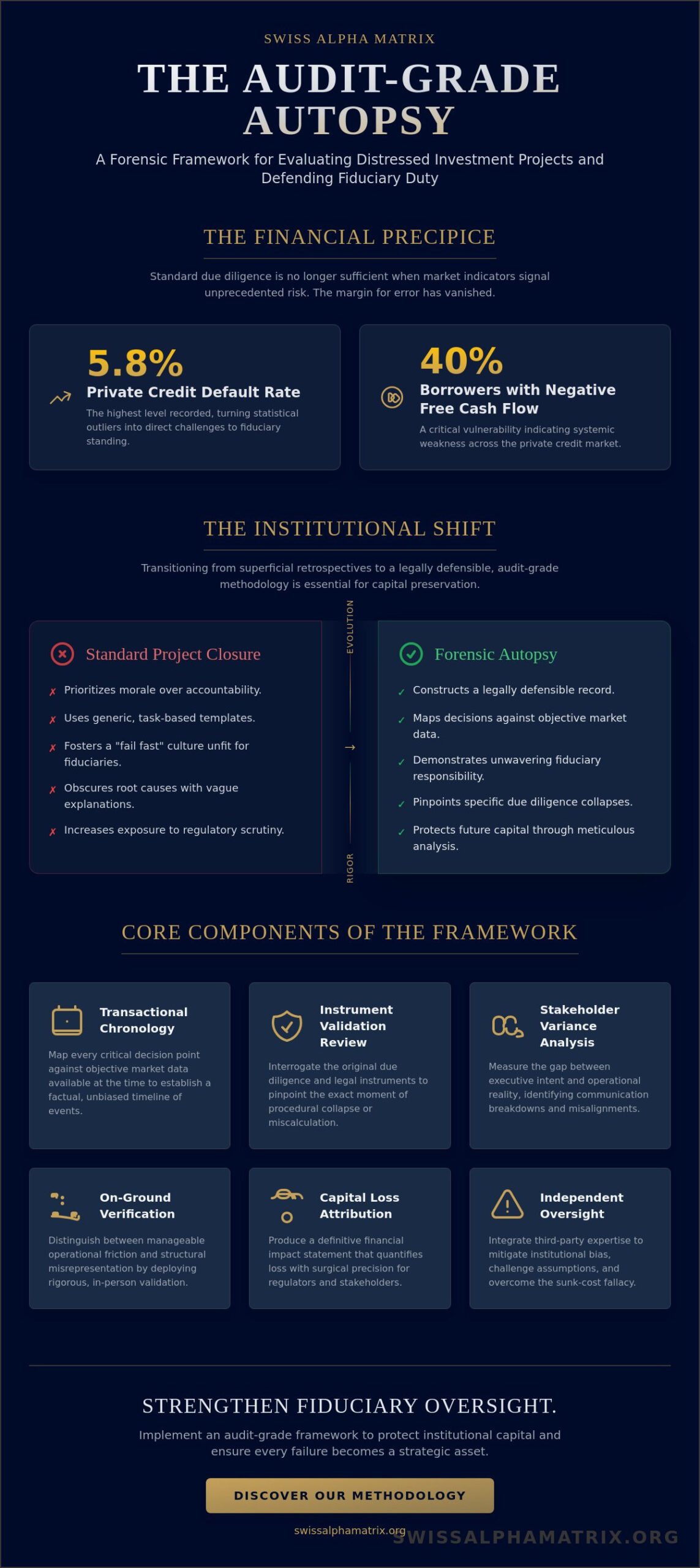
With private credit default rates reaching 5.8 percent in early 2026, the highest level recorded since the index began, a failed 100 million dollar deal is no longer a statistical outlier; it’s a direct challenge to your fiduciary standing. You likely recognize that standard due diligence templates are woefully insufficient for the intricacies of cross-border debt, making a robust framework for evaluating distressed investment projects an essential instrument for institutional survival. When 40 percent of borrowers in the private credit market report negative free cash flow, the margin for error in project oversight has effectively vanished.
This article details a sophisticated forensic methodology, transforming what is often a fragmented retrospective into an audit-grade autopsy that satisfies the most stringent regulatory inquiries. By adopting this rigorous approach, you’ll gain the tools to protect institutional capital through meticulous on-ground verification and operational due diligence, ensuring that every failure is cataloged with surgical precision. We’ll examine how to pinpoint specific due diligence lapses, navigate the complexities of the 3.42 million dollar Subchapter V debt limit, and ultimately produce a professional report that demonstrates an unwavering commitment to fiduciary responsibility and strategic capital preservation.
Key Takeaways
- Elevate institutional rigor by transitioning from standard project closures to a sophisticated forensic autopsy designed for long-term capital preservation and fiduciary defensibility.
- Deploy a structured framework for evaluating distressed investment projects to map every critical decision point against objective market data and pinpoint specific procedural collapses.
- Distinguish between manageable operational friction and structural misrepresentation by applying a rigorous methodology rooted in audit-grade instrument validation and on-ground verification.
- Construct a definitive financial impact statement and transactional chronology that serves as a professional document of record for regulators and internal stakeholders.
- Mitigate the risks of institutional bias and the sunk-cost fallacy by integrating independent, third-party oversight into your distressed project management and risk frameworks.
Beyond the Autopsy: Why Distressed Project Failures Require Institutional Rigor
Standard project closures often prioritize the preservation of morale and the expeditious reallocation of personnel, yet such superficial retrospectives are fundamentally incompatible with the gravity of institutional capital deployment. When a venture involving distressed securities collapses, the primary objective isn’t merely to learn from mistakes, but to construct a legally defensible, audit-grade record of why the capital was lost. A robust framework for evaluating distressed investment projects serves as this definitive record, providing the intellectual depth required to satisfy internal stakeholders and external regulators who demand absolute precision. The contemporary “fail fast” ethos, while perhaps suitable for nascent technology startups, is an unacceptable posture for fiduciaries managing nine-figure exposures. Failure in this context requires a master planner’s approach, characterized by a measured and steady deconstruction of the delta between the initial risk assessment and the final economic outcome. This quiet authority ensures that the firm’s reputation for technical accuracy remains intact, even when a specific transaction doesn’t yield the intended results.
The Limitations of Generic Project Management Templates
Generic task-based templates focus on whether a deadline was met, but they rarely interrogate the underlying instrument risk or the validity of the original due diligence. In distressed markets, failures are rarely the result of a missed meeting; they’re the result of mispriced jurisdictional risk or a breakdown in on-ground verification. Moving beyond a simple blame culture requires an institutional commitment to accountability, where the focus shifts to protecting future capital through a more sophisticated framework for evaluating distressed investment projects. Oversimplifying a cross-border failure doesn’t just obscure the root cause; it actively increases the firm’s exposure to regulatory blowback and fiduciary scrutiny. Precision is the only shield against such outcomes.
Defining Failure in Multi-Jurisdictional Distressed Transactions
Failure in complex transactions often manifests as a divergence between instrument validation and operational execution. You might find that while the legal instruments were technically sound, the operational due diligence failed to account for regional friction or localized regulatory shifts that occurred during the project lifecycle. Identifying the forensic delta between the projected ROI and the actual loss requires a high level of professional competence and a refusal to accept vague, qualitative explanations. By documenting the precise point where the transaction deviated from its projected trajectory, fiduciaries can demonstrate the institutional rigor necessary to maintain their standing as seasoned experts. This process isn’t about looking backward with regret, but about ensuring that every future deployment of capital is informed by a meticulous understanding of structural and operational vulnerabilities.
The Forensic Framework: Key Components of an Audit-Grade Post-Mortem
To move beyond superficial retrospectives, an institution must adopt a framework for evaluating distressed investment projects that mirrors the precision of a high-level financial audit. This forensic approach begins with a comprehensive transactional chronology, which maps every critical decision point against the objective market data available at that specific juncture. It’s insufficient to merely note a project’s failure; fiduciaries must interrogate the instrument validation review to pinpoint exactly where the due diligence process collapsed. This requires a clinical analysis of stakeholder variance, measuring the often-silent gap between executive intent and the actual operational reality on the ground. By quantifying capital loss attribution through a lens that distinguishes between direct fiscal loss and the broader opportunity cost, firms can maintain the intellectual depth required to satisfy regulatory scrutiny. Ensuring that the failure did not breach framework for analyzing distressed assets standards is paramount for institutional preservation.
- Transactional Chronology: A minute-by-minute reconstruction of capital deployment and the corresponding risk-mitigation decisions.
- Instrument Validation: A technical reassessment of the legal and financial instruments to identify structural weaknesses overlooked during the initial acquisition.
- Capital Loss Attribution: A granular breakdown of losses, categorizing them by market volatility, operational error, or jurisdictional friction.
Pre-Mortem Delta Analysis
The first stage of a forensic review involves comparing the initial adherence to International Financial Regulations against the actual outcomes recorded during the project’s lifecycle. Transactional variance represents the quantitative disparity between the anticipated financial trajectory and the realized economic outcome, serving as the primary metric for diagnosing financial project failure. This analysis helps distinguish between genuine “black swan” events and predictable due diligence lapses that should have been captured by a robust framework for evaluating distressed investment projects. Implementing a rigorous risk management framework ensures that these procedural lacunae are identified before they metastasize into terminal capital loss.
On-Ground Verification Lapses
In the high-stakes environment of distressed assets, digital-only due diligence has frequently proven to be a catastrophic vulnerability. The absence of physical, on-ground verification often masks discrepancies in asset valuation and operational viability that no spreadsheet can capture. Analyzing why these lapses occurred is essential, particularly when they are directly linked to a failure in cross-border investment due diligence. For institutional entities, the reliance on third-party digital reports without local, primary-source validation represents a fundamental breach of operational rigor. A professional post-mortem must honestly address whether the failure was an inevitable market shift or a preventable consequence of insufficient physical oversight in complex jurisdictions.
Root Cause Analysis: Distinguishing Operational Friction from Structural Fraud
Distinguishing between market-driven volatility and the more insidious presence of structural fraud is a primary requirement for any institutional framework for evaluating distressed investment projects. In the nuanced field of distressed debt investing, failure is frequently misattributed to general market conditions when the root cause actually lies in specific, detectable misrepresentations. By applying the “Five Whys” methodology to financial failure, an investigator can look past surface-level operational friction to uncover whether a transaction’s collapse was an inherent feature of its deal structure. This process moves from the obvious effect, capital loss, down through layers of counterparty risk and systemic instability to reach the fundamental idiosyncratic failure point. Integrating independent financial project management provides a necessary layer of objectivity, ensuring that internal biases don’t obscure the distinction between a project that was poorly executed and one that was fundamentally flawed from inception.
Lapses in Financial Instrument Validation
The authenticity of Standby Letters of Credit (SBLCs) or Bank Guarantees (BGs) often serves as the fulcrum upon which a distressed project’s survival depends. When these instruments are not subjected to rigorous, bank instrument validation services, the resulting exposure can be catastrophic for institutional capital. Audit-grade validation would have alerted stakeholders to the structural deficiencies within the provided collateral prior to any significant capital deployment, effectively neutralizing the risk of fraudulent misrepresentation. Without this level of verification, the delta between projected security and actual liquidity becomes an unbridgeable chasm, leading to terminal failure in cross-border contexts. It’s a matter of technical accuracy over optimistic projection.
Stakeholder Misalignment and RACI Breakdown
Cross-border execution failures in distressed markets are rarely the result of a single error, but rather the cumulative effect of unclear mandates and a breakdown in the Responsibility, Accountability, Consulted, and Informed (RACI) matrix. Re-evaluating the financial advisory methodologies employed during the planning phase often reveals that information silos prevented critical risk data from reaching decision-makers. In multi-billion dollar distressed programs, the institutional cost of these silos is measured in lost recovery potential and increased regulatory exposure. A robust framework for evaluating distressed investment projects must therefore prioritize the synchronization of all stakeholders, ensuring that the master plan is not undermined by fragmented communication or misaligned operational incentives.
The Executive Framework for Evaluating Distressed Investment Projects
The transition from theoretical analysis to a structured boardroom presentation requires a framework for evaluating distressed investment projects that prioritizes technical accuracy over narrative convenience. This executive-level document serves as the definitive record of fiduciary diligence, categorizing the failure into five distinct analytical pillars. First, the Executive Summary provides a clinical Financial Impact Statement, establishing the bottom line for stakeholders. This is followed by the Transactional Chronology, a forensic review of validation protocols, and a Fiduciary Risk Assessment that identifies specific accountability gaps. Finally, the Strategic Remediation plan outlines the forward path for capital protection. The forensic review pillar specifically interrogates the validity of bank instruments, ensuring that the initial due diligence wasn’t compromised by a lack of physical verification or audit-grade oversight. By adhering to this multifaceted structure, an institution demonstrates the intellectual depth necessary to maintain its standing as a master planner, even in the wake of a distressed project collapse.
Section 1: The Transactional Chronology
A professional reconstruction of the distressed asset lifecycle must document every KYC/AML and validation touchpoint with surgical precision. This chronology isn’t a mere list of events; it’s a strategic mapping of external market factors against internal project milestones. For instance, mapping the 5.8 percent private credit default rate observed in early 2026 against a firm’s specific internal decision points can reveal whether a project’s failure was an isolated incident or a failure to adapt to systemic shifts. By identifying where internal execution diverged from external market realities, fiduciaries can pinpoint the exact point of no return in the failure timeline. This forensic mapping ensures that future ventures aren’t undermined by the same jurisdictional friction, providing a historical baseline for regional excellence and precision.
Section 2: Capital Protection Review
Quantifying the total cost of project failure requires a sophisticated analysis that extends beyond direct capital loss to include the significant opportunity cost of misallocated institutional focus. An effective review interrogates why existing risk mitigation frameworks failed to trigger early-warning protocols in distressed scenarios. Often, a forensic post-mortem reveals that specific financial advisory methodologies were bypassed or neutralized by institutional silos during the initial acquisition phase. Identifying which protocols were ignored allows the firm to rebuild its internal controls with a renewed focus on long-term preservation and strategic growth. To ensure your firm’s future capital is shielded from similar structural vulnerabilities, you should implement a more robust risk management framework that prioritizes on-ground verification over passive digital due diligence. This review process transforms a retrospective loss into a proactive strategic asset, reinforcing the moral character and high-level standards of the institution.
From Retrospective to Proactive: Implementing Independent Oversight
The true value of a forensic post-mortem lies not in the mere documentation of loss, but in the institutionalization of those findings to prevent the recurrence of similar structural vulnerabilities. Internal reviews, while necessary for immediate reporting, frequently fall victim to institutional bias, as the individuals responsible for the initial capital deployment are rarely the most objective critics of its subsequent failure. By decoupling the evaluation process from the original deal-making team, an institution can effectively neutralize the psychological pressure of the sunk-cost fallacy, allowing for a clinical assessment of procedural lacunae that might otherwise be obscured by a desire for professional self-preservation. A robust framework for evaluating distressed investment projects must therefore integrate independent oversight to ensure that future mandates are governed by technical accuracy rather than optimistic projection. Swiss Alpha Matrix provides the dignified discretion and regional precision required to navigate complex global mandates, moving beyond passive observation to active, audit-grade capital preservation.
Transitioning from a retrospective stance to a proactive one requires a fundamental shift in how fiduciaries perceive risk management. It’s no longer sufficient to rely on digital-only due diligence when 40 percent of borrowers in the private credit market report negative free cash flow as of Q1 2026. Institutional rigor demands on-ground verification and a refusal to oversimplify the intricate nature of cross-border distressed assets. This proactive posture ensures that interests are in the hands of seasoned, unemotional experts who prioritize long-term preservation over short-term speculation, reinforcing the moral character and high-level standards expected of elite wealth management entities.
The Role of Independent Verification
External validation serves as a critical circuit breaker for impending project failure, providing a level of scrutiny that internal teams often find difficult to maintain. There’s a profound difference between the “box-checking” exercises common in standard project management and the audit-grade forensic investigation required for distressed capital. Building an institutional culture of capital protection necessitates senior-level advisory that isn’t afraid to identify where a framework for evaluating distressed investment projects was circumvented. This independent oversight ensures that every financial instrument is validated with surgical precision, preventing the misrepresentation that often characterizes structural fraud in high-risk jurisdictions.
Securing Future Mandates
Using post-mortem data to refine future investment due diligence protocols is the hallmark of a master planner. By establishing a permanent independent financial project management function, firms can ensure that the hard-won lessons of past failures are woven into the fabric of every new transaction. This approach doesn’t just protect capital; it demonstrates a level of institutional rigor that satisfies both internal stakeholders and increasingly vigilant regulators. To secure the long-term integrity of your complex capital deployments, you should consult with Swiss Alpha Matrix for independent project oversight and operational due diligence that meets the highest standards of professional competence.
Securing the Path to Institutional Capital Preservation
Transitioning from a state of reactive analysis to proactive oversight is the definitive hallmark of a sophisticated fiduciary. By implementing a comprehensive framework for evaluating distressed investment projects, your institution transforms past failure into a strategic blueprint for future resilience. It’s a process that requires more than simple retrospection; it demands the clinical application of audit-grade instrument validation and on-ground verification to neutralize structural risks before they jeopardize the portfolio. Precision is the only shield against the complexities of cross-border distressed deals.
Managed by former Tier-1 global banking executives, Swiss Alpha Matrix brings an unparalleled level of intellectual depth and Swiss precision to global project management. Our experts don’t just observe; they validate through rigorous operational due diligence and regulatory compliance advisory to ensure interests remain secure. We invite you to Secure Your Next Mandate with Independent Project Oversight and experience the stability that comes from partnering with seasoned, unemotional experts who prioritize long-term preservation. Your commitment to institutional rigor today is the foundation for strategic growth tomorrow.
Frequently Asked Questions
What is the primary difference between a project retrospective and a forensic financial post-mortem?
The primary distinction lies in the objective; while a traditional retrospective focuses on internal team learning and cultural improvement, a forensic financial post-mortem constructs an audit-grade record of fiduciary diligence and capital loss attribution. This rigorous approach ensures that every decision point is mapped against objective market data to satisfy the most stringent external regulatory inquiries.
How should I handle sensitive information or potential liability in a post-mortem report?
Sensitive information should be managed through restricted access protocols and the use of precise, technical terminology that avoids speculative language. By adhering to a structured framework for evaluating distressed investment projects, fiduciaries can document the quantitative delta between projected and actual outcomes without inadvertently creating unnecessary institutional exposure.
Who should lead the post-mortem session for a failed multi-million dollar distressed transaction?
A failed multi-million dollar transaction should be led by an independent, senior-level expert who possesses the intellectual depth to interrogate complex instrument risk. Utilizing a third-party advisor with experience in Tier-1 global banking ensures that institutional bias and the sunk-cost fallacy don’t compromise the integrity of the forensic review or the master plan for remediation.
How often should an institutional project failure template be updated to reflect regulatory changes?
Institutional templates should be updated dynamically following major regulatory shifts or significant market events, such as the SEC’s proposed rule changes in May 2026 regarding public float thresholds. Maintaining a static framework in a rapidly evolving credit market, where private credit default rates reached 5.8 percent in early 2026, represents a fundamental failure in risk management.
Can a forensic post-mortem report be used as evidence in regulatory audits or legal proceedings?
A forensic post-mortem report serves as a critical document of record that can demonstrate institutional rigor during regulatory audits or internal oversight reviews. When constructed with surgical precision, these reports provide a defensible trail of operational due diligence and instrument validation that reinforces the firm’s moral character and professional competence before external stakeholders.
What are the most common root causes of cross-border distressed investment failure in 2026?
The most common root causes in 2026 include persistent “higher-for-longer” interest rates impacting floating-rate debt and the catastrophic failure of digital-only due diligence in cross-border contexts. With 40 percent of private credit borrowers now experiencing negative free cash flow, the absence of on-ground verification has become a primary driver of terminal project failure in high-risk jurisdictions.
How do I ensure that post-mortem action items are actually implemented across the organization?
Implementation is ensured by integrating post-mortem findings directly into the firm’s permanent risk management framework and assigning board-level accountability for specific remediation milestones. Utilizing a framework for evaluating distressed investment projects that includes a clear RACI matrix ensures that action items aren’t lost in institutional silos but are instead translated into operational reality.
Is it necessary to involve legal counsel in the project failure post-mortem process for distressed assets?
Involving legal counsel is a prudent step to ensure that the forensic process remains protected by appropriate confidentiality standards, though the post-mortem itself focuses on operational and financial validation. Readers should consult their own legal representatives to navigate specific jurisdictional requirements while the forensic team focuses on the technical accuracy of the instrument review and on-ground verification.