

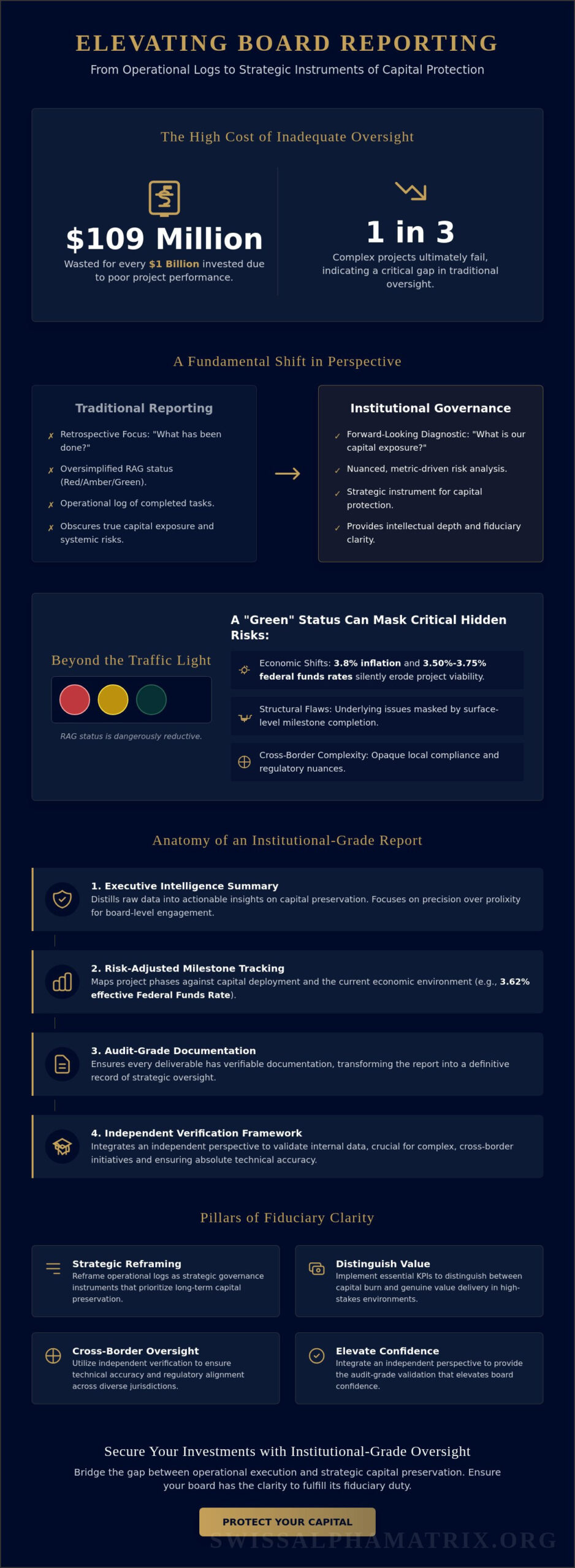
Organizations waste an average of $109 million for every $1 billion invested due to poor project performance, a statistic that underscores the profound necessity for a more rigorous institutional framework. When approximately one third of complex projects fail, it’s clear that traditional summaries often fail to provide the intellectual depth required for true fiduciary oversight. You’ve likely experienced the frustration of wading through operational data that obscures real capital exposure, especially when managing cross-border initiatives across multiple jurisdictions. Effective board reporting on project status must transcend simple updates, evolving into a sophisticated instrument of capital protection that aligns every milestone with your broader strategic objectives.
We understand that you require clarity, not just volume, to fulfill your duty to the institution. This guide will provide you with the methodologies to master sophisticated reporting that serves as a strategic instrument for risk mitigation and capital oversight. We’ll explore how to implement early warning systems that protect your interests while ensuring a standard of service that is both broad in reach and meticulous in its attention to detail.
Key Takeaways
- Reframe operational logs as strategic governance instruments that prioritize long-term capital preservation and intellectual depth.
- Refine your board reporting on project status by adopting an institutional-grade anatomy that emphasizes actionable executive intelligence and fiduciary clarity.
- Distinguish between capital burn and genuine value delivery through the implementation of five essential KPIs tailored for high-stakes financial environments.
- Manage cross-border oversight across diverse jurisdictions by utilizing independent verification to ensure absolute technical accuracy and regulatory alignment.
- Elevate board confidence by integrating an independent perspective that provides the audit-grade validation internal teams may lack in complex scenarios.
The Strategic Evolution of Board Reporting on Project Status
The transition from operational oversight to strategic governance represents a fundamental shift in how executive leadership perceives project health. Historically, reports served as chronological logs of completed tasks; however, in the context of institutional capital protection, this retrospective focus is insufficient. Modern board reporting on project status must function as a forward-looking diagnostic tool that prioritizes the identification of capital risk over mere timeline adherence. This requires a level of intellectual depth that mirrors Swiss-grade precision, where every data point is verified to ensure it reflects the true state of the investment. By adopting a robust project governance framework, institutions can move beyond the “what has been done” narrative to a rigorous analysis of “what is the current state of capital exposure.”
Beyond the Traffic Light: Why RAG Status is Insufficient
The traditional Red-Amber-Green (RAG) status indicator, while useful for internal team alignment, often proves dangerously reductive at the board level. In high-stakes environments, a Green status can frequently mask underlying structural or regulatory risks, particularly in cross-border deals where local compliance nuances remain opaque to central oversight. This oversimplification fails to account for the 3.8% inflation rate or the shifting 3.50% to 3.75% federal funds rate reported in mid-2026, both of which can silently erode project viability despite meeting internal milestones. A more nuanced, metric-driven approach is required. This methodology categorizes risk through the lens of capital volatility and jurisdictional complexity rather than subjective project manager sentiment, ensuring that board reporting on project status provides a true reflection of institutional health.
Reporting as a Pillar of Fiduciary Duty
Accurate reporting constitutes the primary evidence of diligent capital oversight, serving as the definitive record that fiduciary obligations have been met. With the May 2026 COSO guidance emphasizing practical enterprise risk management, the legal and regulatory implications of reporting failures have never been more pronounced. When organizations waste an average of $109 million for every $1 billion invested, the board’s inability to detect early warning signs is no longer just an operational lapse; it’s a governance failure. Proactive risk management frameworks must be integrated into the reporting cycle to provide the necessary audit-grade validation. Board reporting serves as the critical bridge between operational execution and strategic capital preservation.
Anatomy of an Institutional-Grade Project Status Report
Constructing an institutional-grade report requires more than a simple aggregation of task updates. It demands a structured hierarchy of information that mirrors the rigorous standards of a Tier-1 global bank. At the core of this framework lies the “Executive Intelligence” section, a dedicated space where raw data is distilled into actionable insights regarding capital preservation. Developing such a report necessitates an awareness of the inconvenient truths about project status reporting, specifically the tendency for internal teams to inadvertently obscure systemic risks. By mandating “Audit-Grade” documentation for every deliverable, the board ensures that board reporting on project status is not merely a formality but a verifiable record of strategic oversight.
The integration of milestone tracking with capital deployment schedules is essential for maintaining visibility over liquidity and risk. It’s no longer sufficient to report on progress in isolation; every phase must be mapped against the current economic environment, including the 3.62% effective Federal Funds Rate. This level of detail provides the board with a clear understanding of how project delays or accelerations impact the institution’s overall capital position. It’s this commitment to technical accuracy that distinguishes a professional governance tool from a standard status update.
The Executive Summary: Precision Over Prolixity
The executive summary serves as the primary instrument for board-level engagement. It must offer precision over prolixity. A master planner approach focuses on a single-page narrative that synthesizes critical risk indicators with capital deployment schedules. Refining board reporting on project status through this lens allows the board to focus on high-level capital oversight without becoming entangled in operational minutiae. While the summary provides the strategic overview, it must be supported by the technical rigor found in specialized bank instrument validation services. This dual layer ensures that while the board sees the broad landscape, the underlying assets remain verified to the highest institutional standards.
Milestones vs. Deliverables: Establishing Clear Accountability
Establishing accountability requires a clear distinction between a project milestone and a verifiable deliverable. A milestone marks a point in time, such as the completion of a phase, whereas a deliverable is a tangible, audit-ready asset. To ensure clarity, a RACI matrix should define reporting lines, particularly for “soft” milestones like stakeholder alignment or regulatory progress in complex jurisdictions. For projects requiring on-ground verification, utilizing on-ground verification services can provide the objective evidence necessary to confirm that milestones are not just reported, but achieved. This rigorous approach ensures that every claim made to the board is backed by verifiable data, fulfilling the institution’s commitment to transparency and moral character.
Metrics That Matter: Aligning Project Health with Capital Risk
Effective board reporting on project status requires a transition from superficial progress tracking to a rigorous evaluation of capital health. When approximately one third of complex projects fail, nearly double the rate of standard initiatives, the board’s primary objective must be the preservation of capital through the lens of sophisticated performance indicators. We identify five critical KPIs for complex financial programs: Capital At Risk (CaR), Value Delivery Index (VDI), Regulatory Compliance Velocity, Counterparty Stability Score, and Jurisdictional Risk Weighting. These metrics move beyond the binary “on time and on budget” narrative, providing a multi-dimensional view of how project activities influence the institution’s balance sheet and long-term strategic growth.
In capital-intensive programs, distinguishing between “Burn Rate” and “Value Delivery” is essential to avoid the trap of sunk cost fallacies. While a high burn rate might suggest operational momentum, it’s the realization of tangible, verifiable value that justifies continued investment. Without this distinction, boards risk authorizing capital deployment for initiatives that are technically progressing but strategically stagnant. To ensure these metrics meet the highest standards of technical accuracy, institutions should integrate institutional-grade financial advisory methodologies into their reporting cadence. This alignment ensures that every figure presented is backed by a robust framework of capital protection and professional competence.
Quantitative Risk Assessment in Status Updates
Quantifying the financial impact of project delays or scope creep is fundamental to sophisticated oversight. By utilizing Earned Value Management (EVM), boards can assess whether the work performed justifies the capital expended, providing a clear early warning system for budget variances. This method allows for a precise calculation of the Cost Performance Index (CPI) and Schedule Performance Index (SPI), which are vital for predicting final outcomes in a volatile economic climate where U.S. GDP growth is currently 2.0%. Metric-driven reporting prevents emotional bias in capital allocation decisions, ensuring that interests remain in the hands of seasoned, unemotional experts who prioritize long-term stability.
Qualitative Intelligence: The Human Element of Oversight
While quantitative data provides the foundation, qualitative intelligence offers the necessary context regarding geopolitical shifts or counterparty stability. Reporting on these nuances requires a master planner’s touch, distilling complex findings from on-ground verification into strategic narratives that don’t overwhelm the board with operational detail. Stakeholder sentiment, particularly in cross-border investment due diligence, serves as a leading indicator of potential friction in jurisdictions like London, Geneva, or Hong Kong. By integrating these qualitative insights, the board gains a comprehensive understanding of the project’s ecosystem, allowing for proactive risk mitigation rather than reactive crisis management.
Navigating Cross-Border Complexities in Status Reporting
Managing capital across London, Geneva, and Hong Kong introduces a layer of jurisdictional friction that standard reporting often fails to capture. The board reporting on project status must account for these geographic variances to ensure that capital protection remains uniform, regardless of the local operational environment. Discrepancies in reporting cycles, local accounting standards, and regulatory disclosure requirements can create a fragmented view of project health. Utilizing independent financial project management allows for the synthesis of data from disparate sources into a cohesive, audit-grade narrative. This independent layer acts as a master planner, standardizing terminology across global teams to prevent the misinterpretation of risk metrics.
Reporting delays caused by local operational hurdles are inevitable in complex cross-border initiatives. However, the sophistication of the report lies in how these delays are communicated to the board. Rather than focusing solely on shifted timelines, the narrative should analyze the impact of the delay on capital exposure and resource allocation. With the EUR/USD at 1.1646 and the USD/JPY at 159.46 as of June 1, 2026, currency volatility must also be factored into the risk weighting of international project segments. This level of technical accuracy ensures that the board remains informed of the true cost of project inertia in a fluctuating global market.
Regulatory Compliance Reporting
Institutional mandates require the seamless integration of updates on international financial regulations directly into the project status report. This includes reporting on AML/KYC milestones as critical prerequisites for capital deployment, ensuring that no funds are released until regulatory clearance is verified. Managing the flow of such sensitive information requires Swiss-level discretion to maintain the privacy and exclusivity of the mandate. By aligning project progress with the latest regulatory standards, including the May 2026 COSO guidance, the institution reinforces its commitment to moral character and high-level standards of service.
Geographic Risk and On-Ground Verification
Physical verification of project assets or counterparties remains a non-negotiable component of a robust status report. Desk-based data can be misleading, particularly in jurisdictions where local market conditions shift rapidly. Integrating “Red Flag” analysis into the monthly board update provides an early warning system for geopolitical instability or counterparty distress. For institutions seeking absolute certainty in their global mandates, our On-Ground Verification Services provide the necessary physical oversight to validate cross-border status reports. This meticulous attention to detail distinguishes a performance-oriented mindset from passive participants in the global financial landscape.
The Independent Advisory Advantage: Elevating Board Confidence
The efficacy of board reporting on project status depends entirely upon the objectivity of the source, a requirement that internal teams, despite their best intentions, often struggle to meet due to systemic organizational pressures. While internal project management offices are essential for day-to-day execution, their proximity to the project often creates an inherent conflict of interest that can obscure the unvarnished reality of capital risk. By introducing an independent “Third-Eye,” boards gain access to an unemotional evaluation of project health, which is vital when approximately one third of complex projects face failure. Swiss Alpha Matrix provides the audit-grade verification required to ensure that interests are in the hands of seasoned experts who prioritize long-term preservation over short-term milestones.
This independent layer serves as a strategic instrument for directors to verify the “Master Planner” vision, ensuring that the transition from broad philosophical principles to specific strategic pillars remains grounded in technical accuracy. With the May 2026 COSO guidance emphasizing practical action in enterprise risk management, the role of external advisory becomes a cornerstone of modern fiduciary duty. It provides the board with the quiet authority needed to make informed decisions, especially when managing the 3.8% inflation pressures or the 3.50% to 3.75% federal funds rate environment that impacts project viability across global portfolios. It’s this level of meticulous attention to detail that reinforces the exclusive nature of the service and provides the stability boards require.
Eliminating Internal Bias in Status Reporting
Optimism bias remains a pervasive challenge in internal reporting structures, where the natural desire to demonstrate progress can lead to the marginalization of critical risk indicators. Independent oversight eliminates this distortion, providing the board with a transparent view of the current state of capital exposure. Our approach utilizes peer-level intelligence from former Tier-1 executives who possess the intellectual depth to challenge internal narratives and identify structural weaknesses before they escalate. This ensures that board reporting on project status reflects the actual risk profile rather than a curated version of operational success, maintaining the high-level standards expected by institutional entities.
Implementing a High-Level Oversight Framework
Transitioning to an independent reporting model is a measured process that involves integrating specialized advisory into existing structures without disrupting operational flow. Boards can start by mandating independent operational due diligence for all projects exceeding a specific capital threshold. By integrating Swiss Alpha Matrix into the project governance framework, institutions ensure that every status update is backed by meticulous on-ground verification and risk management frameworks. It’s this commitment to regional excellence and hyper-personalization that distinguishes a performance-oriented mindset from passive participants in the global financial landscape. Contact Swiss Alpha Matrix to secure your capital through independent project oversight.
Fortifying Institutional Governance Through Strategic Oversight
The evolution of board reporting on project status from a mere administrative exercise to a fundamental pillar of institutional governance is a necessary response to the increasing complexity of the global financial landscape. By prioritizing executive intelligence over raw data and integrating independent verification, boards ensure that fiduciary responsibilities are met with the highest degree of technical accuracy. True capital protection requires a framework that transcends internal bias, utilizing sophisticated risk-weighting and on-ground validation to safeguard long-term interests against unforeseen volatility. This methodology leads to a structured argument for precision that encourages unwavering confidence in the decision-making process.
Swiss Alpha Matrix, led by former Tier-1 global banking executives, brings decades of experience in managing cross-border transaction risk to your most sensitive mandates. As specialists in complex financial instrument validation, we provide the quiet authority and meticulous oversight necessary to transform project updates into strategic instruments of growth. We invite you to elevate your reporting standards and secure your institution’s legacy through our dedicated partnership. Secure your capital with audit-grade project oversight from Swiss Alpha Matrix.
Your commitment to excellence deserves a reporting framework that is as broad in reach as it is meticulous in its attention to detail.
Frequently Asked Questions
What is the ideal frequency for board reporting on project status?
Monthly reporting is the standard for institutional programs, though material capital risks require immediate escalation through established ad-hoc triggers. This cadence allows for a logical progression from broad principles to specific strategic pillars without the frantic energy of daily updates. It’s about maintaining a steady, unwavering pace that encourages confidence in the decision-making process while fulfilling fiduciary duties through consistent, measured oversight.
How much detail should be included in a project status report for the C-suite?
Reports for the C-suite should prioritize executive intelligence over raw data, focusing on how project health impacts capital risk. Distilling complex dynamics into a single-page narrative requires intellectual depth and a refusal to oversimplify underlying risks. While the summary remains concise, the underlying documentation must meet audit-grade standards to withstand rigorous internal or external scrutiny during operational due diligence or regulatory reviews.
How do you report on project risks without causing unnecessary alarm?
Communicating risk effectively involves presenting it as a managed variable within a sophisticated risk management framework. By quantifying the financial impact of potential delays and providing clear mitigation strategies, you transform alarm into informed oversight. This approach ensures the board feels that interests are in the hands of seasoned experts who prioritize long-term preservation and strategic growth over short-term speculation.
What is the role of an independent advisor in project status reporting?
An independent advisor serves as a master planner who provides an objective “Third-Eye” to verify internal project claims and data accuracy. This role is critical for eliminating the optimism bias that often permeates internal board reporting on project status. By offering peer-level intelligence and on-ground verification, they provide the audit-grade validation that internal teams might lack during complex, multi-jurisdictional initiatives.
How can I ensure my project status reports meet audit-grade standards?
Achieving audit-grade standards requires the implementation of standardized documentation and rigorous operational due diligence for every project deliverable. Every data point in your board reporting on project status must be verifiable and mapped against institutional performance metrics. This level of meticulous attention to detail ensures that the reporting process serves as a definitive record of diligent capital oversight and regulatory compliance.
What are the most common mistakes in board-level project reporting?
The most common mistakes include information overload from operational teams and the failure to align project milestones with strategic capital objectives. Many reports focus on “what has been done” rather than current capital exposure, which obscures the true health of the program. This lack of clarity can lead to governance failures, especially when managing cross-border projects with multiple regulatory requirements and jurisdictions.
How do you handle reporting on cross-border projects with different time zones and regulations?
Handling cross-border complexities requires a standardized reporting framework that accounts for local regulatory variances and time zone discrepancies. Consistency in terminology across global teams is essential to prevent the misinterpretation of risk metrics in jurisdictions like Geneva or Hong Kong. Utilizing on-ground verification services ensures that the data provided to the board is technically accurate and reflects the unvarnished reality of the local market.
Can project status reporting be automated for high-stakes financial programs?
Automation is increasingly utilized for routine tasks and risk flagging, but high-stakes financial programs still require human expert validation for nuanced strategic oversight. While AI can assist with forecasting and data aggregation, it can’t replace the intellectual depth and moral character required for complex decision-making. The ideal model combines modern automated strategies with the traditional discretion and precision of seasoned institutional advisors.