

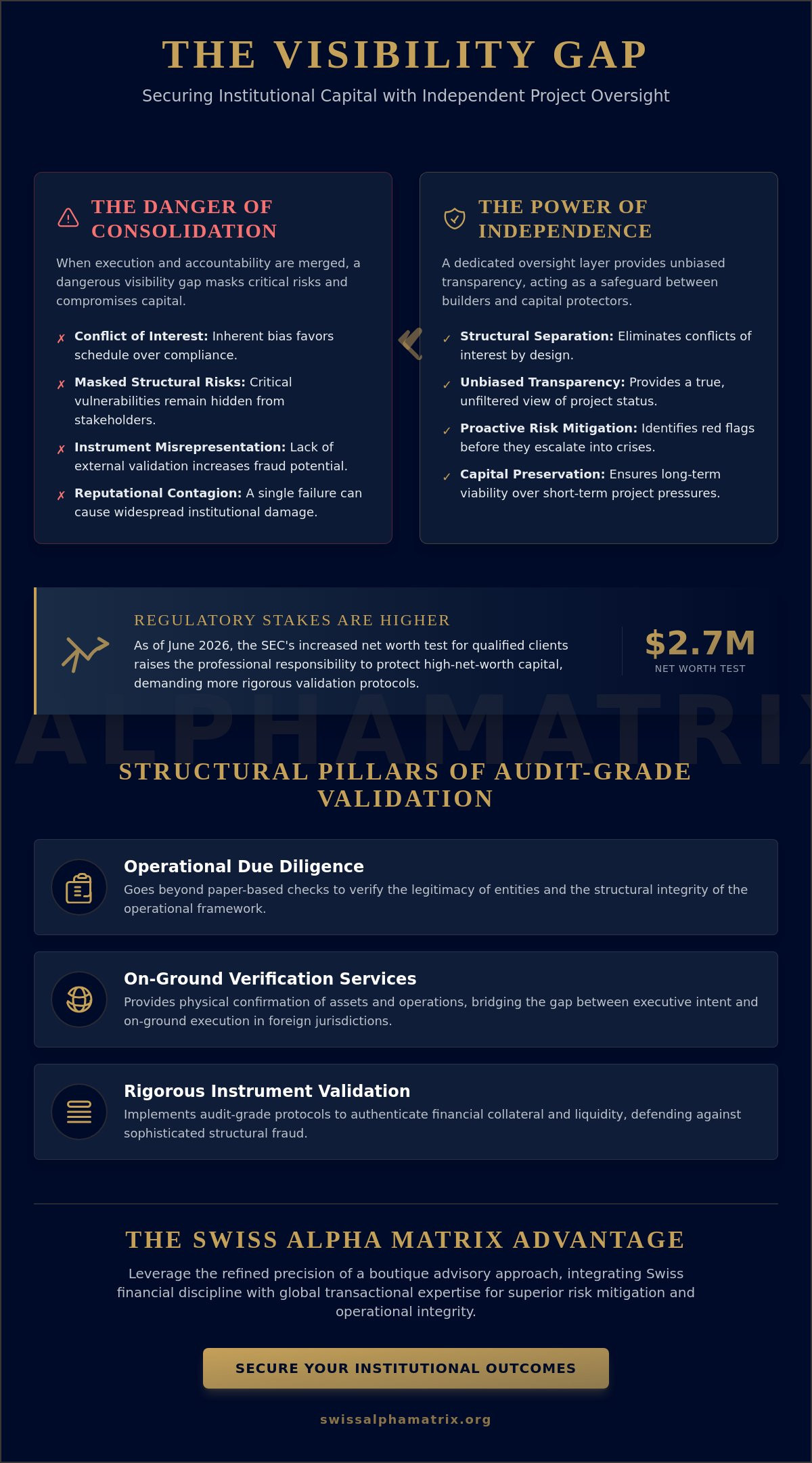
The structural integrity of a multi-billion dollar deployment is rarely compromised by a lack of ambition, but rather by the dangerous consolidation of execution and accountability within a single delivery team. When internal project leads are tasked with both the momentum of development and the scrutiny of their own progress, the resulting visibility gap often masks significant structural risks in foreign jurisdictions. Implementing institutional-grade independent project oversight for large investments creates a necessary barrier between those who build and those who protect, ensuring that capital remains insulated from the inherent biases of the delivery cycle.
You’ve likely felt the unease that accompanies complex, multi-jurisdictional financial programs, where the fear of instrument misrepresentation or misaligned incentives keeps even the most seasoned partners awake. It’s a valid concern, especially as the SEC increased the net worth test for qualified clients to $2.7 million in June 2026, raising the stakes for every strategic allocation. This article explores how a robust, audit-grade reporting structure secures your capital exactly as mandated. We’ll examine the strategic pillars of operational due diligence, on-ground verification services, and the rigorous risk management frameworks required to mitigate reputational exposure in today’s intricate global markets.
Key Takeaways
- Establish a clear structural separation between project execution and accountability to eliminate the inherent conflicts of interest that often compromise institutional capital preservation.
- Discover how institutional-grade independent project oversight for large investments employs rigorous instrument validation and on-ground verification to secure transparency beyond traditional paper-based due diligence.
- Navigate the evolving complexities of international financial regulations through a structured framework that defines precise roles for oversight monitors within high-stakes, multi-jurisdictional decision-making.
- Leverage the refined precision of a boutique advisory approach to integrate Swiss financial discipline with global transactional expertise for superior risk mitigation and operational integrity.
The Imperative for Independent Project Oversight in Large-Scale Investments
The deployment of institutional capital into high-stakes, cross-border initiatives demands a level of scrutiny that transcends the operational focus of standard project management. While delivery teams are inherently incentivized to prioritize milestones and budgetary adherence, independent project oversight for large investments functions as a dedicated risk-management layer, structurally positioned to provide unbiased transparency to the capital protector. This is not merely a supplementary service; it’s a strategic necessity in an era where the complexity of global markets has rendered traditional trust-based models obsolete. By establishing a rigorous separation between those who execute and those who verify, institutions can ensure that their long-term capital viability remains uncompromised by the short-term pressures of project completion.
The necessity for this level of technical precision has become even more acute following the regulatory shifts of early 2026. With the SEC’s heightened thresholds for qualified clients, specifically the increase in the net worth test to $2.7 million as of June 2026, the professional responsibility to protect high-net-worth capital has reached a new level of technical demand. This methodology draws on established precedents of institutional integrity, much like the Office of Inspector General, which maintains independence to conduct audits that prevent the erosion of trust through fraud or mismanagement. In the private sector, this translates to a proactive framework that prioritizes capital preservation over simple momentum.
The Structural Separation of Execution and Accountability
Project delivery teams, including construction managers and owner representatives, often face conflicting incentives that favor schedule over meticulous compliance. When the same entity responsible for progress is also responsible for reporting it, a natural bias emerges that can obscure structural vulnerabilities. An external specialty resource provides the essential check and balance required to maintain oversight without disrupting the operational flow of the project. Independent oversight is the institutional safeguard that bridges the gap between executive intent and on-ground execution.
Mitigating Reputational and Financial Contagion
In complex, multi-jurisdictional deals, a single project failure doesn’t exist in a vacuum; it often leads to broader institutional exposure and significant reputational damage. Proactive monitoring identifies red flags, such as misaligned incentives or regulatory non-compliance, before they escalate into full-scale financial crises. Using executive-level intelligence ensures that capital deployment decisions remain precise and mandate-aligned. This level of independent project oversight for large investments provides the quiet authority needed to navigate 2026’s intricate regulatory environment, ensuring that every dollar spent is a dollar accounted for under the highest standards of professional discipline.
Structural Pillars of Audit-Grade Instrument and Operational Validation
The integrity of a capital deployment framework rests upon the veracity of its underlying financial collateral, a reality that necessitates a transition from traditional, paper-reliant due diligence to rigorous, audit-grade validation protocols. Within the scope of independent project oversight for large investments, the authentication of liquidity and the legitimacy of entities are not merely administrative hurdles but are fundamental defensive measures against structural fraud. While many entities rely on surface-level bank confirmations, sophisticated capital protectors recognize that the current regulatory climate, underscored by Federal Project Management Oversight regulations, demands a more granular level of scrutiny. This process involves a multi-layered approach to operational due diligence, ensuring that every financial instrument and local partner aligns with the institutional mandate before a single dollar is committed.
Deep-Dive Validation of Financial Instruments
Verifying high-value instruments, such as Standby Letters of Credit (SBLCs), requires specialized bank instrument validation services that look beyond the document’s face value. Audit-grade protocols involve direct, secure communication with issuing institutions to confirm that the credit facility is not only authentic but also unencumbered and fully callable. Experts in this field are trained to identify specific anomalies that indicate potential misrepresentation. Common red flags include:
- Inconsistent SWIFT formatting or the use of non-standard verbiage that deviates from ICC UCP 600 guidelines.
- Discrepancies in the signatory authority or the presence of intermediary entities with no verifiable institutional standing.
- Unusual terms regarding the transferability or divisibility of the instrument that suggest it may be part of a non-standard secondary market scheme.
Detecting these nuances early prevents the catastrophic financial contagion often associated with fraudulent instruments in complex deals. It’s about establishing a standard of technical accuracy that resists the pressure of project timelines.
On-Ground Verification and Operational Due Diligence
The human element of project delivery remains the most significant variable in cross-border investments, making physical on-ground verification a non-negotiable requirement. Relying solely on digital reporting or remote audits leaves an institution vulnerable to jurisdictional blind spots where local partners might misrepresent project maturity or operational capacity. By maintaining a physical presence, oversight monitors can assess the actual progress of massive infrastructure, such as the $27.3 billion Hyperion data center campus financed in October 2025, ensuring the reality on the ground matches the technical specifications in the contract. This level of on-ground verification services provides the unemotional, technical certainty required to manage complex project management lifecycles with absolute precision, ensuring that executive intent is never lost in translation during local execution.
Deconstructing the Dilemma: Project Management vs. Independent Oversight
A fundamental tension often exists between the drive for project completion and the requirement for absolute fiscal integrity. While a Project Management Office (PMO) is vital for coordinating the myriad contractors, designers, and logistics required for delivery, its primary incentive is forward momentum. In contrast, the function of independent project oversight for large investments is to serve as a high-level monitor focused exclusively on mandate adherence and capital preservation. This distinction is critical; a delivery team’s success is measured by milestones, whereas an oversight monitor’s success is defined by the absence of structural and financial deviations. This methodology mirrors the findings of the GAO report on strengthening investment board oversight, which emphasizes that independent review is the cornerstone of managing complex, high-value initiatives without sacrificing accountability.
Distinct Roles, Distinct Responsibilities, Distinct Incentives
The operational reality of large-scale deployment necessitates a “double-loop” of accountability. The Project Manager handles the “first loop,” managing the immediate technical challenges of the build. However, the Oversight Monitor manages the “second loop,” verifying that the Project Manager’s actions remain within the institution’s risk appetite. While the PM coordinates designers and contractors, the Monitor protects the owner’s capital interest through unemotional, technical scrutiny. By integrating independent financial project management into the existing framework, institutions create a self-correcting system where delivery and integrity are no longer in competition but are instead mutually reinforcing pillars of governance.
The Value Proposition of Unbiased Oversight
Executive stakeholders frequently ask if an additional layer of scrutiny will slow down the project. The reality is that independent oversight prevents the “silent delays” caused by unresolved disputes or hidden red flags that eventually escalate into crises. By providing an unfiltered, data-driven view of the project’s true status, monitors resolve stakeholder conflicts through neutral reporting rather than internal politics. This reduces the operational blind spots that delivery teams might overlook due to project fatigue or the intense pressure of delivery. Far from being a bottleneck, independent project oversight for large investments acts as a strategic accelerant by ensuring that the path forward is structurally sound and cleared of latent regulatory or financial risks.
Orchestrating a Framework for Cross-Border Investment Protection
The successful execution of multi-jurisdictional capital deployment requires a framework that transcends localized project management to address the systemic complexities of the global financial landscape. As of January 1, 2026, the implementation of new FinCEN rules has mandated that SEC-registered investment advisers maintain formal anti-money laundering programs, adding a layer of regulatory scrutiny that demands absolute precision in reporting. Within this high-stakes environment, independent project oversight for large investments serves as the primary mechanism for navigating international financial regulations while maintaining the structural integrity of the investment. This isn’t a static obligation but a dynamic process where a clearly defined RACI matrix ensures that the oversight monitor remains a central, authoritative figure in high-stakes decisions, preventing the dilution of accountability across borders.
Effective capital protection treats cross-border investment due diligence as a continuous lifecycle rather than a preliminary checklist. By utilizing milestone-based reporting, institutions can achieve total transparency across multiple time zones, ensuring that on-ground realities in foreign jurisdictions are communicated to executive stakeholders with unemotional accuracy. This continuous scrutiny is essential for detecting the subtle shifts in jurisdictional risk that can jeopardize capital recovery if left unmonitored. To secure your capital against these evolving global threats, you should implement a robust risk management framework tailored to the specific nuances of your multi-jurisdictional mandate.
The Multi-Jurisdictional Reporting Architecture
Designing a reporting architecture that serves both local operational needs and global executive requirements is a complex undertaking that requires a sophisticated understanding of institutional needs. Oversight monitors utilize executive-level intelligence to distill vast amounts of technical data into actionable strategic insights, allowing decision-makers to maintain control without becoming mired in granular project details. These reports are designed to be audit-grade, satisfying the rigorous demands of internal compliance departments and external regulatory bodies alike. This structured flow of information ensures that executive intent remains the driving force behind every local action, regardless of the geographic distance from the home office.
Standardizing Risk Management Across Borders
Volatility in geopolitical environments necessitates the application of standardized financial advisory methodologies to normalize risk assessments in diverse markets. By identifying the critical path of risks, such as shifts in local regulatory posture or sudden liquidity constraints in regional banking sectors, independent project oversight for large investments provides a stabilizing influence. This methodology allows institutions to manage the news cycle and deal integrity with quiet authority, ensuring that the project’s reputation remains intact even when operating in less transparent environments. It’s about maintaining Swiss-style precision in every jurisdiction, ensuring that the standards of the mandate are never compromised by local variables.
Securing Institutional Outcomes through Meticulous Advisory and Precision
The ultimate efficacy of a capital protection strategy relies not just on the robustness of the framework, but on the caliber of the professionals tasked with its execution. While larger global consultancies often provide a standardized, high-volume approach to compliance, the unique complexities of multi-jurisdictional mandates require a level of nuance that only a boutique advisory can sustain. Within this elite tier, independent project oversight for large investments is repositioned from a perceived cost center to a critical insurance policy for the structural integrity of the entire programme. By fusing traditional Swiss financial discipline with deep global transactional expertise, Swiss Alpha Matrix serves as a dedicated partner for institutions that prioritize long-term preservation over speculative momentum, ensuring that executive intent is never diluted by the operational frictions of local delivery teams.
The Tier-1 Executive Advantage
The methodology employed by Swiss Alpha Matrix is informed by decades of experience at the highest levels of global banking, where our principals served as Tier-1 bank executives managing some of the world’s most intricate financial instruments. This background provides an immediate credibility that larger, more generalized firms cannot replicate, particularly when conducting audit-grade instrument validation or navigating the subtle red flags of foreign jurisdictional risk. Discretion is paramount. Our mandates are characterized by an uncompromising commitment to exclusivity, catering to a specific caliber of audience that values technical accuracy and moral character above all else. We craft bespoke oversight plans that align perfectly with your specific risk appetite, ensuring that every operational due diligence report and on-ground verification is tailored to the unique requirements of your capital deployment.
Next Steps: Integrating Oversight into Your Next Mandate
Engaging a master planner to secure your interests begins with a structured, logical assessment of the project’s current maturity and its underlying risk architecture. Swiss Alpha Matrix offers a preliminary project assessment designed to identify latent vulnerabilities in your existing project management office or local delivery structures. This initial engagement allows executive stakeholders to experience our measured, steady rhythm of communication before establishing a formal scope of work for fixed-fee or retainer-based strategic consulting. Whether your needs involve establishing a comprehensive risk management framework or providing continuous independent project oversight for large investments, our role is to act as your protective authority. We move from broad philosophical principles to specific strategic pillars with a calm, unwavering pace that encourages total confidence in the decision-making process. To ensure your interests are in the hands of seasoned, unemotional experts, contact Swiss Alpha Matrix to secure your next large-scale investment project.
Advancing the Standard of Capital Preservation
The preservation of institutional capital in an increasingly fragmented global market requires a shift from passive monitoring to the active, technical scrutiny provided by independent project oversight for large investments. By establishing a clear structural separation between project delivery and mandate adherence, organizations can mitigate the inherent conflicts of interest that often obscure structural risks. We’ve explored how audit-grade instrument validation and meticulous on-ground verification serve as the final line of defense against financial misrepresentation in multi-jurisdictional programmes.
Swiss Alpha Matrix, led by former senior executives from Tier-1 global banks, provides the elite discretion and Swiss precision necessary to orchestrate these complex frameworks. Our methodology ensures that your deployment remains mandate-aligned, regardless of the jurisdictional complexities involved. It’s time to elevate your governance from a reactive compliance exercise to a proactive strategy for long-term growth. Secure your capital with Swiss Alpha Matrix independent oversight and ensure your interests remain in the hands of seasoned experts who prioritize stability and strategic integrity.
Frequently Asked Questions
What is the primary difference between a Project Manager and an Independent Oversight Monitor?
The primary difference lies in the alignment of incentives; while a Project Manager is tasked with the momentum of delivery, an Oversight Monitor is dedicated to mandate integrity and capital preservation. Independent project oversight for large investments ensures that the tactical decisions made on the ground never deviate from the strategic intent of the capital protector. This structural separation provides an essential check and balance, allowing the project to proceed without the risk of internal reporting biases.
Why is independent project oversight necessary for cross-border investments in 2026?
Cross-border investments in 2026 are subject to heightened regulatory scrutiny, including the updated FinCEN AML program requirements that became effective January 1, 2026. These regulations, coupled with the SEC’s increased net worth thresholds for qualified clients, necessitate a more rigorous approach to jurisdictional risk management. Independent oversight provides the regional precision required to navigate these complexities, ensuring that multi-jurisdictional capital deployment remains compliant and structurally sound across all operating environments.
How does independent oversight help in validating complex financial instruments like SBLCs?
Independent oversight utilizes audit-grade validation protocols that go far beyond surface-level bank confirmations to authenticate the liquidity and legitimacy of financial collateral. By leveraging direct, secure communication with issuing institutions, monitors can verify that Standby Letters of Credit (SBLCs) are unencumbered and fully callable. This technical accuracy is vital for detecting sophisticated misrepresentations in complex financial programmes that traditional, paper-only due diligence often fails to identify.
Can independent oversight prevent fraud in large-scale construction or infrastructure projects?
Fraud prevention in large-scale infrastructure projects is achieved through the integration of on-ground verification services and continuous operational due diligence. By maintaining a physical presence in the jurisdiction of deployment, monitors can confirm that physical progress aligns with the technical specifications outlined in the contract. In megascale developments, such as the $18 billion New Mexico data center campus financed in late 2025, proactive monitoring identifies red flags before they escalate into significant financial crises.
What are the typical reporting deliverables an executive should expect from an oversight mandate?
Executives should expect a suite of audit-grade deliverables, including executive-level intelligence reports that distill complex technical data into actionable strategic insights. These deliverables typically encompass milestone-based risk assessments, updated RACI matrices defining decision-making authority, and detailed operational due diligence summaries. Each report is designed to provide an unfiltered, data-driven view of the project’s true status, satisfying both internal compliance mandates and external regulatory requirements for transparency.
How does Swiss Alpha Matrix integrate with our existing legal and project teams?
Swiss Alpha Matrix functions as a dedicated partner that provides a complementary layer of scrutiny without disrupting the existing workflows of your legal or project delivery teams. We provide the “second loop” of accountability, ensuring that the tactical execution managed by your PMO remains within the institution’s defined risk appetite. While we don’t provide legal representation, our technical advisory serves to strengthen the overall governance framework through precise, unemotional reporting and sophisticated risk management frameworks.
Is independent oversight only for projects in distress, or should it be proactive?
While independent oversight is often sought during periods of distress, it’s most effective when implemented proactively as a strategic insurance policy for capital protection. Early integration of independent project oversight for large investments allows for the establishment of robust risk management frameworks before capital is committed. This proactive posture prevents the silent delays and structural vulnerabilities that typically lead to project failure, ensuring the long-term integrity of the investment from its inception.
What qualifications should an independent integrity monitor possess for high-value financial deals?
An effective integrity monitor must possess institutional-grade credibility, typically characterized by extensive experience as a senior executive within Tier-1 global banking environments. They should demonstrate a profound understanding of international financial regulations and the technical accuracy required for complex instrument validation. Beyond technical skills, the monitor must embody the traditional discretion and Swiss-style precision necessary to manage high-net-worth and institutional mandates with absolute professional moral character.