

In an era where digital ledger transparency is often mistaken for actual security, the most profound threat to institutional capital remains the persistent opacity of regional execution. You’ve likely recognized that managing distributed teams across jurisdictions like the EU, where MiCA regulations reach full implementation this month, or Australia, following AUSTRAC’s March 2026 overhaul, requires a level of diligence that transcends standard oversight. The friction caused by information asymmetry in foreign territories often leaves capital exposed, despite the presence of sophisticated digital tools. Implementing rigorous financial controls for cross-border projects isn’t merely an administrative preference; it’s a fundamental institutional mandate for those who prioritize long-term preservation over short-term speculation.
This article provides the sophisticated frameworks and financial controls required to safeguard capital within complex, multi-jurisdictional mandates. You’ll master the art of institutional-grade protection through clear accountability structures and audit-grade verification of all financial instruments. We’ll examine the transition from passive oversight to a methodology rooted in regional precision, ensuring your projects withstand the scrutiny of 2026’s evolving regulatory landscape. By the conclusion, you’ll possess the strategic clarity needed to maintain absolute control over every instrument, regardless of the distance or the complexity of the local mandate.
Key Takeaways
- Understand why 2026 mandates require a deliberate transition from passive monitoring to active strategic oversight to mitigate the risks inherent in multi-jurisdictional coordination.
- Establish a centralized Project Management Office (PMO) utilizing a rigorous RACI matrix to ensure absolute accountability and clear command structures across distributed teams.
- Synthesize global regulatory standards with meticulous regional precision to navigate the complexities of fragmented jurisdictions like London, Geneva, and Hong Kong.
- Implement sophisticated financial controls for cross-border projects that prioritize audit-grade instrument validation and physical, on-ground verification over insufficient digital-only dashboards.
- Discover the value of positioning independent, seasoned experts as the strategic lead to provide the uncompromised oversight essential for institutional-grade capital protection.
The Architecture of Global Mandates: Defining Financial Controls for Cross-Border Projects
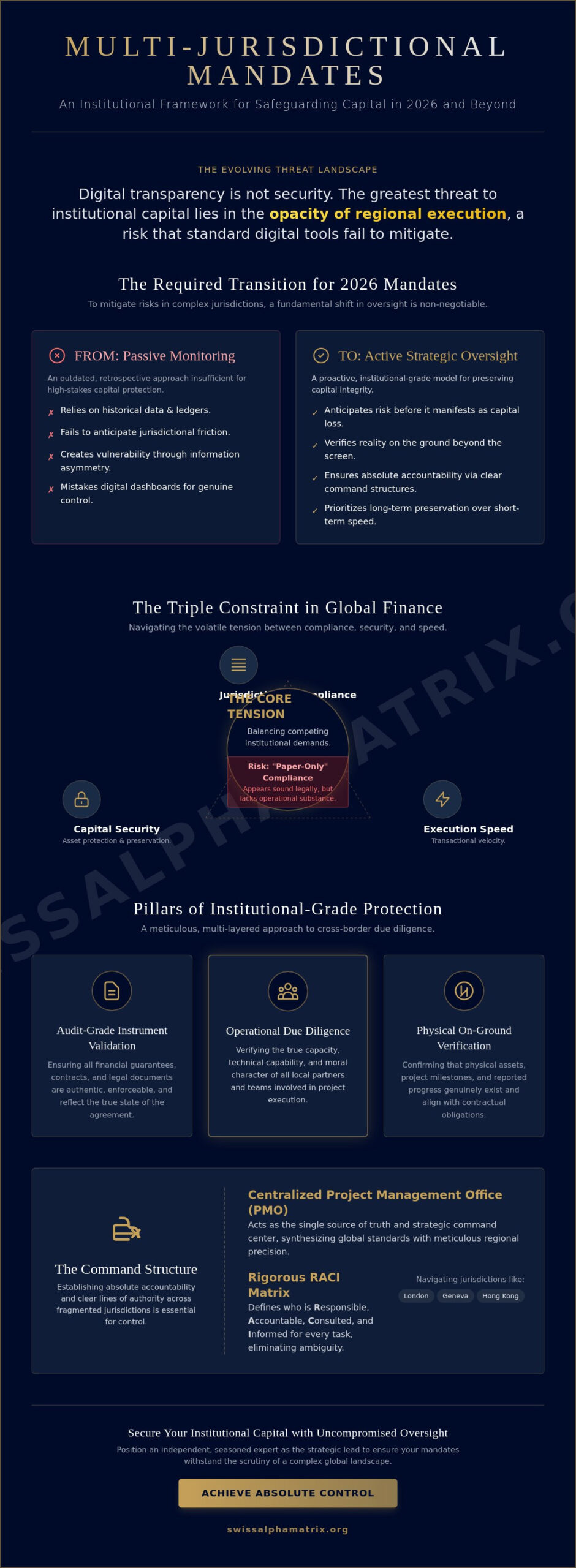
The structural integrity of a global mandate is fundamentally dependent upon the robustness of its underlying financial controls for cross-border projects, which function as the primary defense against the erosion of institutional capital. These controls are not merely administrative procedures for recording expenses; they represent a sophisticated architecture of oversight designed to mitigate the risks inherent in multi-jurisdictional execution. In the landscape of 2026, where regulatory frameworks like the EU’s MiCA and Australia’s overhauled AML/CTF rules have introduced unprecedented complexity, the standard for “institutional-grade” execution has shifted. It now requires a transition from passive, retrospective monitoring to an active, strategic oversight model that anticipates jurisdictional friction before it manifests as capital loss.
A critical distinction must be made between standard accounting controls, which focus on the historical accuracy of ledgers, and transactional risk mitigation, which ensures that the underlying project milestones are legitimately achieved before capital is released. Effective management necessitates a deep understanding of Capital control measures and residency-based regulations that can unexpectedly trap or devalue assets. By implementing these rigorous frameworks, an organization establishes a protective authority that prioritizes long-term preservation over the dangerous allure of short-term speculative speed.
Beyond Digital Dashboards: The Need for Strategic Oversight
While modern project management software provides a necessary veneer of organization, digital dashboards are fundamentally insufficient for high-stakes financial mandates. They often fail to capture the subtle jurisdictional nuances and “soft” risks that only seasoned experts can identify. Audit-grade reporting in a cross-border environment demands more than just data entry; it requires the intellectual depth to verify that the information presented reflects reality on the ground. This level of precision is typically the hallmark of senior executives who possess the historical reliability to look beyond the screen and interrogate the authenticity of every financial instrument and operational claim.
The Triple Constraint in Global Financial Projects
The execution of international mandates involves a constant, often volatile tension between jurisdictional compliance, capital security, and execution speed. A common failure point in these complex deals is “paper-only” compliance, where a project appears sound on a legal document but lacks the operational substance to survive an audit. To prevent such vulnerabilities, institutional-grade management requires a standard of cross-border investment due diligence that is both broad in its reach and meticulous in its attention to detail. This approach ensures that every transaction is validated against real-world progress, creating a sense of inevitable logic and professional calm throughout the project lifecycle.
- Audit-Grade Instrument Validation: Ensuring all financial guarantees and contracts are authentic and enforceable.
- Operational Due Diligence: Verifying the capacity and moral character of local partners.
- On-Ground Verification: Confirming that physical assets and project milestones actually exist.
Institutional Frameworks for High-Stakes Coordination and Control
The successful execution of multi-jurisdictional mandates requires a structural foundation that transcends simple administrative coordination. The Project Management Office (PMO) serves as the indispensable central nervous system for financial controls for cross-border projects, providing a unified vantage point from which all capital movements are observed, analyzed, and validated. This centralized approach is essential for establishing a robust Matrix of Authority, which dictates the precise hierarchy of sign-offs required for capital deployment. By centralizing oversight, institutions can ensure that no single local entity possesses the autonomy to bypass established risk management frameworks, thereby preserving the integrity of the entire financial structure.
Within this framework, it’s vital to distinguish between strategic milestones, which track general progress, and audit-grade deliverables, which require concrete, third-party verification of the underlying financial instruments. High-stakes coordination relies on the latter to provide the certainty required for senior executive sign-off. This rigorous distinction ensures that capital is only released upon the fulfillment of verified operational requirements, rather than the mere passage of time or the superficial completion of project phases.
The PMO as a Risk Mitigation Engine
A centralized PMO functions as a proactive risk mitigation engine by preventing the formation of information silos that frequently plague distributed global teams. Integrating the strategic architecture of independent financial project management as a core pillar allows for an objective layer of scrutiny that is uncoupled from local operational pressures. In light of the Bank for International Settlements’ recent initiatives regarding streamlining cross-border transaction compliance, the PMO must maintain meticulously documented real-time risk assessments. These documents serve as a vital resource for executive stakeholders, providing a clear, unvarnished view of the project’s financial health and its adherence to global regulatory standards.
Deploying the RACI Matrix in Global Transactions
To ensure absolute accountability in multi-jurisdictional environments, the RACI matrix must be deployed with surgical precision. Each task associated with instrument validation is assigned a specific role: the Responsible party executes the validation, the Accountable executive holds the ultimate mandate for its accuracy, the Consulted experts provide jurisdictional nuance, and the Informed stakeholders receive regular updates. This structure is designed to prevent the “diffusion of responsibility” that often occurs when distributed teams face complex regulatory hurdles. The RACI model serves as the ultimate deterrent against operational negligence. For entities requiring a higher standard of oversight, Swiss Alpha Matrix offers the seasoned expertise necessary to implement these accountability structures within the most demanding global mandates.
Synthesising Regional Precision with Global Regulatory Standards
The efficacy of financial controls for cross-border projects is ultimately tested by an organization’s ability to navigate the inherent “Regulatory Fragmentation” of the global market. While the structural frameworks established in the preceding sections provide the internal scaffolding, they must be meticulously synthesized with the specific demands of local jurisdictions such as Hong Kong, London, and Geneva. This synthesis requires a departure from rigid, one-size-fits-all methodologies in favor of a hyper-personalized approach that respects institutional hierarchies and the subtle nuances of regional excellence. Merging the traditional discretion of Swiss oversight with the operational mechanics of major financial hubs ensures that capital remains protected within a framework of absolute technical accuracy.
Bridging the gap between divergent regulatory bodies, such as the U.S. Securities and Exchange Commission (SEC) and the Swiss Financial Market Supervisory Authority (FINMA), is a primary responsibility of the strategic lead. It involves more than simple compliance; it’s a process of reconciling differing reporting standards and transparency expectations to ensure a seamless flow of capital. By merging Swiss-grade precision with deep local knowledge, the management team creates a protective barrier that safeguards interests against the friction often caused by jurisdictional misalignment. This deliberate complexity serves to demonstrate a refusal to oversimplify the intricate dynamics of global finance, catering to a sophisticated audience that values thoroughness and professional competence.
Navigating Jurisdictional Compliance Gaps
Understanding how international financial regulations impact project workflows is critical for maintaining operational momentum. The manager’s role involves reconciling the prescriptive nature of certain regimes with the principle-based oversight found in others. This proactive reconciliation is particularly vital in the mitigation of Anti-Money Laundering (AML) and Know Your Customer (KYC) risks within distributed project teams. By establishing audit-grade verification protocols that satisfy the most stringent requirements, the organization ensures that the mandate remains resilient against regulatory scrutiny from all involved jurisdictions.
The Cultural Nuance of High-Value Mandates
High-finance controls are built upon the cultural pillars of discretion and formality, which are essential for fostering trust with high-net-worth individuals and institutional entities. Different regional business cultures approach financial transparency and risk with varying degrees of openness. A measured and steady communication rhythm, led by an unemotional expert, serves to de-risk complex transactions by providing a sense of professional calm. This authoritative presence ensures that all stakeholders, regardless of their regional background, feel their interests are being managed with the highest standards of moral character and technical accuracy.
Mitigating Transactional Risk Through Physical On-Ground Verification
The prevailing reliance on digital dashboards as the primary instrument for capital protection represents a significant vulnerability in contemporary global finance. While fintech platforms offer the allure of real-time visibility, they’re fundamentally incapable of verifying the physical reality of the assets or entities they claim to represent. Within a robust framework of financial controls for cross-border projects, on-ground verification must be established as a non-negotiable milestone rather than an optional supplementary procedure. This physical layer of scrutiny ensures that the intellectual depth of the management team is applied directly to the site of execution, bridging the gap between digital representation and physical truth.
Relying solely on electronic data flows leaves capital exposed to sophisticated fraud that can easily bypass standard digital security protocols. The integration of specialized Verification Agents into the project structure allows for a level of technical accuracy that automated systems simply can’t replicate. These experts operate as an extension of the central authority, ensuring that every claim is substantiated through direct observation and meticulous document review. By prioritizing this tangible oversight, institutions demonstrate a commitment to long-term preservation and a refusal to be swayed by the dangerous efficiencies of unverified digital transactions.
The Failure of Paper-Only Due Diligence
Cross-border fraud frequently exploits the limitations of digital-only management structures by presenting falsified documents that appear legitimate within an electronic environment. Physical presence remains the only definitive method for achieving audit-grade certainty, particularly in bank instrument validation services where the authenticity of the paper itself is paramount. Integrating operational due diligence into the standard financial control cycle allows for the identification of subtle jurisdictional risks that no algorithm can detect. This approach moves beyond the superficiality of “check-box” compliance, ensuring that every financial instrument is backed by a verified physical entity or asset.
Managing Local Verification Protocols
Establishing rigorous protocols for on-site visits and entity verification is essential for maintaining mandate security in fragmented jurisdictions, serving as a cornerstone of effective financial controls for cross-border projects. These protocols must include the physical review of original documents and the on-ground assessment of project sites by qualified subject matter experts who understand local nuances. Managing these agents requires a steady, measured rhythm that ensures their findings are integrated into the final Capital Deployment decision framework without compromising the privacy or exclusivity of the mandate. For those who require an elite standard of transactional security, on-ground verification services from seasoned experts provide the necessary assurance to proceed with absolute professional calm.
Strategic Oversight: Positioning Swiss Alpha Matrix as the Independent Lead
The implementation of robust financial controls for cross-border projects reaches its logical conclusion with the appointment of an independent strategic lead. While internal institutional teams often provide a necessary baseline of coordination, they frequently encounter inherent conflicts of interest and the limitations of internal silos that can obscure emerging risks. True capital protection in 2026 requires an uncompromised vantage point, one that is uncoupled from the operational pressures of the underlying transaction. Positioning a specialized oversight partner as the independent lead ensures that the rigorous frameworks established in previous phases, from RACI accountability to on-ground verification, are executed with the technical accuracy and moral character that high-stakes mandates demand.
The Swiss Alpha Matrix approach is defined by a synthesis of traditional financial discipline and hyper-personalized regional precision. By deploying former Tier-1 global bank executives to manage cross-border mandates, the firm provides a level of executive-level intelligence that transcends standard project management. These seasoned experts possess the historical reliability and technical depth to navigate the intricate nature of international finance, ensuring that every strategic pillar is aligned with the long-term preservation of capital. This master planner persona offers a standard of service that is both broad in its global reach and meticulous in its attention to every qualifying clause of a financial instrument.
The Advantage of Independent Advisory
Independence is a critical component of institutional-grade project management. It eliminates the institutional inertia and potential biases that can manifest within internal bank teams, providing stakeholders with an unvarnished view of transactional reality. The benefit of engaging executive intelligence lies in the ability to anticipate jurisdictional friction before it impacts the ledger. This commitment to prestige and permanence ensures that interests are in the hands of unemotional experts who prioritize strategic growth over short-term speculation. By maintaining this dignified and formal distance, the independent lead provides a layer of stability and trust that is essential for the successful deployment of capital in fragmented markets.
Engaging the Matrix: Next Steps for Global Mandates
Integrating Swiss Alpha Matrix into an existing project structure begins with a measured transition from initial operational due diligence to ongoing regulatory oversight. This steady rhythm ensures that the financial controls for cross-border projects remain resilient throughout the entire lifecycle of the mandate. The firm functions as a dedicated partner, providing high-level access and a standard of oversight that mirrors the discretion of private wealth management. Stakeholders seeking to safeguard their capital in complex global deals are invited to explore our institutional-grade financial advisory methodologies. Securing a mandate with seasoned experts is the final, inevitable step for those who demand absolute professional calm and the highest standards of capital protection.
- Strategic Lead: Establishing independent authority over multi-jurisdictional workflows.
- Regulatory Oversight: Ensuring continuous compliance with evolving global standards.
- Risk Management Frameworks: Implementing audit-grade validation for all transactional milestones.
Securing Institutional Excellence in an Era of Global Fragmentation
The landscape of 2026 demands a deliberate shift from passive observation toward a standard of active, strategic lead management that prioritizes the long-term preservation of institutional capital. The transition from a reliance on digital-only dashboards toward a framework of physical, on-ground verification represents the final, essential evolution in safeguarding complex capital flows. Implementing sophisticated financial controls for cross-border projects requires a synthesis of global regulatory compliance and the meticulous validation of every financial instrument involved, ensuring that no detail is overlooked in the pursuit of strategic growth. By leveraging the intellectual depth of former Tier-1 global bank executives, organizations can navigate the complexities of multi-jurisdictional mandates with the technical accuracy and moral character necessary for audit-grade reporting.
Stakeholders who value privacy, exclusivity, and historical reliability are invited to secure your global mandate with Swiss Alpha Matrix institutional oversight. With decades of transactional and regulatory expertise at your disposal, the transition to a performance-oriented mindset becomes a structured journey toward inevitable professional calm. It’s time to entrust your most complex mandates to those who treat capital protection as a fundamental institutional mandate.
Frequently Asked Questions
What are the primary challenges when implementing financial controls for cross-border projects?
The primary challenges involve navigating information asymmetry and the inherent opacity of foreign jurisdictions where local operational practices may conflict with global standards. Implementing financial controls for cross-border projects is often hindered by regulatory fragmentation and the difficulty of maintaining audit-grade oversight over distributed teams. These obstacles require a transition from passive monitoring to an active, strategic lead that anticipates jurisdictional friction before it impacts capital security.
How does a PMO structure improve the security of cross-border financial transactions?
A PMO structure serves as the central nervous system for a mandate, ensuring that all data flows are synchronized and that information silos are eliminated. By centralizing the management of risk assessments and compliance documentation, the PMO provides executive stakeholders with a unified, real-time view of the project’s financial health. This structural approach ensures that no local entity operates in isolation, thereby reinforcing the integrity of the entire transactional framework.
Why is a RACI matrix essential for managing multi-jurisdictional mandates?
The RACI matrix is essential because it prevents the diffusion of responsibility that frequently occurs in complex, multi-jurisdictional mandates. By clearly defining who is Responsible, Accountable, Consulted, and Informed for each financial task, the matrix establishes a rigid hierarchy of authority. This clarity is a fundamental requirement for maintaining institutional-grade execution and ensuring that every sign-off is backed by the appropriate level of senior oversight.
How can a project manager mitigate regulatory fragmentation in global deals?
Mitigating regulatory fragmentation requires a strategic lead with the intellectual depth to reconcile divergent reporting standards, such as those between the SEC and FINMA. The project manager must proactively align AML and KYC protocols to satisfy the most stringent requirements across all involved regions. This process ensures that the mandate remains resilient against regulatory scrutiny while maintaining the steady, measured pace required for successful execution.
What is the difference between digital due diligence and on-ground verification?
Digital due diligence focuses on the analysis of electronic data and ledger entries; in contrast, on-ground verification involves physical site visits and the review of original, hard-copy documentation. While digital tools offer visibility, they can’t confirm the physical existence of assets or the moral character of local partners. On-ground verification provides the final, audit-grade layer of certainty that is necessary to prevent sophisticated cross-border fraud.
How do you maintain communication consistency across different regional business cultures?
Maintaining consistency requires a measured and steady communication rhythm that respects institutional hierarchies and regional business nuances. An unemotional, expert approach helps build trust with high-net-worth individuals and institutional entities by prioritizing long-term stability over frantic energy. This hyper-personalized communication style ensures that all stakeholders feel their interests are being managed with the highest standards of professional competence.
Why should an independent advisory firm lead cross-border project oversight?
An independent advisory firm provides an uncompromised vantage point that is free from the conflicts of interest often found in internal bank teams. This independence allows for a more rigorous application of financial controls for cross-border projects, ensuring that capital deployment decisions are guided by objective, executive-level intelligence. Such oversight reinforces the brand’s commitment to prestige, permanence, and meticulous attention to detail.
How does managing financial instrument validation differ from standard project management?
Financial instrument validation demands a level of technical accuracy and audit-grade scrutiny that far exceeds the scope of standard milestone tracking. While standard project management focuses on timelines and deliverables, validation requires verifying the authenticity and enforceability of every contract and guarantee. This specialized focus ensures that the underlying financial scaffolding of a project is sound before any capital is released.